Alabama Order Appointing Court Representative
Understanding this form
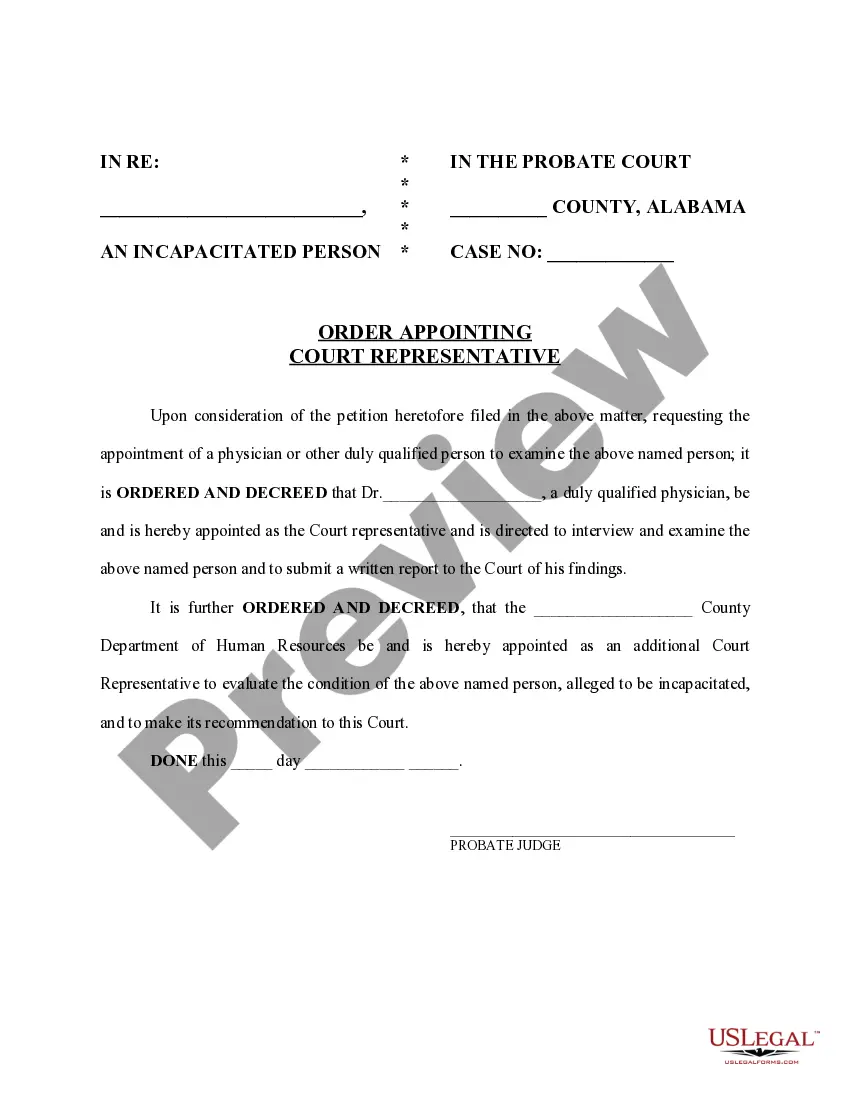
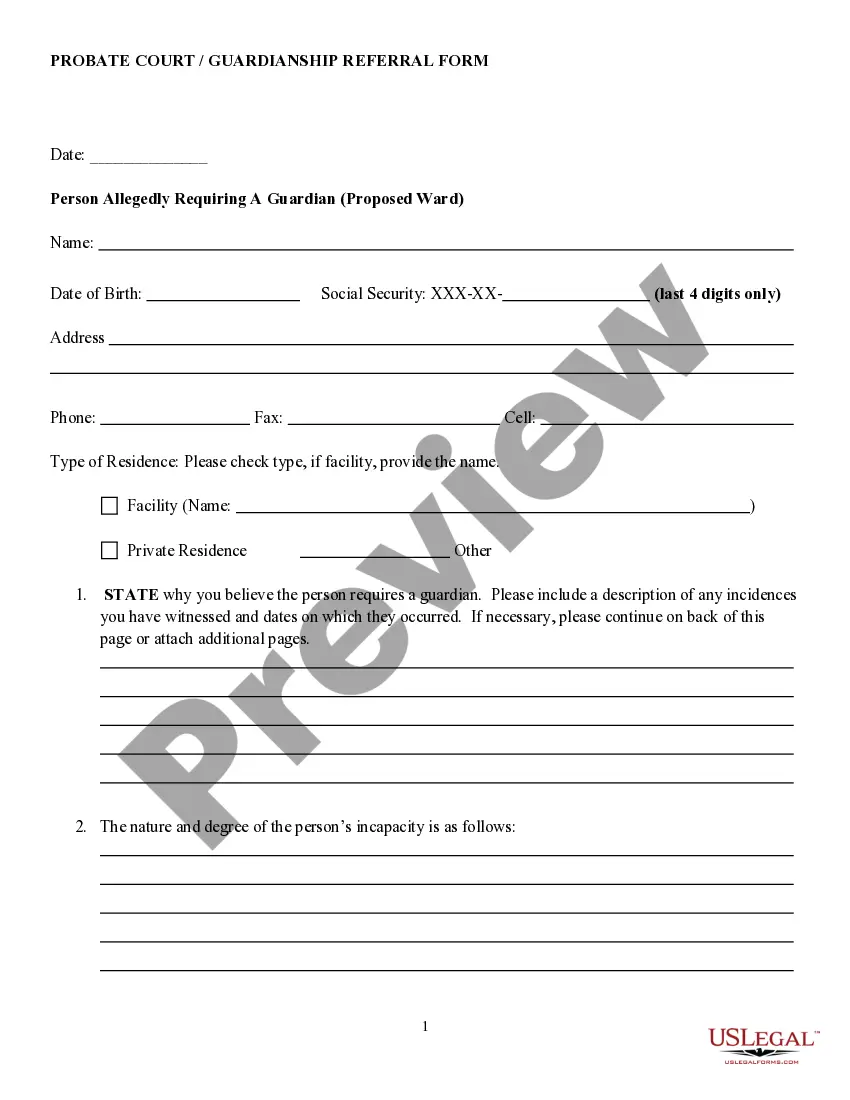
The Order Appointing Court Representative is a legal document that allows a court to appoint a qualified individual, such as a physician, to examine an incapacitated person involved in guardianship proceedings. This form is essential for ensuring that a thorough evaluation occurs, providing crucial information for the court's decisions. It differs from other legal forms by specifically designating representatives who have the authority to investigate and report on the incapacitated individual's condition.
Form components explained
- Title and case number: identifies the court and the specific case related to the incapacitated person.
- Appointment of a qualified representative: specifies the individual designated to perform the examination.
- Report requirement: mandates the representative to submit a written report of findings to the court.
- Additional representatives: allows for the appointment of additional agencies or individuals for comprehensive evaluations.
- Date of order: provides a formal date when the court order is issued.
- Probate judge's signature: confirms the authority of the order through the judge's endorsement.


When this form is needed
This form should be used during guardianship proceedings when a court needs to thoroughly assess the condition of an incapacitated person. You may require this form if there are questions regarding the individual's ability to manage personal affairs or make decisions, necessitating a formal evaluation by a qualified representative.
Who needs this form
- Court officials or attorneys involved in guardianship cases.
- Family members or caregivers seeking to establish a guardian for an incapacitated individual.
- Representatives appointed by the court to evaluate the incapacitated person's condition.
How to complete this form
- Identify the parties involved in the case, including the incapacitated person and the court.
- Complete the appointment section by entering the name of the qualified representative.
- Specify any additional representatives or agencies involved, such as the Department of Human Resources.
- Fill in the case number and date of order for accurate record-keeping.
- Obtain the signature of the probate judge to validate the order.
Notarization guidance
This form does not typically require notarization to be legally valid. However, some jurisdictions or document types may still require it. US Legal Forms provides secure online notarization powered by Notarize, available 24/7 for added convenience.
Get your form ready online
Our built-in tools help you complete, sign, share, and store your documents in one place.
Make edits, fill in missing information, and update formatting in US Legal Forms—just like you would in MS Word.
Download a copy, print it, send it by email, or mail it via USPS—whatever works best for your next step.
Sign and collect signatures with our SignNow integration. Send to multiple recipients, set reminders, and more. Go Premium to unlock E-Sign.
If this form requires notarization, complete it online through a secure video call—no need to meet a notary in person or wait for an appointment.
We protect your documents and personal data by following strict security and privacy standards.

Make edits, fill in missing information, and update formatting in US Legal Forms—just like you would in MS Word.

Download a copy, print it, send it by email, or mail it via USPS—whatever works best for your next step.

Sign and collect signatures with our SignNow integration. Send to multiple recipients, set reminders, and more. Go Premium to unlock E-Sign.

If this form requires notarization, complete it online through a secure video call—no need to meet a notary in person or wait for an appointment.

We protect your documents and personal data by following strict security and privacy standards.
Common mistakes
- Failing to include all necessary information, such as the case number or representative's name.
- Not obtaining the judge's signature, which is essential for the order's validity.
- Neglecting to specify any additional representatives or agencies that should be involved in the evaluation.
Why complete this form online
- Convenience of accessing the form from anywhere at any time.
- Editable fields allow for customization to meet specific case needs.
- Reliable templates drafted by licensed attorneys ensure legal compliance.
Legal use & context
- This form is legally enforceable once signed by the probate judge.
- It provides a structured approach to appointing a representative during guardianship proceedings.
- Failure to use this form appropriately may delay the guardianship process.
Key takeaways
- The Order Appointing Court Representative is crucial for assessing an incapacitated individual's needs.
- Completing the form accurately is essential for the progression of guardianship proceedings.
- This form is tailored to conform with Alabama's legal requirements for guardianship cases.
Looking for another form?

Form popularity
FAQ
The California Court system has three levels: the California Supreme Court, the Courts of Appeal and the Superior Courts.
The federal court system has three main levels: district courts (the trial court), circuit courts which are the first level of appeal, and the Supreme Court of the United States, the final level of appeal in the federal system.
In Alabama, there are three federal district courts, a state supreme court, a state court of appeals, and trial courts with both general and limited jurisdiction. These courts serve different purposes, which are outlined in the sections below.
The three levels of courts in India are - District (District and Sessions Courts), State (High Courts) and the Supreme Court at the top.
Not Exempt: In the case of a closed investigation, while the records are not statutory public records, police reports and internal police records are considered common law public records which may be subject to disclosure following an in camera review and balancing of interests by the court.
Why are court records public?Any resident of Alabama can request and copy public records held by the state or local government, unless it is prohibited by law.
State Courts in California. California has 2 types of state courts, trial courts (also called superior courts) and appellate courts, made up of the Courts of Appeal and the California Supreme Court.
The Supreme Court ,District Courts (trial courts) and Federal Courts.
This legislation cites that all public records are presumed to be available to all public citizens for investigation.Alabama State Records maintains information about publicly available records including criminal records, court records, and vital records, as well as over 45 million transparent public records.