Alaska Mining Claim Location Notice
About this form
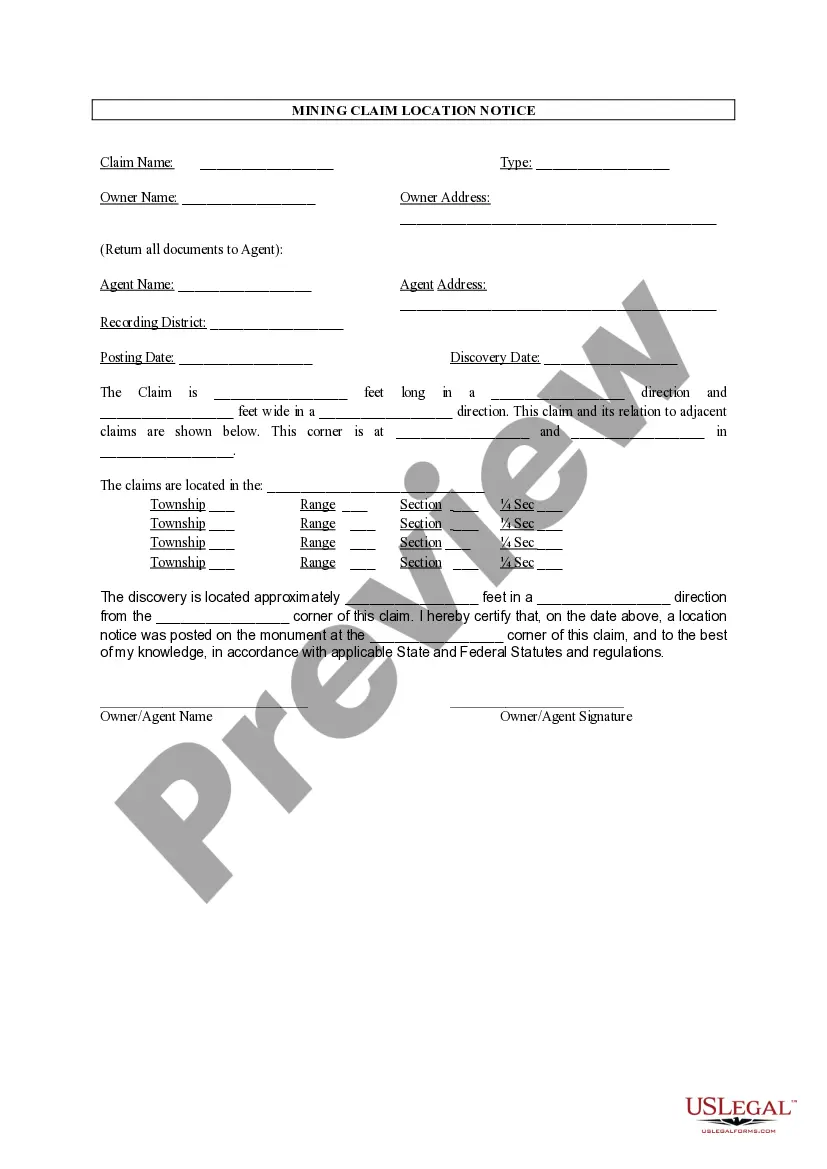
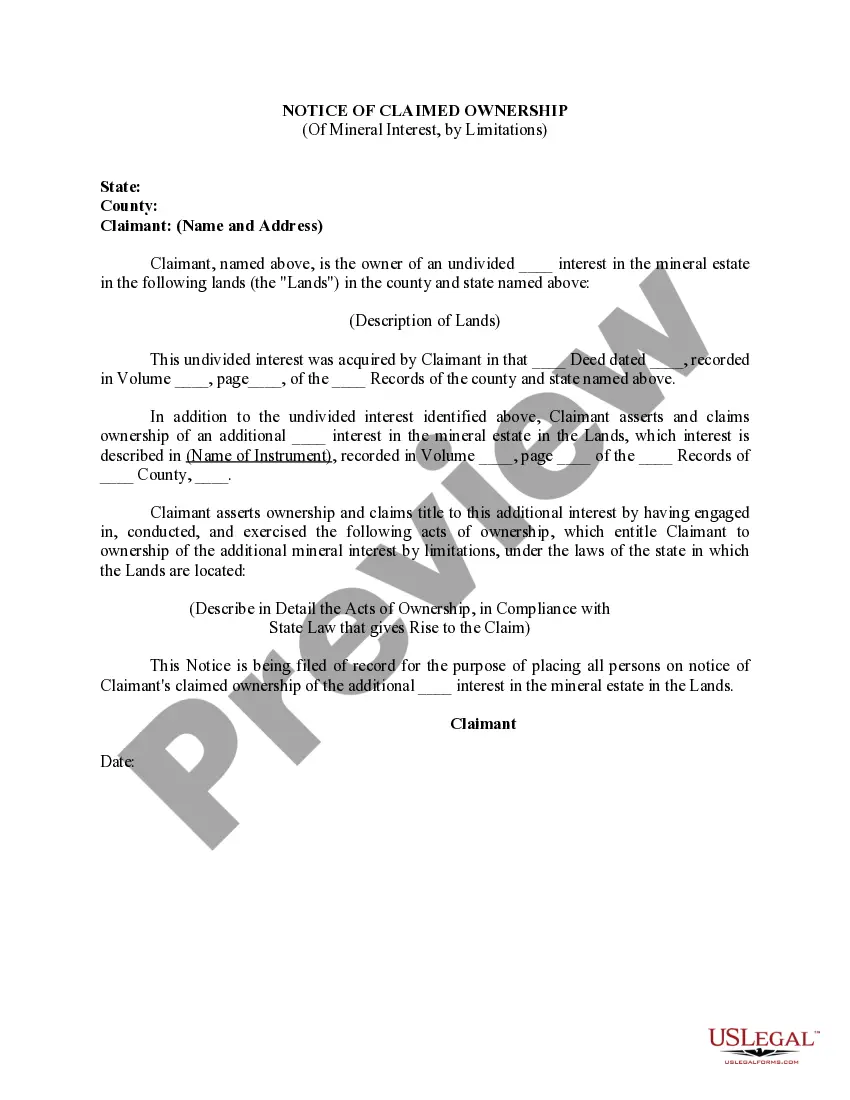
The Mining Claim Location Notice is a legal document that serves as a formal notice of a mining claim on a specific parcel of land. This form is used by individuals or entities that assert their right to possess and develop valuable mineral deposits found on the claimed land. Unlike other land use forms, the Mining Claim Location Notice explicitly details the dimensions and location of the mining claim, ensuring compliance with state and federal regulations governing mining practices.
Key parts of this document
- Claim name and type of mining claim.
- Ownerâs name and address, along with agent information.
- Recording district and essential dates including posting and discovery dates.
- Claim dimensions including length and width, along with directions.
- Geographical data related to the claim, including township, range, section, and quarter-section.
- Certification statement and signature of the owner or agent.

Situations where this form applies
This form should be used when a person or company discovers a valuable mineral deposit and intends to establish a legal claim to the land where the deposit is located. It is crucial for asserting rights before other claimants make competing claims in the area. Additionally, it may be needed to fulfill state regulatory requirements for mining operations.
Who should use this form
- Individuals or companies looking to claim mining rights on discovered mineral deposits.
- Mining operators who need to formalize their claim to comply with state and federal laws.
- Landowners interested in asserting rights over mineral resources on their property.
- Agents acting on behalf of claimants to file the notice properly.
Steps to complete this form
- Identify and enter the claim name and type of mining claim.
- Fill in the owner's name and address, as well as the agent's details.
- Provide the necessary recording district and dates, including posting and discovery dates.
- Specify the claim's dimensions, including length, width, and directions.
- Enter the geographic information related to the claim, detailing township, range, section, and quarter-section.
- Sign and date the form to certify the information provided is accurate.
Does this document require notarization?
This form does not typically require notarization unless specified by local law. Always check your specific state requirements to ensure compliance with legal standards for mining claims.
Get your form ready online
Our built-in tools help you complete, sign, share, and store your documents in one place.
Make edits, fill in missing information, and update formatting in US Legal Forms—just like you would in MS Word.
Download a copy, print it, send it by email, or mail it via USPS—whatever works best for your next step.
Sign and collect signatures with our SignNow integration. Send to multiple recipients, set reminders, and more. Go Premium to unlock E-Sign.
If this form requires notarization, complete it online through a secure video call—no need to meet a notary in person or wait for an appointment.
We protect your documents and personal data by following strict security and privacy standards.

Make edits, fill in missing information, and update formatting in US Legal Forms—just like you would in MS Word.

Download a copy, print it, send it by email, or mail it via USPS—whatever works best for your next step.

Sign and collect signatures with our SignNow integration. Send to multiple recipients, set reminders, and more. Go Premium to unlock E-Sign.

If this form requires notarization, complete it online through a secure video call—no need to meet a notary in person or wait for an appointment.

We protect your documents and personal data by following strict security and privacy standards.
Avoid these common issues
- Failing to provide accurate dimensions of the claim.
- Not including the required dates, which can lead to invalid claims.
- Omitting the signature of the owner or agent, which is necessary for validation.
- Incorrectly identifying the geographic location of the claim, leading to potential disputes.
Why use this form online
- Convenient access to legal forms created by licensed attorneys.
- Easy to edit form fields to ensure accuracy.
- Immediate downloading and printing capabilities for timely filing.
- Reliable format that meets legal standards for mining claims.
Looking for another form?

Form popularity
FAQ
The Homestead Act of 1862 is no longer in effect, but free land is still available out there in the great wide open (often literally in the great wide open). In fact, the town of Beatrice, Nebraska has even enacted a Homestead Act of 2010.
In the U.S. there are a few circumstances where you can file a claim on abandoned, unclaimed, and currently owned land. Keep in mind that land that may have been physically abandoned is still legally owned in most cases.
Federal lands where you can stake a claim are located in 19 states. These states are Alaska, Montana, Utah, Arizona, Arkansas, Nebraska, South Dakota, California, Nevada, Oregon, Colorado, New Mexico, Florida, Idaho, North Dakota, Louisiana, Wyoming, Mississippi, and Washington.
No. Homesteading ended on all federal lands on October 21, 1986. The State of Alaska currently has no homesteading program for its lands. In 2012, the State made some state lands available for private ownership through two types of programs: sealed-bid auctions and remote recreation cabin sites.
The Homestead Act was finally repealed in 1976, but a provision of the repeal allowed for homesteading to continue in Alaska until 1986.
The last claim was issued in 1974 to Ken Deardorff for a homestead in Alaska. However, free land is still available from small towns and cities or farming communities. These areas hope to boost their population or draw businesses to their areas.
A miner has the right only to the minerals; he may not live on the land without permission. If a cabin is located on a new claim, it belongs to the BLM and may not be used by the miner.Other agencies may be involved in the permitting and mining process, such as Department of Ecology, Fish, and Wildlife, etc.
Mining claims both patented or unpatented are interests in real property. A patented mining claim is one for which the federal government has passed its title to the claimant, giving the claimant exclusive title to the surface of the claim area and its locatable minerals.
Mining claims can be located on open public land administered by another federal agency (most commonly on Forest Service land). You may prospect and locate claims and sites on public and NFS land open to mineral entry.