Alaska Sample Cover Letter for Filing of LLC Articles and Certificate with Secretary of State
What is this form?
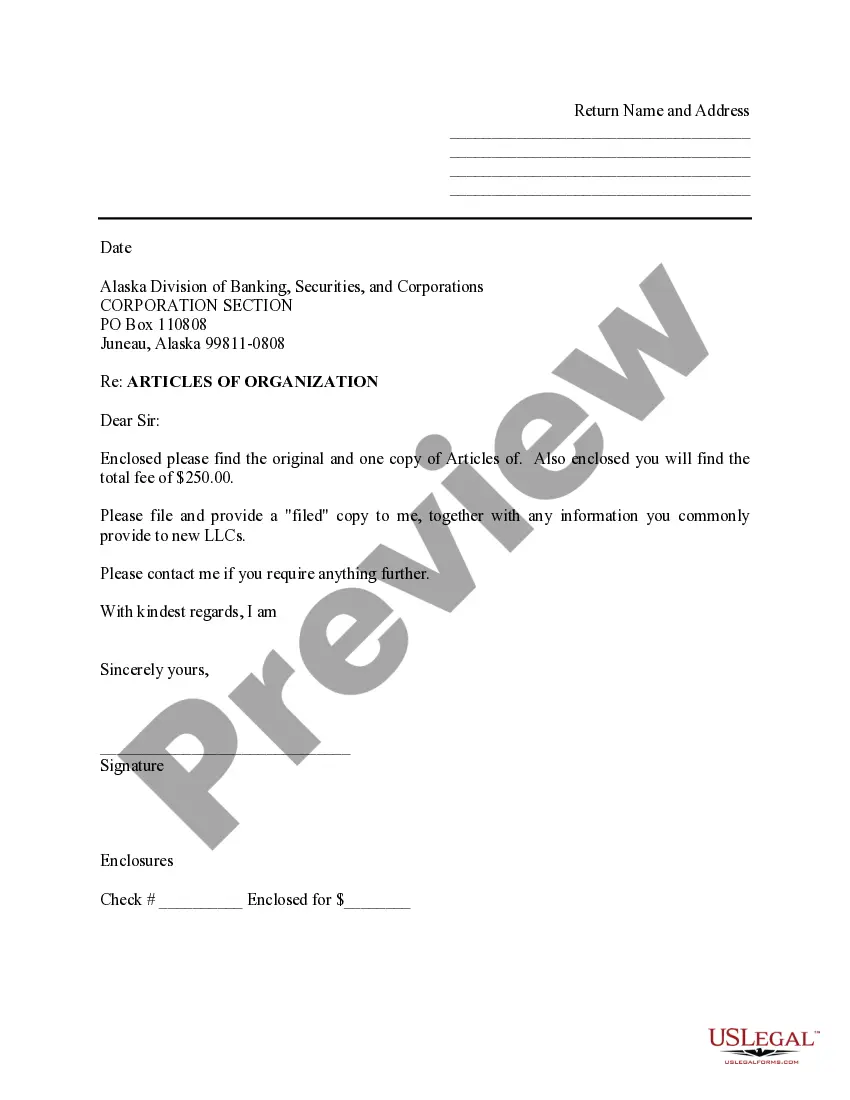
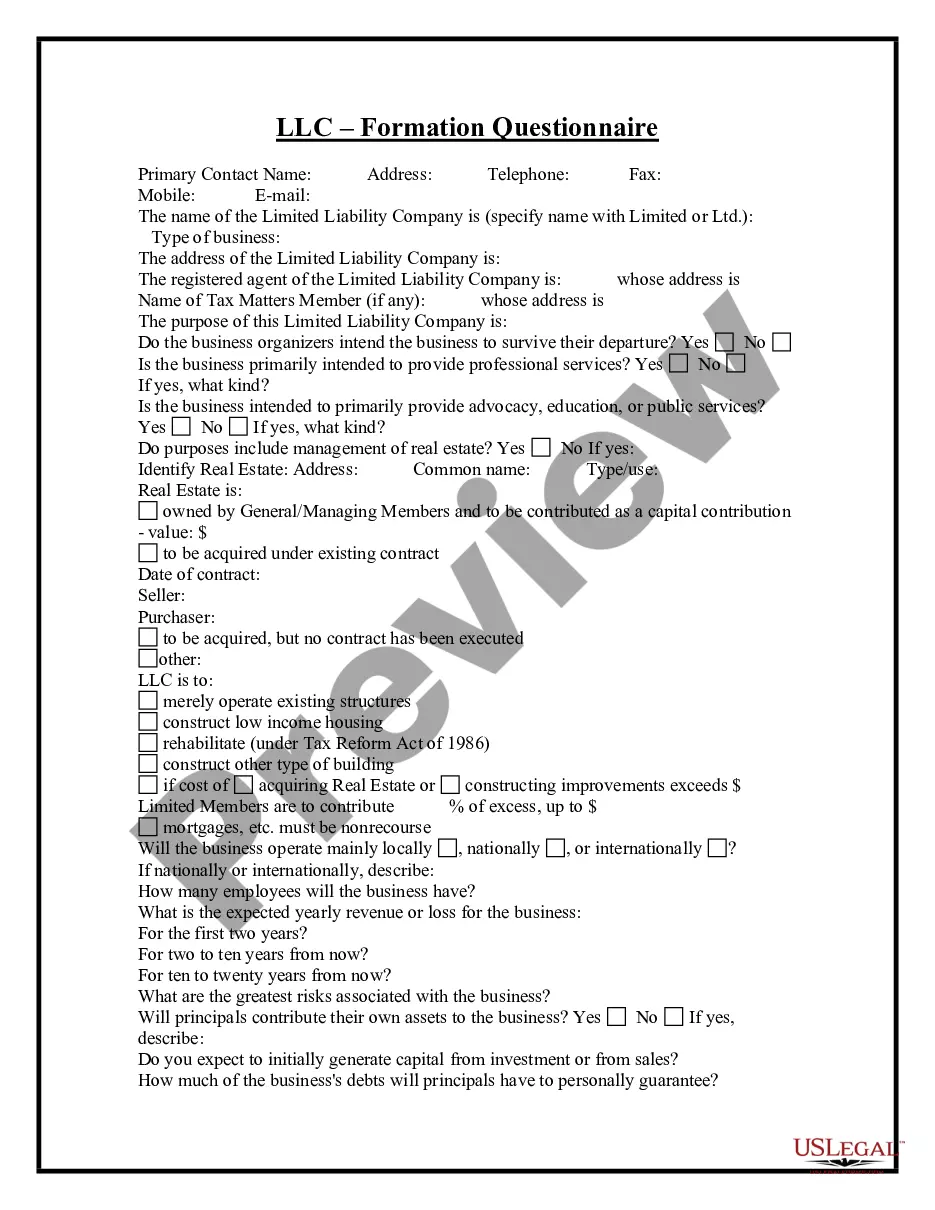
This form is a Sample Cover Letter for Filing of LLC Articles and Certificate with the Secretary of State. It is used alongside the Articles of Organization or Certificate of Formation when establishing a Limited Liability Company (LLC). This cover letter simplifies the filing process by providing a standard format that informs the Secretary of State about the accompanying documents and fees, streamlining the LLC registration process.
Main sections of this form
- Date of submission
- Recipient details (Alaska Division of Banking, Securities, and Corporations)
- Subject line indicating the purpose (Articles of Organization)
- List of enclosed documents (original Articles and one copy)
- Payment details (total fee included)
- Request for a filed copy and additional information
- Signature line
- Enclosure details (check for filing fee)
Common use cases
This form should be used when you are submitting your LLC Articles of Organization or Certificate of Formation to establish a Limited Liability Company in Alaska. It is particularly important when you want to ensure that the filing is complete, includes the appropriate fees, and provides a clear indication of the necessary documentation to the state authorities.
Who needs this form
- Individuals or businesses planning to form an LLC in Alaska
- Business owners needing to submit Articles of Organization to the Secretary of State
- Legal representatives or other authorized individuals filing on behalf of a business
Instructions for completing this form
- Enter the current date at the top of the letter.
- Fill in the recipient's information, including the address for the Alaska Division of Banking, Securities, and Corporations.
- State the purpose of the letter clearly, mentioning that it is for Articles of Organization.
- List the documents you are enclosing, including fees and any required copies.
- Sign the letter and provide your contact information for any follow-up.
Does this form need to be notarized?
This form does not typically require notarization to be legally valid. However, some jurisdictions or document types may still require it. US Legal Forms provides secure online notarization powered by Notarize, available 24/7 for added convenience.
Get your form ready online
Our built-in tools help you complete, sign, share, and store your documents in one place.
Make edits, fill in missing information, and update formatting in US Legal Forms—just like you would in MS Word.
Download a copy, print it, send it by email, or mail it via USPS—whatever works best for your next step.
Sign and collect signatures with our SignNow integration. Send to multiple recipients, set reminders, and more. Go Premium to unlock E-Sign.
If this form requires notarization, complete it online through a secure video call—no need to meet a notary in person or wait for an appointment.
We protect your documents and personal data by following strict security and privacy standards.

Make edits, fill in missing information, and update formatting in US Legal Forms—just like you would in MS Word.

Download a copy, print it, send it by email, or mail it via USPS—whatever works best for your next step.

Sign and collect signatures with our SignNow integration. Send to multiple recipients, set reminders, and more. Go Premium to unlock E-Sign.

If this form requires notarization, complete it online through a secure video call—no need to meet a notary in person or wait for an appointment.

We protect your documents and personal data by following strict security and privacy standards.
Common mistakes
- Forgetting to include the correct total fee for filing.
- Not signing the cover letter.
- Failing to include a copy of the Articles of Organization or Certificate of Formation.
- Using outdated or incorrect recipient information.
Why complete this form online
- Convenient access to pre-drafted templates saves time.
- Edit and customize the cover letter to fit specific needs.
- Reliable and compliant with current legal requirements.
Looking for another form?
Form popularity
FAQ
The main difference between a LLC and a PLLC is that only professionals recognized in a state through licensing, such as architects, medical practitioners and lawyers, can form PLLCs. The articles of organization are similar to those for a standard LLC, but extra steps are necessary to file.
The name of the LLC. The names of the members and managers of the LLC. The address of the LLC's principal place of business.
The articles of organization document typically includes the name of the LLC, the type of legal structure (e.g. limited liability company, professional limited liability company, series LLC), the registered agent, whether the LLC is managed by members or managers, the effective date, the duration (perpetual by default
The name of the LLC. The names of the members and managers of the LLC. The address of the LLC's principal place of business.
LLCs are not corporations and do not use articles of incorporation. Instead, LLCs form by filing articles of organization.
Do the Articles of Organization need to be notarized? Some states require that you have your Articles of Organization documents notarized. For your state's notarization requirements, choose your state from the drop-down list above.
The LLC Organizer is the individual or entity that files the Articles of Organization (referred to as a Certificate of Formation in some states) on behalf of a Limited Liability Company.A member is defined as an owner of the LLC, and an organizer merely facilitates the technical formation of the LLC.
You'll need your LLC's name, the name and address of its registered agent, and other basic information, like how it will be managed or the names of the LLC owners. You'll have to pay a filing fee when you submit the articles. In most states, the fees are modest - typically around $100.