Alaska Complaint for Custody of Minor Children
What is this form?
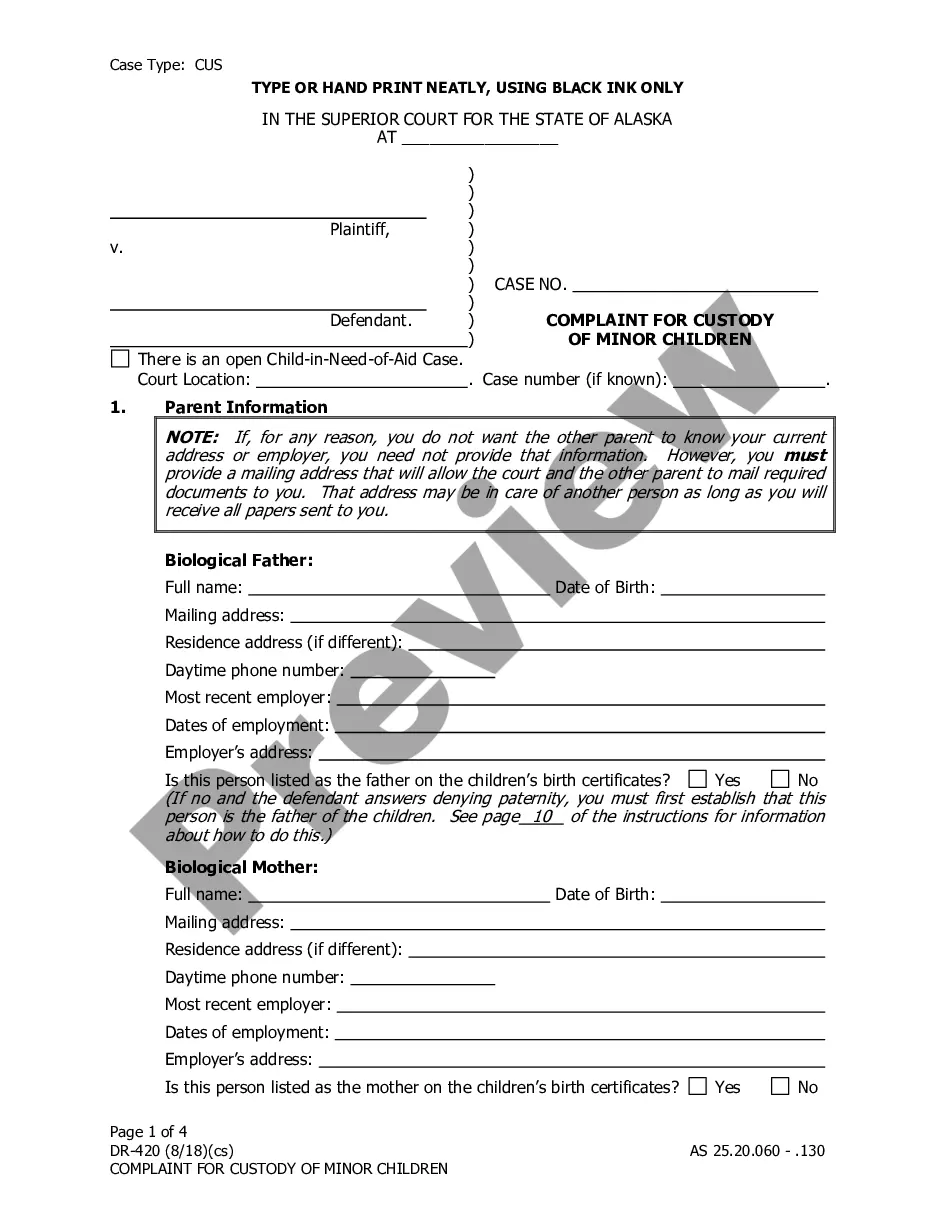
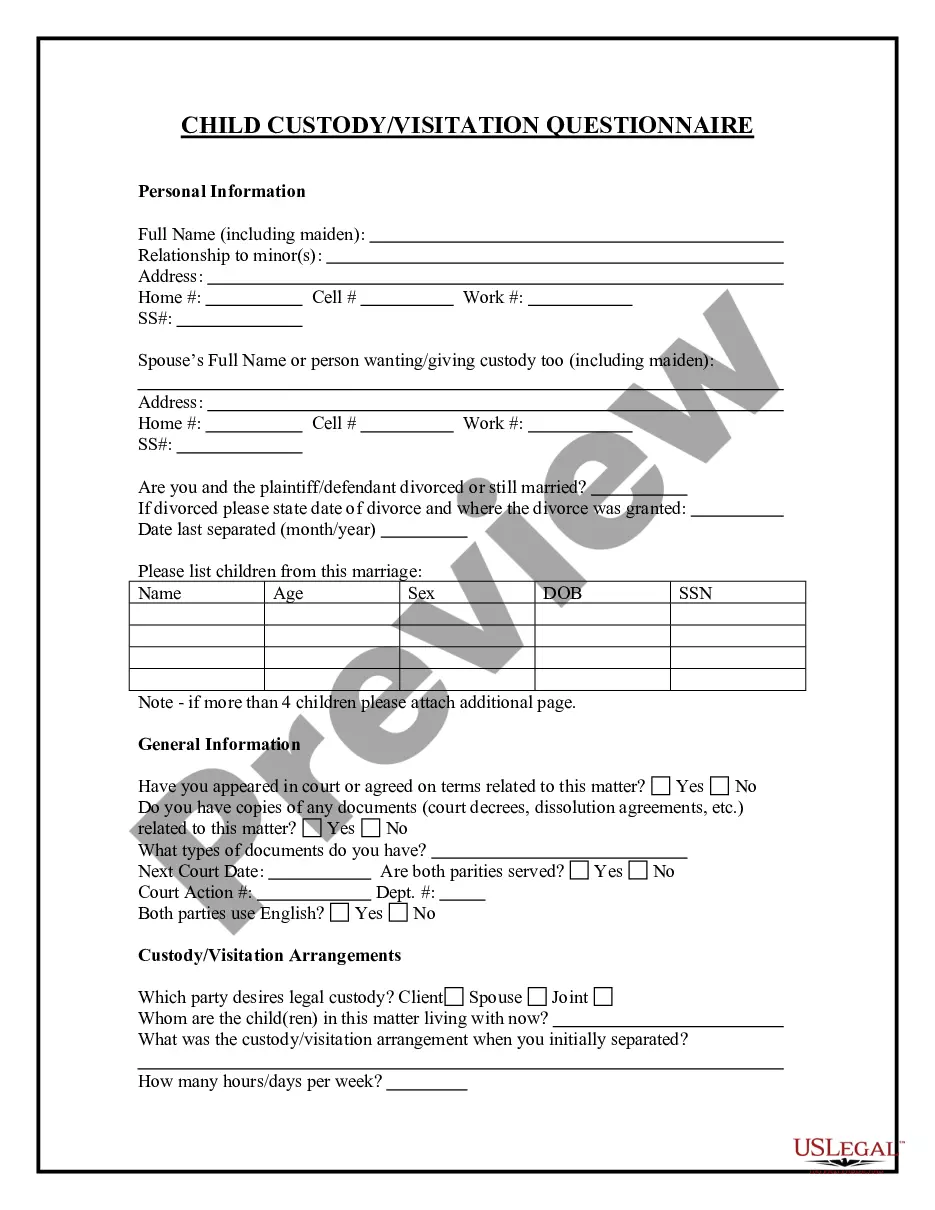
The Complaint for Custody of Minor Children is a legal document used by a petitioner to seek custody of minor children and establish child support. This form is specifically tailored for the Alaska Court System and is compliant with relevant Alaska laws. Unlike other custody forms, this document addresses both custody and child support matters, making it essential for parents navigating custody disputes in Alaska.
Key parts of this document
- Parent Information: Details about the biological father and mother, including their addresses and employment.
- The Children: Names, birth dates, and living arrangements of the minor children involved.
- Court Jurisdiction: Declaration of the court's authority to decide on custody matters.
- Other Custody Orders: Information on existing custody orders from other jurisdictions.
- Marital History: Background on the marital relationship between the parents.
- Custody Requests: Sections for legal and physical custody requests, including specifics on visitation and child support.


When to use this form
This form is needed when a parent seeks legal custody of their minor children following a separation or divorce. It is appropriate to use it if there is an existing child-in-need-of-aid case or when needing to request child support orders. Parents should also use this form to clarify custody arrangements, particularly in cases involving changes in living situations or parental rights.
Who should use this form
- Parents seeking legal custody of their minor children.
- Individuals involved in custody disputes in Alaska.
- Parents looking to establish or modify child support arrangements.
- Individuals who have an existing child-in-need-of-aid case.
How to complete this form
- Identify the parties: Provide the full names and contact information of both parents.
- Detail the children: List the names and birthdates of each child involved in the custody case.
- Submit jurisdiction information: Indicate the court's authority over the custody matter.
- Specify custody requests: Clearly state requests for legal and physical custody arrangements.
- Outline visitation schedules: Include detailed visitation plans for the non-custodial parent.
- Request child support: Complete the relevant section for child support arrangements as outlined.
Does this document require notarization?
This form does not typically require notarization unless specified by local law. It is essential to check for any additional requirements that may apply in specific counties or districts within Alaska.
Get your form ready online
Our built-in tools help you complete, sign, share, and store your documents in one place.
Make edits, fill in missing information, and update formatting in US Legal Forms—just like you would in MS Word.
Download a copy, print it, send it by email, or mail it via USPS—whatever works best for your next step.
Sign and collect signatures with our SignNow integration. Send to multiple recipients, set reminders, and more. Go Premium to unlock E-Sign.
If this form requires notarization, complete it online through a secure video call—no need to meet a notary in person or wait for an appointment.
We protect your documents and personal data by following strict security and privacy standards.

Make edits, fill in missing information, and update formatting in US Legal Forms—just like you would in MS Word.

Download a copy, print it, send it by email, or mail it via USPS—whatever works best for your next step.

Sign and collect signatures with our SignNow integration. Send to multiple recipients, set reminders, and more. Go Premium to unlock E-Sign.

If this form requires notarization, complete it online through a secure video call—no need to meet a notary in person or wait for an appointment.

We protect your documents and personal data by following strict security and privacy standards.
Mistakes to watch out for
- Failing to provide complete parent information, including addresses and employers.
- Not including previous custody orders that may affect the case.
- Overlooking to specify a visitation schedule or child support requests.
- Incomplete or inaccurate details about the children, such as living arrangements.
- Not updating contact information with the court during the proceedings.
Benefits of completing this form online
- Convenient download options allow for immediate access to necessary legal documents.
- Forms are formatted correctly to comply with Alaska law, reducing errors and rejections.
- Easily editable fields allow for tailored information based on individual circumstances.
- Access to attorney-drafted templates ensures legal accuracy and adherence to formal requirements.
- Guidance through the completion process minimizes confusion and helps ensure proper filing.
Looking for another form?

Form popularity
FAQ
Although the law specifically permits children at least 14-years-old to express an opinion, there is no specific age when a judge will listen to a child's opinion. California statutes also permit a child younger than 14 years old to testify regarding a custodial preference, unless the court decides it's not in the
You cannot write a letter to the family court judge. This would be considered an ex parte communication.
However, when a person is awaiting trial, writing a letter to the judge will not help. At best, the letter will go unread by the judge, and will be of no help. In a worst-case scenario, the letter will end up being used by the prosecution as evidence against that person.
You can write a letter to the Judge but the Judge will not read it. You have to provide testimony through witnesses including yourself. You do not have to agree with what the GAL proposes. You need an attorney to represent you.
Begin your letter by introducing yourself and explaining your relationship to the parent and how long you've known her. Then, spend two or three paragraphs explaining why you think she should be awarded custody. Use your final paragraph to summarize the points you've made in the body of your letter.
A history of child abuse. A history of substance abuse. A history of domestic violence. The parent's ability to make age-appropriate decisions for a child. The parent's ability to communicate with a child. Psychiatric concerns. The parent's living conditions. The child's opinion.
The clearest reason to ask for sole custody is to protect your child from physical harm, especially if the other parent has a history of any of the following issues: ABUSE: If a parent has assaulted or sexually abused the other parent or any child, this presents an obvious danger to their child.
Children are only allowed to choose which parent to live with after they have attained the age of majority at 18. Child custody laws in Alaska do allow judges to take a child's preferences into account as one factor in their determinations, but only when considered in conjunction with many other factors.
Can my child write a letter or a Declaration to the Judge? The answer is usually, no. If your child writes a letter or a Declaration to the Judge, the Judge will not read it nor will it be accepted by the court.