Alaska Revocation of Postnuptial Property Agreement
Understanding this form
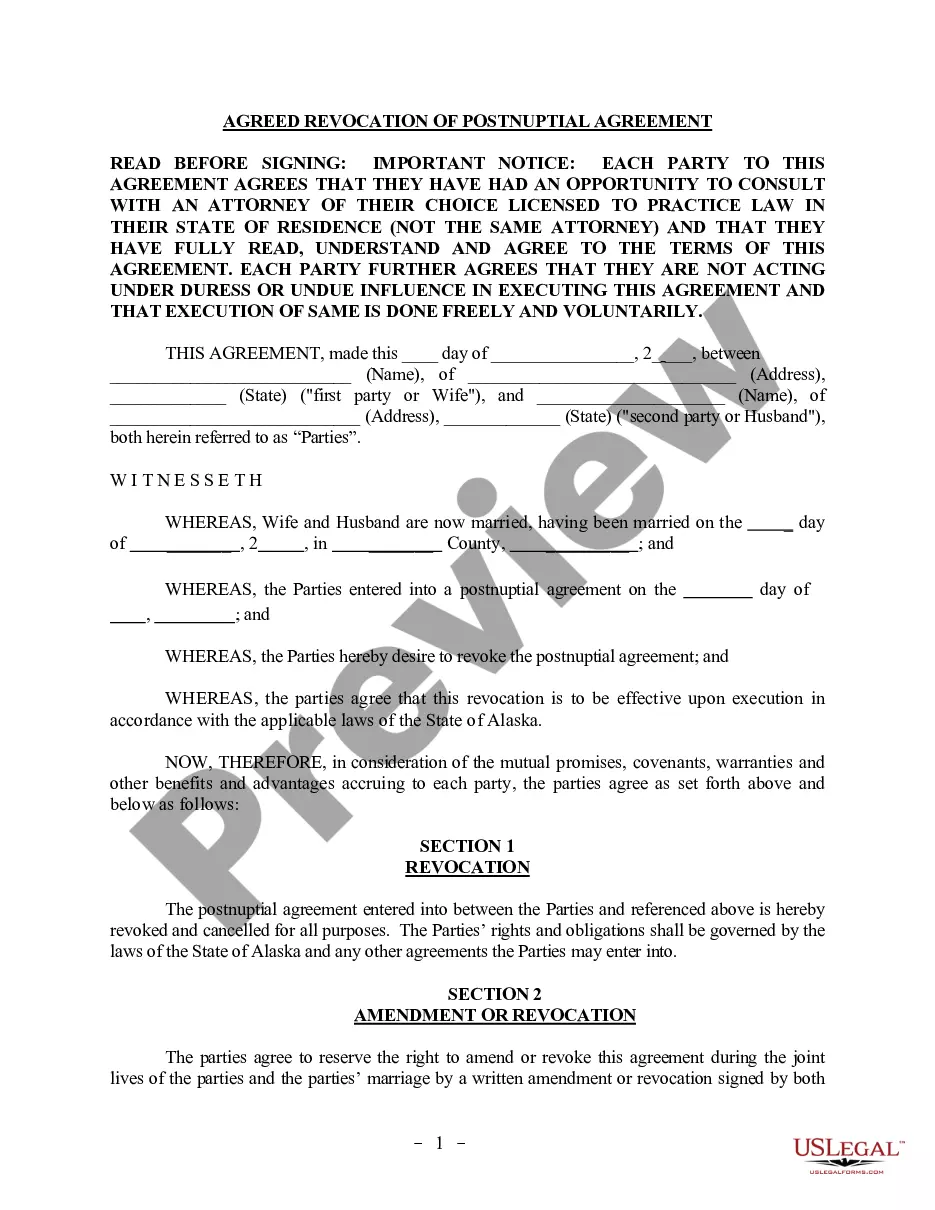
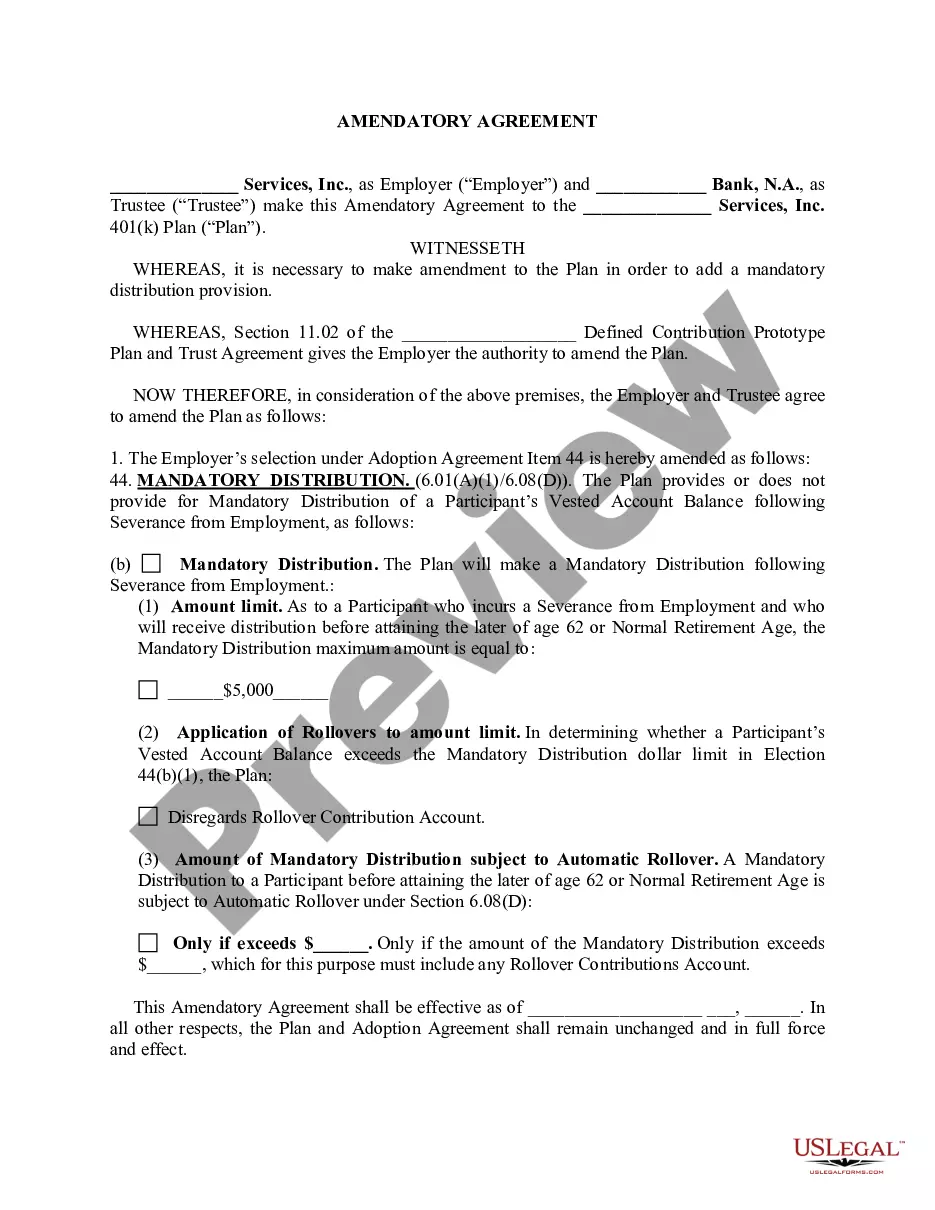
The Revocation of Postnuptial Property Agreement is a legal document used by spouses to revoke an existing postnuptial agreement. This form ensures that both parties formally cancel their prior arrangement regarding the division of property and financial obligations, allowing them to move forward without the constraints of the previous agreement. It differs from a postnuptial agreement as it effectively nullifies any previously agreed-upon terms.
Key components of this form
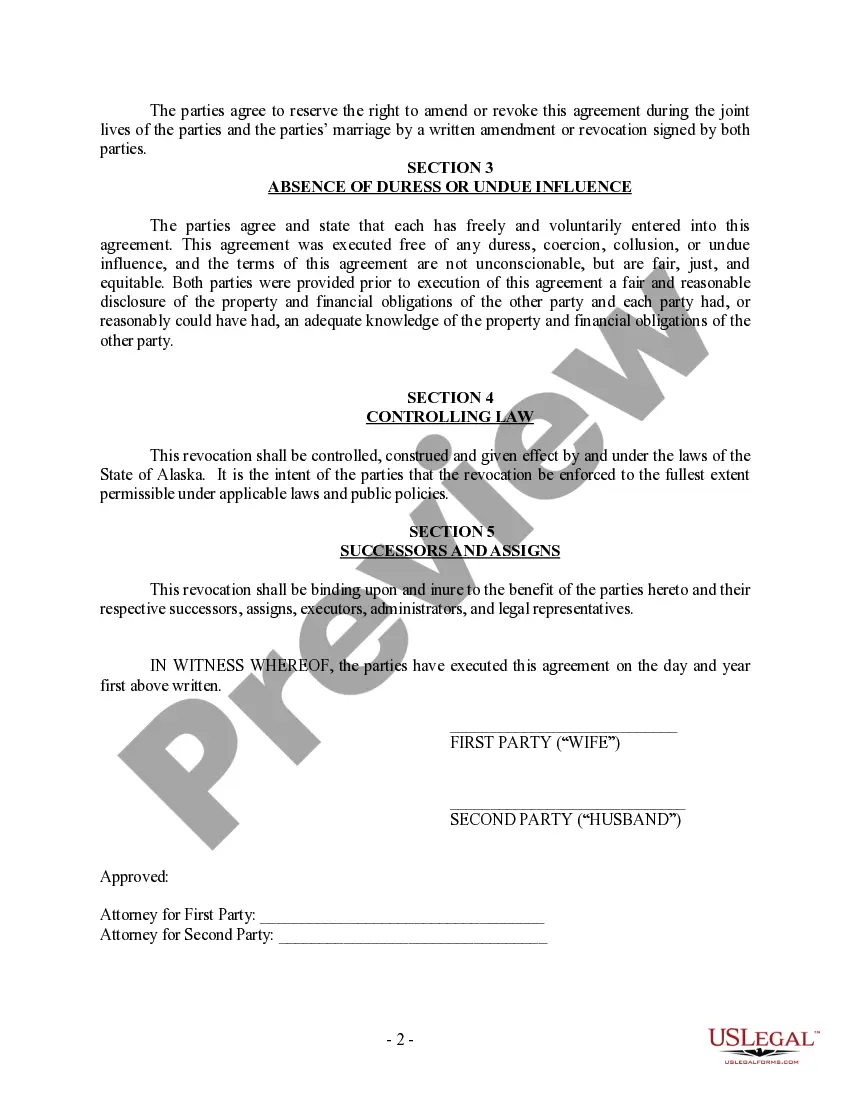
- Revocation clause: Confirms the cancellation of the existing postnuptial agreement.
- Amendment rights: States that parties may amend or revoke this agreement in writing.
- Affirmation of voluntary execution: Both parties agree that they are signing under no pressure.
- Governing law: Specifies that the agreement is governed by the laws of Alaska.
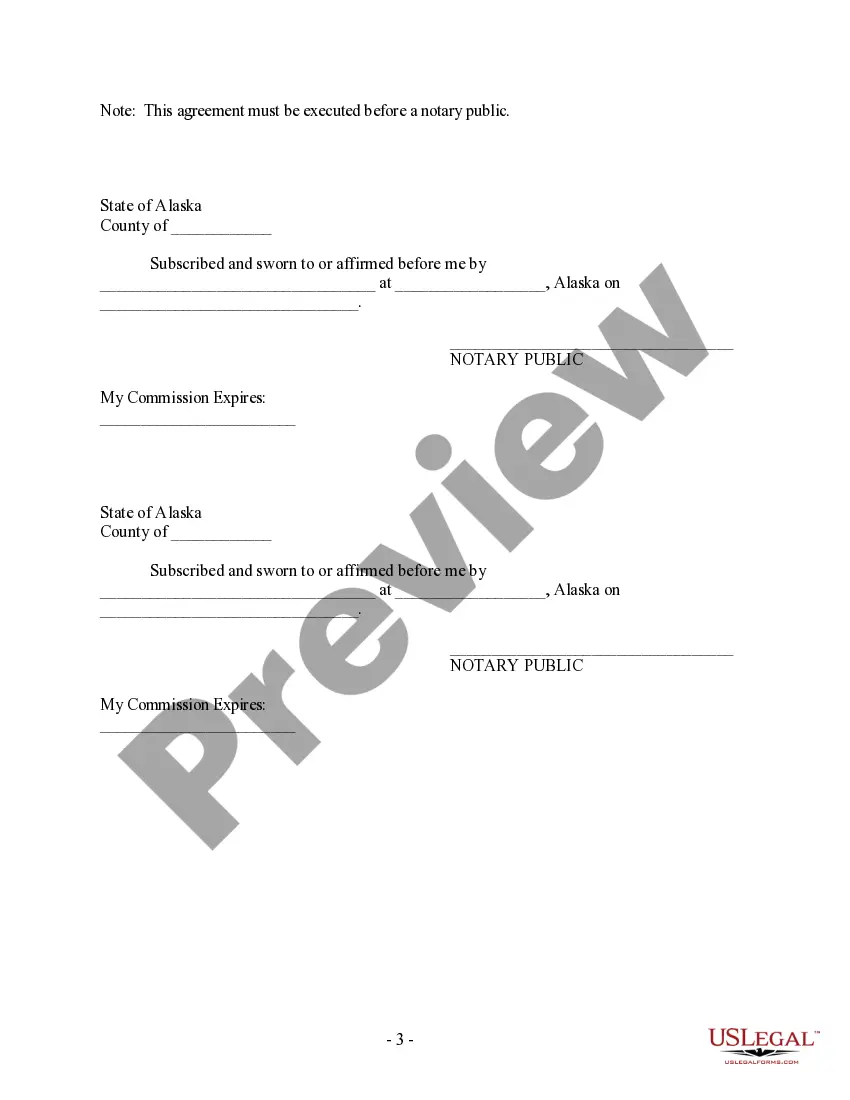
- Notary requirement: Indicates the need for notarization for validity.
Common use cases
This form should be used when both spouses wish to revoke an existing postnuptial property agreement. Common situations include changes in financial circumstances, reconciliations, or significant relationship developments that warrant a reevaluation of their previous terms. This revocation will legally update their property rights and obligations moving forward.
Who needs this form
- Married couples who have previously entered into a postnuptial agreement.
- Individuals looking to nullify property-related arrangements established after marriage.
- Parties seeking to ensure clarity and legal standing regarding their property rights.
How to prepare this document
- Identify and list the full names of both parties in the agreement.
- Enter the date the agreement is being signed.
- Complete the notary section to ensure the validity of the document.
- Both parties should sign the document in the presence of a notary public.
- Retain a copy for personal records once the form is executed.
Is notarization required?
To make this form legally binding, it must be notarized. Our online notarization service, powered by Notarize, lets you verify and sign documents remotely through an encrypted video session.
Get your form ready online
Our built-in tools help you complete, sign, share, and store your documents in one place.
Make edits, fill in missing information, and update formatting in US Legal Forms—just like you would in MS Word.
Download a copy, print it, send it by email, or mail it via USPS—whatever works best for your next step.
Sign and collect signatures with our SignNow integration. Send to multiple recipients, set reminders, and more. Go Premium to unlock E-Sign.
If this form requires notarization, complete it online through a secure video call—no need to meet a notary in person or wait for an appointment.
We protect your documents and personal data by following strict security and privacy standards.

Make edits, fill in missing information, and update formatting in US Legal Forms—just like you would in MS Word.

Download a copy, print it, send it by email, or mail it via USPS—whatever works best for your next step.

Sign and collect signatures with our SignNow integration. Send to multiple recipients, set reminders, and more. Go Premium to unlock E-Sign.

If this form requires notarization, complete it online through a secure video call—no need to meet a notary in person or wait for an appointment.

We protect your documents and personal data by following strict security and privacy standards.
Common mistakes to avoid
- Failing to have the form notarized as required.
- Not ensuring both parties fully read and understand the terms before signing.
- Missing signatures from one of the parties.
Benefits of completing this form online
- Convenience: Downloadable and accessible from home.
- Editability: Fill in your information easily before printing.
- Reliability: Professionally drafted by licensed attorneys ensuring legal compliance.
Quick recap
- The Revocation of Postnuptial Property Agreement cancels existing agreements.
- Both parties must sign and notarize the form for it to be valid.
- This form is specific to Alaska, adhering to its legal standards.
Looking for another form?
Form popularity
FAQ
Reasons a Judge Can Overturn a Prenuptial Agreement There are no specific rules that state what will overturn a prenup.Neither person should be in a state of duress or under any pressure to sign the prenup. Any indication of coercion or lack of willingness can give way for a divorce judge to overturn the agreement.
It needs to be in writing. An oral contract is often difficult to enforce legally in any case. It needs to be signed and notarized. It needs to be fair and reasonable. There must be full disclosure of assets by both spouses. Both parties agree to the terms of the postnuptial agreement.
The three most common grounds for nullifying a prenup are unconscionability, failure to disclose, or duress and coercion.Duress and coercion can also invalidate a prenup. If the prenup was signed the day before your wedding, it may appear that the parties didn't have much time to fully review the agreement.
In general, you should expect that a postnuptial agreement will receive scrutiny from the court before it decides to enforce the agreement. As your family law attorney would advise you, these agreements are not usually signed under the best of circumstances in the marriage.
An infidelity clause in a prenuptial agreement states that if one party is proved to have been involved in an extramarital affair, the aggrieved spouse will receive a financial award from the cheating spouse.The major pitfall of a infidelity clause is that it can raise doubt or mistrust where none is warranted.
Per , since postnuptial agreements generally handle the same issues that prenuptial agreements address, the same circumstances that can cause a court to void part or all of a prenuptial agreement also apply to a postnuptial. Like a prenuptial, a postnuptial agreement should be in written form.
Postnuptial agreements are generally enforceable if the parties of the document adhere to all state laws regarding inheritance, child custody, visitation and monetary support if a divorce does occur.This may also come with a will or other legal document.
Are Post-Nuptial Agreements Legally Binding? Post-Nuptial Agreements are usually legally binding and the position has been strengthened since 2008 following a Privy Council judgement.
If a spouse is able to prove non-disclosure of all previous assets or property, then the prenuptial agreement can be considered void. Second, if a spouse is able to prove that he or she was compelled to sign the prenuptial agreement under stressful circumstances, then the prenup can be invalidated.