Wisconsin Quitclaim Deed from Individual to Two Individuals in Joint Tenancy
About this form
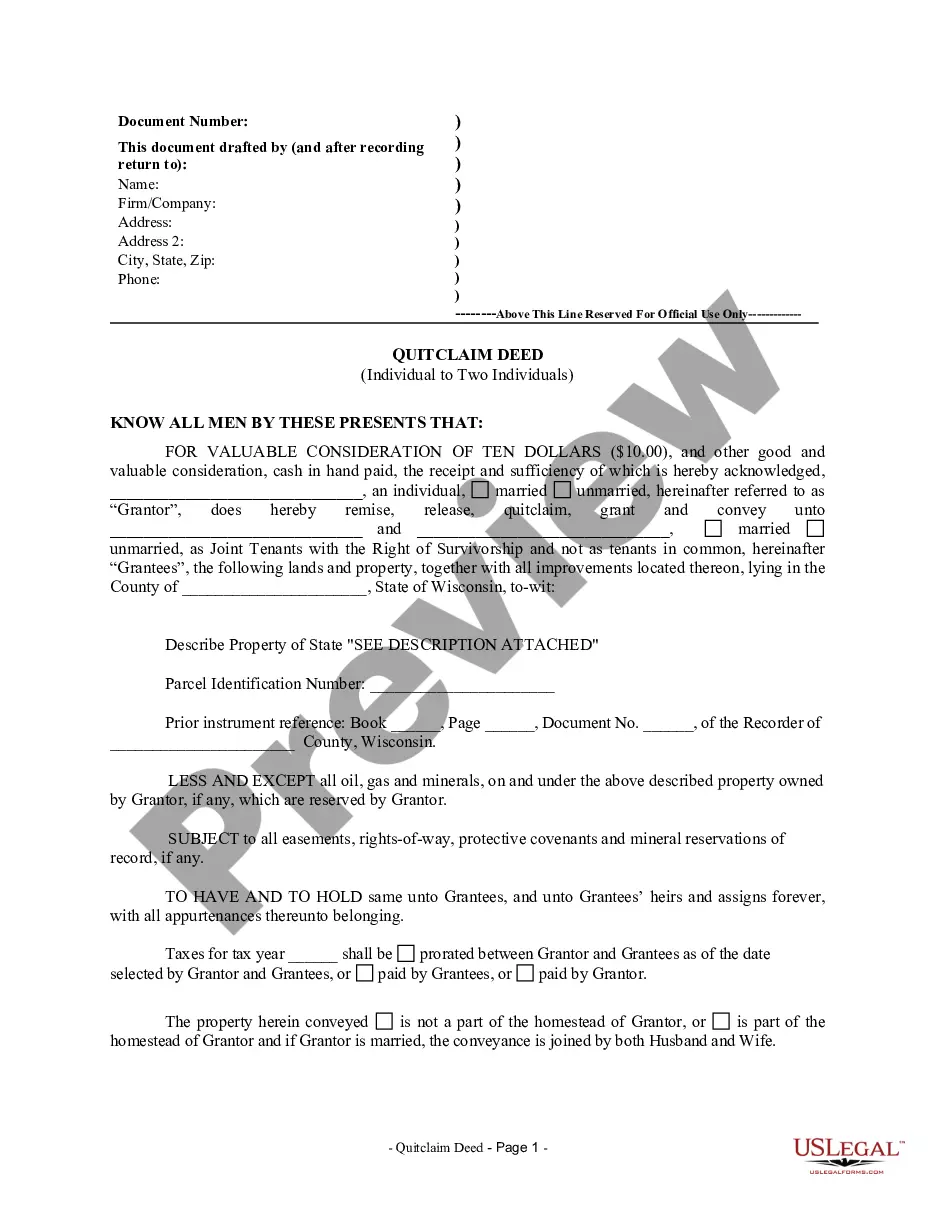
The Quitclaim Deed from Individual to Two Individuals in Joint Tenancy is a legal document that allows an individual (the Grantor) to transfer property ownership to two individuals (the Grantees) as joint tenants. This form is distinct as it relinquishes any claim the Grantor has to the property, while also reserving certain rights, such as oil, gas, and mineral rights. It complies with state statutory laws, ensuring its legality and effectiveness in property transfer processes.
Form components explained
- Description of the Property: This includes details like the parcel identification number and prior instrument reference.
- Granting Clauses: Specifies the transfer of property from the Grantor to the Grantees, including any reserved rights.
- Provisions for Taxes: Determines how property taxes will be handled between the Grantor and Grantees.
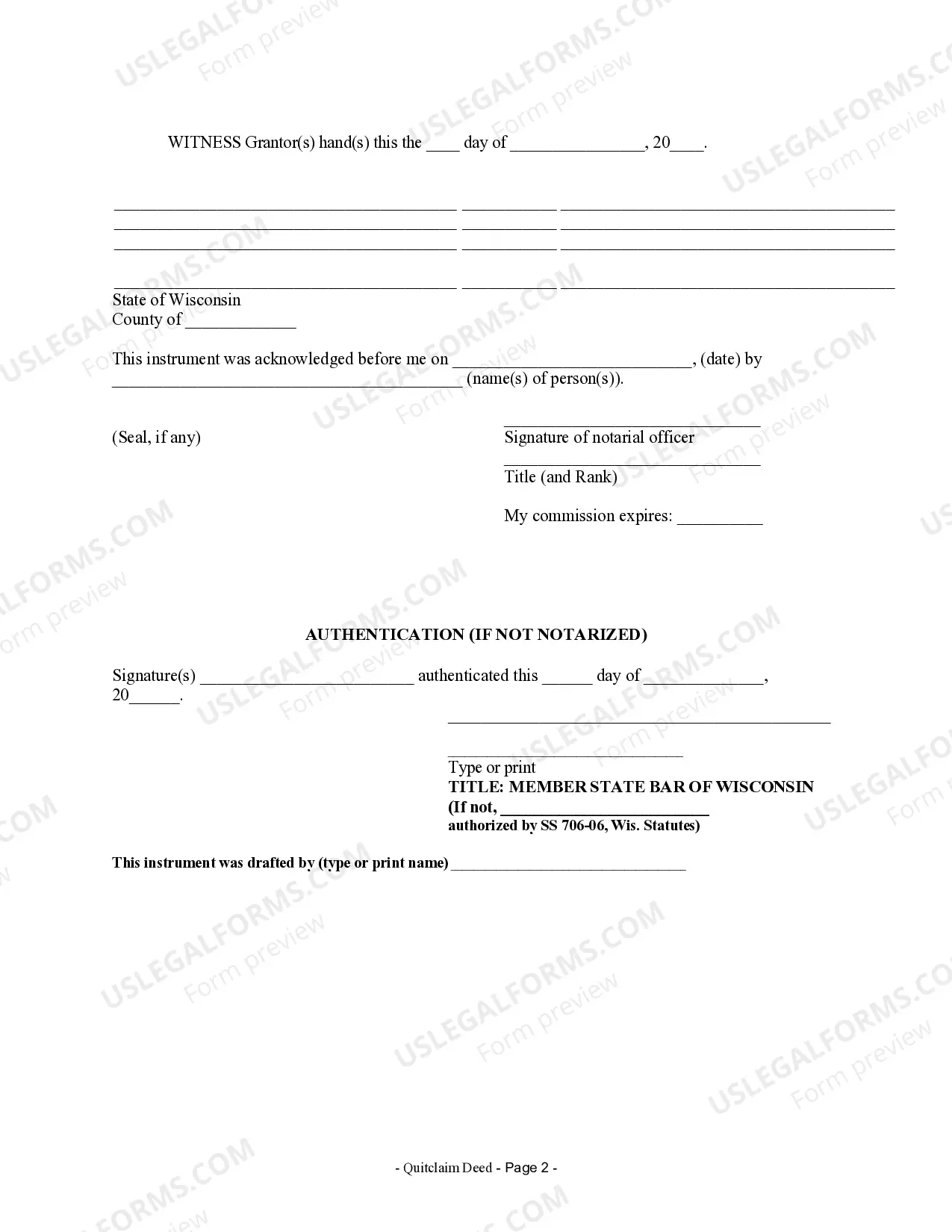
- Acknowledgment: A section for the notary public to verify the identities of the parties involved.
- Signature Lines: Spaces for the Grantor and, if necessary, the Grantees to sign the document.




When this form is needed
This form is appropriate when an individual wishes to convey property ownership to two other individuals who will hold the property as joint tenants. It is commonly used in situations such as transferring ownership to family members, establishing joint ownership between partners, or eliminating the Grantor's claim on the property while ensuring both Grantees have equal rights to it.
Who needs this form
- Property owners (Grantors) wanting to transfer real estate ownership to two individuals.
- The individuals receiving the property (Grantees) who want to hold the property jointly.
- Individuals looking for a simple way to relinquish their ownership rights without a lengthy legal process.
How to prepare this document
- Identify the parties: Enter the name of the Grantor and the names of the two Grantees.
- Specify the property: Fill in the description of the property, including the parcel identification number and prior instrument references.
- Reserve rights: Indicate any oil, gas, and mineral rights that are to be reserved by the Grantor.
- Enter tax arrangements: Decide how taxes will be prorated or paid between the Grantor and Grantees.
- Sign and notarize: The Grantor must sign the form, and it may require notarization for it to be legally valid.
Does this form need to be notarized?
Notarization is required for this form to take effect. Our online notarization service, powered by Notarize, lets you verify and sign documents remotely through an encrypted video session, available 24/7.
Get your form ready online
Our built-in tools help you complete, sign, share, and store your documents in one place.
Make edits, fill in missing information, and update formatting in US Legal Forms—just like you would in MS Word.
Download a copy, print it, send it by email, or mail it via USPS—whatever works best for your next step.
Sign and collect signatures with our SignNow integration. Send to multiple recipients, set reminders, and more. Go Premium to unlock E-Sign.
If this form requires notarization, complete it online through a secure video call—no need to meet a notary in person or wait for an appointment.
We protect your documents and personal data by following strict security and privacy standards.

Make edits, fill in missing information, and update formatting in US Legal Forms—just like you would in MS Word.

Download a copy, print it, send it by email, or mail it via USPS—whatever works best for your next step.

Sign and collect signatures with our SignNow integration. Send to multiple recipients, set reminders, and more. Go Premium to unlock E-Sign.

If this form requires notarization, complete it online through a secure video call—no need to meet a notary in person or wait for an appointment.

We protect your documents and personal data by following strict security and privacy standards.
Avoid these common issues
- Failing to provide a complete property description.
- Not reserving crucial rights if applicable.
- Missing signatures from either the Grantor or Grantees.
- Neglecting to have the document notarized, if required by local law.
Why use this form online
- Convenient access to legal documents that can be downloaded instantly.
- Editability allows you to customize the form according to your specific needs.
- Access to templates drafted by licensed attorneys ensures reliability and compliance with the law.
- No need to visit a legal office; complete your deed from the comfort of your home.
Main things to remember
- This Quitclaim Deed facilitates property transfer between individuals as joint tenants.
- It is crucial to include all pertinent property information and reserve rights correctly.
- The document requires notarization to ensure its legal validity.
- Review state-specific requirements to comply with local laws effectively.
Looking for another form?
Form popularity
FAQ
In order to terminate a joint tenancy, one of the four unities must be destroyed. You may do this by conveying your joint tenancy interest to any third person. This can be done through gift or sale. Upon termination, a tenancy in common is formed between the third person and the remaining co-tenant(s).
Serve a written notice of the change (a 'notice of severance') on the other owners - a conveyancer can help you do this. Download and fill in form SEV to register a restriction without the other owners' agreement. Prepare any supporting documents you need to include.
Joint ownership. Unlike a tenancy in common, where co-owners may possess unequal interests, the legal interest of each joint owner is equal to the interest of every other joint owner. If there are three joint owners, each owns an equal, undivided, one-third interest in the entire property.
This is known as 'Severing the Joint Tenancy'. It requires service of a written notice of change the 'severance'. It can be done without the other owner's cooperation or agreement. It is recorded at the Land Registry, and the other owner will know it has been done but only 'after the event' so to speak.
You can apply to court to change your ex-partner's tenancy to your name, or remove their name from a joint tenancy. You can apply for a 'transfer of tenancy' if: your landlord refuses to change your tenancy. your tenancy doesn't allow a transfer.
If you look at the registered title to your own jointly owned property and the text isn't shown on it, you own it as joint tenants. If it is there, you own it as tenants-in-common.This title is dealt with by Land Registry, Sample Town Office.
While the joint tenant with right of survivorship can't will his share in the property to his heir, he can sell his interest in the property before his death. Once a joint tenant sells his share, this ends the joint tenancy ownership involving the share.
The deed specifies that the joint tenants own an equal amount of interest in the purchased property and are thus equally liable for it financially.Instead of selling, a joint tenant can choose to transfer their interest to another party.
A quitclaim deed transfers title but makes no promises at all about the owner's title.A person who signs a quitclaim deed to transfer property they do not own results in no title at all being transferred since there is no actual ownership interest. The quitclaim deed only transfers the type of title you own.