Washington Commercial Lease Assignment from Tenant to New Tenant
Understanding this form
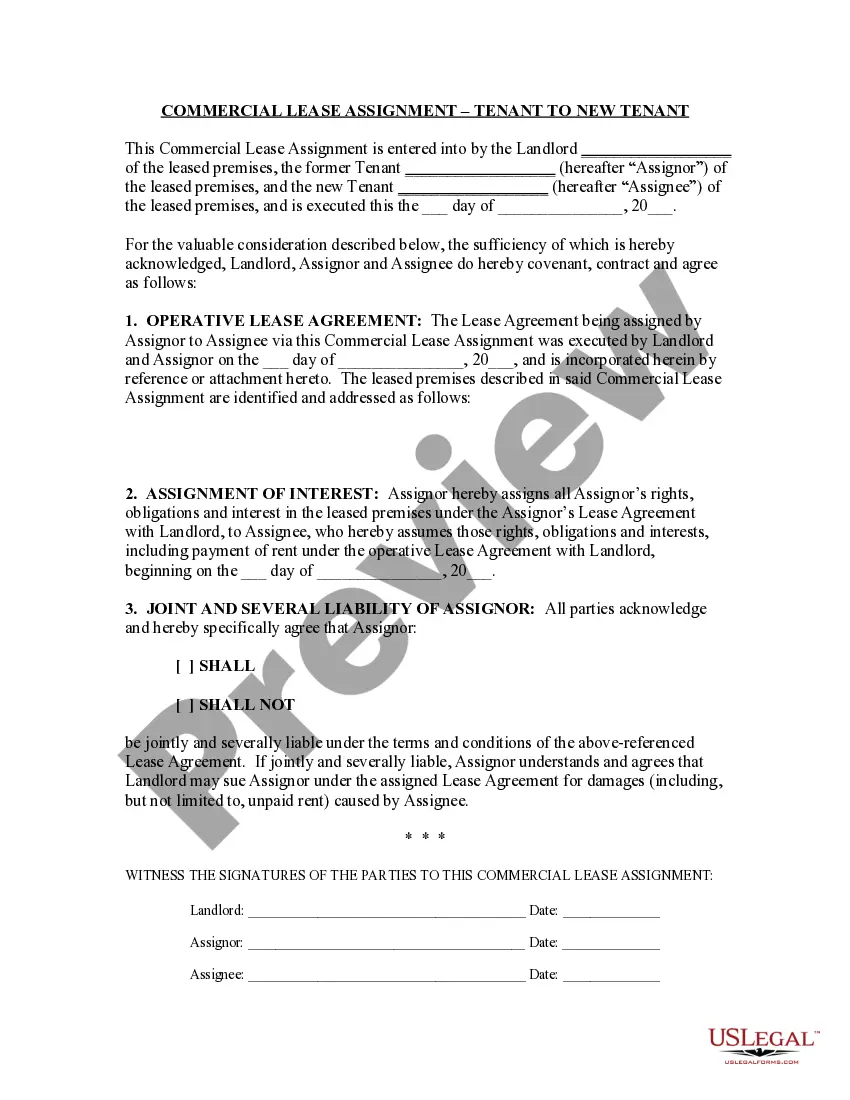
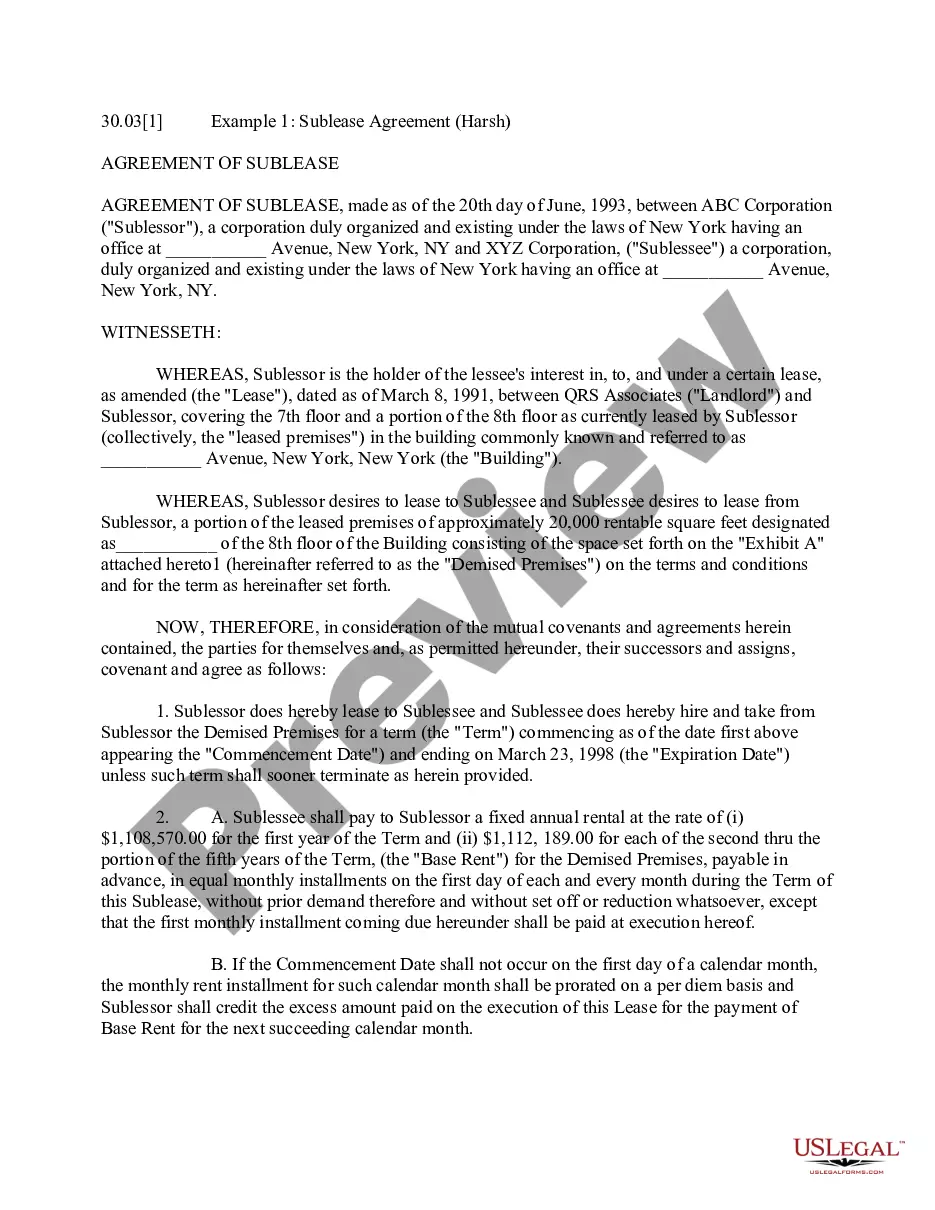
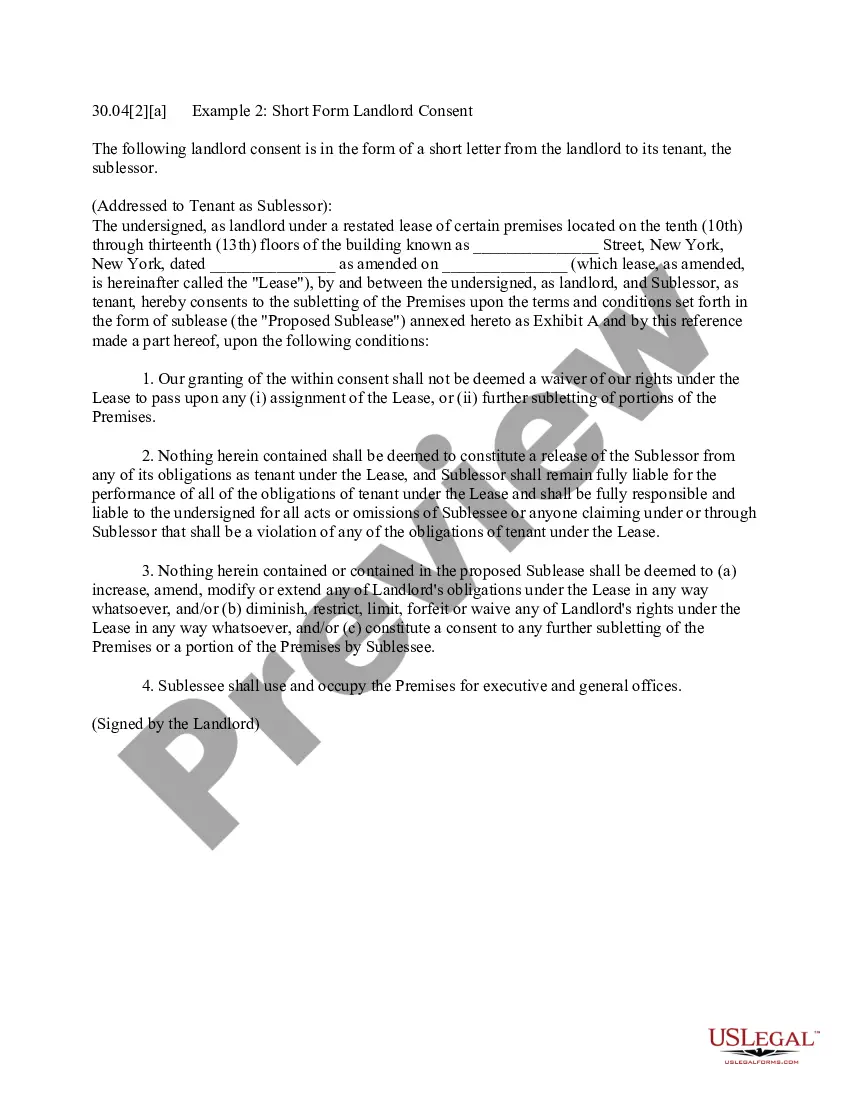
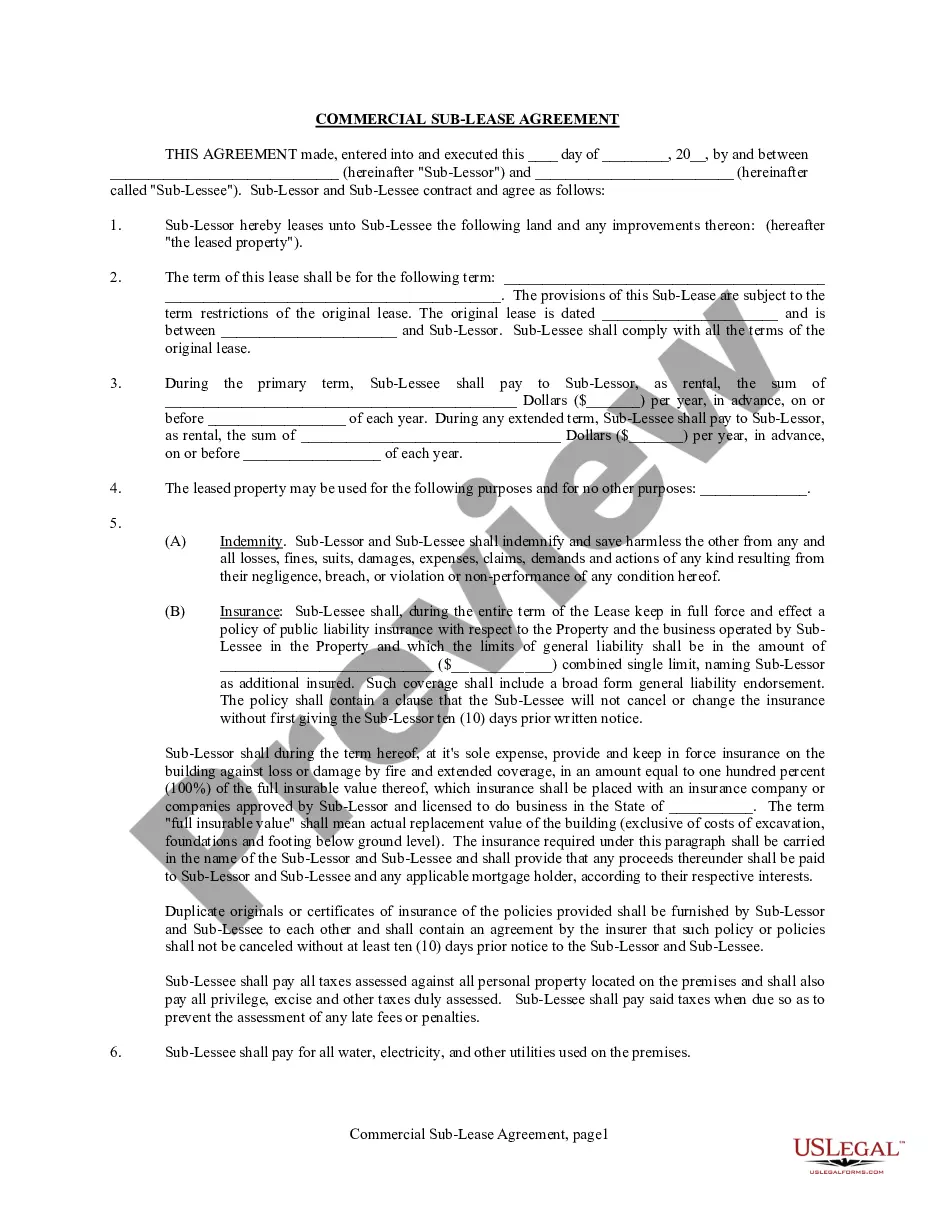
The Commercial Lease Assignment from Tenant to New Tenant is a legal document that allows an existing tenant (the Assignor) to transfer their leasing rights and responsibilities to a new tenant (the Assignee) while keeping the landlord unchanged. This form differs from lease termination because it maintains the original lease agreement, allowing the new tenant to step into the previous tenant's role.
Key components of this form
- Identification of the parties involved: Landlord, Assignor, and Assignee.
- Specification of joint and several liability: Defines if the Assignor remains liable for obligations under the lease.
- Details regarding the leased premises: Location and description of the property being transferred.
- Execution section: Signature lines for all parties involved, including dates.
When to use this form
This form is needed when a tenant wishes to transfer their lease agreement to another tenant due to circumstances such as business relocation, financial changes, or other personal reasons. It is particularly useful in commercial settings where business continuance is vital, and the original lease remains intact, providing legal stability for the new occupant.
Who should use this form
- Current tenants looking to assign their lease to a new tenant.
- Landlords who need to ensure that leasing rights are transferred without altering their agreement with the original tenant.
- New tenants who are interested in taking over an existing lease arrangement.
Steps to complete this form
- Identify the parties involved: Fill in the names of the Landlord, Assignor, and Assignee.
- Specify the property: Enter the details of the leased premises being assigned.
- Determine liability: Clearly indicate whether the Assignor will remain jointly liable or not.
- Enter the execution date: Fill in the date when the form is signed by all parties.
- Collect signatures: Ensure all parties sign and date the form to finalize the agreement.
Does this form need to be notarized?
This form does not typically require notarization unless specified by local law. However, notarizing the agreement can enhance its enforceability and provide additional legal safeguards.
Get your form ready online
Our built-in tools help you complete, sign, share, and store your documents in one place.
Make edits, fill in missing information, and update formatting in US Legal Forms—just like you would in MS Word.
Download a copy, print it, send it by email, or mail it via USPS—whatever works best for your next step.
Sign and collect signatures with our SignNow integration. Send to multiple recipients, set reminders, and more. Go Premium to unlock E-Sign.
If this form requires notarization, complete it online through a secure video call—no need to meet a notary in person or wait for an appointment.
We protect your documents and personal data by following strict security and privacy standards.

Make edits, fill in missing information, and update formatting in US Legal Forms—just like you would in MS Word.

Download a copy, print it, send it by email, or mail it via USPS—whatever works best for your next step.

Sign and collect signatures with our SignNow integration. Send to multiple recipients, set reminders, and more. Go Premium to unlock E-Sign.

If this form requires notarization, complete it online through a secure video call—no need to meet a notary in person or wait for an appointment.

We protect your documents and personal data by following strict security and privacy standards.
Common mistakes to avoid
- Failing to read the original lease for assignment restrictions.
- Not getting signatures from all parties involved.
- Neglecting to specify liability terms clearly.
- Using incorrect or outdated form versions.
Benefits of completing this form online
- Convenient access: Download the form anytime without needing a legal appointment.
- Editability: Easily modify the template to fit specific situations.
- Reliability: Utilizes attorney-drafted templates ensuring legal soundness.
- The assignment must comply with the original lease terms to be enforceable.
- Both the Assignor and Assignee should understand their obligations under the assigned lease.
- Landlords may have specific provisions regarding assignments in commercial leases, making it crucial to review those before proceeding.
Main things to remember
- The Commercial Lease Assignment facilitates the transfer of lease rights from one tenant to another while keeping the landlord unchanged.
- Proper execution of the form is essential to ensure all responsibilities are clarified and legally binding.
- Understanding joint and several liability is critical for all parties involved in the assignment.
Looking for another form?
Form popularity
FAQ
Anyone renting a building, whether for commercial or personal use, has the right to privacy. You are entitled to do anything on the property that you wish, so long as whatever you are doing is legal. The landlord cannot prevent you from operating your business nor from allowing guests or patrons on the property.
Though landlords must scrupulously respect tenants' rights, one thing they don't have to do is automatically renew tenant's leases. In fact, except for discriminatory or retaliatory reasons, landlords of rental properties can refuse to renew tenant leases as it suits them.
Whatever the reason, tenants can transfer their lease interests to new parties by completing an assignment of the lease. An assignment is the transfer of one party's entire interest in and obligations under a lease to another party.
Great, you'll just need to let your agent or landlord know you'll be breaking your lease as soon as you have exchanged contracts. This will allow as much time as possible for them to find a new tenant to replace you. In this case, you're also up for a penalty fee called a 'break fee'.
Lease Provisions First and foremost, the lease must be honored.He or she is still responsible for paying rent and carrying out the terms of the original lease, although rents will generally be paid to the new owner. The other terms and conditions of the lease also stay in effect until the lease expires.
Landlords can try and forfeit a lease if a tenant is in breach of their obligations (this assumes that the lease document includes a right to forfeit).If a commercial lease contains a break clause, either or both parties to the agreement may seek to terminate the lease before its fixed period has ended.
What happens if a leased property is sold to another owner during the lease term?The lease will continue to apply to the subsequent owner if so stated in the lease. Or the lease may require that upon transfer, the lease terminates and the existing owner compensates the tenant per the terms in the lease.
The tenant's agreement is tied to the property, not the owner. That means if the property sells while occupied, the tenant has the right to live there until the lease expires. The buyer has to honor the length of the original lease created between the seller and tenant.
Can the landlord refuse consent to an Assignment? Most leases will say that the Landlord cannot unreasonably withhold consent. According to section 19 (1A) of the Landlord and Tenant Act 1927 the landlord can insert conditions in the lease, which need to be met in the case of an assignment.