Vermont Letter from Landlord to Tenant as Notice of Default on Commercial Lease
Overview of this form
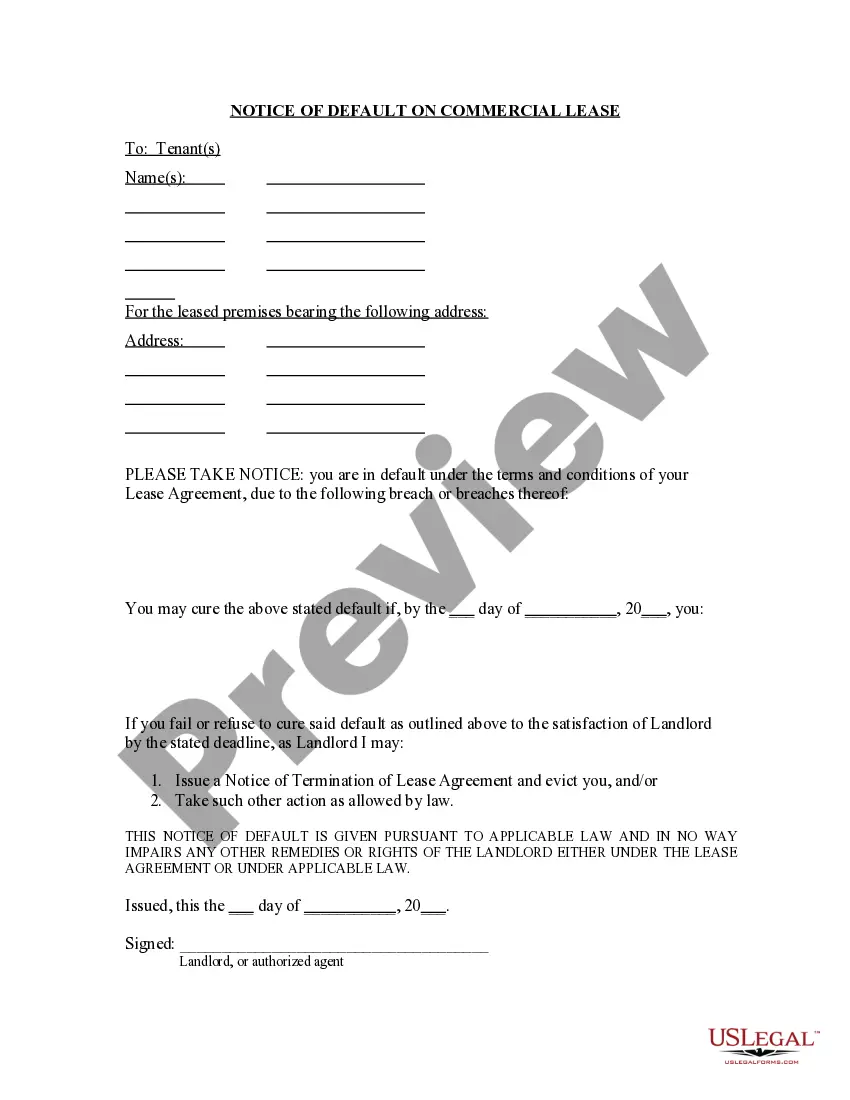
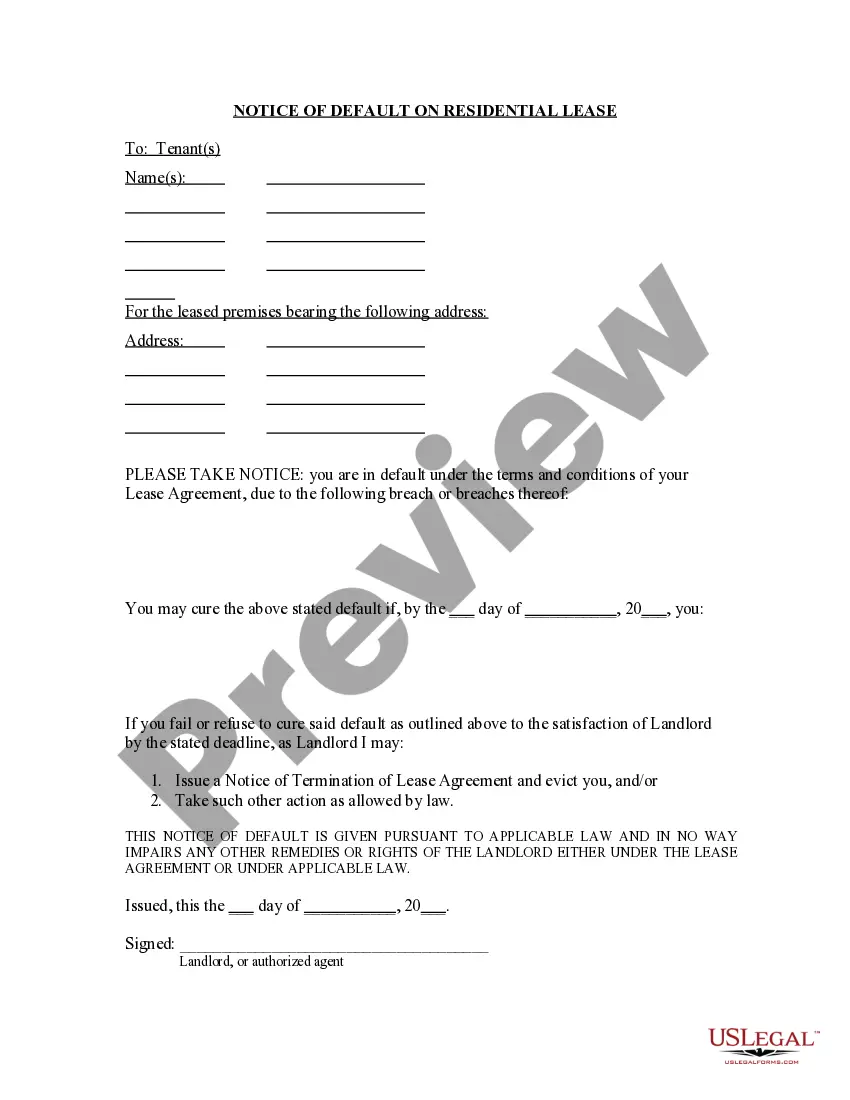
The Letter from Landlord to Tenant as Notice of Default on Commercial Lease is a legal document used by landlords to formally notify tenants of a default in their lease agreement. This notice details the specific breaches of the lease, sets a deadline for the tenant to remedy these breaches, and outlines the potential consequences if the issues are not resolved. This form is distinct from other lease forms because it specifically addresses defaults, making it a critical step in the eviction process if necessary.
What’s included in this form
- Statement of default: Clearly states the nature of the default(s) being addressed.
- Deadline for cure: Specifies a timeframe within which the tenant must correct the default.
- Consequences of inaction: Outlines the potential actions the landlord may take if the breach is not remedied.
- Signature block: Includes space for the landlord or authorized agent to sign and date the notice.


When this form is needed
This form should be used when a tenant has failed to comply with the terms outlined in their commercial lease, such as not paying rent on time or violating specific lease clauses. Landlords must issue this notice before taking further legal action, such as eviction proceedings or applying security deposit funds to cover unpaid rent. It is an essential document in managing any lease default and ensuring compliance with legal requirements before escalating to eviction.
Intended users of this form
- Commercial landlords seeking to address tenant defaults.
- Property managers representing landlords in lease agreements.
- Legal professionals advising landlords on lease enforcement.
- Tenants who are recipients of the default notice to understand their obligations.
How to prepare this document
- Identify the parties: Insert the landlord's name and contact information, and the tenant's name and business details.
- Specify the property: Include the address and description of the leased commercial property.
- List the default(s): Clearly outline the specific breaches of the lease agreement.
- Set a cure deadline: Indicate a specific date by which the tenant must address the default.
- Provide a signature: Have the landlord or an authorized agent sign and date the notice.
Notarization guidance
This form does not typically require notarization unless specified by local law. Ensure to verify any specific state requirements regarding notarization for legal validity.
Get your form ready online
Our built-in tools help you complete, sign, share, and store your documents in one place.
Make edits, fill in missing information, and update formatting in US Legal Forms—just like you would in MS Word.
Download a copy, print it, send it by email, or mail it via USPS—whatever works best for your next step.
Sign and collect signatures with our SignNow integration. Send to multiple recipients, set reminders, and more. Go Premium to unlock E-Sign.
If this form requires notarization, complete it online through a secure video call—no need to meet a notary in person or wait for an appointment.
We protect your documents and personal data by following strict security and privacy standards.

Make edits, fill in missing information, and update formatting in US Legal Forms—just like you would in MS Word.

Download a copy, print it, send it by email, or mail it via USPS—whatever works best for your next step.

Sign and collect signatures with our SignNow integration. Send to multiple recipients, set reminders, and more. Go Premium to unlock E-Sign.

If this form requires notarization, complete it online through a secure video call—no need to meet a notary in person or wait for an appointment.

We protect your documents and personal data by following strict security and privacy standards.
Typical mistakes to avoid
- Failing to specify the exact nature of the default.
- Not providing a clear deadline for the tenant to cure the default.
- Neglecting to sign the notice, rendering it invalid.
- Using ambiguous language that may lead to misinterpretation.
Benefits of completing this form online
- Convenience of immediate access and download.
- Easy customization to fit specific lease terms and conditions.
- Reliable templates drafted by licensed attorneys, ensuring legal compliance.
- Time-saving compared to creating a notice from scratch.
- The notice serves as a formal warning and is often a legal requirement before eviction proceedings can begin.
- Failure to provide this notice may impact the landlord's ability to seek eviction under the law.
- This notice is crucial for landlords when lease violations occur.
- It gives tenants a chance to correct their breaches before eviction processes start.
- Understanding state-specific requirements can enhance the effectiveness of the notice.
Looking for another form?
Form popularity
FAQ
Paying the remainder of the rent still owed on the lease in full; Paying a specified amount of liquidated damages as outlined in the contract terms; Paying an additional amount of punitive damages, dependent on local state laws; and/or.
A lease is automatically void when it is against the law, such as a lease for an illegal purpose. In other circumstances, like fraud or duress, a lease can be declared void at the request of one party but not the other.
In Colorado, evictions are sometimes referred to as forcible entry & detainer (FED). Before you can file for eviction, you must generally provide 10 days' notice (increased from 3 days prior) for tenants to correct a deficiency or leave the property, except in certain circumstances.
Protect your rental income. Even the most reliable tenants sometimes struggle to pay their rent.Tenant default insurance from Simply Business provides vital back-up for landlords it can cover your rental income if your tenant fails to pay rent.
In landlord-tenant law, default refers to the failure of a tenant to timely pay rent due.In general, the landlord is required to give the tenant notice of the default before bringing eviction proceedings or applying security deposit proceeds to the payment in default.
To evict a tenant in California, a landlord must put his eviction notice in writing.If a landlord is evicting a tenant for a lease violation or to take control of the property, he must give the tenant 30-60 days notice.
For example, the lease may provide that in case of default, the landlord can recover late fees and interest. If the lease is a net lease, it may provide for the landlord to recover such things as property taxes, insurance, utilities, maintenance and repairs.
Tenant default occurs when a Tenant breaches one of the tenant's covenants in its lease. Tenant default can arise in a number of different ways but will typically be for one of the following: Non-payment of rent or other sums reserved under the lease.
A break-early fee is a lump sum payment. The amount of the break-early fee will vary greatly depending upon the commercial tenant's specific circumstances. In exchange for the break-early fee, the landlord will agree to release the commercial tenant from all of its obligations under the commercial lease.