Texas Renunciation And Disclaimer of Joint Tenant or Tenancy Interest
Understanding this form
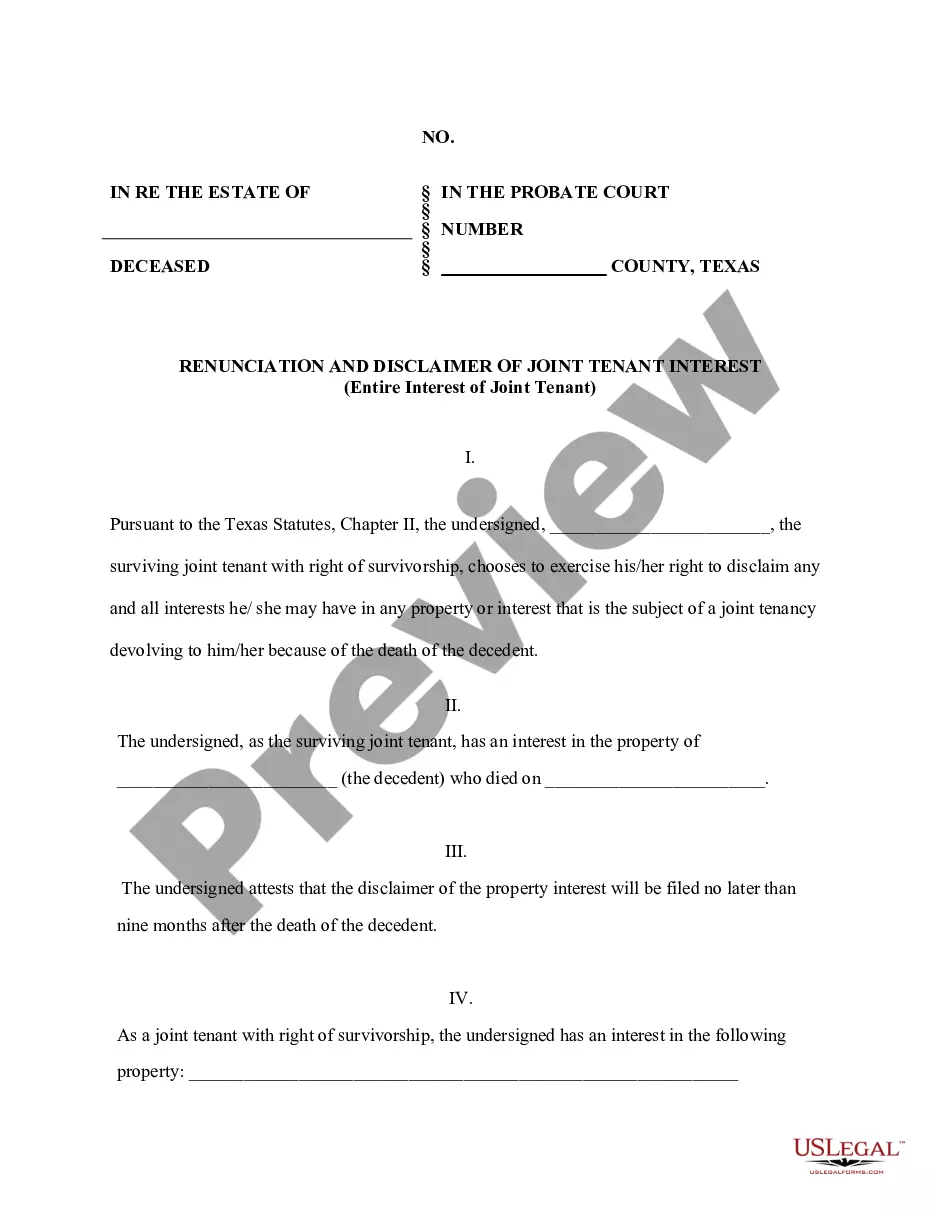
The Renunciation and Disclaimer of Joint Tenant or Tenancy Interest form allows a surviving joint tenant to formally renounce their interest in a property inherited due to the death of another joint tenant. This legal document is significant as it enables the disclaimed property interest to be treated as though the joint tenant predeceased the decedent, thus allowing the property to devolve to the alternative beneficiaries. This form is crucial for Texans who wish to refuse inheritance rights, ensuring clear legal documentation and adherence to Texas law.
Key parts of this document
- Parties involved in the joint tenancy are identified.
- Details of the decedent and their date of death are provided.
- Attestation of filing the disclaimer within nine months of the death.
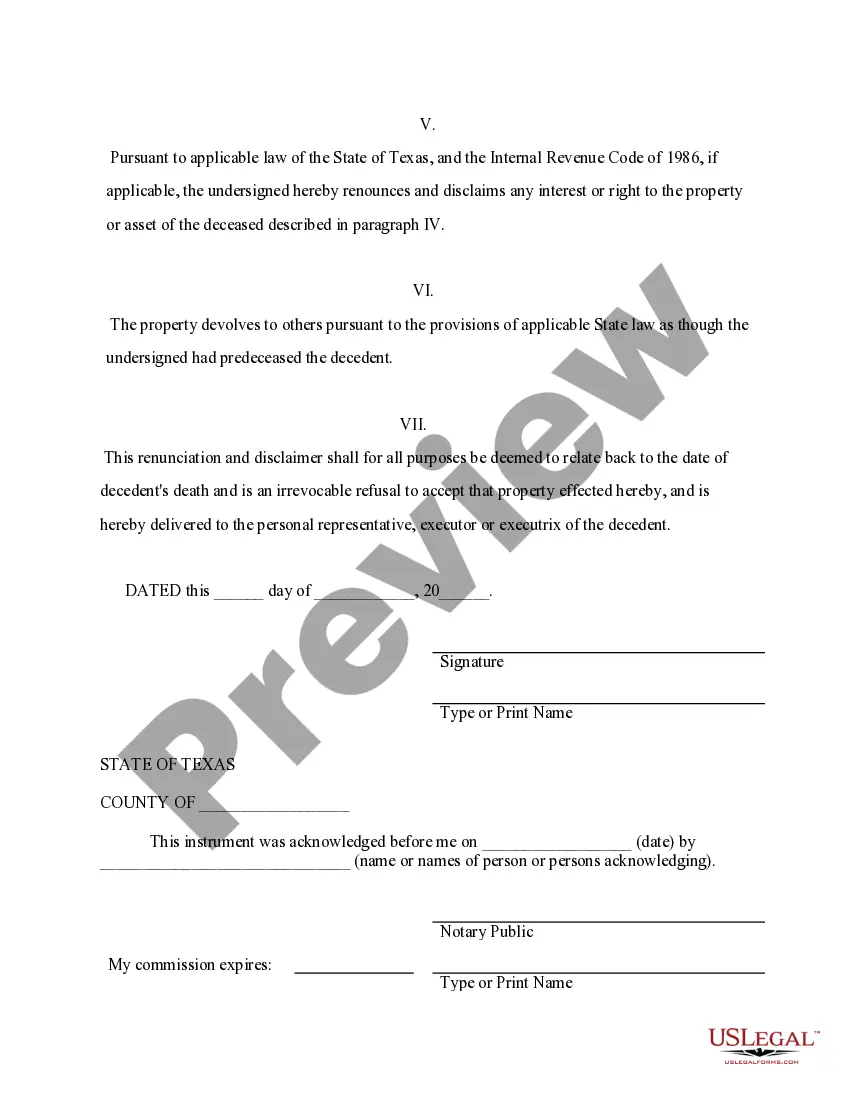
- A clear statement renouncing all interest in the specified property.
- Confirmation that the property interest devolves according to state law.
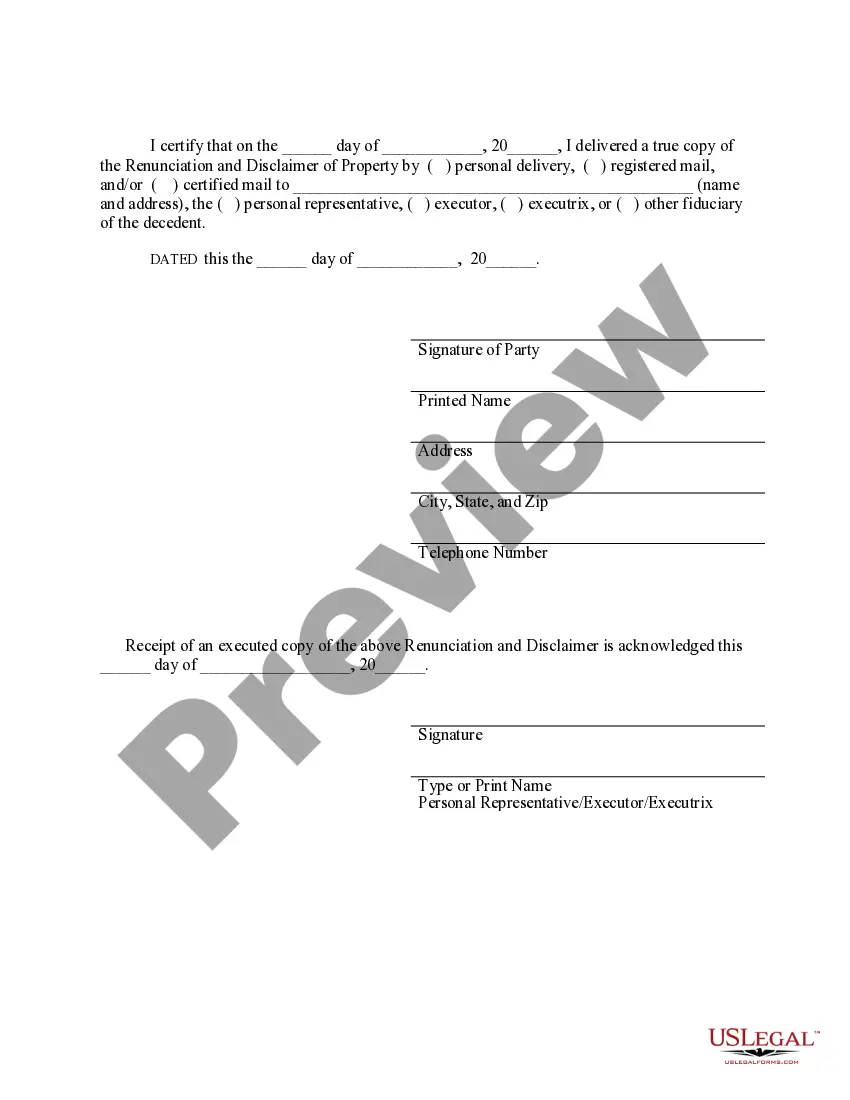
- Irrevocable nature of the decision and delivery to the decedentâs personal representative.


When this form is needed
You should use this form when you are a surviving joint tenant who does not wish to inherit property due to the death of the other joint tenant. This may be relevant in circumstances where you want the property to pass to other beneficiaries or when you aim to avoid potential tax implications associated with inheriting the property. Completing this form helps clarify your intentions and ensures proper legal procedures are followed.
Who should use this form
- Surviving joint tenants who wish to renounce inherited property interests.
- Individuals who need to document their decision to disclaim a property interest.
- Those looking to ensure that property passes to other beneficiaries without legal complications.
How to prepare this document
- Identify yourself as the surviving joint tenant at the beginning of the document.
- Provide the full name of the decedent and their date of death in the specified sections.
- Clearly indicate the property or interest you are renouncing.
- Sign and date the document to confirm your irrevocable decision.
- Deliver the completed form to the personal representative of the decedent or their estate.
Is notarization required?
This form does not typically require notarization unless specified by local law. However, it is important to check local regulations to ensure compliance. If needed, US Legal Forms provides integrated online notarization services for convenience and reliability.
Get your form ready online
Our built-in tools help you complete, sign, share, and store your documents in one place.
Make edits, fill in missing information, and update formatting in US Legal Forms—just like you would in MS Word.
Download a copy, print it, send it by email, or mail it via USPS—whatever works best for your next step.
Sign and collect signatures with our SignNow integration. Send to multiple recipients, set reminders, and more. Go Premium to unlock E-Sign.
If this form requires notarization, complete it online through a secure video call—no need to meet a notary in person or wait for an appointment.
We protect your documents and personal data by following strict security and privacy standards.

Make edits, fill in missing information, and update formatting in US Legal Forms—just like you would in MS Word.

Download a copy, print it, send it by email, or mail it via USPS—whatever works best for your next step.

Sign and collect signatures with our SignNow integration. Send to multiple recipients, set reminders, and more. Go Premium to unlock E-Sign.

If this form requires notarization, complete it online through a secure video call—no need to meet a notary in person or wait for an appointment.

We protect your documents and personal data by following strict security and privacy standards.
Common mistakes
- Failing to file the disclaimer within the nine-month timeframe after the decedent's death.
- Not providing complete and accurate information about the property or interest.
- Overlooking the necessity for signatures and dates on the form.
Why use this form online
- Access to professionally drafted legal documents ensuring compliance with Texas law.
- Convenient download and completion from anywhere, at any time.
- Easy editing to tailor the form to your specific situation.
Summary of main points
- The form allows a surviving joint tenant to renounce their inherited interest in property.
- It is essential to file the disclaimer within nine months of the decedent's death.
- The document facilitates the transfer of property according to the deceased's wishes, avoiding potential disputes among heirs.
Looking for another form?
Form popularity
FAQ
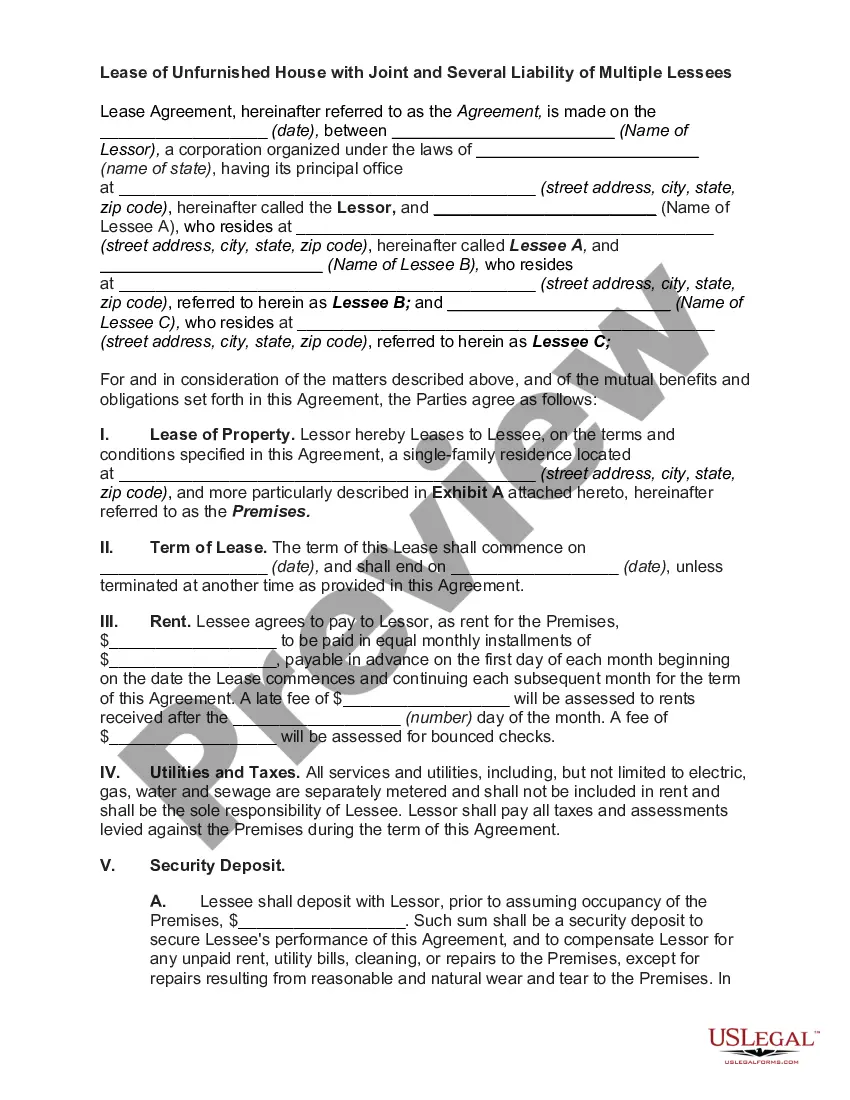
Notice to Vacate The amount of time the tenant has to move out or fix a certain problem before an eviction suit is filed. This must be at least 3 days unless the lease specifically states otherwise.
Notice to Vacate The amount of time the tenant has to move out or fix a certain problem before an eviction suit is filed. This must be at least 3 days unless the lease specifically states otherwise.
No Texas statute addresses landlord's entry, but Texas courts have held that a landlord may not enter the rental property unless entry is authorized by the lessee.Since no Texas laws state when a landlord can enter a rental property, the rules default to the lease agreement.
Your rights as a tenant include the right to "quiet enjoyment," a legal term. This means your landlord cannot evict you without cause or otherwise disturb your right to live in peace and quiet. If other tenants in your building are disturbing you, you should complain to the landlord.
A landlord cannot evict a tenant without an adequately obtained eviction notice and sufficient time. A landlord cannot retaliate against a tenant for a complaint. A landlord cannot forego completing necessary repairs or force a tenant to do their own repairs.A landlord cannot remove a tenant's personal belongings.
No Texas statute addresses landlord's entry, but Texas courts have held that a landlord may not enter the rental property unless entry is authorized by the lessee. Once a residential property is leased, the landlord's ability to enter the rental unit is diminished.
To remove a holdover tenant in Texas, the landlord must give the tenant a three-day notice to vacate. If the tenant does not move out by the end of the three-day period, then the landlord can file an eviction lawsuit with the court.
Your rights as a tenant include the right to "quiet enjoyment," a legal term. This means your landlord cannot evict you without cause or otherwise disturb your right to live in peace and quiet. If other tenants in your building are disturbing you, you should complain to the landlord.