Oregon Essential Legal Life Documents for New Parents
What this form package covers
The Oregon Essential Legal Life Documents for New Parents form package offers crucial legal documents tailored for new parents. This package is specifically designed to assist in addressing the significant legal changes that arise with the addition of a child. It includes a well-rounded set of documents that ensure legal protection for you and your loved ones during this important life transition, including a will, health care directives, and powers of attorney, among others.
Forms provided in this package
- General Durable Power of Attorney for Property and Finances or Financial Effective Immediately
- General Power of Attorney for Care and Custody of Child or Children
- Health Care Directive - Advance Healthcare directive - includes Living Will and Health Care Decisions Statutory form
- Financial Statement Form - Husband and Wife Joint
- Parental Permission and Medical Consent Form
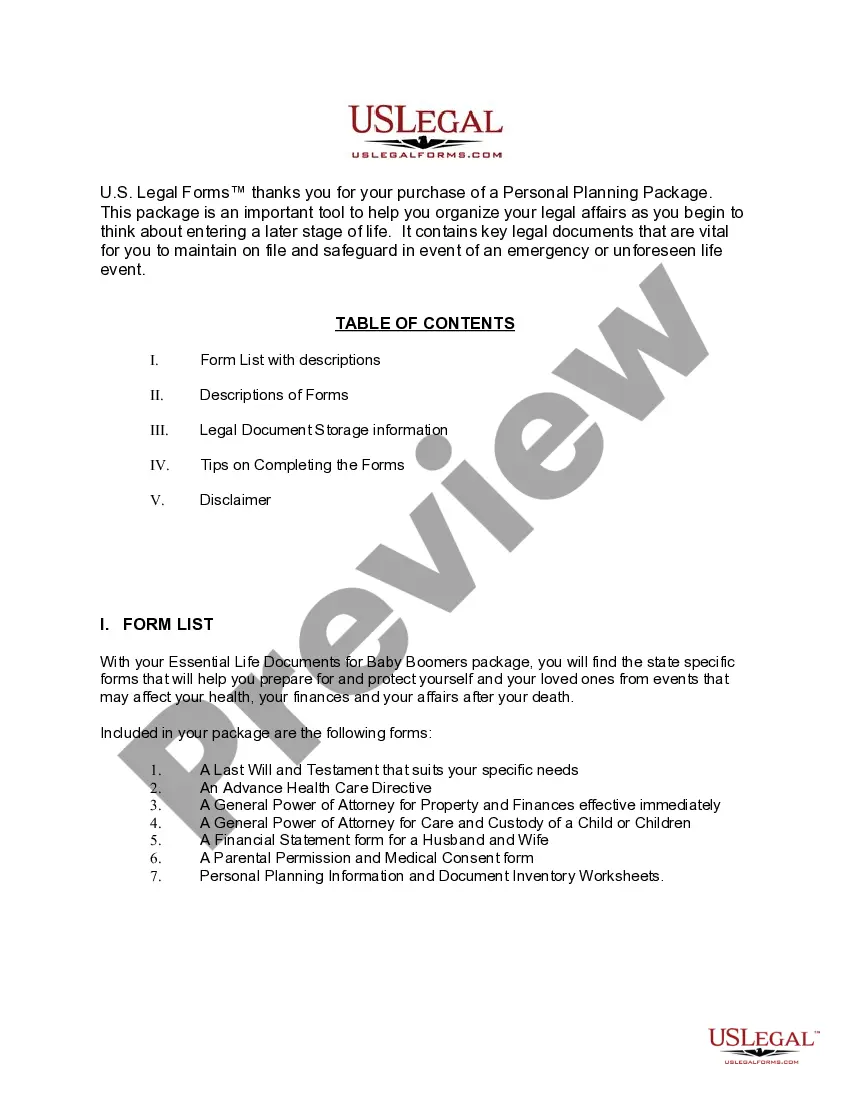
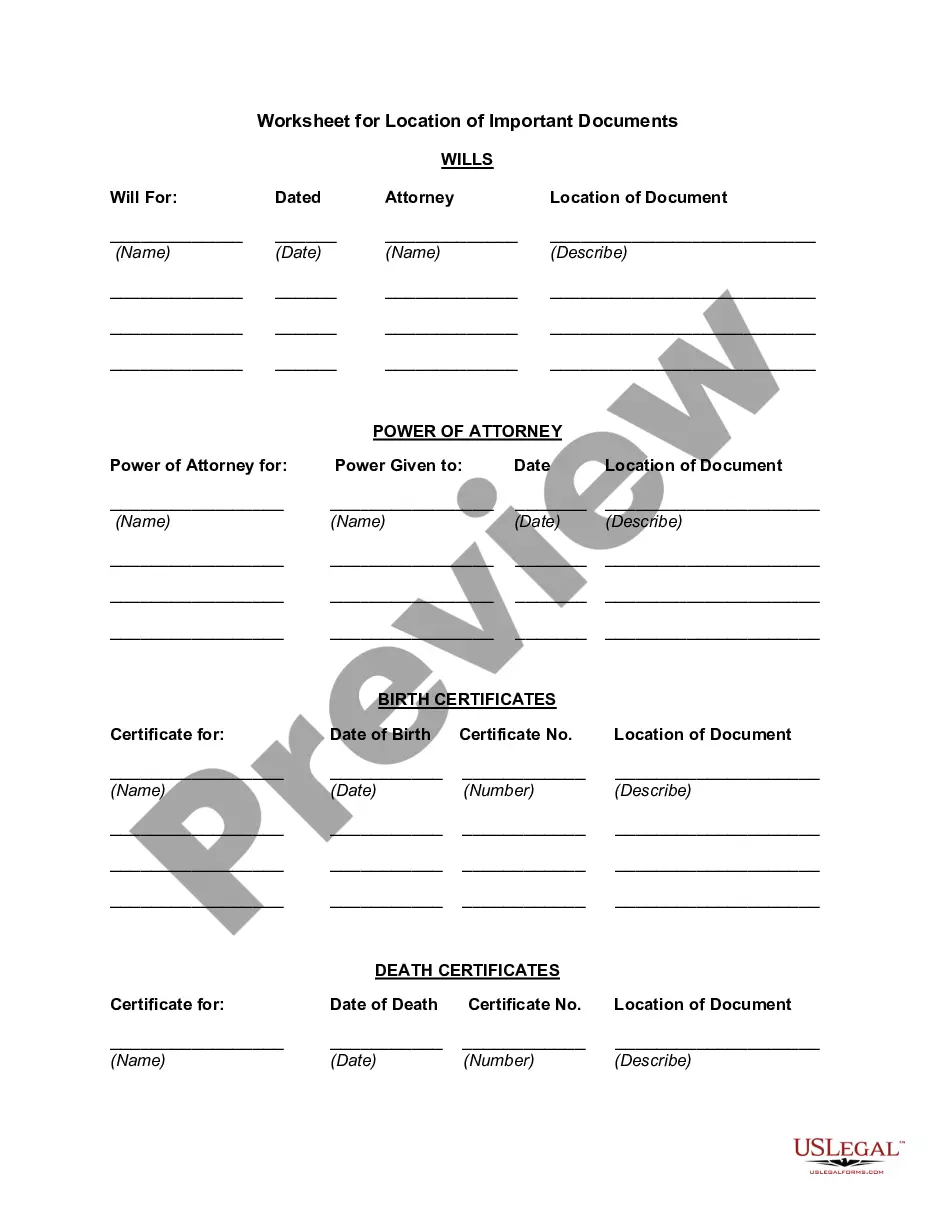
- Personal Planning Information and Document Inventory Worksheets - A Legal Life Document






When this form package is needed
This form package is essential in the following scenarios:
- When expecting or have recently welcomed a child into your family.
- When you want to ensure your child's welfare and care in the event you are unable to act on their behalf.
- When you wish to make medical decisions for your child or appoint someone to do so.
- When you want to organize your estate planning to reflect your new responsibility as a parent.
Who should use this form package
- New parents who have just welcomed a child.
- Expectant parents looking to prepare in advance for the legal implications of parenthood.
- Parents desiring to secure their family's legal rights and responsibilities.
- Individuals who want to establish a clear plan for their child's care in case of emergencies.
How to complete these forms
- Review each included form and ensure you understand its purpose.
- Identify the relevant parties involved, including guardians and health care proxies.
- Enter the required information, making sure to use accurate details.
- Sign the documents where necessary, including any required witnesses or notarization.
- Store the completed forms in a safe location, such as a locked filing cabinet or a safe deposit box.
- Inform trusted family members or your attorney about the location of these documents.
Notarization details for included forms
Certain documents in this package must be notarized for legal effectiveness. Our online notarization service, powered by Notarize, lets you verify and sign documents remotely through an encrypted video session, available anytime.
Get your form ready online
Our built-in tools help you complete, sign, share, and store your documents in one place.
Make edits, fill in missing information, and update formatting in US Legal Forms—just like you would in MS Word.
Download a copy, print it, send it by email, or mail it via USPS—whatever works best for your next step.
Sign and collect signatures with our SignNow integration. Send to multiple recipients, set reminders, and more. Go Premium to unlock E-Sign.
If this form requires notarization, complete it online through a secure video call—no need to meet a notary in person or wait for an appointment.
We protect your documents and personal data by following strict security and privacy standards.

Make edits, fill in missing information, and update formatting in US Legal Forms—just like you would in MS Word.

Download a copy, print it, send it by email, or mail it via USPS—whatever works best for your next step.

Sign and collect signatures with our SignNow integration. Send to multiple recipients, set reminders, and more. Go Premium to unlock E-Sign.

If this form requires notarization, complete it online through a secure video call—no need to meet a notary in person or wait for an appointment.

We protect your documents and personal data by following strict security and privacy standards.
Typical mistakes to avoid
- Failing to sign documents or missing witness signatures where required.
- Not updating the will or powers of attorney when circumstances change.
- Neglecting to store documents in a secure, yet accessible location.
- Overlooking the need for notarization when required by state law.
Benefits of completing this package online
- Convenience of downloading and completing forms at your own pace.
- Editability to tailor the documents to your specific needs.
- Quick access to essential legal documents without the need for in-person appointments.
- Reliability of forms drafted by licensed attorneys, ensuring legal compliance.
Looking for another form?

Form popularity
FAQ
Witnesses: An Oregon will must be signed by at least two individuals who saw the testator sign the will or heard him acknowledge the signature. Writing: An Oregon will must be in writing. Beneficiaries: A testator can leave property to anyone.
Children are not allowed to decide, only the court can modify visitation/parenting plans. Children over 14 are considered to have some maturity ad the court may listen to their testimony but generally speaking the court frowns on parents...
It is a common misconception that there is a magic age when a child can decide which parent they will live with. In both Washington and Oregon, a child can only choose which parent they'd like to live with when they turn 18 or are otherwise emancipated.
One parent gets legal custody of the children. Both parents have joint custody. In families with more than one child, one or more children live with one parent and one or more children live with the other parent.
In general, a child cannot legally decide which parent to live with unless they are emancipated or reach the age of majority. However, let us assume that parties in a divorce are dealing with a custody and parenting time dispute related to a 16-year old child.
In Oregon, you must be at least 18 years old and of sound mind to make a will. If you are married or emancipated, you can make a will before you turn 18. Your will must be in writing and must be signed by you and two witnesses. Some people cannot serve as witnesses to your will.
Although the law specifically permits children at least 14-years-old to express an opinion, there is no specific age when a judge will listen to a child's opinion. California statutes also permit a child younger than 14 years old to testify regarding a custodial preference, unless the court decides it's not in the
There is no need for a will to be drawn up or witnessed by a solicitor. If you wish to make a will yourself, you can do so. However, you should only consider doing this if the will is going to be straightforward.
Create the initial document. Start by titling the document Last Will and Testament" and including your full legal name and address. Designate an executor. Appoint a guardian. Name the beneficiaries. Designate the assets. Ask witnesses to sign your will. Store your will in a safe place.