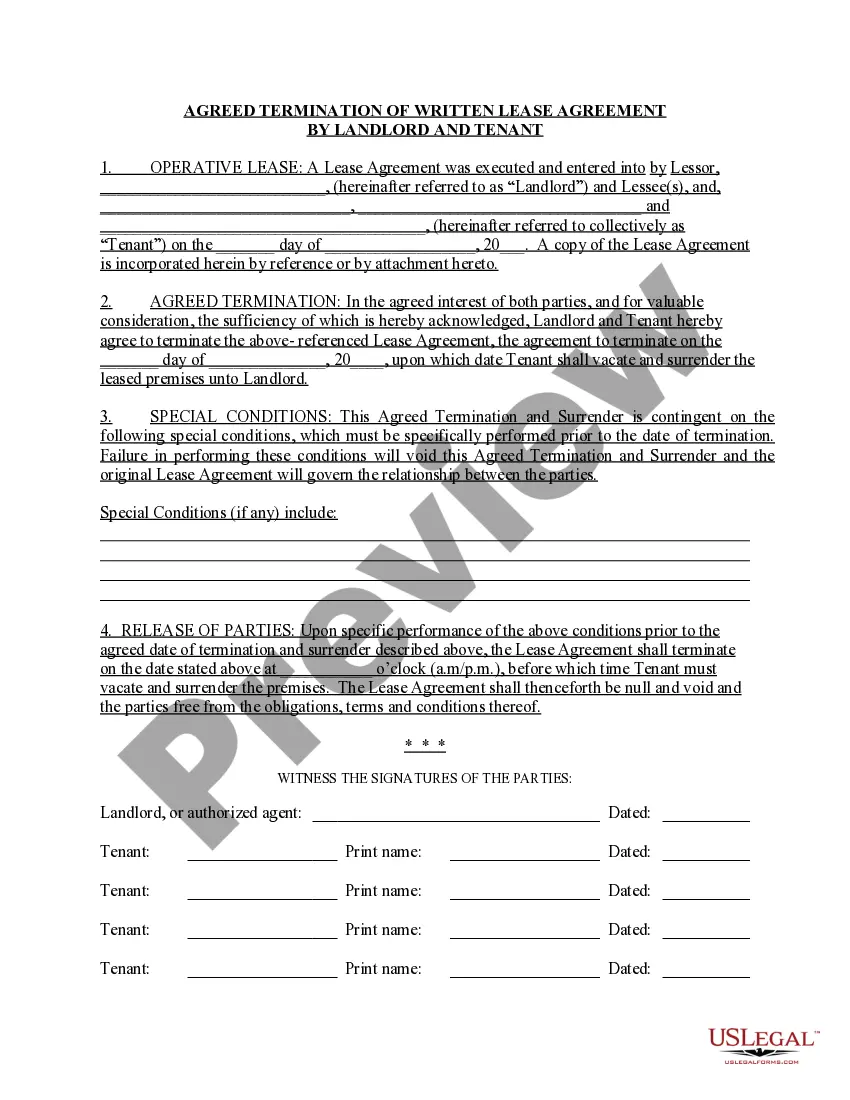
Oregon Agreed Written Termination of Lease by Landlord and Tenant
Understanding this form
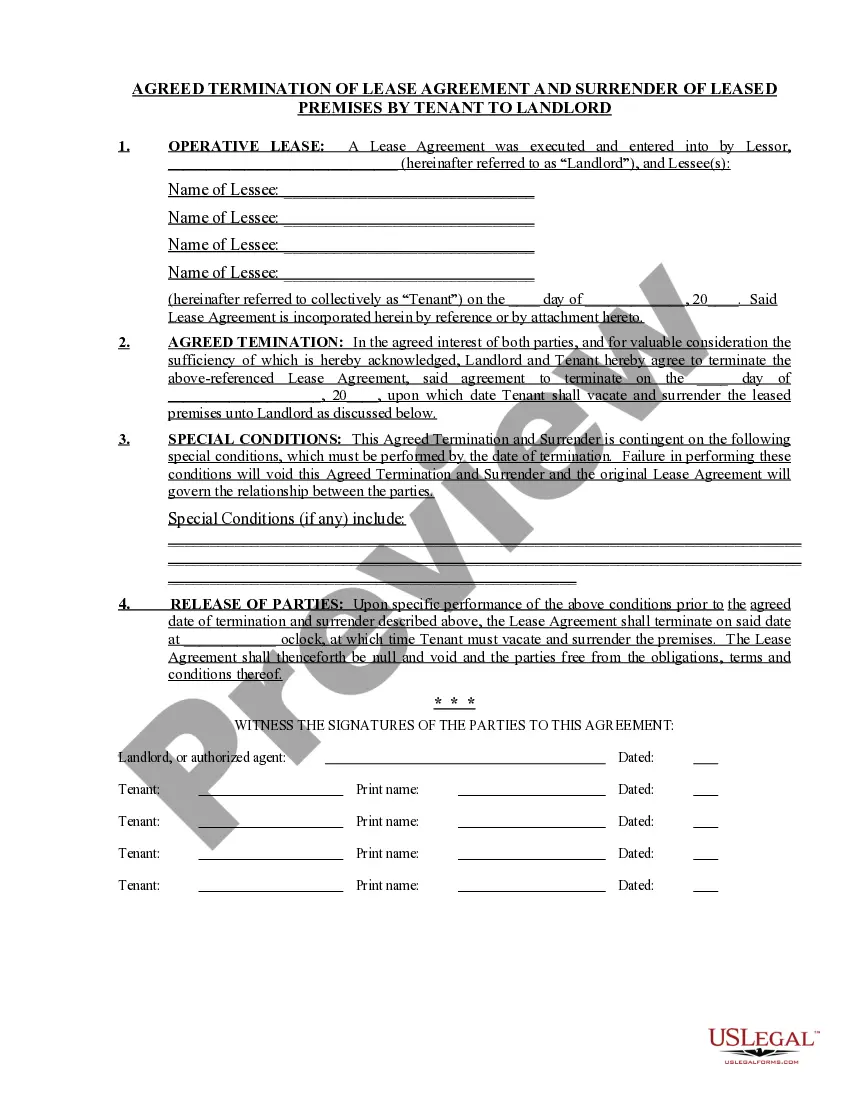
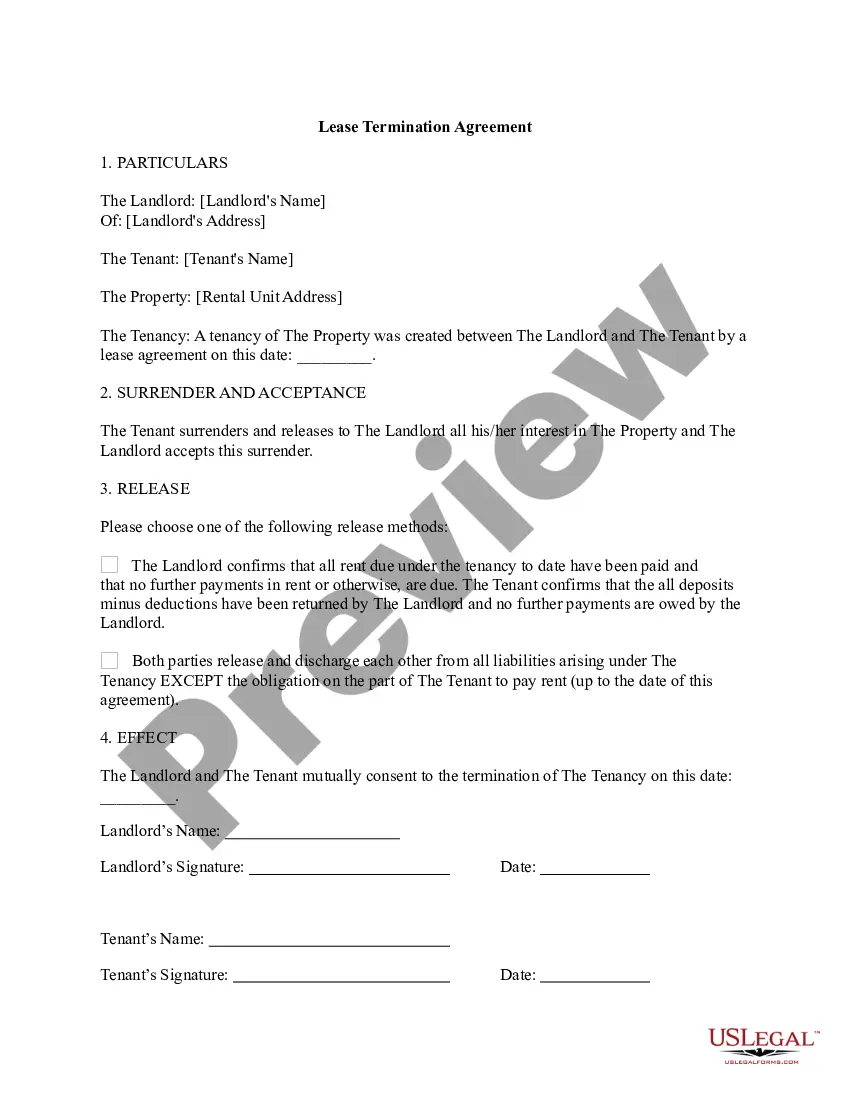
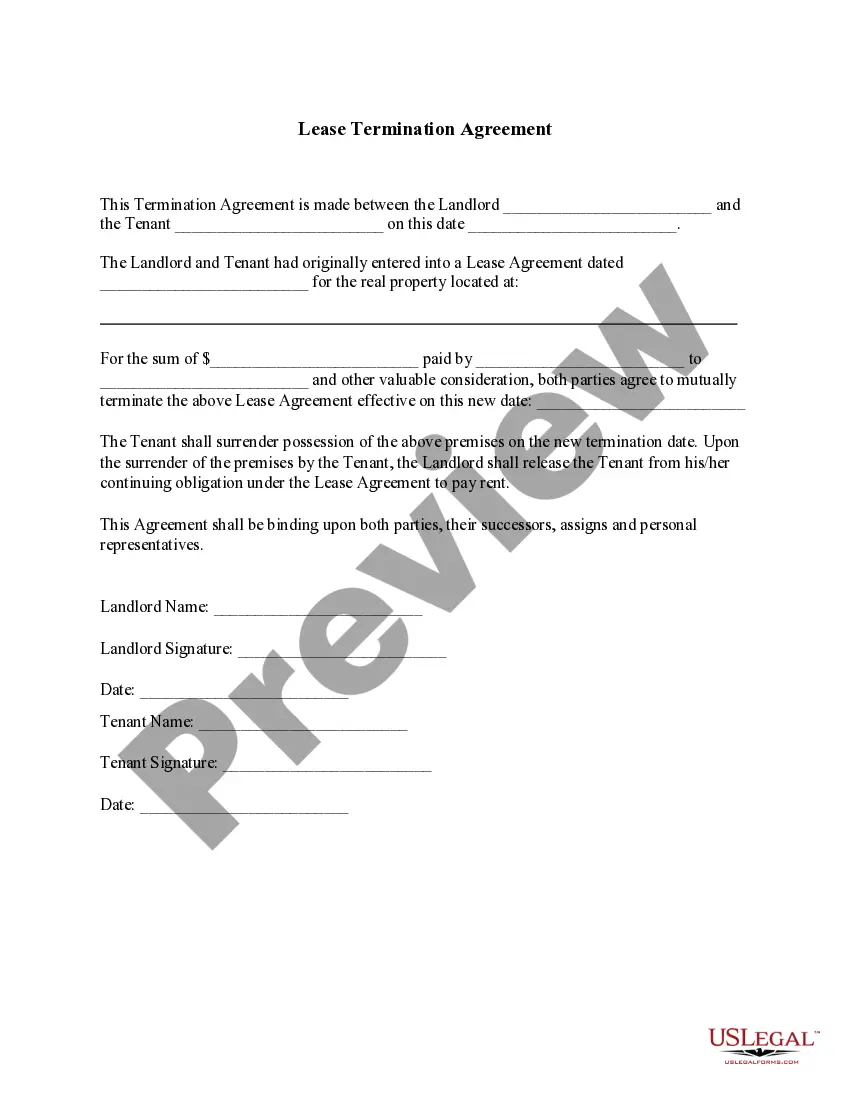
The Agreed Written Termination of Lease by Landlord and Tenant is a legal document used to formally end a rental agreement between a landlord and tenant. This form allows both parties to agree on the termination date and conditions under which the tenant will surrender the property back to the landlord. It differs from other lease termination forms as it requires mutual consent and outlines any special conditions that must be met prior to termination.
Form components explained
- Operative lease reference: details the original lease agreement between landlord and tenant.
- Agreed termination date: specifies the date when the lease will officially end.
- Special conditions: includes any specific requirements that must be completed for the termination to be valid.
- Release of parties: confirms that both landlord and tenant are free from further obligations after the termination.
- Signatures: requires signatures from both the landlord and tenant to validate the agreement.
When to use this form
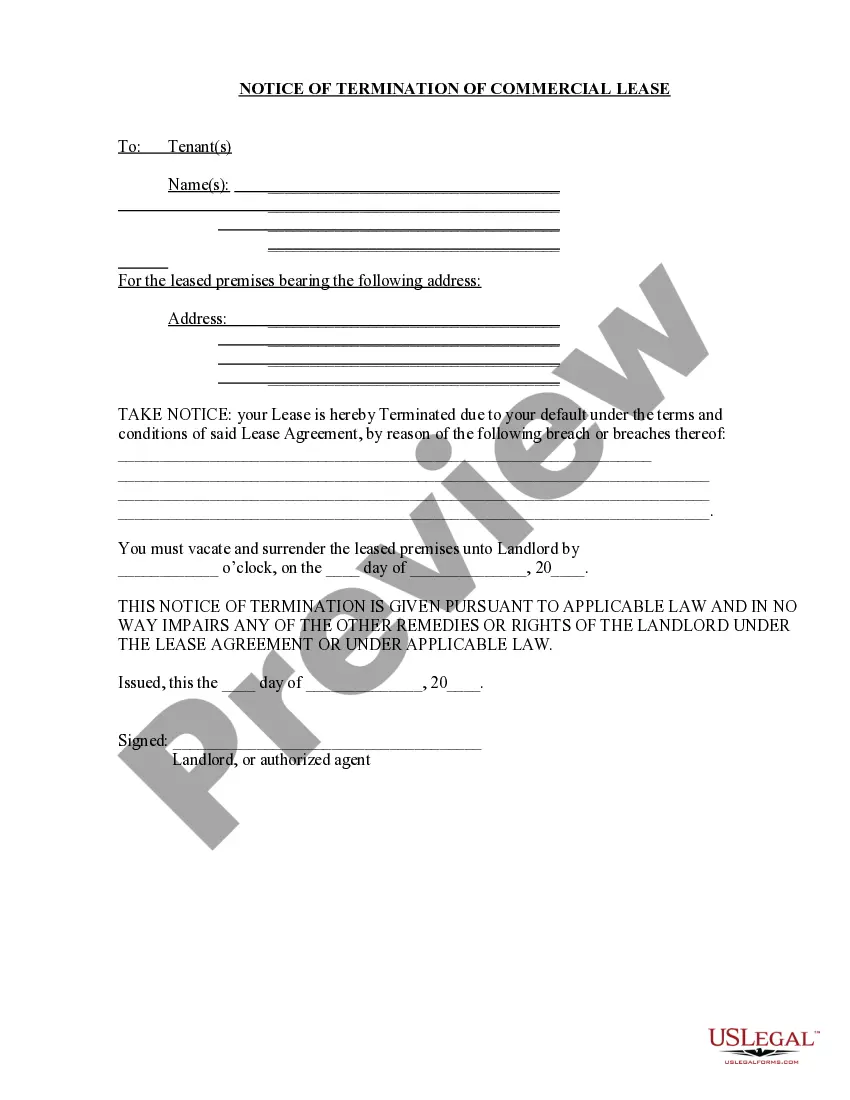
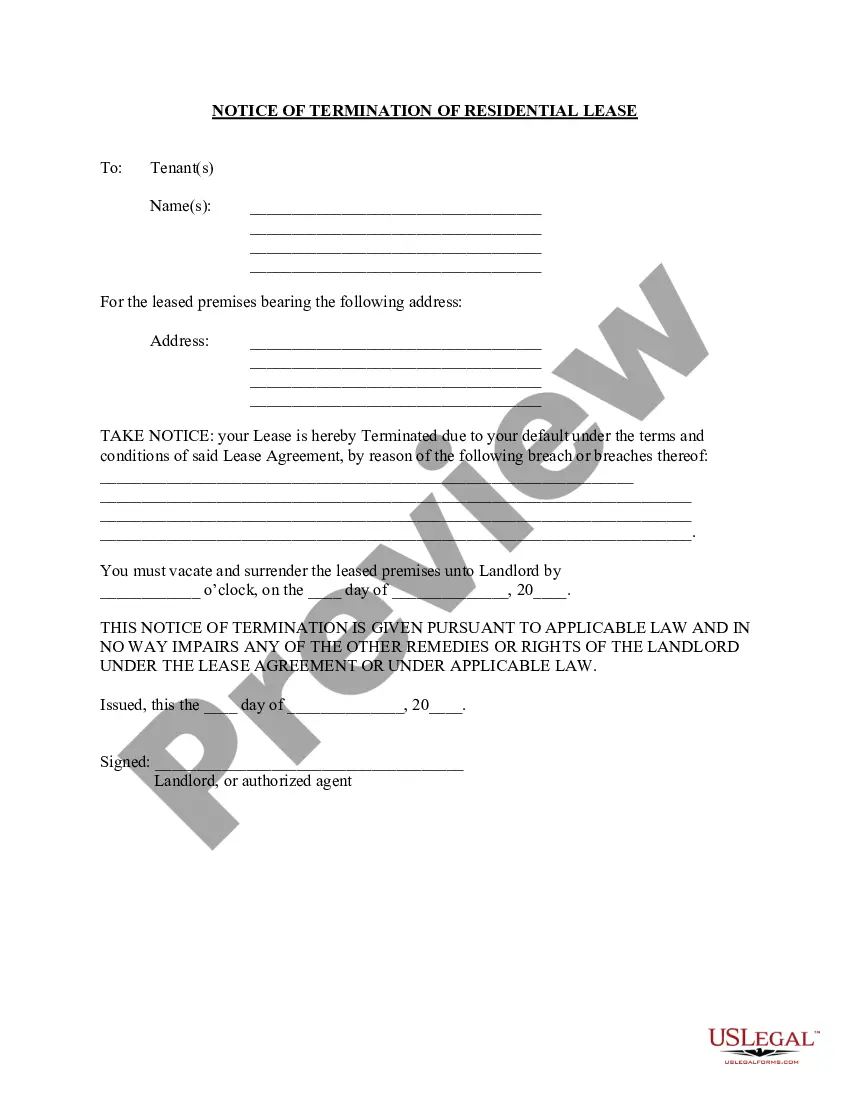
This form should be used when both landlord and tenant mutually agree to terminate a rental agreement before the lease expiration. It is particularly useful when the parties want to clarify the terms of surrendering the property and any conditions that must be met to avoid disputes. Ideal scenarios include early lease cancellations due to relocation, financial difficulties, or changes in personal circumstances.
Who can use this document
This form is suitable for:
- Landlords seeking a legal way to end a lease with a tenant.
- Tenants who wish to formally document their agreement to vacate a rental property.
- Real estate professionals assisting landlords and tenants in lease terminations.
How to prepare this document
- Identify the parties: fill in the names of the landlord and tenants involved.
- Specify the property: include the address and any reference to the original lease agreement.
- Enter the agreed termination date: clearly state the date when the lease will end.
- List any special conditions: outline any requirements that must be fulfilled before termination.
- Obtain signatures: have all parties sign and date the form to make it legally binding.
Does this form need to be notarized?
In most cases, this form does not require notarization. However, some jurisdictions or signing circumstances might. US Legal Forms offers online notarization powered by Notarize, accessible 24/7 for a quick, remote process.
Get your form ready online
Our built-in tools help you complete, sign, share, and store your documents in one place.
Make edits, fill in missing information, and update formatting in US Legal Forms—just like you would in MS Word.
Download a copy, print it, send it by email, or mail it via USPS—whatever works best for your next step.
Sign and collect signatures with our SignNow integration. Send to multiple recipients, set reminders, and more. Go Premium to unlock E-Sign.
If this form requires notarization, complete it online through a secure video call—no need to meet a notary in person or wait for an appointment.
We protect your documents and personal data by following strict security and privacy standards.
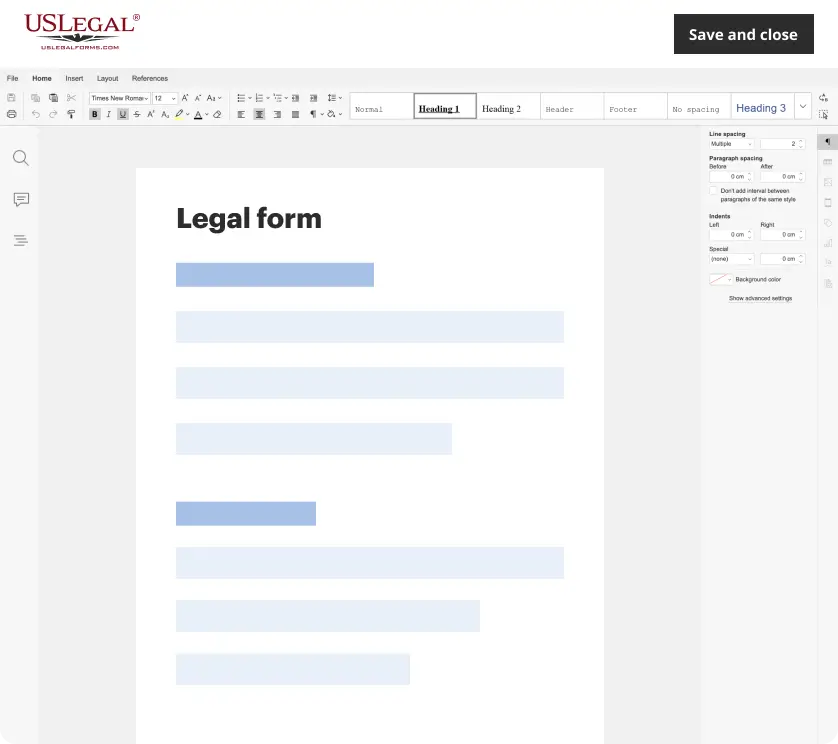
Make edits, fill in missing information, and update formatting in US Legal Forms—just like you would in MS Word.
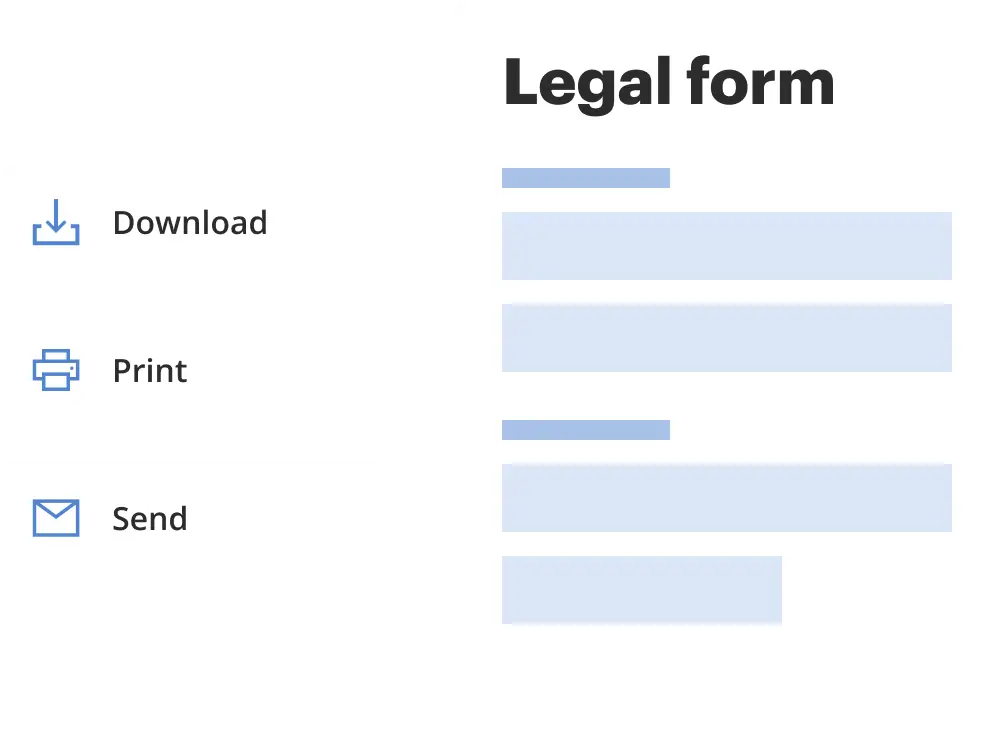
Download a copy, print it, send it by email, or mail it via USPS—whatever works best for your next step.
Sign and collect signatures with our SignNow integration. Send to multiple recipients, set reminders, and more. Go Premium to unlock E-Sign.
If this form requires notarization, complete it online through a secure video call—no need to meet a notary in person or wait for an appointment.
We protect your documents and personal data by following strict security and privacy standards.
Mistakes to watch out for
- Failing to specify the termination date clearly.
- Not including special conditions that may affect the termination.
- Omitting signatures or dates from the form.
- Using the form without understanding state-specific regulations.
Why use this form online
- Convenient access: download and complete the form anytime, from anywhere.
- Editability: easily customize the form to meet specific agreement terms.
- Reliable templates: forms drafted by licensed attorneys ensure legal compliance.
Looking for another form?
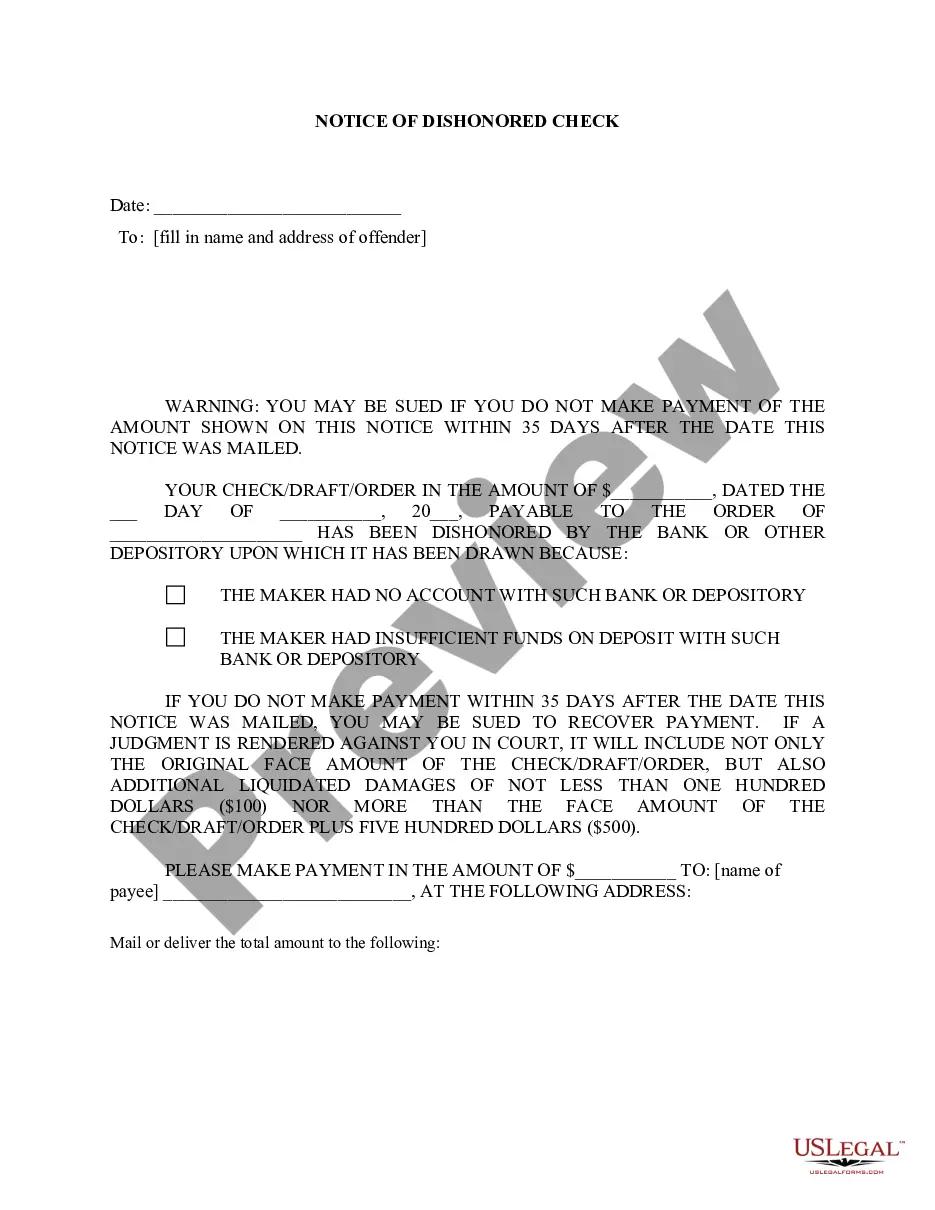
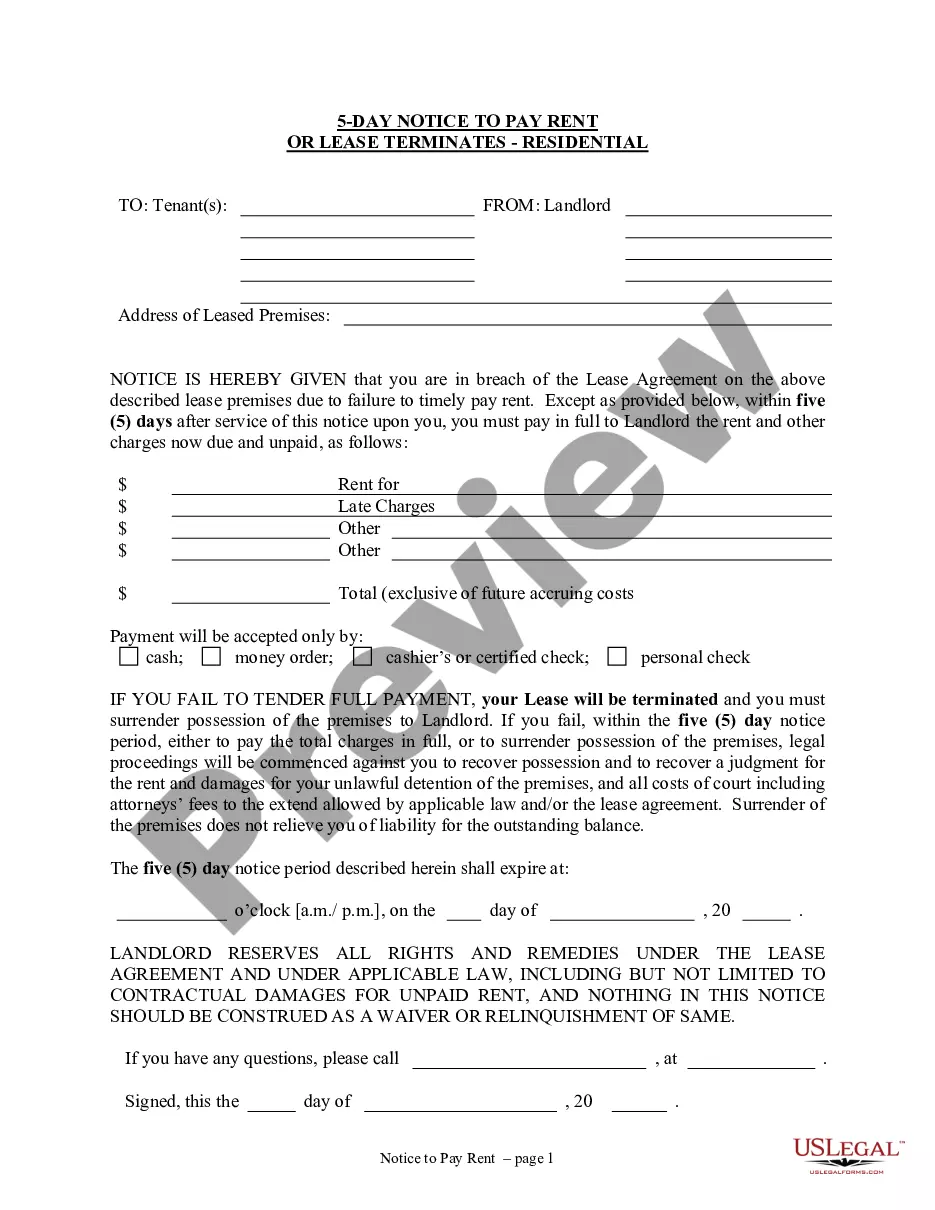
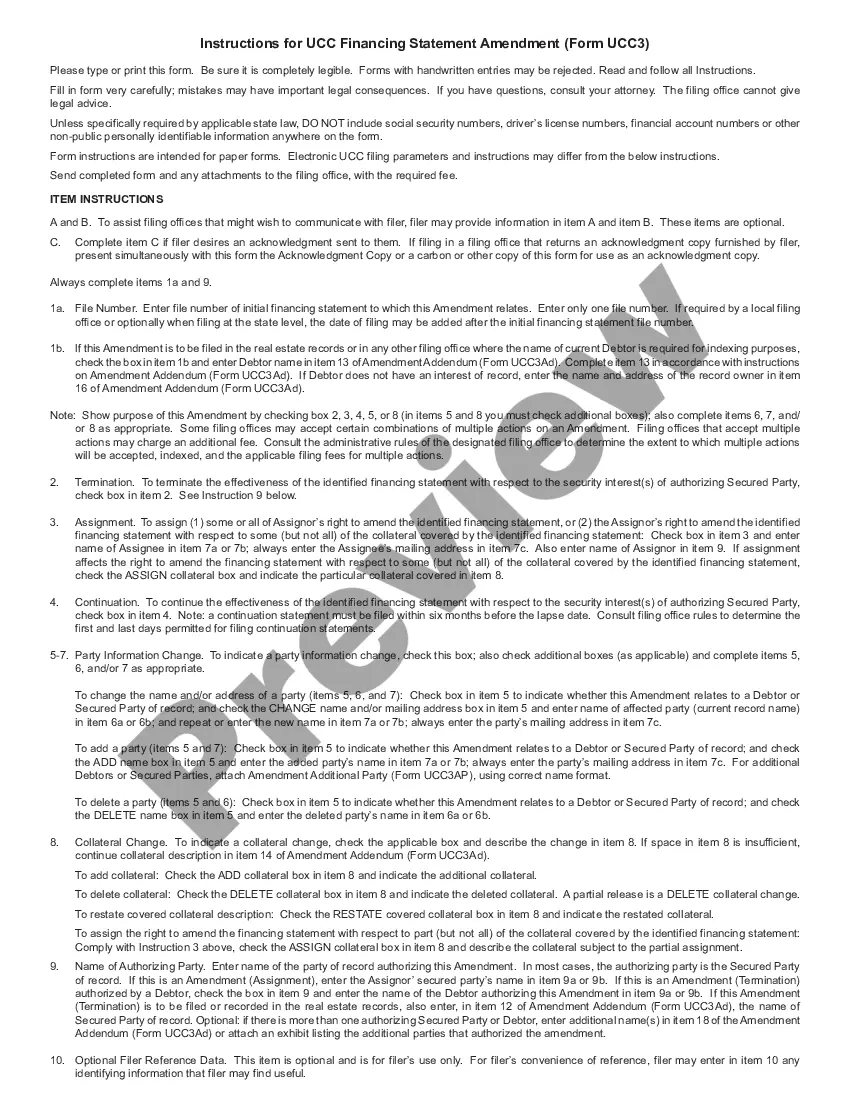
Form popularity
FAQ
To evict a tenant in California, a landlord must put his eviction notice in writing.If a landlord is evicting a tenant for a lease violation or to take control of the property, he must give the tenant 30-60 days notice.
In the state of Oregon, if tenants hold over, or stay in the rental unit after the rental term has expired, then the landlord must give tenants notice before evicting them. This can include tenants without a written lease and week-to-week and month-to-month tenants.
Your name, and the landlord's name and address. The date you're writing the letter. Informing the landlord you're breaking your lease early. The reason why you're breaking your lease. The building and apartment you're vacating. The date by which you're vacating.
For 2020, the maximum rent increase is 9.9%. Between tenants, there is no limit to how much the rent can go up (except if a short-term tenant was just evicted from the unit, a provision that discourages a revolving door of tenants for rent increases.)
A no-cause eviction means that your landlord is not giving any reason for the eviction. The notice must clearly state the date that the tenancy will end.
A landlord can't force you to move out before the lease ends, unless you fail to pay the rent or violate another significant term, such as repeatedly throwing large and noisy parties. In these cases, landlords in Oregon must follow specific procedures to end the tenancy.
The tenant must give the landlord notice of their intention to move out within 90 days of the event causing the need to move. The notice must be given to the landlord at least 14 days before the tenant intends to move out.
The tenant will have fourteen days after receiving the thirty-day notice to fix the violation, and if the tenant fixes it, then the landlord must not proceed with the eviction. If the tenant does not fix the violation, then the landlord can proceed with the eviction after the thirty days has expired (see Ore.
Dear (Name of landlord or manager), This letter constitutes my written (number of days' notice that you need to give based on your lease agreement)-day notice that I will be moving out of my apartment on (date), the end of my current lease. I am leaving because (new job, rent increase, etc.)