Oregon Seller's Disclosure of Forfeiture Rights for Contract for Deed
Overview of this form
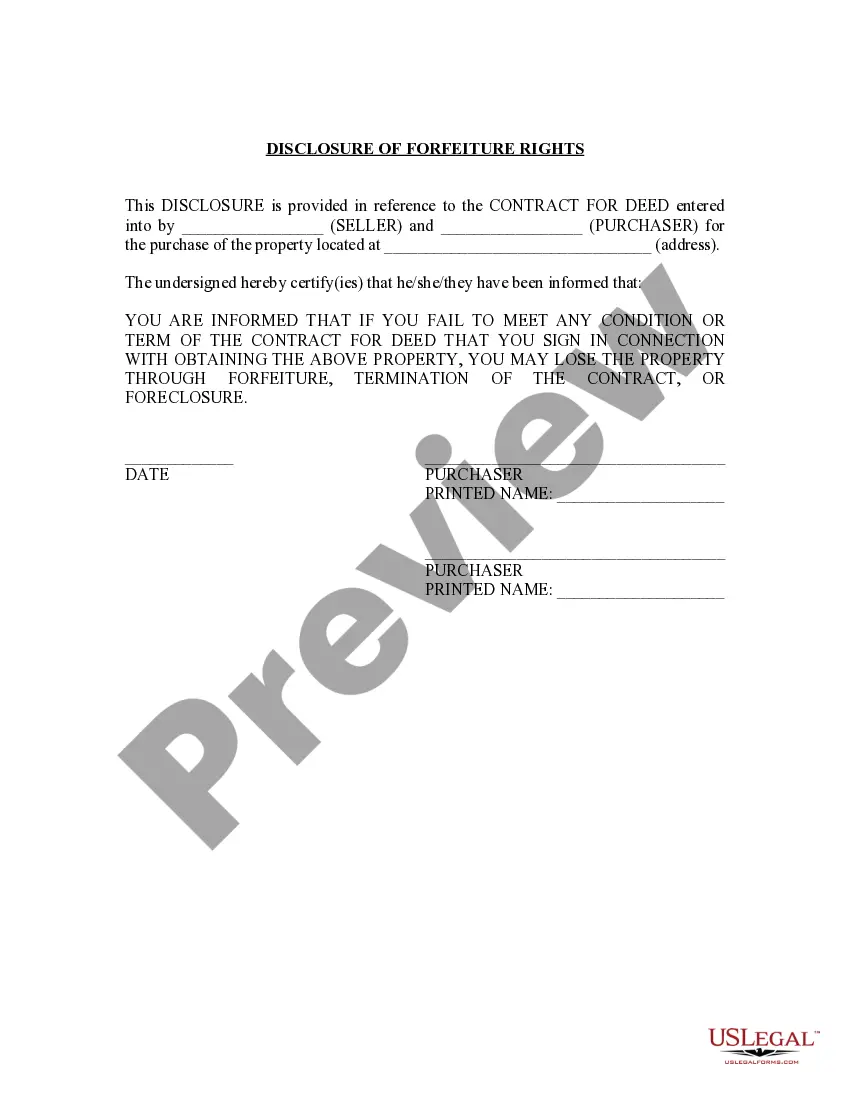
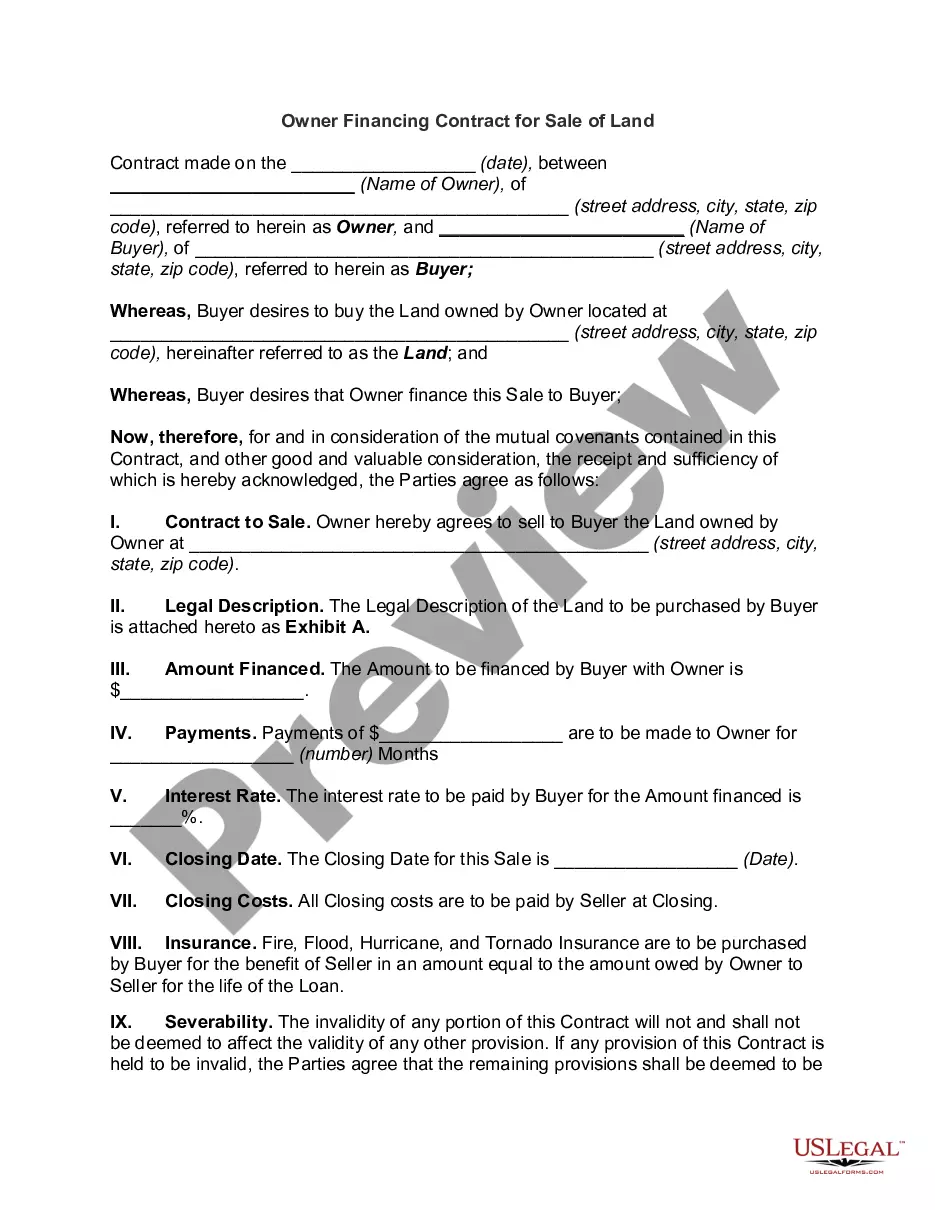
The Seller's Disclosure of Forfeiture Rights for Contract for Deed is a legal document that informs the Purchaser about the potential consequences of defaulting on the terms of a contract for deed. This form is important as it outlines the Purchaser's rights regarding forfeiture, which can lead to the loss of property. Unlike other real estate forms, this specific disclosure emphasizes the Purchaser's understanding of the risks associated with the contract.
Main sections of this form
- Certification of receipt: Confirms that the Purchaser has received the disclosure notice.
- Risk explanation: Details the consequences of failing to meet the contract terms, including forfeiture and foreclosure.
- Signatures: Indicates agreement and acknowledgment by both parties involved in the contract.
When this form is needed
This form should be used when a Seller and Purchaser enter into a contract for deed. It provides crucial information at the time of signing, helping the Purchaser understand what could happen if they default on the agreement. It is particularly valuable when the Seller wants to mitigate potential disputes by ensuring the Purchaser is fully informed.
Who can use this document
- Individuals entering into a contract for deed as Purchasers.
- Property Sellers who wish to clearly communicate forfeiture risks.
- Real estate professionals and attorneys advising clients on contract for deed transactions.
How to complete this form
- Identify the Seller and Purchaser: Clearly state the names of both parties involved in the contract.
- Provide property details: Include the address and other identifying information about the property in question.
- Explain forfeiture risks: Ensure that the Purchaser understands the implications of defaulting on the contract.
- Certify receipt: Both parties should sign to confirm receipt of the disclosure and understanding of the terms.
- Keep a copy: Ensure both the Seller and Purchaser retain a signed copy for their records.
Does this form need to be notarized?
Notarization is generally not required for this form. However, certain states or situations might demand it. You can complete notarization online through US Legal Forms, powered by Notarize, using a verified video call available anytime.
Get your form ready online
Our built-in tools help you complete, sign, share, and store your documents in one place.
Make edits, fill in missing information, and update formatting in US Legal Forms—just like you would in MS Word.
Download a copy, print it, send it by email, or mail it via USPS—whatever works best for your next step.
Sign and collect signatures with our SignNow integration. Send to multiple recipients, set reminders, and more. Go Premium to unlock E-Sign.
If this form requires notarization, complete it online through a secure video call—no need to meet a notary in person or wait for an appointment.
We protect your documents and personal data by following strict security and privacy standards.

Make edits, fill in missing information, and update formatting in US Legal Forms—just like you would in MS Word.

Download a copy, print it, send it by email, or mail it via USPS—whatever works best for your next step.

Sign and collect signatures with our SignNow integration. Send to multiple recipients, set reminders, and more. Go Premium to unlock E-Sign.

If this form requires notarization, complete it online through a secure video call—no need to meet a notary in person or wait for an appointment.

We protect your documents and personal data by following strict security and privacy standards.
Mistakes to watch out for
- Neglecting to provide the disclosure at the time of contract signing.
- Failing to clearly explain the potential consequences of defaulting.
- Not obtaining signatures from both parties, leading to disputes over acknowledgment.
Benefits of using this form online
- Convenient access: Downloadable forms can be filled out at your own pace.
- Editability: Easily customize the form to meet your specific needs.
- Reliable documentation: Ensures that all necessary information is included and properly formatted.
Looking for another form?
Form popularity
FAQ
In general, you have an obligation to disclose potential problems and material defects that could affect the value of the property you're trying to sell. In addition, it is considered illegal in most states to deliberately conceal major defects on your property.
One question all sellers are required by law to answer on the Real Estate Transfer Disclosure Statement is whether there are any neighborhood noise problems or other nuisances. If the answer is yes, the seller must explain that answer in detail.
Currently, the non-disclosure states are Alaska, Idaho, Kansas, Louisiana, Mississippi, Montana, New Mexico, North Dakota, Texas, Utah, and Wyoming. In Missouri, some of their counties (parishes to us Louisianians) are non-disclosure as well.
Whenever you sell real estate, you are obligated to follow local mandatory disclosure laws. This involves informing the buyer about specific hazards or problems affecting the property before the sale is completed.
In general, as long as any dispute does not affect anything material about the house or property on which it stands, and you're not being asked to disclose information in writing, you shouldn't feel obliged to give a 'warts and all' account of all the problems you've had with a neighbour.
Under California law, all material facts that affect the value or desirability of the property must be disclosed to the buyer. There is no specific definition or rule on what is considered to be a material fact.
"No Seller Disclosures" means that the seller is selling the property without disclosing any defects or facts that might be necessary for a buyer to make an informed decision. A purchaser should get written permission to bring the purchaser's...
California's Especially Stringent Disclosure Requirements Sellers must fill out and give the buyers a disclosure form listing a broad range of defects, such as a leaky roof, deaths that occurred within three years on the property, neighborhood nuisances such as a dog that barks every night, and more.
If a seller fails to disclose, or actively conceals, problems that affect the value of the property; they are violating the law, and may be subject to a lawsuit for recovery of damages based on claims of fraud and deceit, misrepresentation and/or breach of contract.