Nevada Quitclaim Deed - Individual to Two Individuals as Joint Tenants with the Right of Survivorship
Overview of this form
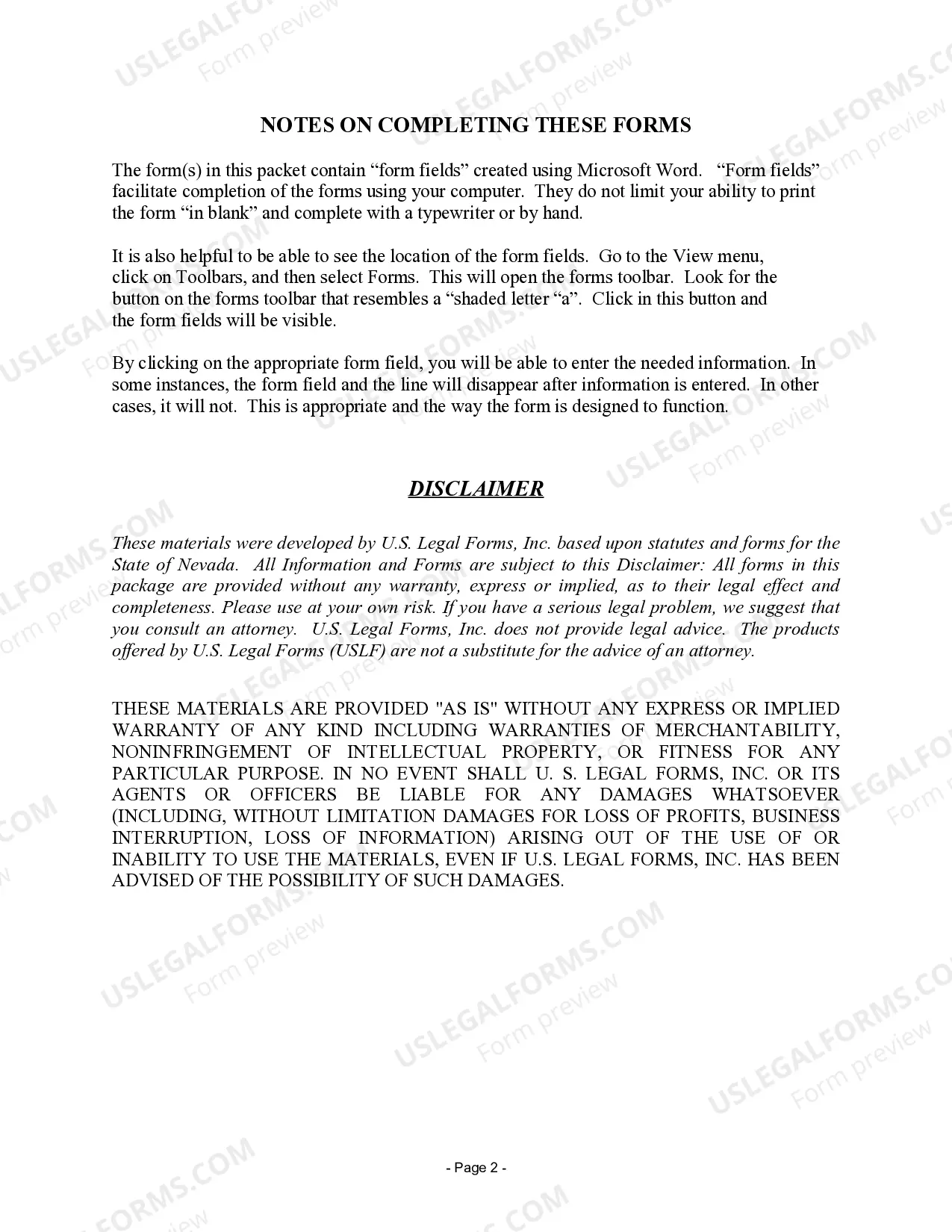
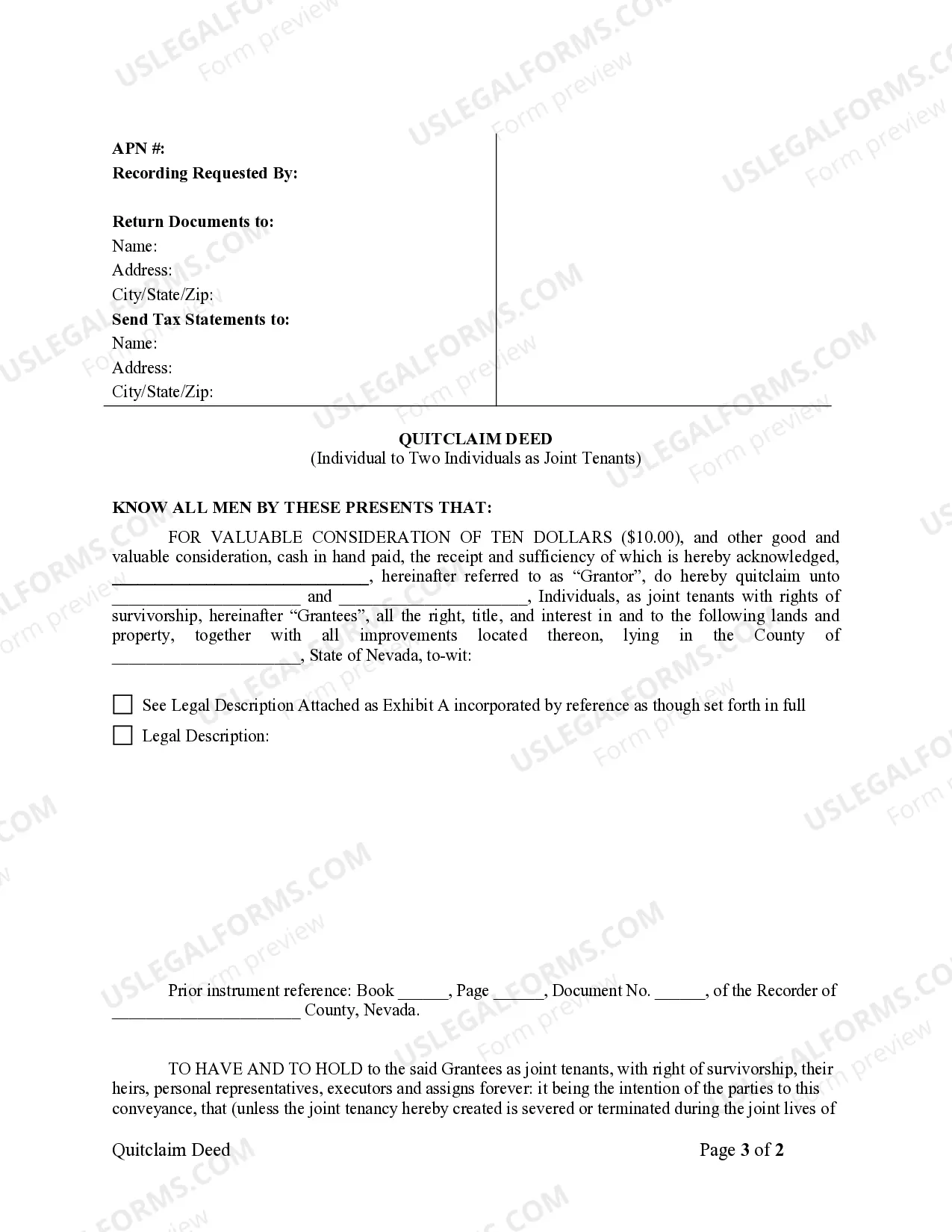
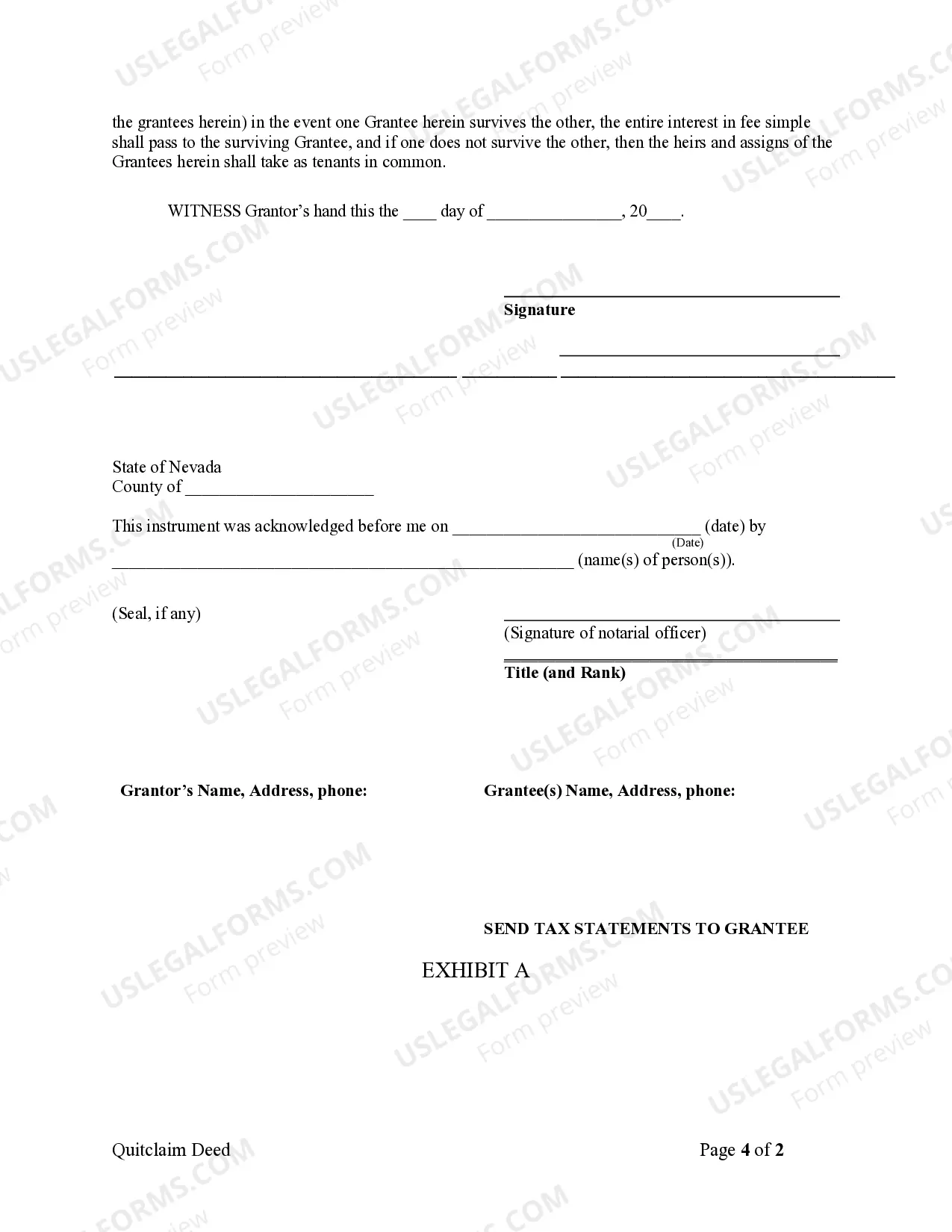
This Quitclaim Deed is a legal document used for transferring property ownership from an individual (known as the Grantor) to two individuals (the Grantees) as joint tenants with the right of survivorship. This means that upon the death of one Grantee, the surviving Grantee automatically inherits the deceased's share of the property. This form is specifically tailored for individuals looking to ensure mutual property ownership while simplifying the transfer process without the need for a warranty of title.
Key parts of this document
- Names of the Grantor and Grantees
- Description of the property being transferred
- Statement of consideration (usually a nominal amount)
- Joint tenancy clause with the right of survivorship
- Execution section for signatures and dates





Common use cases
This form is commonly used when an individual wants to transfer ownership of real property to two people who will hold the property as joint tenants. This is often relevant in scenarios such as couples buying a property together or family members wanting to co-own a home while ensuring that the property passes automatically to the surviving tenant if one of them passes away.
Who this form is for
This form is intended for:
- Individuals transferring property to two other individuals.
- Couples or partners wanting joint ownership of property.
- Family members seeking to simplify property inheritance issues.
Steps to complete this form
- Identify the parties involved: enter the name of the Grantor and both Grantees.
- Specify the property: include a detailed legal description of the property being transferred.
- Enter the consideration: indicate the nominal amount or nature of tangible value exchanged.
- Complete the joint tenancy clause: confirm that the Grantees will hold the property as joint tenants with the right of survivorship.
- Sign and date the form: ensure all parties sign the document in accordance with state requirements.
Is notarization required?
This form does not typically require notarization unless specified by local law. It is advisable to check local regulations to ensure compliance.
Get your form ready online
Our built-in tools help you complete, sign, share, and store your documents in one place.
Make edits, fill in missing information, and update formatting in US Legal Forms—just like you would in MS Word.
Download a copy, print it, send it by email, or mail it via USPS—whatever works best for your next step.
Sign and collect signatures with our SignNow integration. Send to multiple recipients, set reminders, and more. Go Premium to unlock E-Sign.
If this form requires notarization, complete it online through a secure video call—no need to meet a notary in person or wait for an appointment.
We protect your documents and personal data by following strict security and privacy standards.

Make edits, fill in missing information, and update formatting in US Legal Forms—just like you would in MS Word.

Download a copy, print it, send it by email, or mail it via USPS—whatever works best for your next step.

Sign and collect signatures with our SignNow integration. Send to multiple recipients, set reminders, and more. Go Premium to unlock E-Sign.

If this form requires notarization, complete it online through a secure video call—no need to meet a notary in person or wait for an appointment.

We protect your documents and personal data by following strict security and privacy standards.
Typical mistakes to avoid
- Failing to accurately describe the property can lead to disputes.
- Not including the joint tenancy clause may result in unintended inheritance issues.
- Neglecting to sign the document can invalidate the transfer.
Why use this form online
- Convenience of downloading and completing the form at your own pace.
- Editability makes it easy to correct errors before finalizing the deed.
- Guaranteed compliance with state-specific laws, minimizing legal risks.
Summary of main points
- A Quitclaim Deed transfers property without warranties about the title.
- The form is particularly useful for joint ownership with survivorship rights.
- Always accurately complete and sign the document to ensure its validity.
Looking for another form?


Form popularity
FAQ
In order to transfer ownership of the marital home pursuant to a divorce, one spouse is going to need to sign a quitclaim deed, interspousal transfer deed, or a grant deed, in order to convey the title to the property.
You can apply to court to change your ex-partner's tenancy to your name, or remove their name from a joint tenancy. You can apply for a 'transfer of tenancy' if: your landlord refuses to change your tenancy. your tenancy doesn't allow a transfer.
Jointly owned propertyProperty owned as joint tenants does not form part of a deceased person's estate on death. But the value of the deceased person's share of jointly owned property is included when calculating the value of the estate for Inheritance Tax purposes.
Serve a written notice of the change (a 'notice of severance') on the other owners - a conveyancer can help you do this. Download and fill in form SEV to register a restriction without the other owners' agreement. Prepare any supporting documents you need to include.
If you look at the registered title to your own jointly owned property and the text isn't shown on it, you own it as joint tenants. If it is there, you own it as tenants-in-common.This title is dealt with by Land Registry, Sample Town Office.
Transfer By One Co-Owner- Where one of two or more co-owners of immovable property legally competent in that behalf transfers his share of such property or any interest therein, the transferee acquires, as to such share or interest, so far as is necessary to give effect to the transfer, the transferors right to joint
Step 1: Get a Notice200b200b200b of death f200b200borm. Step 2: Fill in Notice of de200bath form. Step 3: Create an electronic notice of Sale (eNOS) record. Step 4: Get a certified copy200b of the Death Certificate. Step 5: Get the origina200bl Certificate of Title or arrange for it to be produced by the bank.
In order to terminate a joint tenancy, one of the four unities must be destroyed. You may do this by conveying your joint tenancy interest to any third person. This can be done through gift or sale. Upon termination, a tenancy in common is formed between the third person and the remaining co-tenant(s).
To hold a real estate property in joint tenancy, you and the co-owners have to write the abbreviation for joint tenants with the right of survivorship, or JTWROS, on the official real estate deed or title. This creates a legally binding joint tenancy.