New Mexico Bill of Sale for Conveyance of Horse - Horse Equine Forms
About this form
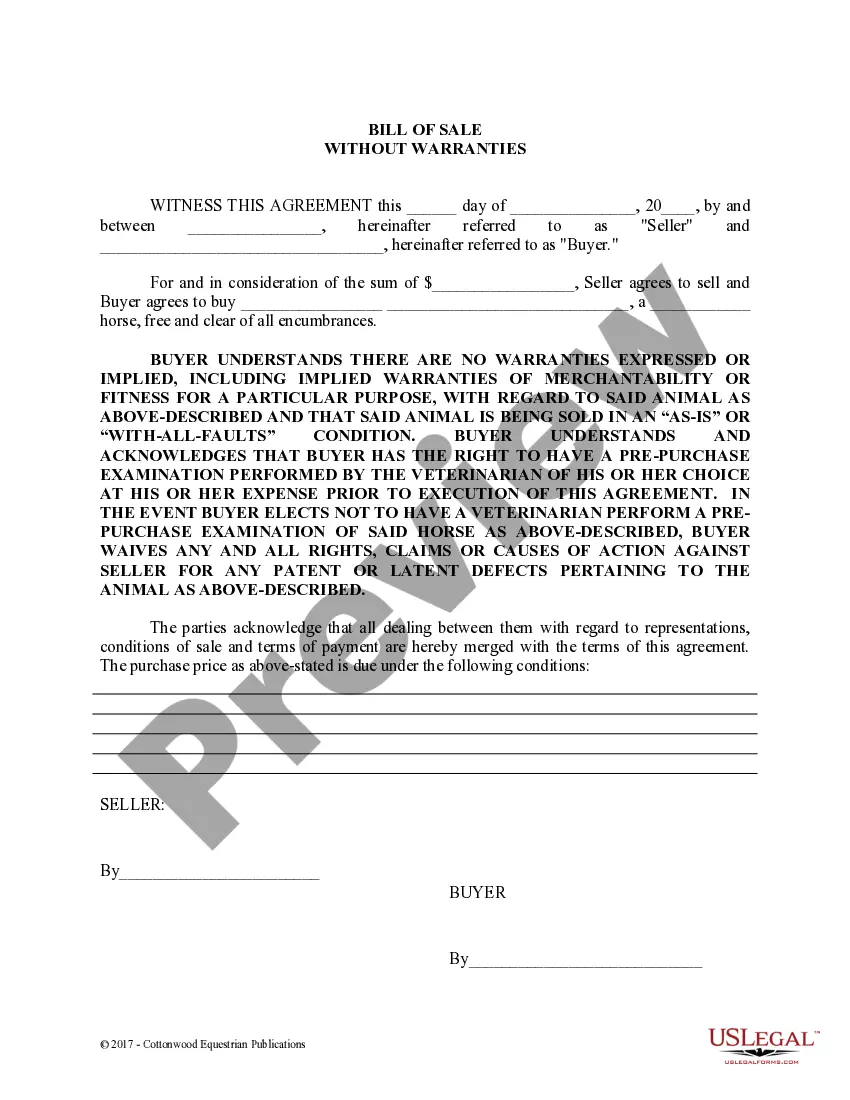
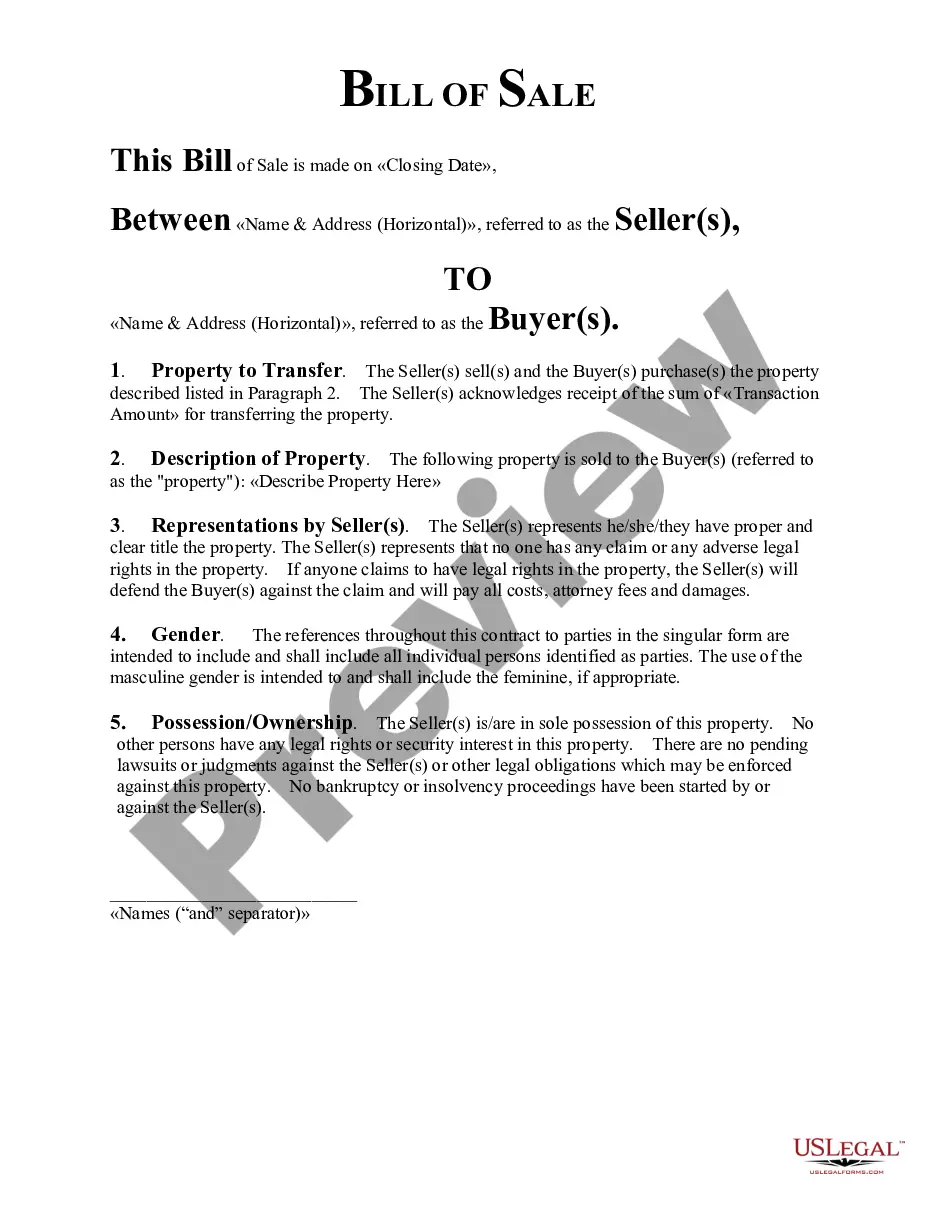
The Bill of Sale for Conveyance of Horse is a legal document used to transfer ownership of a horse from a seller to a buyer. This form is specifically designed for sales where the horse is sold "as is," meaning the seller provides no warranties about the horse's condition or suitability for any particular purpose. Unlike standard bills of sale that may include warranties or guarantees, this form emphasizes the lack of such assurances, making it an essential document for buyers seeking to understand the transactional risks involved.
Key parts of this document
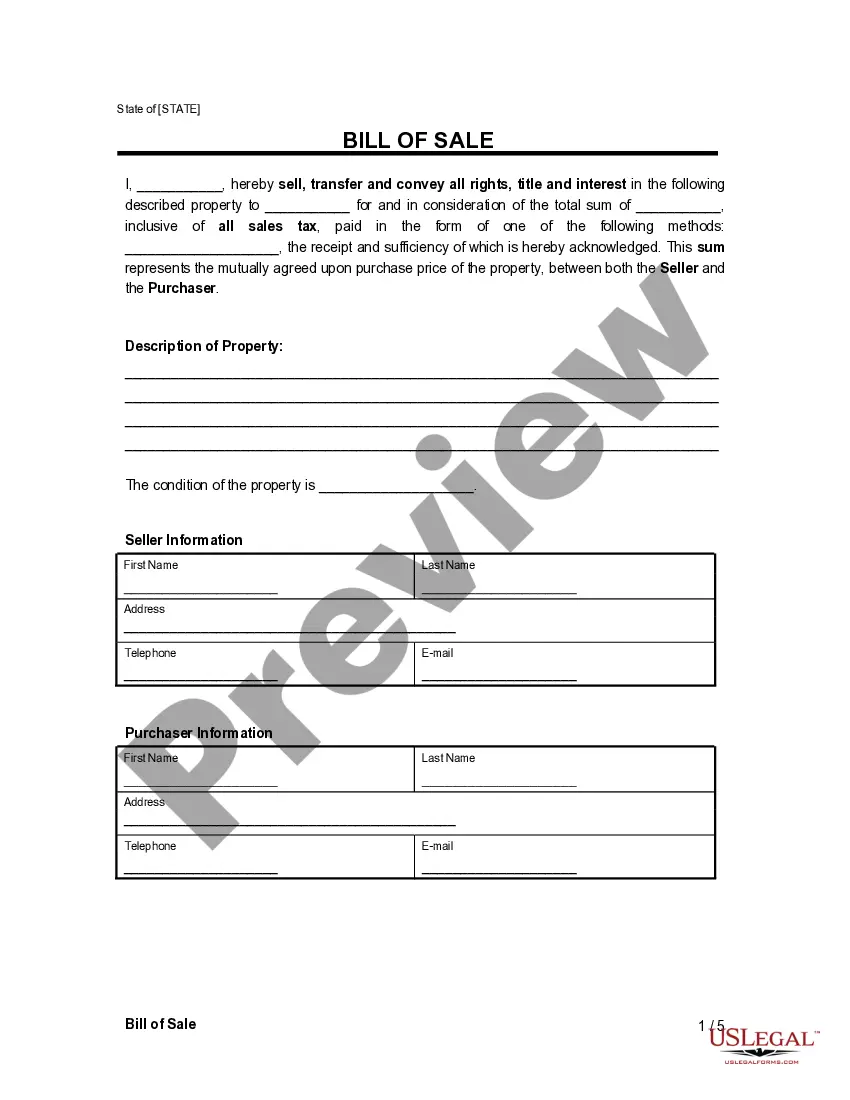
- Identification of the seller and buyer, including their names and contact information.
- Description of the horse, including its name, breed, and any relevant identifying details.
- Purchase price agreed upon by both parties for the horse.
- Disclaimer clause indicating that the horse is sold without warranties, in an "as is" condition.
- Statement of the buyer's opportunity to have a pre-purchase veterinary examination.
- Signatures of both the seller and buyer to authorize the sale.
When this form is needed
This form is necessary when transferring ownership of a horse where the seller does not wish to make any warranties regarding the horse's health or performance. It is commonly used in situations where the buyer is aware of the potential risks of purchasing an equine animal without prior inspection or guarantees. This may include private sales, auctions, or transactions between individuals who are familiar with the horse's background.
Intended users of this form
- Individuals selling a horse who want to clarify that the sale is without warranties.
- Buyers who are willing to assume the risk associated with purchasing a horse in its current condition.
- Equestrian professionals and trainers who may engage in sales transactions involving horses.
- Horse enthusiasts seeking a straightforward means to formalize a purchase agreement.
How to complete this form
- Identify the parties involved by entering the full names and contact information of the seller and buyer.
- Provide a detailed description of the horse, including its name, breed, and any unique identifiers.
- Specify the agreed purchase price for the horse in the appropriate space.
- Read and acknowledge the "without warranties" clause, ensuring both parties understand the sale condition.
- Both seller and buyer should sign and date the document to validate the agreement.
Is notarization required?
This form does not typically require notarization unless specified by local law. It is recommended that both parties keep copies of the signed document for their records.
Get your form ready online
Our built-in tools help you complete, sign, share, and store your documents in one place.
Make edits, fill in missing information, and update formatting in US Legal Forms—just like you would in MS Word.
Download a copy, print it, send it by email, or mail it via USPS—whatever works best for your next step.
Sign and collect signatures with our SignNow integration. Send to multiple recipients, set reminders, and more. Go Premium to unlock E-Sign.
If this form requires notarization, complete it online through a secure video call—no need to meet a notary in person or wait for an appointment.
We protect your documents and personal data by following strict security and privacy standards.

Make edits, fill in missing information, and update formatting in US Legal Forms—just like you would in MS Word.

Download a copy, print it, send it by email, or mail it via USPS—whatever works best for your next step.

Sign and collect signatures with our SignNow integration. Send to multiple recipients, set reminders, and more. Go Premium to unlock E-Sign.

If this form requires notarization, complete it online through a secure video call—no need to meet a notary in person or wait for an appointment.

We protect your documents and personal data by following strict security and privacy standards.
Common mistakes
- Failing to provide a complete and accurate description of the horse.
- Ignoring the option for a pre-purchase veterinary examination.
- Not obtaining signatures from both the seller and buyer, which may lead to disputes later.
- Neglecting to specify the purchase price, leading to misunderstandings.
Why use this form online
- Convenient access to legal documents that can be downloaded and saved for later use.
- Editable form fields allow users to customize the contract details easily.
- Drafted by licensed attorneys to ensure legal reliability and adherence to current laws.
Legal use & context
- Ensures clarity of the transactional terms between the seller and buyer regarding the horse's sale.
- Protects the seller from future claims related to the horse's condition post-sale.
- Requires buyers to acknowledge the inherent risks of purchasing an animal without warranties.
Quick recap
- This form facilitates the sale of a horse without warranties, making it essential for "as is" transactions.
- It clarifies the responsibilities and understanding of both parties involved in the sale.
- Users should carefully consider state-specific laws that may impact the form's effectiveness.
Looking for another form?
Form popularity
FAQ
Date of the Sale. Seller's Name & Address. Buyer's Name & Address. Description of Livestock. Number. Color. Kind. Brand. Weight. Health. Vaccinations. Condition. Any other relevant information.
Step 1 Date and Parties. Enter the date in which the document is being created. Step 2 Horse Description. Horse's Name (if named) Step 3 Purchase Price Information. Step 4 Security Deposit. Step 5 Signatures. Step 6 Acknowledgement of Notary Public.
Name and address of the seller. Name and address of the buyer. Date& time of the purchase. The agreed price for the furniture. The location where the purchase is taking place. Form of payment (is it cash, check, credit card or debit card)
However, certain documents can go towards evidencing ownership in the eyes of the courts. These include a purchase receipt, your historic bills from vets or farriers and old insurance documents. Advertisement. In an ideal world, when you buy a horse, both parties should sign a contract.
In case no paperwork is available on your horse. You can use the registration application of AQHA. What you need to do when registering for your horse is to collect the signature of the owner of your horse at the time she was bred.
The date of the sale. A description of the car, including its: Year, make and model. The selling price of the car. If the car is a gift or partial gift, you should still create a bill of sale. Warranty information. The full names, addresses and signatures of the buyer and seller.
A bill of sale is the most basic of documents.A bill of sale may also be necessary to prove title to the horse in order to obtain a passport for competition. An agreement of purchase and sale with a form of warranty is found in Appendix (C).