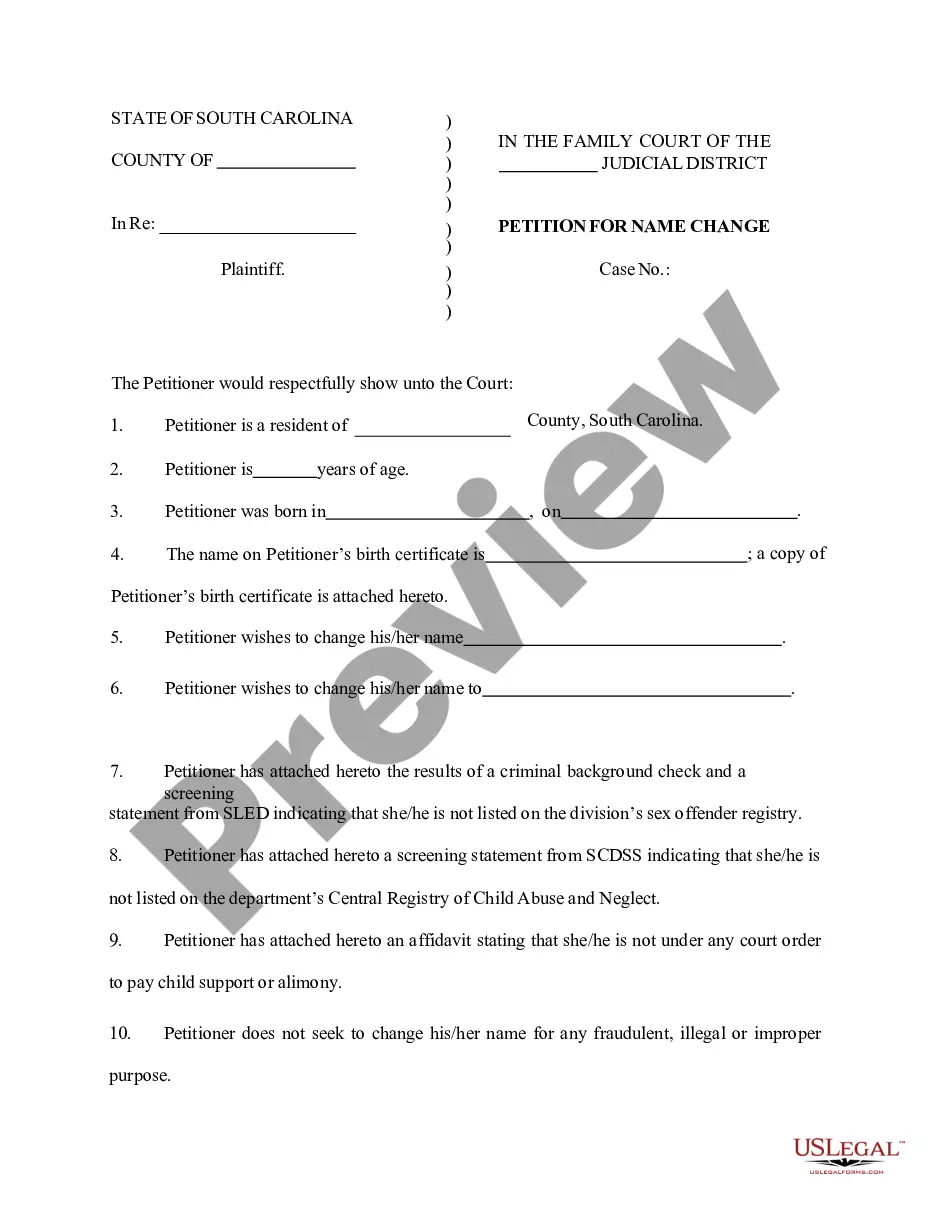
New Mexico Renunciation And Disclaimer of Property from Will by Testate
Overview of this form
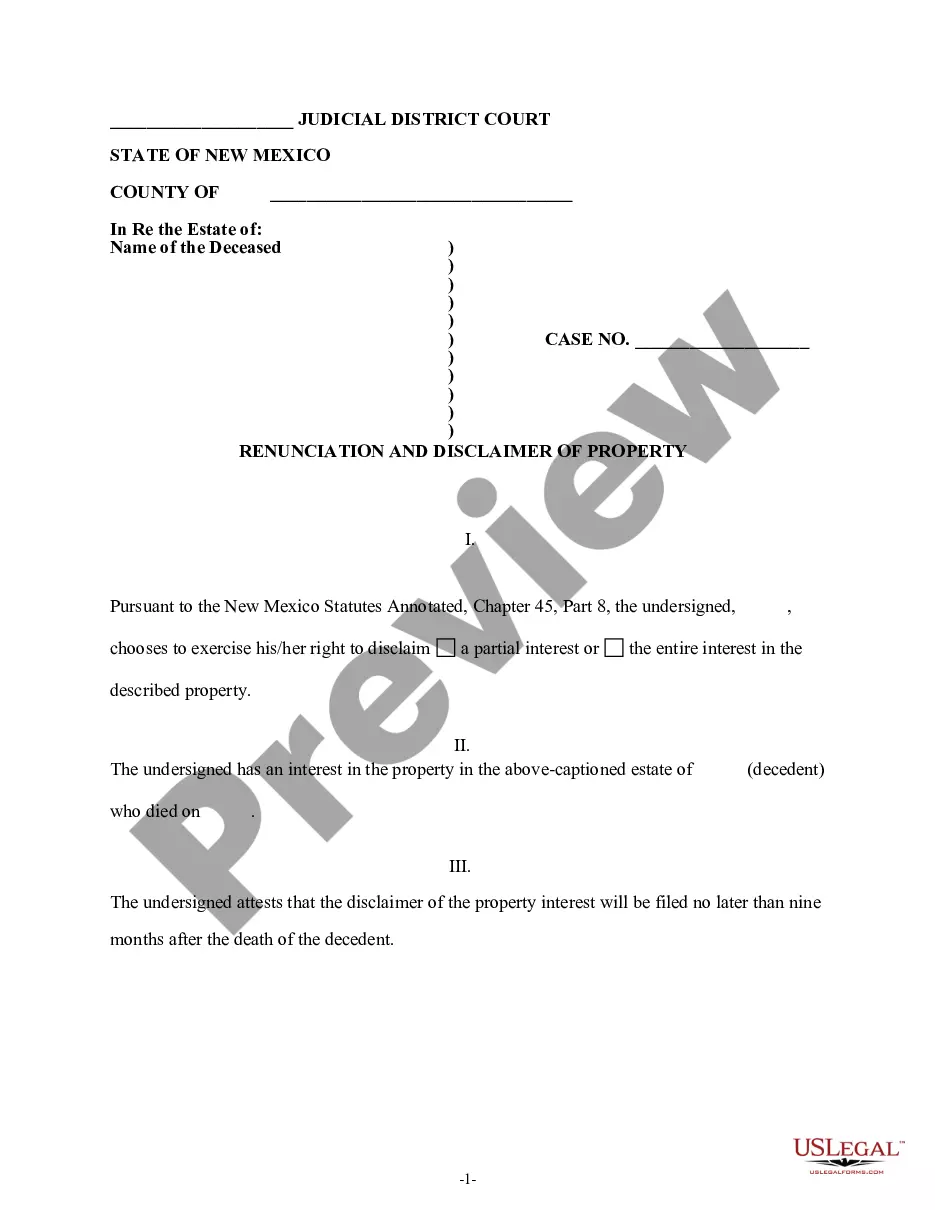
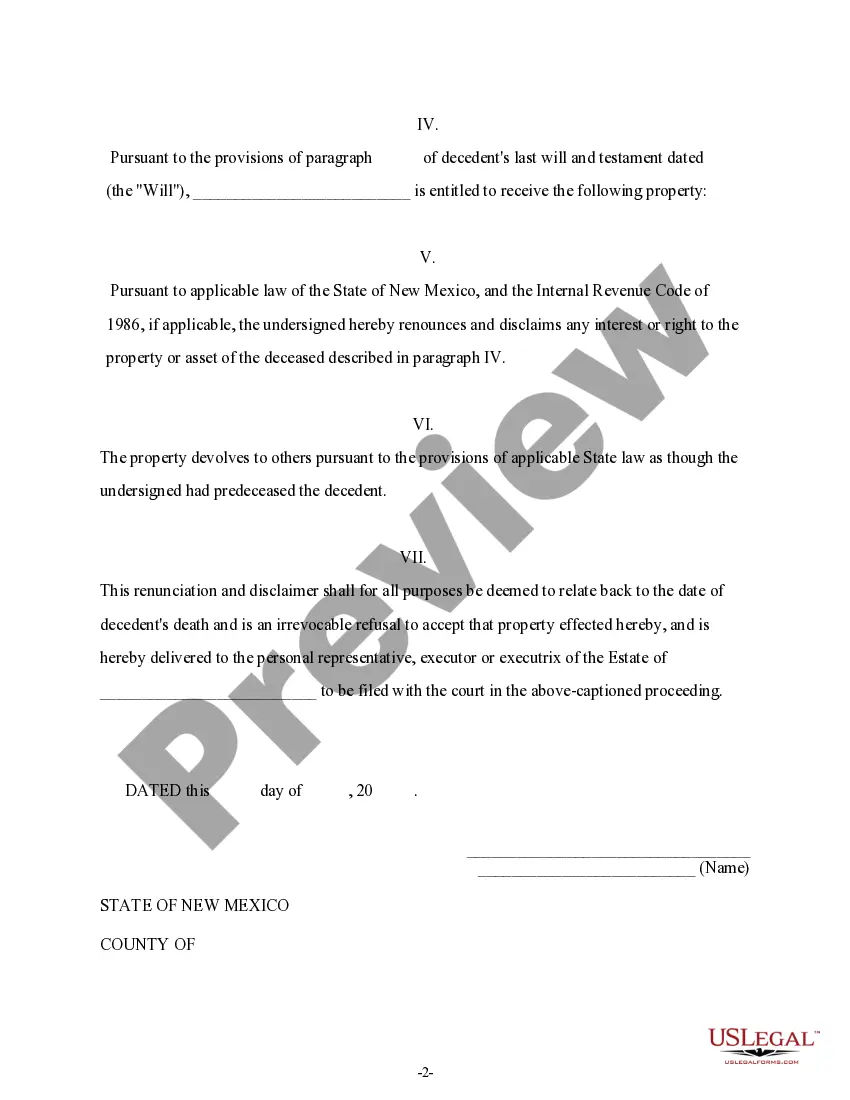
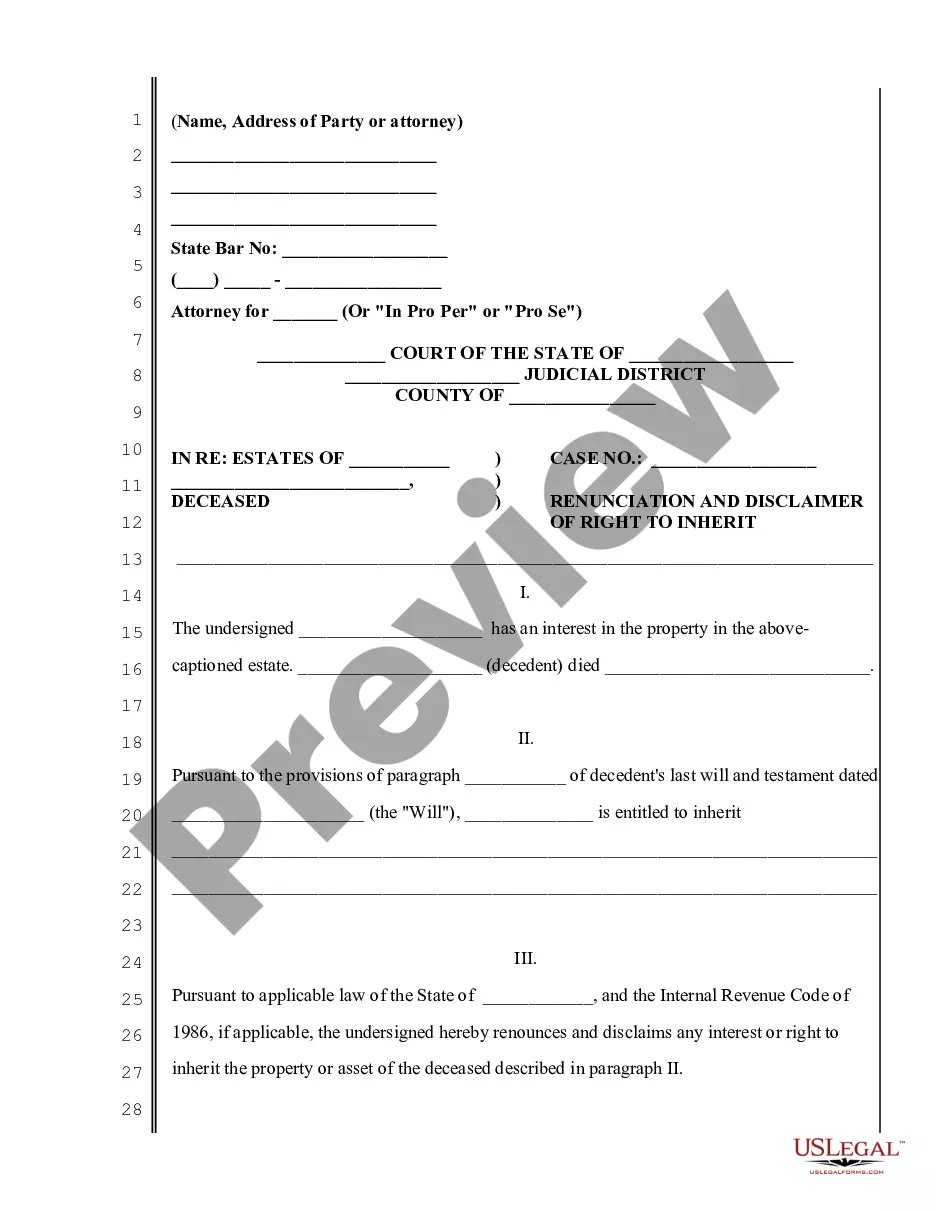
The Renunciation and Disclaimer of Property from Will by Testate is a legal document allowing a beneficiary to formally refuse their interest in property they would receive under a decedent's will. This form is crucial for beneficiaries in New Mexico who have decided to renounce ownership, enabling the property to pass directly to other heirs as if the renouncing beneficiary predeceased the decedent. Unlike a last will and testament, which delineates how one's property is distributed after death, this form specifically addresses the rejection of an inheritance.
Key components of this form
- Identification of the decedent and the beneficiary.
- A statement of renunciation for the specified property.
- Legal backing under New Mexico Statutes Annotated, Chapter 45, Part 8.
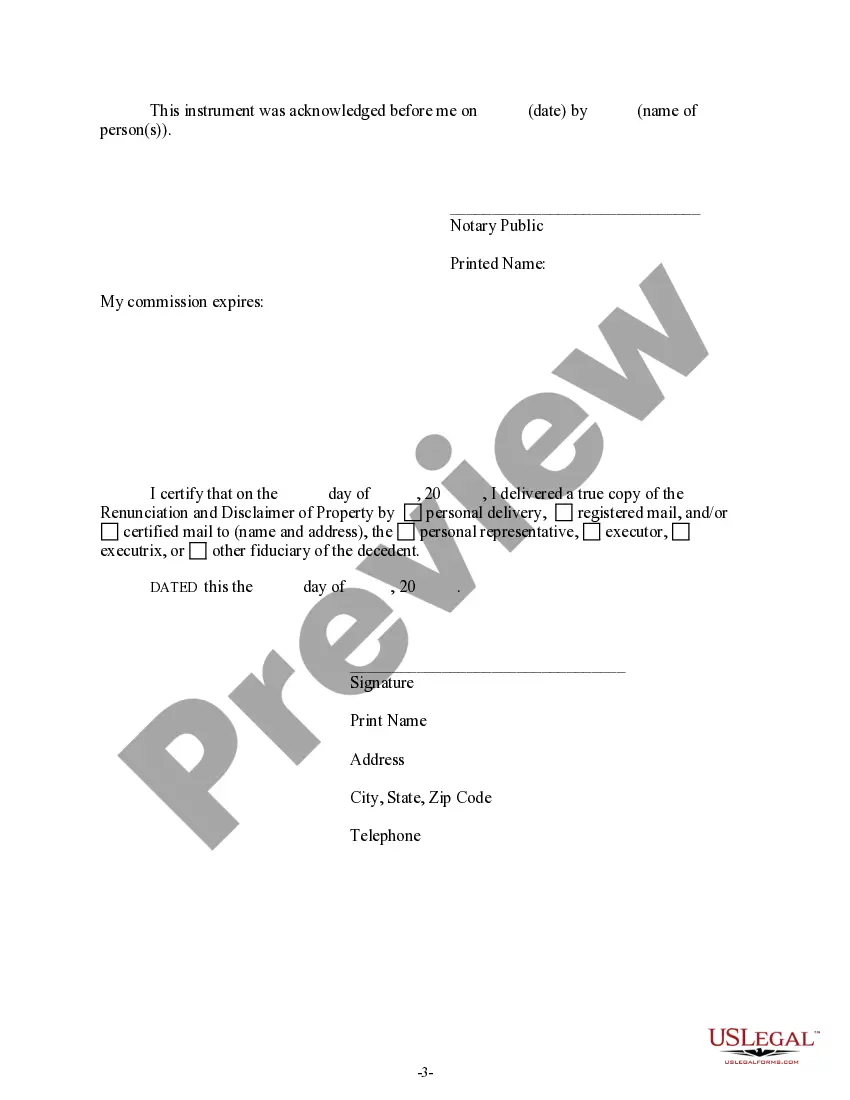
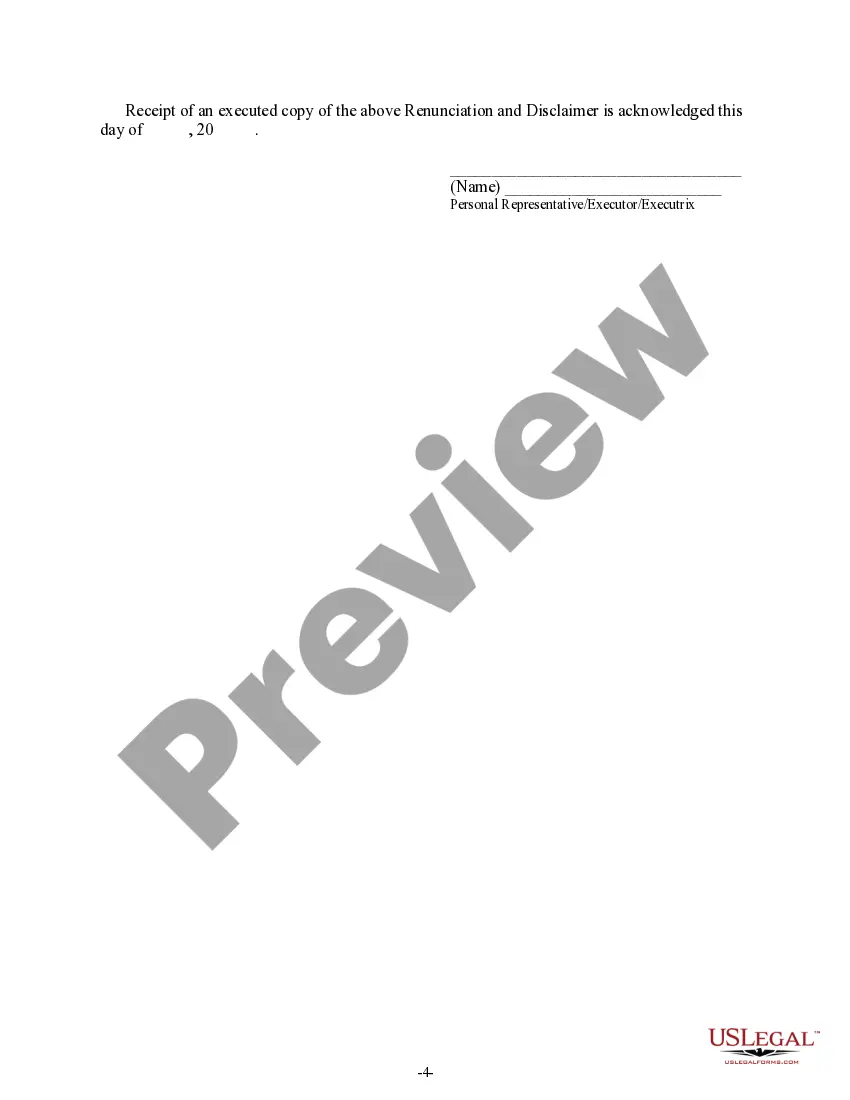
- Certification to verify document delivery.
- State-specific acknowledgment of the renunciation.

When this form is needed
This form is used when a beneficiary chooses to reject an inheritance from a will, allowing the property to pass to other beneficiaries according to state law. This situation often arises when the beneficiary does not want the property due to reasons such as potential tax implications, upkeep costs, or personal preference. By renouncing their interest, they simplify the distribution of the estate and help ensure that the property goes directly to intended heirs.
Who should use this form
This form is intended for:
- Beneficiaries named in a will who wish to disclaim their inheritance.
- Individuals seeking to clarify their legal standing regarding property from an estate.
- Heirs who want to ensure a smooth transfer of property to other parties.
Instructions for completing this form
- Identify the decedent by entering their full name and relevant details.
- Provide your information as the beneficiary renouncing the property.
- Clearly specify the property you are renouncing in the designated section.
- Sign and date the document in the presence of a witness, if applicable.
- Complete the acknowledgment and certificate of delivery as per state requirements.
Notarization guidance
This form does not typically require notarization unless specified by local law. It is always advisable to check specific regulations in your jurisdiction to ensure compliance.
Get your form ready online
Our built-in tools help you complete, sign, share, and store your documents in one place.
Make edits, fill in missing information, and update formatting in US Legal Forms—just like you would in MS Word.
Download a copy, print it, send it by email, or mail it via USPS—whatever works best for your next step.
Sign and collect signatures with our SignNow integration. Send to multiple recipients, set reminders, and more. Go Premium to unlock E-Sign.
If this form requires notarization, complete it online through a secure video call—no need to meet a notary in person or wait for an appointment.
We protect your documents and personal data by following strict security and privacy standards.

Make edits, fill in missing information, and update formatting in US Legal Forms—just like you would in MS Word.

Download a copy, print it, send it by email, or mail it via USPS—whatever works best for your next step.

Sign and collect signatures with our SignNow integration. Send to multiple recipients, set reminders, and more. Go Premium to unlock E-Sign.

If this form requires notarization, complete it online through a secure video call—no need to meet a notary in person or wait for an appointment.

We protect your documents and personal data by following strict security and privacy standards.
Common mistakes to avoid
- Failing to include all necessary details about the property being disclaimed.
- Not signing the form or omitting witness signatures when required.
- Forgetting to submit the form within the relevant time frame set by state law.
Advantages of online completion
- Convenient access and instant downloading options.
- Editable templates that allow for customization to meet specific needs.
- Reliable support and legal oversight ensuring compliance with laws.
Looking for another form?

Form popularity
FAQ
In your disclaimer, cover any and all liabilities for the product or service that you provide. You should warn consumers of any dangers or hazards posed by your product. You should list specific risks while at the same time acknowledging that the list is not exhaustive. For example, you could write, NOTICE OF RISK.
Clearly state that your site may contain copyrighted content not authorized for use by the owner. Explain that your use of copyrighted content falls under the guidelines of fair use. Cite or link to Section 107 of the Copyright Act.
While T&C's contain general liability waivers, Disclaimers address specific issues with your product or service. Disclaimers may cover medical or health risks, professional liability and earnings claims. If your website or app creates a risk of user error or misuse, a disclaimer will do more to help you than hurt you.
They also had to sign a disclaimer saying that they would not put his information to use. She said she was coerced by an officer into signing a disclaimer saying she would not take her complaint further. That's why we issue a disclaimer with our referrals.
A disclaimer is generally any statement intended to specify or delimit the scope of rights and obligations that may be exercised and enforced by parties in a legally recognized relationship.
In your disclaimer, cover any and all liabilities for the product or service that you provide. You should warn consumers of any dangers or hazards posed by your product. You should list specific risks while at the same time acknowledging that the list is not exhaustive. For example, you could write, NOTICE OF RISK.
A disclaimer is generally any statement intended to specify or delimit the scope of rights and obligations that may be exercised and enforced by parties in a legally recognized relationship.
Put your disclaimer where users can easily find it. You can put your disclaimer or disclaimers on a separate page, then link to that page in your website menu, website footer, or impressum page if you have one. You should also put your disclaimers on relevant content.