New Jersey Deed of Easement for Drainage
What this document covers
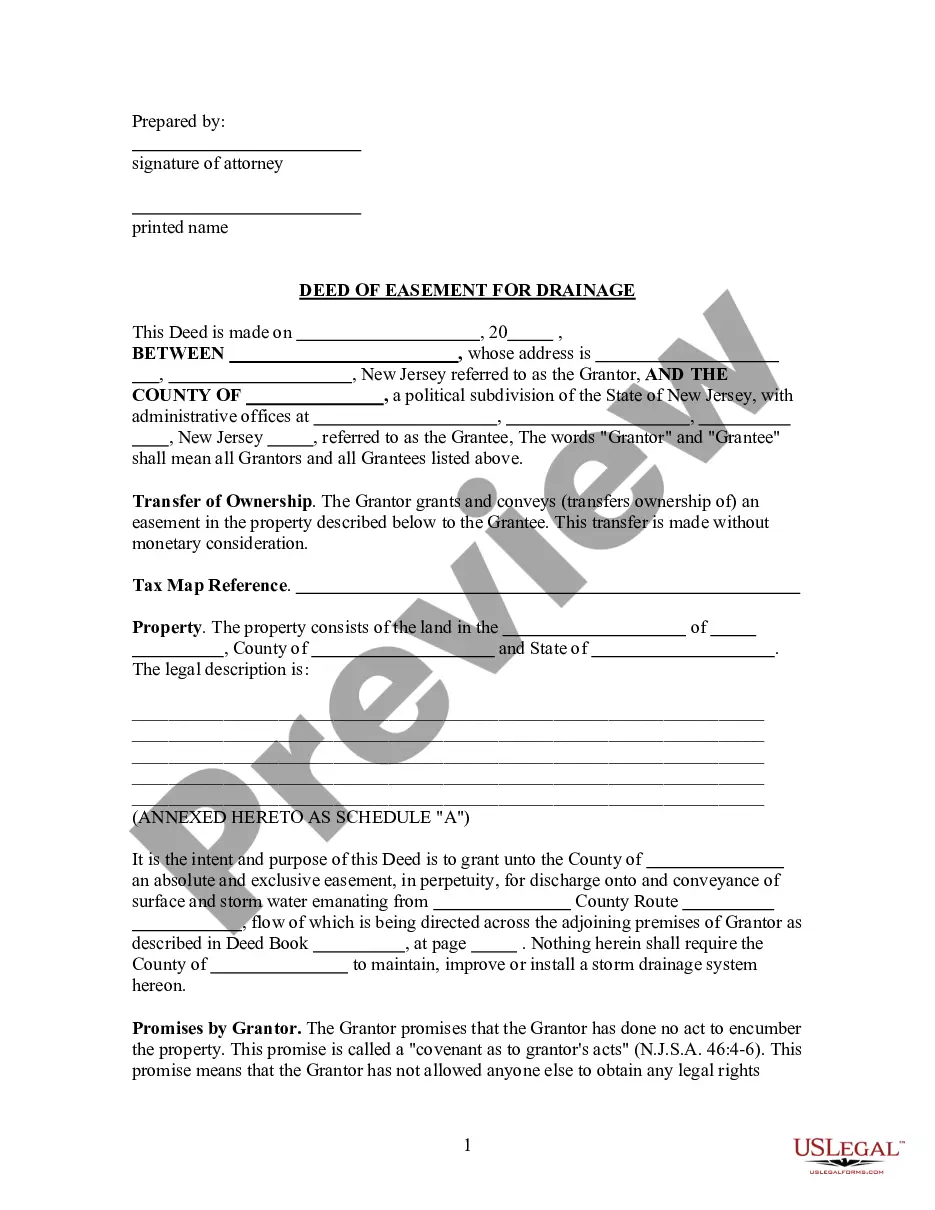
A Deed of Easement for Drainage grants one party the right to discharge and convey surface and storm water onto another party's property. This form establishes a long-term easement, allowing for necessary drainage without infringing on the property rights of the landowner. Unlike other types of easements, which might grant access or utility rights, this easement specifically addresses drainage needs, ensuring that water management complies with local regulations and respects property boundaries.
Key components of this form
- Identification of the Grantor and Grantee, including their respective property details.
- Description of the easement area and the rights granted for drainage purposes.
- Duration and nature of the easement, indicating that it is absolute and exclusive.
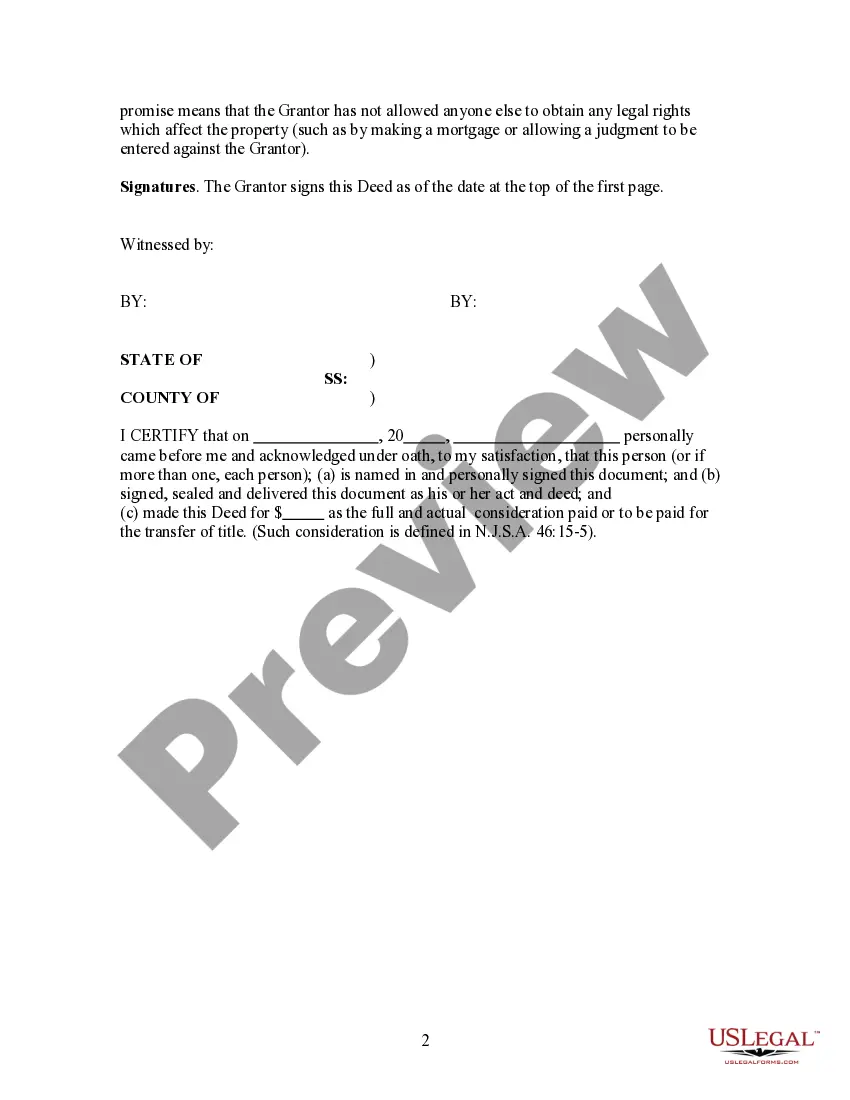
- Signatures required from the Grantor and any optional witnesses to validate the deed.
- Annexed Schedule A, detailing specific property measurements and boundaries related to the easement.
When this form is needed
This form is essential when a property owner needs to grant another party the right to manage water drainage on their land. It is particularly useful in scenarios where a neighbor's property requires crucial drainage access, where there are existing or potential water runoff issues, or for developments that necessitate surface water management. Creating this easement can help to avoid disputes relating to water management and ensure compliance with local water drainage regulations.
Who should use this form
- Property owners looking to grant drainage rights to neighbors or businesses.
- Developers needing to establish formal drainage solutions in compliance with local laws.
- Landlords managing rental properties that may require drainage management provisions.
- Anyone involved in real estate transactions requiring clear drainage rights delineation.
Steps to complete this form
- Identify the parties involved: the Grantor and Grantee, including their addresses and property descriptions.
- Specify the easement area where drainage will occur, ensuring clarity in the description.
- Detail the terms of the easement, highlighting its exclusivity and duration.
- Sign and date the document in the presence of a notary or witness, if required.
- Attach any necessary documents, like Schedule A, which provides additional property details.
Does this form need to be notarized?
This form typically does not require notarization unless specified by local law. Always check your jurisdiction's requirements to ensure legal validity.
Get your form ready online
Our built-in tools help you complete, sign, share, and store your documents in one place.
Make edits, fill in missing information, and update formatting in US Legal Forms—just like you would in MS Word.
Download a copy, print it, send it by email, or mail it via USPS—whatever works best for your next step.
Sign and collect signatures with our SignNow integration. Send to multiple recipients, set reminders, and more. Go Premium to unlock E-Sign.
If this form requires notarization, complete it online through a secure video call—no need to meet a notary in person or wait for an appointment.
We protect your documents and personal data by following strict security and privacy standards.

Make edits, fill in missing information, and update formatting in US Legal Forms—just like you would in MS Word.

Download a copy, print it, send it by email, or mail it via USPS—whatever works best for your next step.

Sign and collect signatures with our SignNow integration. Send to multiple recipients, set reminders, and more. Go Premium to unlock E-Sign.

If this form requires notarization, complete it online through a secure video call—no need to meet a notary in person or wait for an appointment.

We protect your documents and personal data by following strict security and privacy standards.
Common mistakes to avoid
- Failing to clearly define the easement area, leading to confusion or disputes.
- Not including all parties involved in the easement agreement.
- Neglecting to capture signatures or notarization where required.
- Overlooking local laws that may impose additional requirements.
Why use this form online
- Convenient downloadable format that saves time compared to manual drafting.
- Editability allows customization to fit unique property circumstances.
- Access to legally vetted templates ensures that the document meets proper legal standards.
Looking for another form?
Form popularity
FAQ
Rights of way (similar to the driveway example, but also including walkways or pathways); Public utilities, such as gas, electricity or water and sewer mains; Parking areas; Access to light and air; and. Shared walls.
There must be a dominant and a servient tenement; The easement must accommodate the dominant tenement, that is, be connected with its enjoyment and for its benefit; The dominant and servient owners must be different persons; The right claimed must be capable of forming the subject-matter of a grant.
An easement may be created by express words, either of grant or reservation. Typically, an express grant of easement will be created by deed but may be created by any instrument that transfers an interest or estate in real property.
An easement or right-of-way is an agreement that confers on an individual, company or municipality the right to use a landowner's property in some way. While these agreements grant rights, they also have the effect of partially restricting an owner's use of the affected portions of land.
An easement may be created by means of an appropriate dealing registered in NSW LRS or by the inclusion in a Section 88B instrument lodged with a new deposited plan.
Nine Essential Property Easement Agreement Considerations. Legal Description of Properties. Depiction of the Easement Area. Covenant Not to Disturb the Use of the Easement. Determination of Maintenance Obligations. Payment of Property Taxes.
Easements can be created in a variety of ways. They can be created by an express grant, by implication, by necessity, and by adverse possession.
Quiet the Title. Allow the Purpose for the Easement to Expire. Abandon the Easement. Stop Using a Prescriptive Easement. Destroy the Reason for the Easement. Merge the Dominant and Servient Properties. Execute a Release Agreement.
This chapter discusses the characteristics of an easement: there must be a dominant and a servient tenement; the easement must accommodate the dominant tenement; the easement must be owned or occupied by different people; and an easement must be capable of forming the subject matter of a grant.