New Jersey Closing Statement
What this document covers
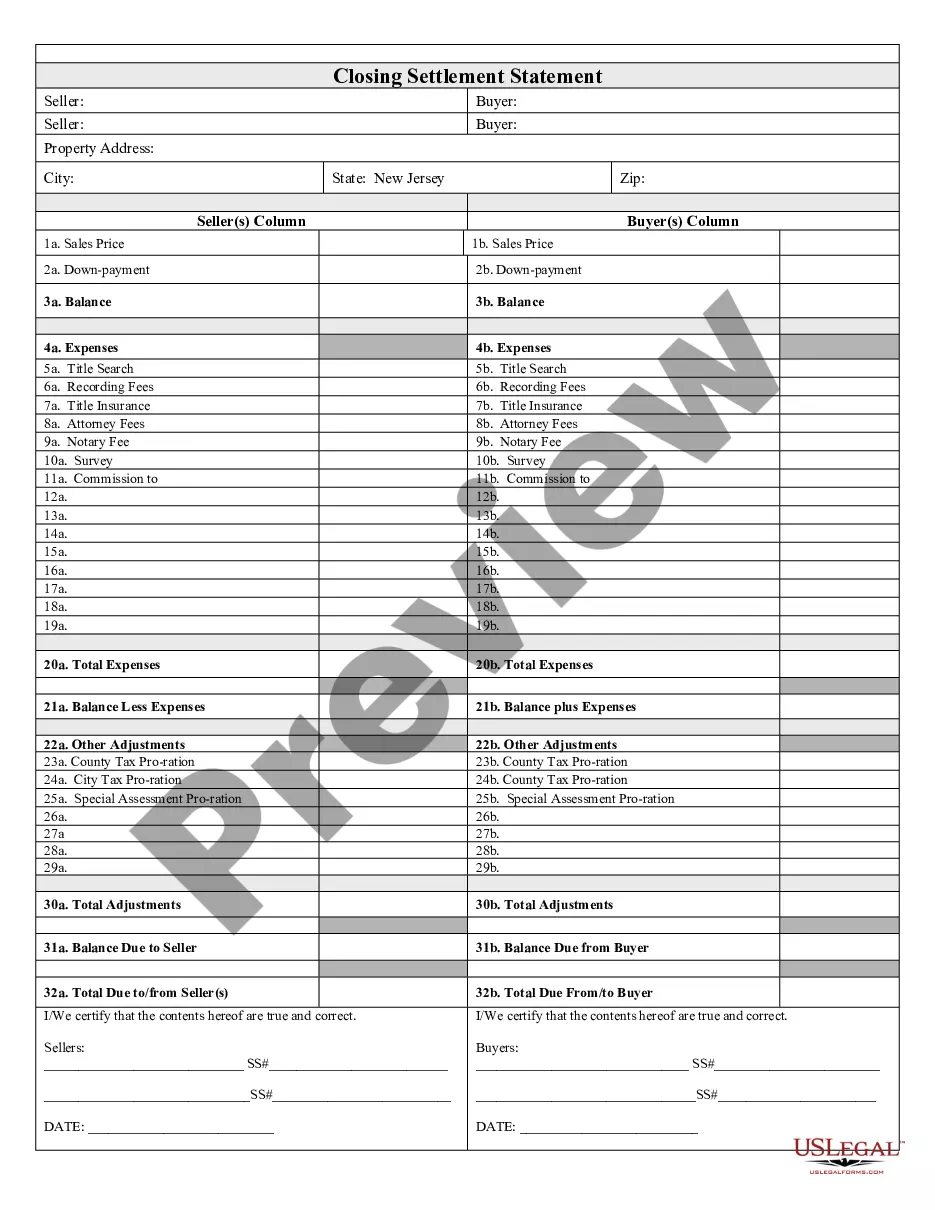
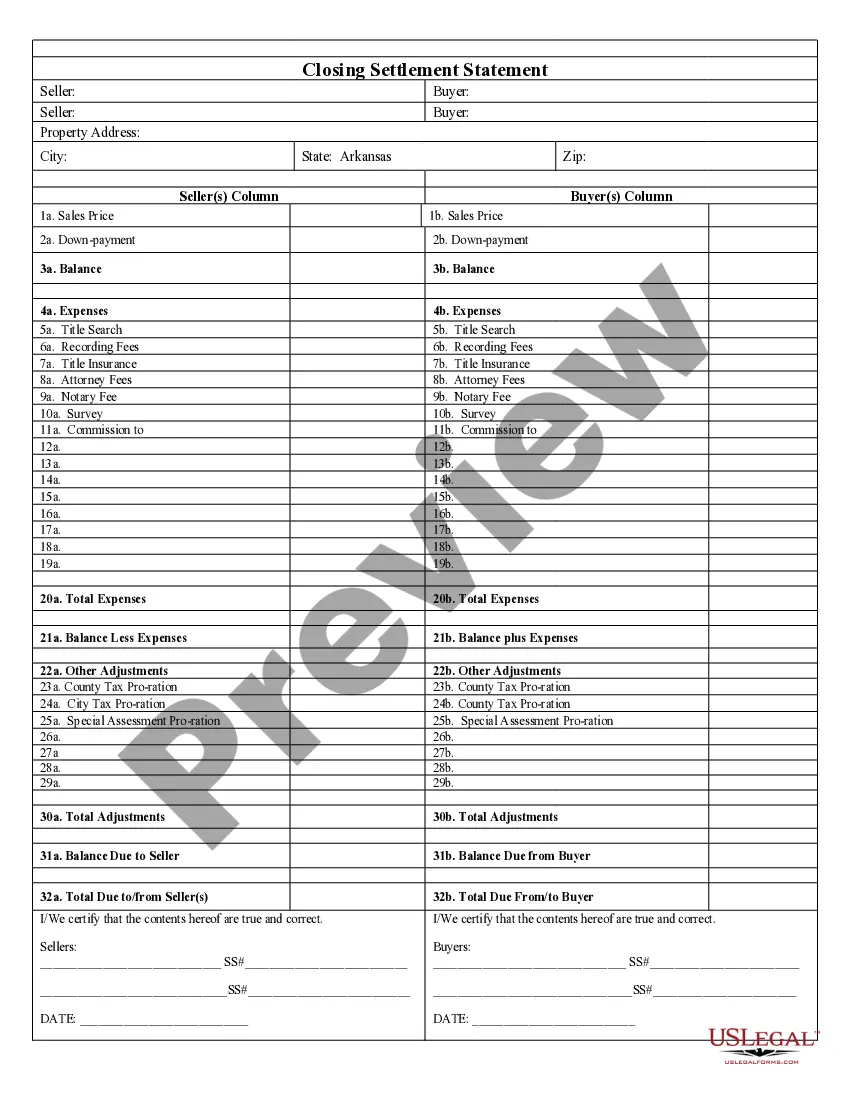
The Closing Statement is a crucial document in real estate transactions, particularly for cash sales or owner-financed deals. It provides a detailed account of all financial aspects related to the transaction, ensuring transparency between the buyer and seller. Unlike other forms, this settlement statement is verified and signed by both parties, which makes it essential for a legal record of the transaction.
Key parts of this document
- Expense identification: outlines various costs involved in the transaction.
- Title search fees: details on costs associated with verifying the property's title.
- Recording fees: includes charges for official recording of documents.
- Title insurance: specifies costs for insurance protecting against title defects.
- Attorney and notary fees: provides details about legal service costs.
- Adjustment details: includes proration of county and city taxes.

When to use this form
This form should be used during the closing phase of a real estate transaction, specifically when the sale is for cash or includes owner financing. It allows both the buyer and seller to review and agree on all financial aspects before finalizing the sale, ensuring that all fees and expenses are accounted for and properly documented.
Who needs this form
- Homebuyers and sellers engaged in a cash transaction.
- Real estate agents facilitating cash sales or owner financing.
- Attorneys representing clients in real estate transactions.
Steps to complete this form
- Identify the parties: enter the names of the buyer and seller.
- Detail the property: specify the property's legal description and address.
- List all expenses: enter all costs associated with the transaction, such as title search, recording fees, and attorney fees.
- Calculate totals: ensure that total expenses and balances are accurately computed.
- Sign and date: both the seller and buyer must sign and date the document to validate the statement.
Notarization requirements for this form
This form must be notarized to be legally valid. US Legal Forms provides secure online notarization powered by Notarize, allowing you to complete the process through a verified video call.
Get your form ready online
Our built-in tools help you complete, sign, share, and store your documents in one place.
Make edits, fill in missing information, and update formatting in US Legal Forms—just like you would in MS Word.
Download a copy, print it, send it by email, or mail it via USPS—whatever works best for your next step.
Sign and collect signatures with our SignNow integration. Send to multiple recipients, set reminders, and more. Go Premium to unlock E-Sign.
If this form requires notarization, complete it online through a secure video call—no need to meet a notary in person or wait for an appointment.
We protect your documents and personal data by following strict security and privacy standards.

Make edits, fill in missing information, and update formatting in US Legal Forms—just like you would in MS Word.

Download a copy, print it, send it by email, or mail it via USPS—whatever works best for your next step.

Sign and collect signatures with our SignNow integration. Send to multiple recipients, set reminders, and more. Go Premium to unlock E-Sign.

If this form requires notarization, complete it online through a secure video call—no need to meet a notary in person or wait for an appointment.

We protect your documents and personal data by following strict security and privacy standards.
Mistakes to watch out for
- Failing to include all necessary expenses, leading to disputes later.
- Omitting signatures from one or both parties, rendering the form invalid.
- Entering incorrect calculations for final balances, which might cause payment issues.
Why use this form online
- Immediate access: download the form instantly at your convenience.
- Editability: easily customize the document to meet your specific transaction needs.
- Reliability: forms are drafted by licensed attorneys to ensure legal validity.
Summary of main points
- The Closing Statement is essential for real estate transactions involving cash or owner financing.
- Accurate completion ensures transparency and prevents misunderstandings between parties.
- Both parties must sign and date the form for it to be legally binding.
Looking for another form?
Form popularity
FAQ
A settlement statement is also known as a HUD-1 form or a closing statement. Until 2015, when the rules changed, this form was provided twice. First, within three business days of applying for a mortgage loan, the borrower receives one in the mail with the person's estimated closing costs.
The HUD-1 Settlement Statement is a standard government real estate form that was once used by settlement agents, also called closing agents, to itemize all charges imposed upon a borrower and seller for a real estate transaction. The statement is no longer used, with one exceptionreverse mortgages.
The HUD-1 form is used in purchase transactions, and it includes lines for both borrower charges/fees and seller charges/fees.The HUD-1A is an option, instead of using the HUD-1, for loan transactions that do not include a seller (refinance). The HUD-1 is three pages, while the HUD-1A is only two pages.
As of October 3, 2015, the Closing Disclosure form replaced the HUD-1 form for most real estate transactions. However, if you applied for a mortgage on or before October 3, 2015, you received a HUD-1.
Completing Part B of HUD-1Fill in the property location and the name and address for the borrower, seller and lender. The settlement agent, date and location also are needed. Fill in the appropriate lines in sections J and K, which are summaries of the borrower's and seller's transactions, respectively.
A closing agent prepares the closing statement, which is settlement sheet. It's a comprehensive list of every expense that the buyer and seller must pay to complete the real estate transaction. Fees listed on this sheet include commissions, mortgage insurance, and property tax deposits.
A HUD-1 or HUD-1A Settlement Statement is prepared by a creditor or, more typically, by the settlement agent who conducts the closing on the creditor's behalf.
6. Attendance Required Power of Attorney Generally, all of the parties must show up at the closing. This is especially true of the buyers, who must sign all of the mortgage documents.
Sellers do not usually need to be present at a New Jersey closing so long as all costs are paid and documents are signed. Typically, the buyers will sign the final documents at the office of their title company or escrow agent and pick up the keys.