North Carolina Warning of Default on Residential Lease
About this form
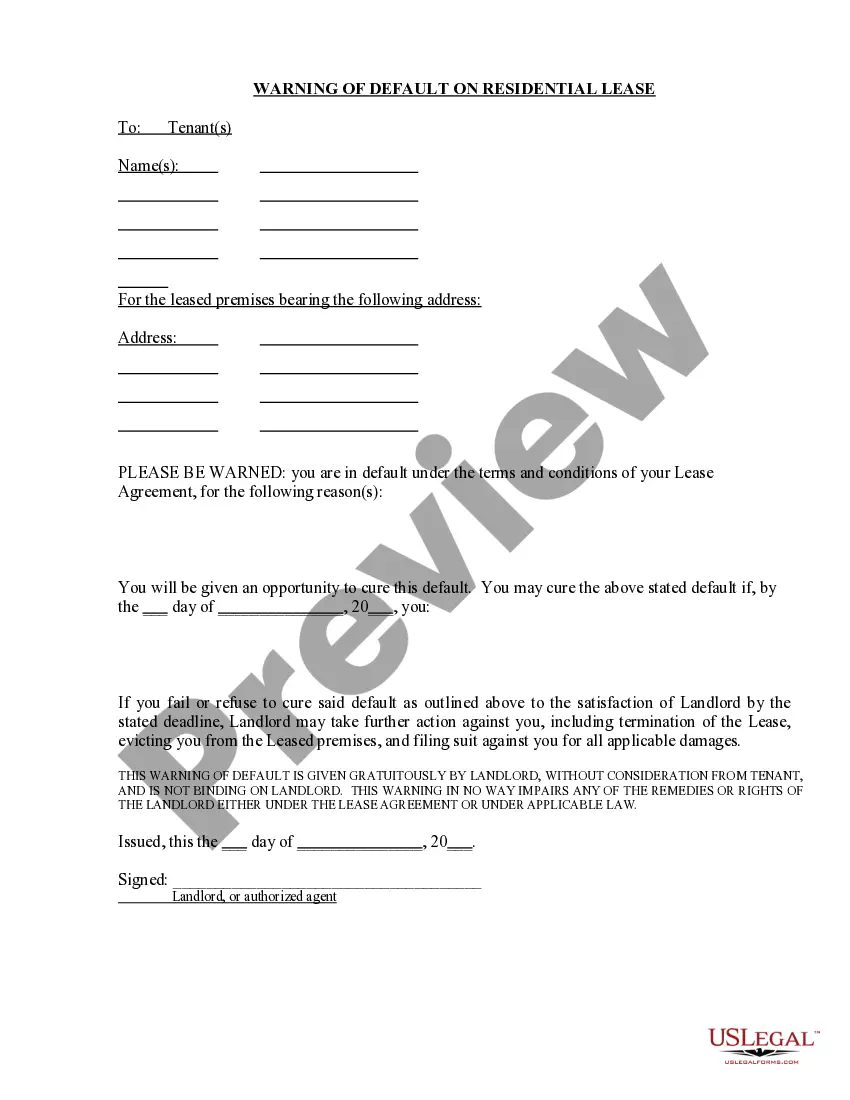
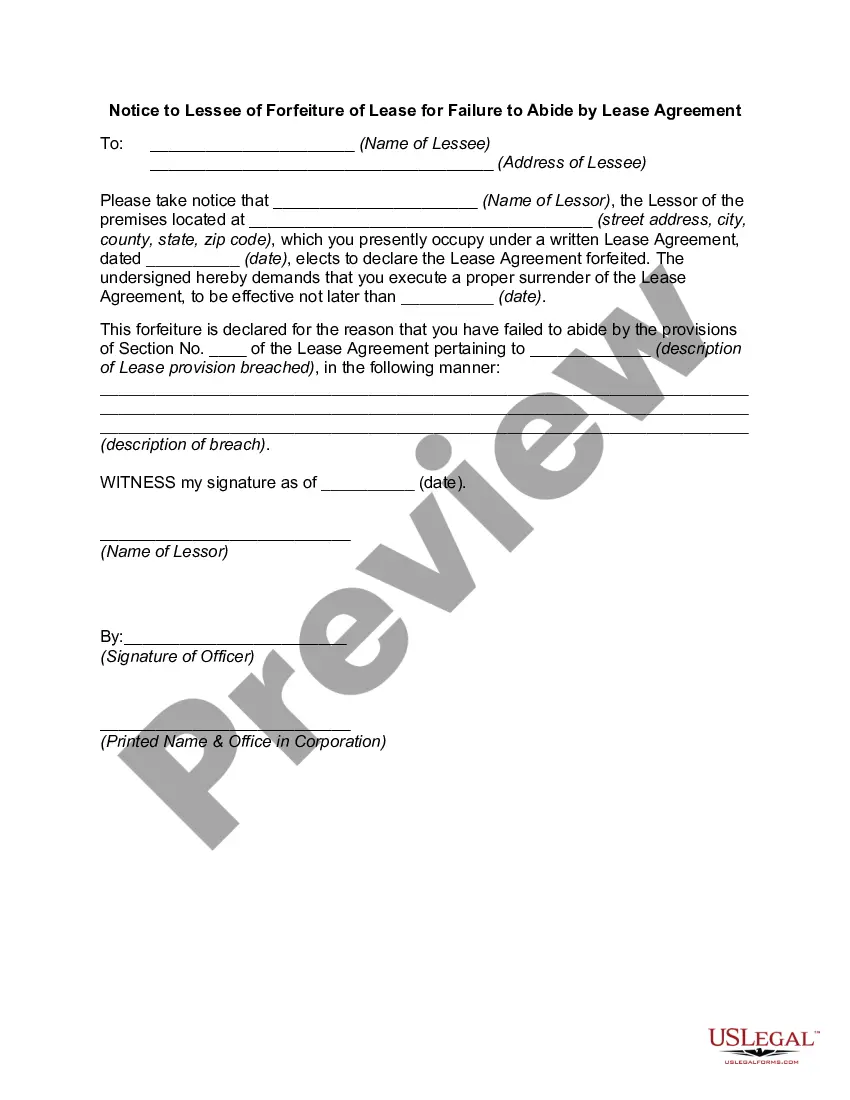
The Warning of Default on Residential Lease is a legal document issued by a landlord to a tenant. This warning letter serves to alert the tenant that they are at risk of being held in default under the lease agreement if specific issues are not addressed. Unlike other tenant notices, this form emphasizes the landlord's concerns and outlines the potential consequences of non-compliance.
What’s included in this form
- Identification of the landlord and tenant.
- Date of issuance.
- Statement indicating the nature of the default.
- A declaration that the warning is given gratuitously and is not binding.
- Landlord's signature or authorized agent's signature.


When to use this form
This form should be used when a landlord believes that the tenant is not complying with the lease terms, such as failing to pay rent or violating other lease conditions. It provides a formal notification to the tenant, indicating that they have a specified time to rectify the issue before further legal action may be taken.
Who this form is for
- Landlords who lease residential properties.
- Property managers acting on behalf of landlords.
- Tenants who want to understand their rights if they receive such a notice.
Instructions for completing this form
- Identify the parties involved by filling in the names of the landlord and tenant.
- Enter the date when the warning is issued.
- Specify the nature of the default that the tenant must remedy.
- Ensure that the document is signed by the landlord or an authorized agent.
- Keep a copy for your records and distribute as necessary, following any legal requirements for notice delivery.
Does this form need to be notarized?
This form does not typically require notarization unless specified by local law. It's advisable for landlords to check their jurisdiction's requirements to ensure enforceability.
Get your form ready online
Our built-in tools help you complete, sign, share, and store your documents in one place.
Make edits, fill in missing information, and update formatting in US Legal Forms—just like you would in MS Word.
Download a copy, print it, send it by email, or mail it via USPS—whatever works best for your next step.
Sign and collect signatures with our SignNow integration. Send to multiple recipients, set reminders, and more. Go Premium to unlock E-Sign.
If this form requires notarization, complete it online through a secure video call—no need to meet a notary in person or wait for an appointment.
We protect your documents and personal data by following strict security and privacy standards.

Make edits, fill in missing information, and update formatting in US Legal Forms—just like you would in MS Word.

Download a copy, print it, send it by email, or mail it via USPS—whatever works best for your next step.

Sign and collect signatures with our SignNow integration. Send to multiple recipients, set reminders, and more. Go Premium to unlock E-Sign.

If this form requires notarization, complete it online through a secure video call—no need to meet a notary in person or wait for an appointment.

We protect your documents and personal data by following strict security and privacy standards.
Common mistakes
- Failing to specify the exact nature of the default.
- Not including the date of issuance.
- Omitting the landlord's signature or that of the authorized agent.
- Not providing the tenant with clear information on how to remedy the default.
Advantages of online completion
- Convenience of access to the document anytime.
- Easy to fill out and customize as needed.
- Instant downloadable format for immediate use.
- Reliability of forms drafted by licensed attorneys.
Legal use & context
- This warning letter provides formal notice to the tenant, essential for establishing a record of communication.
- It is a prerequisite step before a landlord can formally initiate eviction proceedings.
- Utilizing this form legally protects the landlordâs rights under the lease and by applicable law.
Key takeaways
- A Warning of Default on Residential Lease is used to formally notify tenants of unfulfilled lease obligations.
- Completing the form correctly can prevent legal complications later on.
- Always keep a copy for your records and follow local regulations regarding landlord-tenant communications.
Looking for another form?
Form popularity
FAQ
Tenant default occurs when a Tenant breaches one of the tenant's covenants in its lease. Tenant default can arise in a number of different ways but will typically be for one of the following: Non-payment of rent or other sums reserved under the lease.
Default by landlord The most common form of landlord default is failure to provide services and maintain the property condition. When a landlord defaults on the terms of the lease, tenants may sue for damages.
In landlord-tenant law, default refers to the failure of a tenant to timely pay rent due.In general, the landlord is required to give the tenant notice of the default before bringing eviction proceedings or applying security deposit proceeds to the payment in default.
Step 1: Speak to your tenant. Step 2: Provide notice of contract breach. Step 3: Decide between an interdict or cancellation. Step 4: Eviction process. Step 5: Eviction notice. Final advice.
In short, nothing in the CARES Act or Governor Cooper's Order prohibits evictions for reasons other than late payment or nonpayment of rent, such as evictions related to health, safety, or criminal activity. These types of evictions by a landlord would not violate the Order.
North Carolina law says that your landlord must keep your housing fit and safe. It also says that you, the tenant, must pay your rent, keep your home clean, and not damage your home. To make the law work, both the tenant and the landlord must do their part.
Protect your rental income. Even the most reliable tenants sometimes struggle to pay their rent.Tenant default insurance from Simply Business provides vital back-up for landlords it can cover your rental income if your tenant fails to pay rent.
Withhold rent. Move out. Sue the landlord for the difference between the value of the unit with defects and the monthly rent. File a complaint with state or local health or building inspectors. Repair the defect and deduct the cost from the rent.
Declare a Constructive Eviction. Point Out Landlord Breaches to Reduce Your Debt. Landlords Have a Duty to Mitigate Their Damages. Consequences for Breaking Your Lease. Look for These Clauses in Your Lease. Your Landlord May Have a Duty to Mitigate. Declare a Constructive Eviction.