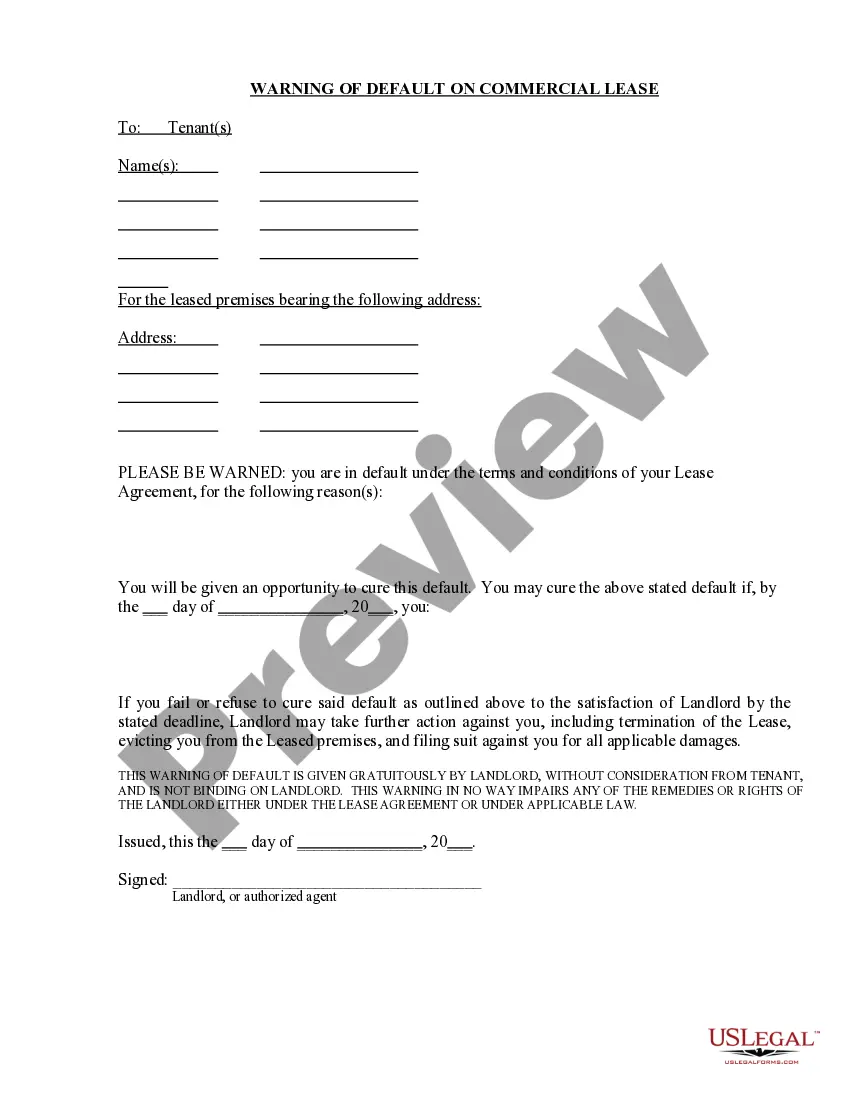
North Carolina Warning of Default on Commercial Lease
Understanding this form
The Warning of Default on Commercial Lease is a crucial notification that a landlord issues to inform a tenant of potential default under a lease agreement. This formal letter expresses concern that if certain conditions, primarily related to timely rent payments, are not remedied, the tenant may face default status. Unlike other lease-related forms, this notice serves as a warning and does not establish binding obligations but is essential for both parties to understand their rights and obligations under the lease agreement.
Main sections of this form
- Identification of parties involved: Clearly states the landlord and tenant.
- Default notice date: Specifies when the warning is issued.
- Conditions with potential default: Details the circumstances that could lead to default.
- Landlord's signature: Required for the validity of the warning.
- Clarification of rights: Reinforces that this warning does not limit the landlord's legal rights.
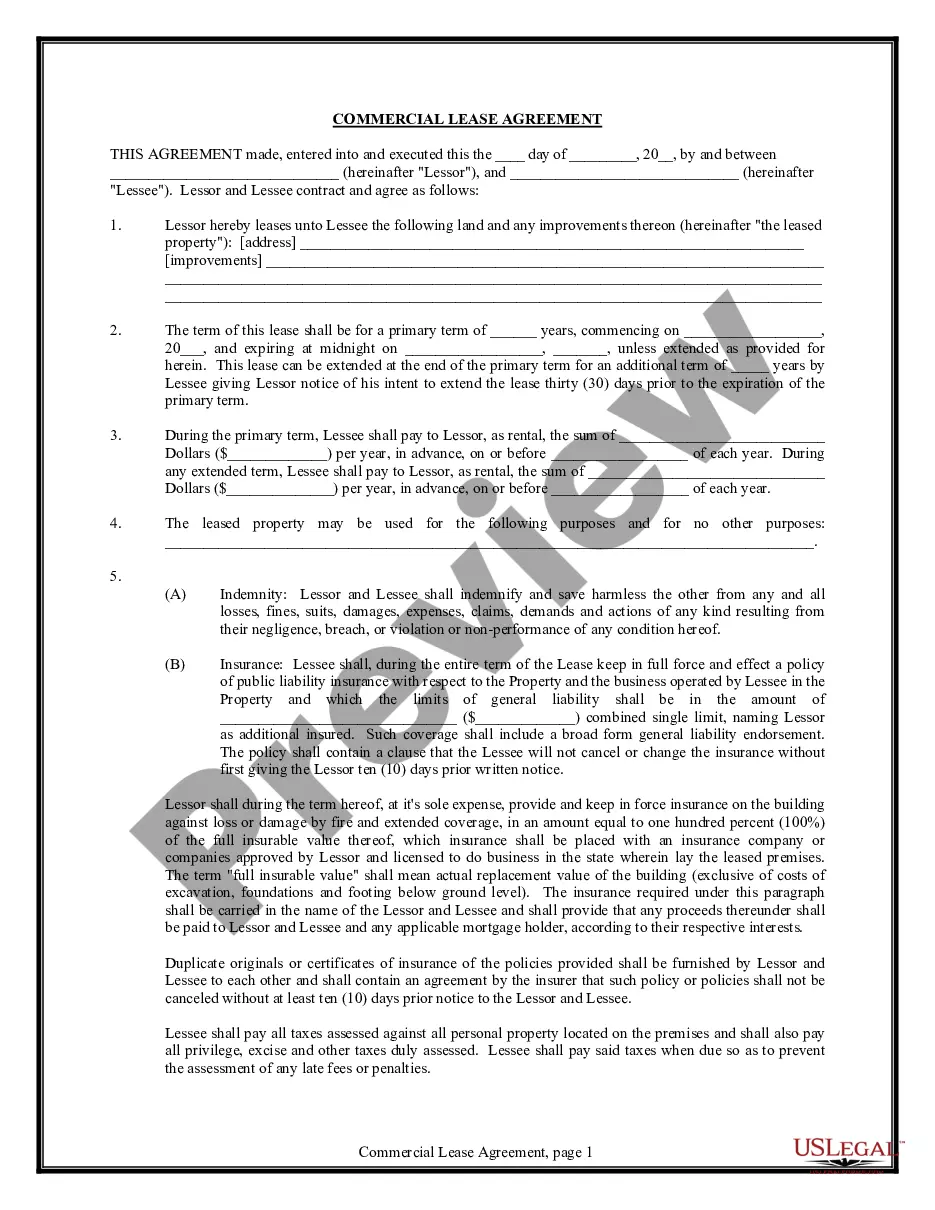
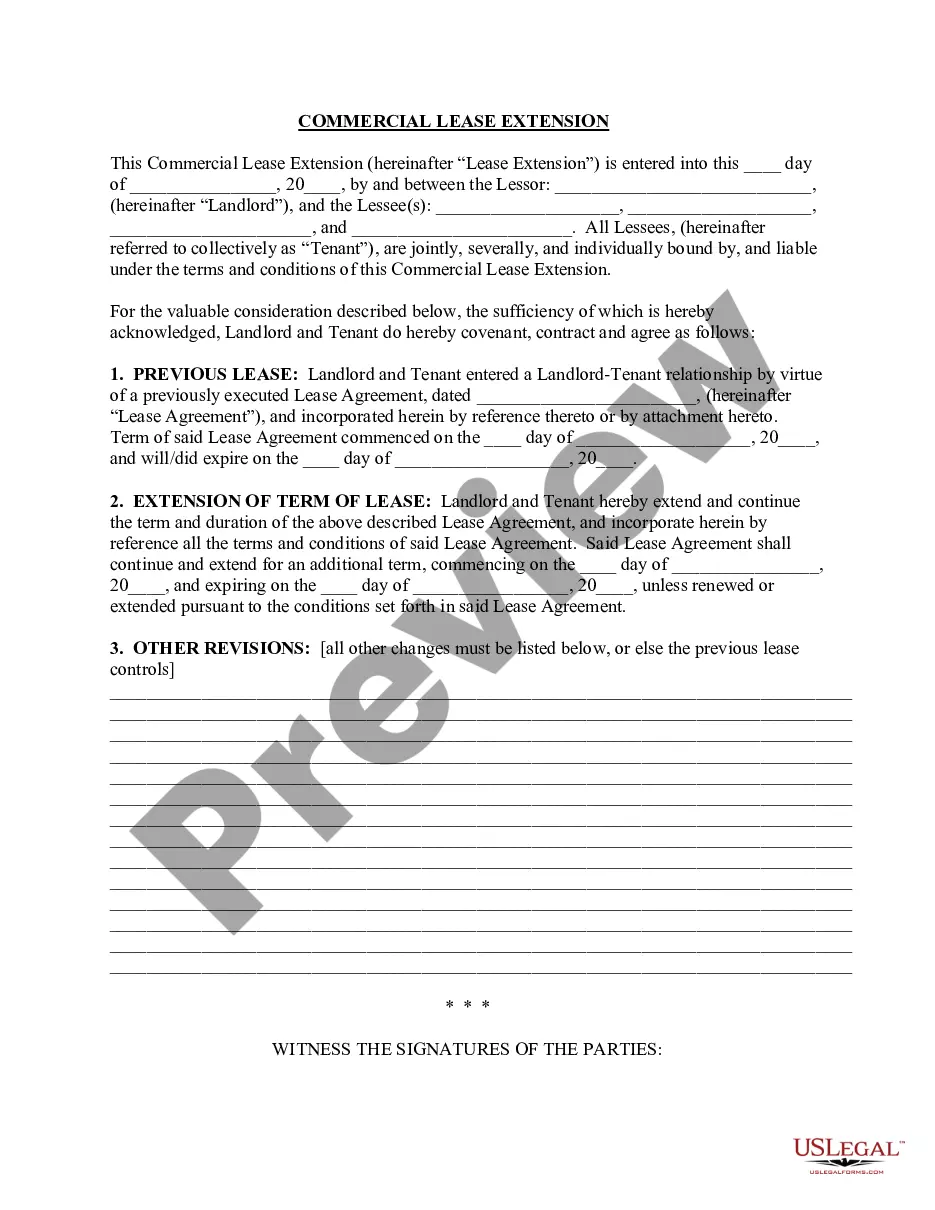
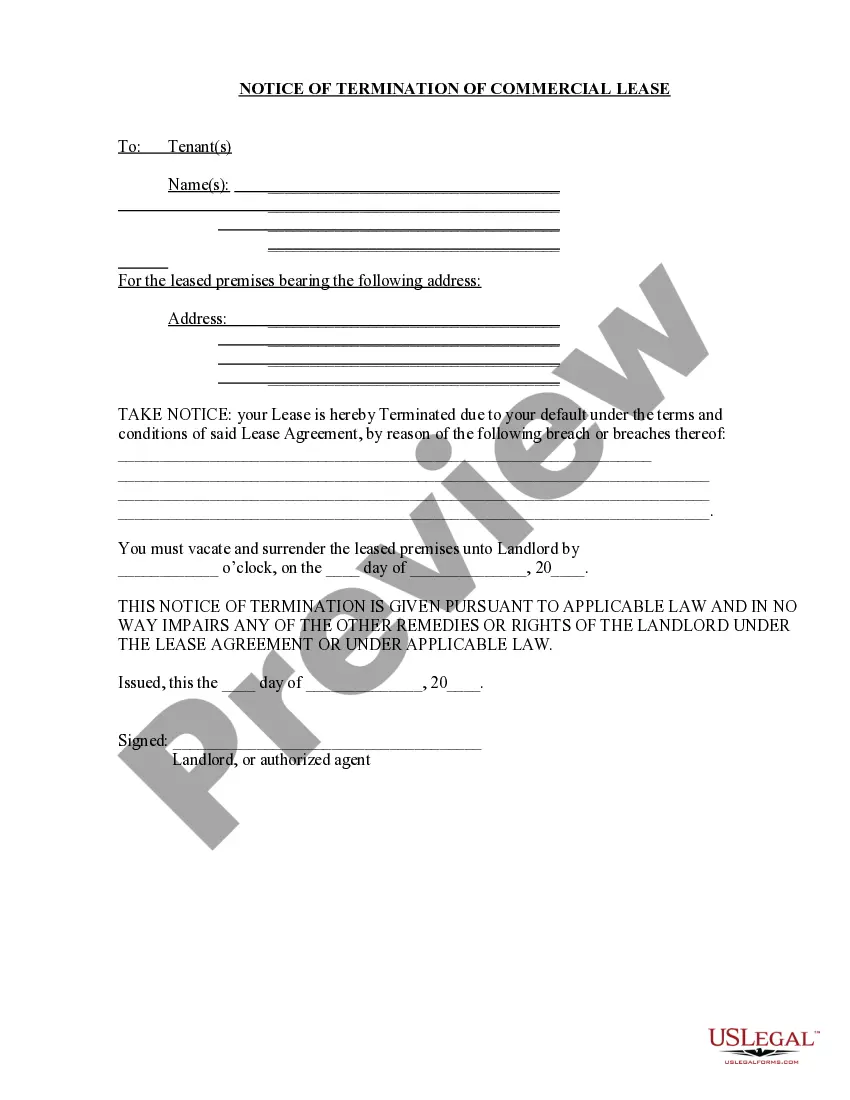
Situations where this form applies
This form is used when a landlord needs to formally notify a tenant of a rent payment issue or other lease violation that may lead to default. It serves as an official warning before taking further actions, such as eviction or claiming a security deposit. It is important to use this notice if a tenant is late on rent or has failed to meet the terms of the lease agreement.
Intended users of this form
- Landlords seeking a method to formally warn tenants of defaults.
- Property managers responsible for maintaining lease agreements and tenant relationships.
- Anyone involved in commercial leasing who needs to understand default procedures.
How to prepare this document
- Identify the landlord and tenant by entering their names and addresses.
- Specify the date the warning is issued to provide a clear timeline.
- Detail the specific reasons for the default notice, focusing on payment issues or lease violations.
- Have the landlord or an authorized agent sign the document for authenticity.
- Keep a copy for records and provide the tenant with any required duplicates.
Notarization guidance
This form does not typically require notarization to be legally valid. However, some jurisdictions or document types may still require it. US Legal Forms provides secure online notarization powered by Notarize, available 24/7 for added convenience.
Get your form ready online
Our built-in tools help you complete, sign, share, and store your documents in one place.
Make edits, fill in missing information, and update formatting in US Legal Forms—just like you would in MS Word.
Download a copy, print it, send it by email, or mail it via USPS—whatever works best for your next step.
Sign and collect signatures with our SignNow integration. Send to multiple recipients, set reminders, and more. Go Premium to unlock E-Sign.
If this form requires notarization, complete it online through a secure video call—no need to meet a notary in person or wait for an appointment.
We protect your documents and personal data by following strict security and privacy standards.

Make edits, fill in missing information, and update formatting in US Legal Forms—just like you would in MS Word.

Download a copy, print it, send it by email, or mail it via USPS—whatever works best for your next step.

Sign and collect signatures with our SignNow integration. Send to multiple recipients, set reminders, and more. Go Premium to unlock E-Sign.

If this form requires notarization, complete it online through a secure video call—no need to meet a notary in person or wait for an appointment.

We protect your documents and personal data by following strict security and privacy standards.
Common mistakes to avoid
- Failing to identify the tenant or landlord accurately, leading to confusion.
- Not specifying the default conditions clearly, which can undermine the warning's effectiveness.
- Neglecting to sign the notice, making it non-binding.
Benefits of completing this form online
- Convenience of immediate access to legal documents at any time.
- Editability allows users to customize the form as needed for their specific circumstances.
- Reliability from using templates drafted by licensed attorneys, ensuring legal compliance.
Looking for another form?
Form popularity
FAQ
Landlords can try and forfeit a lease if a tenant is in breach of their obligations (this assumes that the lease document includes a right to forfeit).If a commercial lease contains a break clause, either or both parties to the agreement may seek to terminate the lease before its fixed period has ended.
Anyone renting a building, whether for commercial or personal use, has the right to privacy. You are entitled to do anything on the property that you wish, so long as whatever you are doing is legal. The landlord cannot prevent you from operating your business nor from allowing guests or patrons on the property.
A break-early fee is a lump sum payment. The amount of the break-early fee will vary greatly depending upon the commercial tenant's specific circumstances. In exchange for the break-early fee, the landlord will agree to release the commercial tenant from all of its obligations under the commercial lease.
Look for a clause: Re-read your lease and look for either a bailout clause or a co-tenancy clause. Ask: If you are in a good space in a popular area, your landlord will be more inclined to an early termination of the lease than if you are in a bad space in a hard-to-rent location.
If the commercial tenant is a shell corporation and/or does not have any assets of value, the commercial tenant may choose to walk away from its commercial lease obligations.Often the landlord will require guarantees in order to prevent a commercial tenant from walking away from its lease obligations.
-Landlords shall not, for reason of late payment or nonpayment, initiate or take any action to further summary ejectment or other eviction proceedings against a Commercial Tenant for reason caused by the COVID-19 pandemic, perform self-help eviction of a Commercial Tenant, require Commercial Tenants to vacate their
For example, the lease may provide that in case of default, the landlord can recover late fees and interest. If the lease is a net lease, it may provide for the landlord to recover such things as property taxes, insurance, utilities, maintenance and repairs.