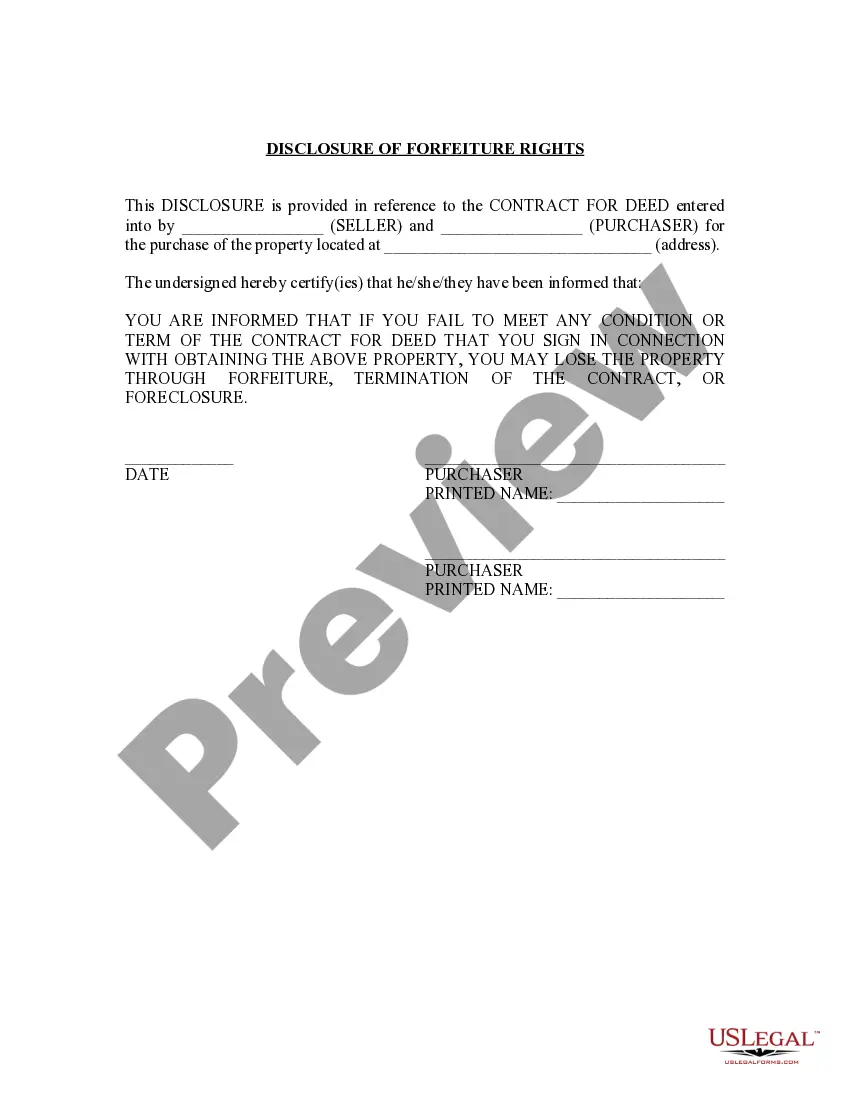
North Carolina Seller's Disclosure of Forfeiture Rights for Contract for Deed
What this document covers
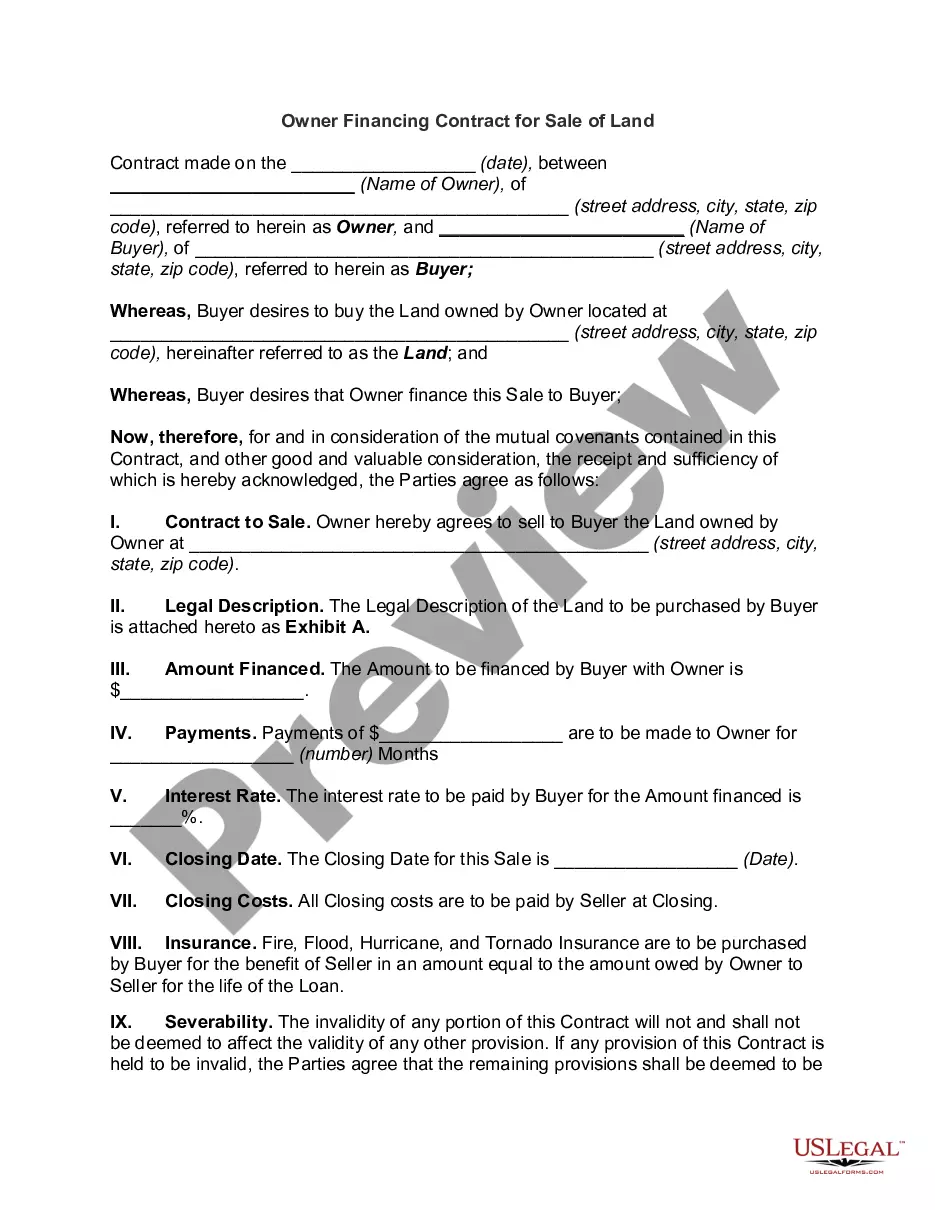
The Seller's Disclosure of Forfeiture Rights for Contract for Deed is a legal document provided by the seller to the purchaser at the time of signing a contract for deed. This form is not typically mandated, but it informs the purchaser about the implications of forfeiture related to the contract. It is crucial for preventing misunderstandings should the purchaser default, ensuring they are aware of the risks involved, including the potential loss of property through forfeiture, termination of the contract, or foreclosure. This form serves to clarify the obligations and rights of both parties in such transactions.
Main sections of this form
- Certification by the seller regarding the purchaser's understanding of forfeiture rights.
- Explanation of consequences if the purchaser fails to meet contract conditions.
- Identification of the property covered under the contract for deed.
Situations where this form applies
This form should be used whenever a contract for deed is established between a seller and a purchaser. It is particularly important in situations where the purchaser is uncertain about their rights and obligations related to forfeiture. Using this disclosure helps both parties understand the terms of the contract and protects the seller's interests in case of any disputes or defaults by the purchaser.
Who needs this form
- Property sellers entering into a contract for deed with a buyer.
- Purchasers who need clarification on their forfeiture rights within such contracts.
- Real estate professionals facilitating seller-buyer transactions involving contract for deeds.
How to prepare this document
- Identify the parties involved in the contract.
- Provide a clear description of the property being sold under the contract.
- Ensure both seller and purchaser confirm their understanding by signing the document.
- Discuss and clarify any conditions of the contract that relate to forfeiture.
- Keep a copy of the signed disclosure for future reference.
Does this document require notarization?
This form does not typically require notarization unless specified by local law. It is recommended that all parties involved keep a copy of the signed document for their records.
Get your form ready online
Our built-in tools help you complete, sign, share, and store your documents in one place.
Make edits, fill in missing information, and update formatting in US Legal Forms—just like you would in MS Word.
Download a copy, print it, send it by email, or mail it via USPS—whatever works best for your next step.
Sign and collect signatures with our SignNow integration. Send to multiple recipients, set reminders, and more. Go Premium to unlock E-Sign.
If this form requires notarization, complete it online through a secure video call—no need to meet a notary in person or wait for an appointment.
We protect your documents and personal data by following strict security and privacy standards.

Make edits, fill in missing information, and update formatting in US Legal Forms—just like you would in MS Word.

Download a copy, print it, send it by email, or mail it via USPS—whatever works best for your next step.

Sign and collect signatures with our SignNow integration. Send to multiple recipients, set reminders, and more. Go Premium to unlock E-Sign.

If this form requires notarization, complete it online through a secure video call—no need to meet a notary in person or wait for an appointment.

We protect your documents and personal data by following strict security and privacy standards.
Mistakes to watch out for
- Failing to explain forfeiture rights to the purchaser adequately.
- Not completing the form or leaving essential sections blank.
- Providing inaccurate property descriptions, leading to misunderstandings.
Benefits of using this form online
- Convenience of instant access to a legally vetted form.
- Editability to tailor the template to your specific needs.
- Reliability from a resource utilized by licensed attorneys.
Quick recap
- The Seller's Disclosure of Forfeiture Rights is crucial for understanding the implications of a contract for deed.
- Both parties must be informed and acknowledge their rights regarding forfeiture.
- Completing this form accurately can prevent legal disputes in the future.
Looking for another form?

Form popularity
FAQ
Monetary Damages If the Seller decides to breach the contract and keep their home, they may do so, but the court may order the Buyer receive money for the resulting breach. Generally, the money owed to Buyer may include reimbursing the Buyer with: The buyer's temporary housing costs.
Backing out of a home sale can have costly consequences A home seller who backs out of a purchase contract can be sued for breach of contract. A judge could order the seller to sign over a deed and complete the sale anyway. The buyer could sue for damages, but usually, they sue for the property, Schorr says.
A disadvantage to the seller is that a contract for deed is frequently characterized by a low down payment and the purchase price is paid in installments instead of one lump sum.The legal fees and time frame for this process will be more extensive than a standard Power of Sale foreclosure.
According to the North Carolina Offer to Purchase and Contract, both the Buyer and Seller have the right to terminate the contract in certain instances upon written notice to the other party.
But unlike buyers, sellers can't back out and forfeit their earnest deposit money (usually 1-3 percent of the offer price). If you decide to cancel a deal when the home is already under contract, you can be either legally forced to close anyway or sued for financial damages.
This means that if you default and can?t make your payments, you lose the property and all of the money you have already paid into it (often including repairs and improvements). Unlike a traditional mortgage, a defaulting buyer in a contact for deed may only have 30-60 days to cure the default or move out.
If a seller is actually breaching a contract and you can prove you have been financially damaged, you could sue. However, the amount you can sue for depends on the law in your individual state.With that said, if you can show the seller acted in bad faith, your state may allow you to seek additional damages.
If a seller defaults, he must return all deposits, plus added reasonable expenses, to the buyer. The other party may also seek to compel the erring party to complete the deal under specific performance. From a buyer's point of view, it is advisable to get the sale agreement registered.
But unlike buyers, sellers can't back out and forfeit their earnest deposit money (usually 1-3 percent of the offer price). If you decide to cancel a deal when the home is already under contract, you can be either legally forced to close anyway or sued for financial damages.