Missouri Unconditional Waiver and Release of Lien Upon Progress Payment
What is this form?
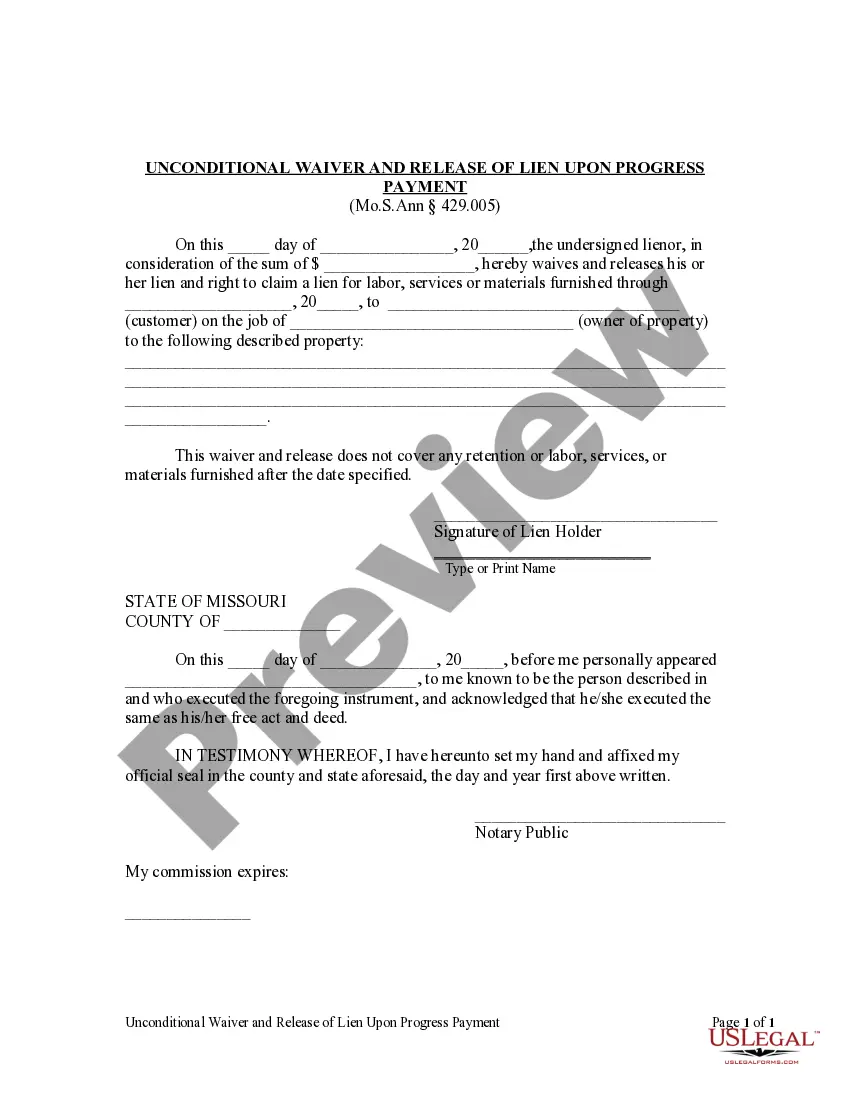
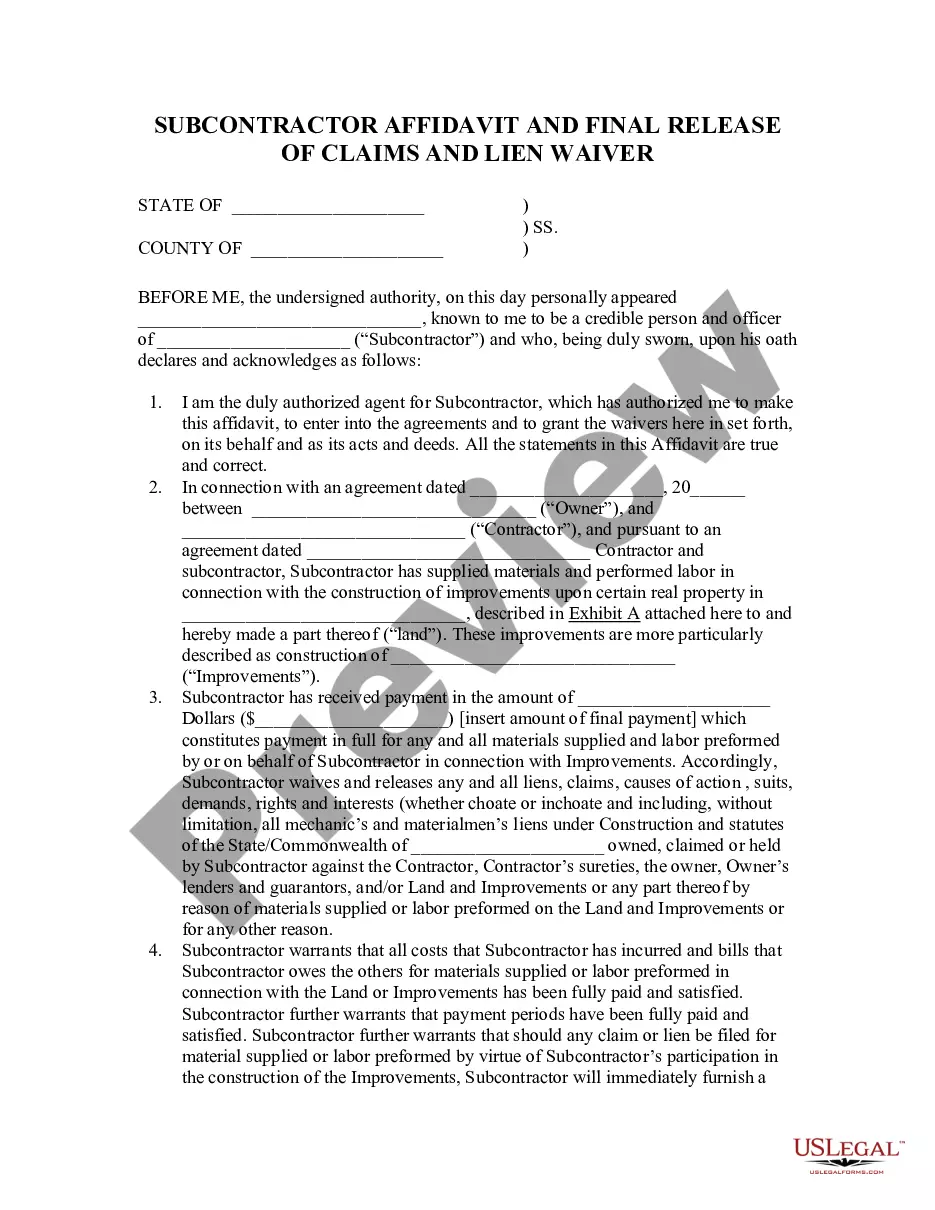
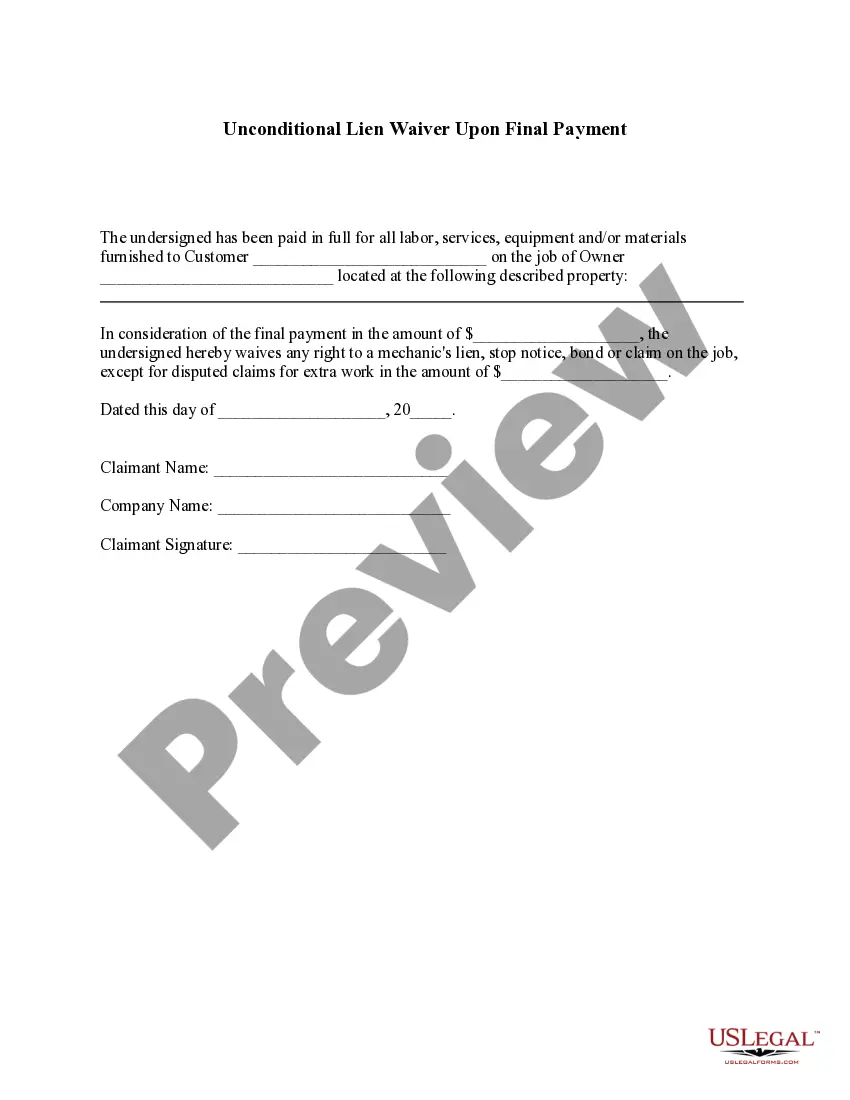
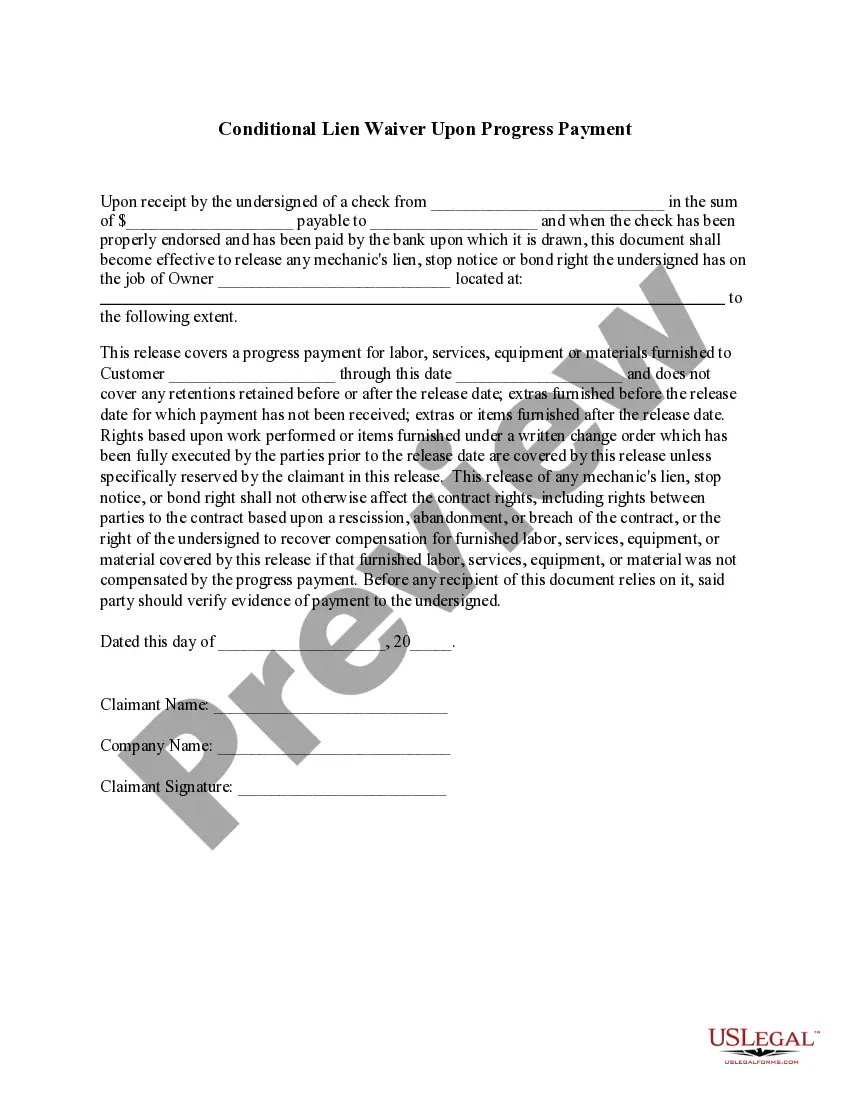
The Unconditional Waiver and Release of Lien Upon Progress Payment is a legal document used by lienors to waive their right to claim a lien on property in exchange for a specified payment. This form serves to document that the lienor has received payment for labor, services, or materials provided up to a certain date, thus ensuring that the property owner is freed from potential claims related to those services. It is distinct from similar forms as it is unconditional, meaning it does not ocknowledge any further claims after the specified date of payment.
Form components explained
- Date of execution
- Amount received for payment
- Description of services, labor, or materials provided
- Name of the customer and owner of the property
- Description of the property related to the lien
- Signatures of the lien holder and notary acknowledgment
When to use this form
This form is used in situations where a contractor, subcontractor, or supplier has provided services or materials to a property owner. If these parties have received a progress payment for their services as part of a construction project, they can use this form to formally release any claims they may have on the property for the work completed up to that point. This helps prevent disputes over payments and supports smooth transactions in construction projects.
Who can use this document
- Contractors who have completed part of their work and received a progress payment
- Subcontractors who have been paid for specific services rendered
- Suppliers who have delivered materials and received a payment
How to complete this form
- Identify the date on which the form is being executed.
- Enter the amount of money received as payment.
- Specify the date until which services or materials were provided.
- Fill in the names of the customer and property owner.
- Describe the property related to the lien in sufficient detail.
- Sign the form and have it notarized to validate your waiver.
Is notarization required?
Yes, this form must be notarized to be legally valid. US Legal Forms offers integrated online notarization services, making the process convenient. You can complete your notarization securely via video call, ensuring legal equivalence without the need to travel.
Get your form ready online
Our built-in tools help you complete, sign, share, and store your documents in one place.
Make edits, fill in missing information, and update formatting in US Legal Forms—just like you would in MS Word.
Download a copy, print it, send it by email, or mail it via USPS—whatever works best for your next step.
Sign and collect signatures with our SignNow integration. Send to multiple recipients, set reminders, and more. Go Premium to unlock E-Sign.
If this form requires notarization, complete it online through a secure video call—no need to meet a notary in person or wait for an appointment.
We protect your documents and personal data by following strict security and privacy standards.

Make edits, fill in missing information, and update formatting in US Legal Forms—just like you would in MS Word.

Download a copy, print it, send it by email, or mail it via USPS—whatever works best for your next step.

Sign and collect signatures with our SignNow integration. Send to multiple recipients, set reminders, and more. Go Premium to unlock E-Sign.

If this form requires notarization, complete it online through a secure video call—no need to meet a notary in person or wait for an appointment.

We protect your documents and personal data by following strict security and privacy standards.
Mistakes to watch out for
- Failing to include the precise amount received in the payment section.
- Not specifying the date of services or materials covered by the waiver.
- Omitting details about the property, which can lead to ambiguity.
- Not having the waiver notarized, which might affect its legality.
Advantages of online completion
- Convenience of accessing and completing the form from any location.
- Editability allows for immediate updates before finalizing the document.
- Reliable templates ensure that all necessary legal language is included.
Key takeaways
- The form releases lien rights in exchange for a specified payment.
- It is important for both lienors and property owners to ensure clarity on payment obligations.
- Notarization is required for the form to be legally effective.
- Complete details about the services and property are essential to avoid disputes.
Looking for another form?


Form popularity
FAQ
Several states, including Missouri, have statutory lien waiver forms designed to standardize the process. Each state has its own specific requirements and forms, such as the Missouri Unconditional Waiver and Release of Lien Upon Progress Payment. It is essential to check the regulations in your specific state to ensure compliance. Resources like US Legal Forms can help you find the appropriate forms for your state.
Yes, Missouri offers statutory lien waiver forms that comply with state laws. One of the key forms is the Missouri Unconditional Waiver and Release of Lien Upon Progress Payment, which is widely used in the construction industry. These forms help protect both property owners and contractors by confirming that payments have been made. You can access these forms easily through platforms such as US Legal Forms.
In Missouri, lien waivers generally do not require notarization to be valid. However, having a notary witness the signing can add an extra layer of authenticity to the document. Using the Missouri Unconditional Waiver and Release of Lien Upon Progress Payment provides clarity and peace of mind in the process. It's always wise to consult with a legal professional if you have specific questions about your situation.
To obtain a lien release in Missouri, you must ensure that all payments related to the construction project are settled. Once payment is made, you can request a Missouri Unconditional Waiver and Release of Lien Upon Progress Payment from the contractor or subcontractor. This form must be filled out correctly and signed to officially release the lien. Using resources like US Legal Forms can simplify obtaining and completing the necessary documentation.
Yes, Missouri does have statutory lien waivers that are specifically designed to protect property owners and contractors. These waivers include forms like the Missouri Unconditional Waiver and Release of Lien Upon Progress Payment. Utilizing these statutory forms ensures that you meet legal requirements and safeguards against potential disputes regarding payment. You can find these forms on various platforms, including US Legal Forms.
You should request a lien waiver when you are making a progress payment on a construction project. This ensures that contractors and subcontractors confirm they have received payment and will not place a lien on your property. Using the Missouri Unconditional Waiver and Release of Lien Upon Progress Payment form can help streamline this process. It's a vital step to protect your financial interests.
Signing an unconditional lien waiver is enforceable even before you get paid. This means that if you sign an unconditional lien waiver before receiving the money and the property owner ends up not paying up, you have already waived your lien rights because you signed the unconditional lien waiver.
An "Unconditional Waiver and Release Upon Final Payment" extinguishes all claimant rights upon receipt of the payment. A "Conditional Waiver and Release Upon Final Payment" extinguishes all claimant rights upon receipt of the final payment with certain provisions.
An unconditional mechanic's lien waiver states the contractor has in fact been paid in full for the stated work. Write the name of the maker of the check in the space provided on the mechanic's lien release form. Fill in the amount of the payment. Write the name of contractor the payment is being made to.
Name of Claimant. This is the name the party to be paid, and the party who will be signing the lien waiver document. Name of Customer. Job Location. Owner. Exceptions. Claimant's Signature. Claimant's Title. Date of Signature.