Missouri Lien Claim - Corporation
Understanding this form
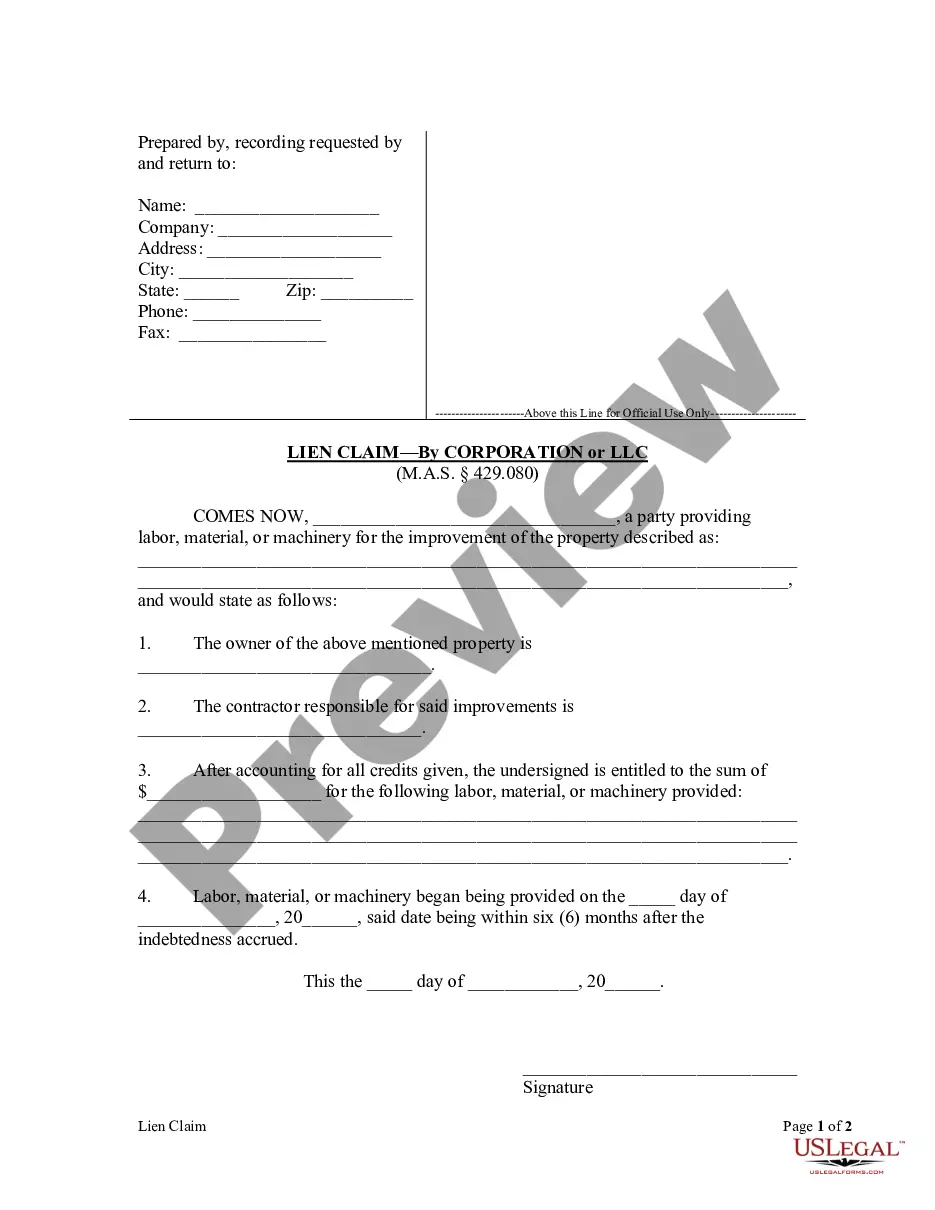
The Lien Claim - Corporation form is a legal document used in Missouri to assert a claim against a property for unpaid labor, materials, or machinery provided for improvements. This form is essential for contractors and suppliers seeking to ensure they are compensated for their work. Unlike general forms of lien claims, this specific version is tailored for corporations, making it critical for those operating in a corporate structure. This form must be completed and filed within six months of the debt accruing to be valid.
What’s included in this form
- Prepared by and return address fields for official use.
- Information about the lien claimant, including name, company, address, and contact details.
- Details of the property subject to the lien claim.
- Identification of the property owner and the contractor responsible for improvements.
- Financial details itemizing the amount owed after credits.
- Date when labor, materials, or machinery were first supplied.
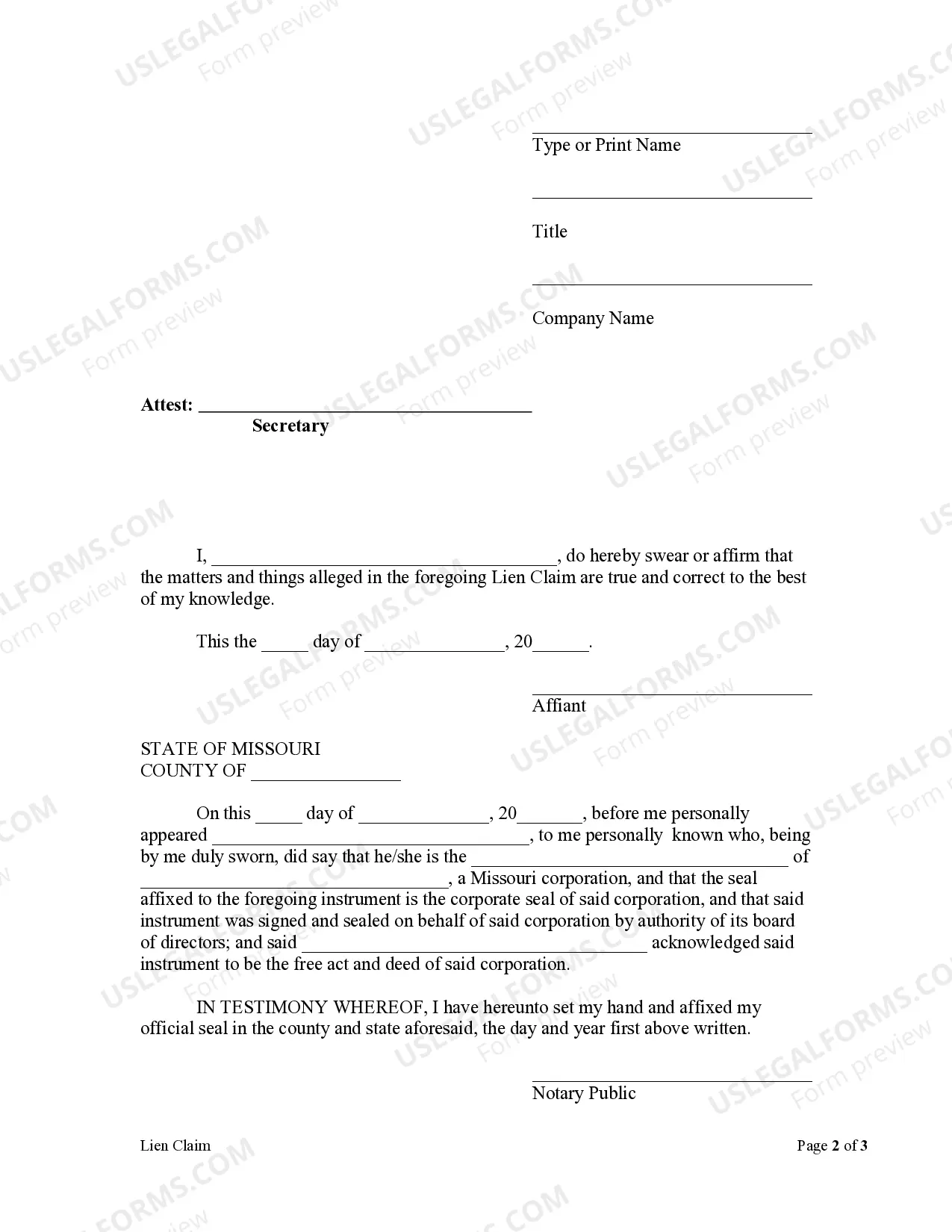
- Signature section for the lien claimant, including official verification by a notary public.
When to use this form
This form should be used when a corporation has provided labor, materials, or machinery for property improvements and has not been paid. If you are a contractor or supplier in Missouri and need to file a lien to secure payment, this form will help you formally assert your claim within the required time frame of six months after the debt has accrued.
Who can use this document
- Contractors who have not received payment for services rendered.
- Suppliers of materials used in property improvements.
- Certain corporations that engage in construction or renovation projects.
Steps to complete this form
- Fill in the details for the preparer, including name, company, and contact information.
- Describe the property where improvements were made.
- Identify the owner of the property and the contractor responsible for the improvements.
- Provide the total amount owed after accounting for any credits.
- Indicate the date when the work began.
- Sign the form and complete the notarization section to verify the claim.
Does this form need to be notarized?
This form must be notarized to be legally valid. US Legal Forms provides secure online notarization powered by Notarize, allowing you to complete the process through a verified video call.
Get your form ready online
Our built-in tools help you complete, sign, share, and store your documents in one place.
Make edits, fill in missing information, and update formatting in US Legal Forms—just like you would in MS Word.
Download a copy, print it, send it by email, or mail it via USPS—whatever works best for your next step.
Sign and collect signatures with our SignNow integration. Send to multiple recipients, set reminders, and more. Go Premium to unlock E-Sign.
If this form requires notarization, complete it online through a secure video call—no need to meet a notary in person or wait for an appointment.
We protect your documents and personal data by following strict security and privacy standards.

Make edits, fill in missing information, and update formatting in US Legal Forms—just like you would in MS Word.

Download a copy, print it, send it by email, or mail it via USPS—whatever works best for your next step.

Sign and collect signatures with our SignNow integration. Send to multiple recipients, set reminders, and more. Go Premium to unlock E-Sign.

If this form requires notarization, complete it online through a secure video call—no need to meet a notary in person or wait for an appointment.

We protect your documents and personal data by following strict security and privacy standards.
Common mistakes
- Failing to file the lien within the six-month deadline.
- Omitting important details about the property or services provided.
- Not having the form notarized when required.
- Incorrectly identifying the property owner or contractor.
Benefits of completing this form online
- Conveniently complete the form at your own pace.
- Easily revise and edit your entries before finalizing.
- Access reliable legal templates prepared by licensed attorneys.
Looking for another form?

Form popularity
FAQ
Yes, you can place a lien on a corporation in Missouri, provided you follow the appropriate legal procedures. A Missouri Lien Claim - Corporation allows creditors to secure their debts by establishing a legal claim against the corporation's assets. Utilizing resources from platforms like USLegalForms can help you navigate this process and ensure your lien is properly filed.
The 407.675 law in Missouri pertains to consumer protection and defines certain practices related to liens on property. It emphasizes fair dealings and transparency in lien claims, particularly those involving Missouri Lien Claim - Corporation. Familiarity with this law can help you ensure compliance and protect your rights as a creditor.
To file a lien in Missouri, you must provide essential information such as the debtor's name, the amount owed, and a description of the property involved. Additionally, you must comply with specific procedural steps to ensure your Missouri Lien Claim - Corporation is valid and enforceable. This process can be complex, but platforms like USLegalForms can simplify your experience and guide you through the necessary documentation.
The statute 492.100 in Missouri outlines the requirements for establishing and enforcing liens, particularly in relation to corporations. This statute provides the legal framework for filing a Missouri Lien Claim - Corporation, ensuring that creditors can protect their interests effectively. Understanding this statute is crucial for anyone looking to navigate the lien process in Missouri.
Keep in mind, however, that you must file this notice within 6 months after you recorded the mechanics lien. If you do not initiate foreclosure within the 6-month period, the mechanics lien will expire and it will no longer hold a claim against the property.
A mortgage creates a lien on your property that gives the lender the right to foreclose and sell the home to satisfy the debt. A deed of trust (sometimes called a trust deed) is also a document that gives the lender the right to sell the property to satisfy the debt should you fail to pay back the loan.
File your lien. If you're claiming a lien on real property, it must be filed in the recorder's office of the county where the property is located. Expect to pay a filing fee between $25 and $50 depending on the location where you file.
In Missouri, a mechanics lien must be filed within 6 months after the last day of services or materials were provided. This date is crucial to the rights of the project participant. The lien should be filed with the recorder of deeds in the county where the property is located.
A Missouri mechanics lien stays effective for 6 months from the date the lien was filed.
Missouri does not require that lien waivers be notarized in order to be effective. However, there are specific signature requirements that apply to residential jobs.