Minnesota Warranty Deed - One Individual to Four Individuals
Overview of this form
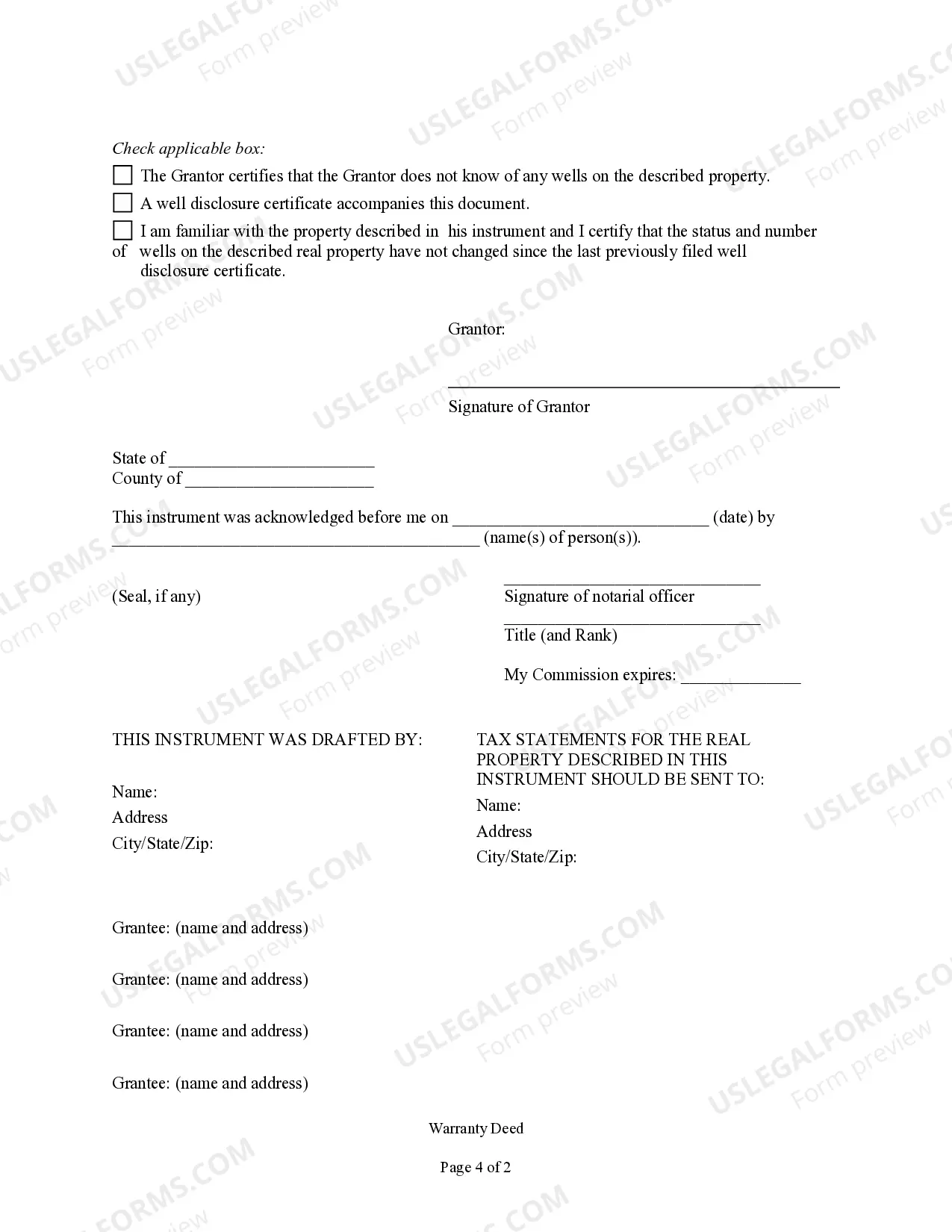
This Warranty Deed is a legal document that allows an individual, referred to as the Grantor, to convey property ownership to four individuals, known as the Grantees. This deed guarantees that the property title is being transferred with full warranties. The Grantees can hold the property either as tenants in common or as joint tenants with rights of survivorship. This document is essential for formalizing property transfers, ensuring that all parties have legal assurance over their ownership rights, which sets it apart from other types of deeds, like quitclaim deeds, which do not provide such warranties.
Key parts of this document
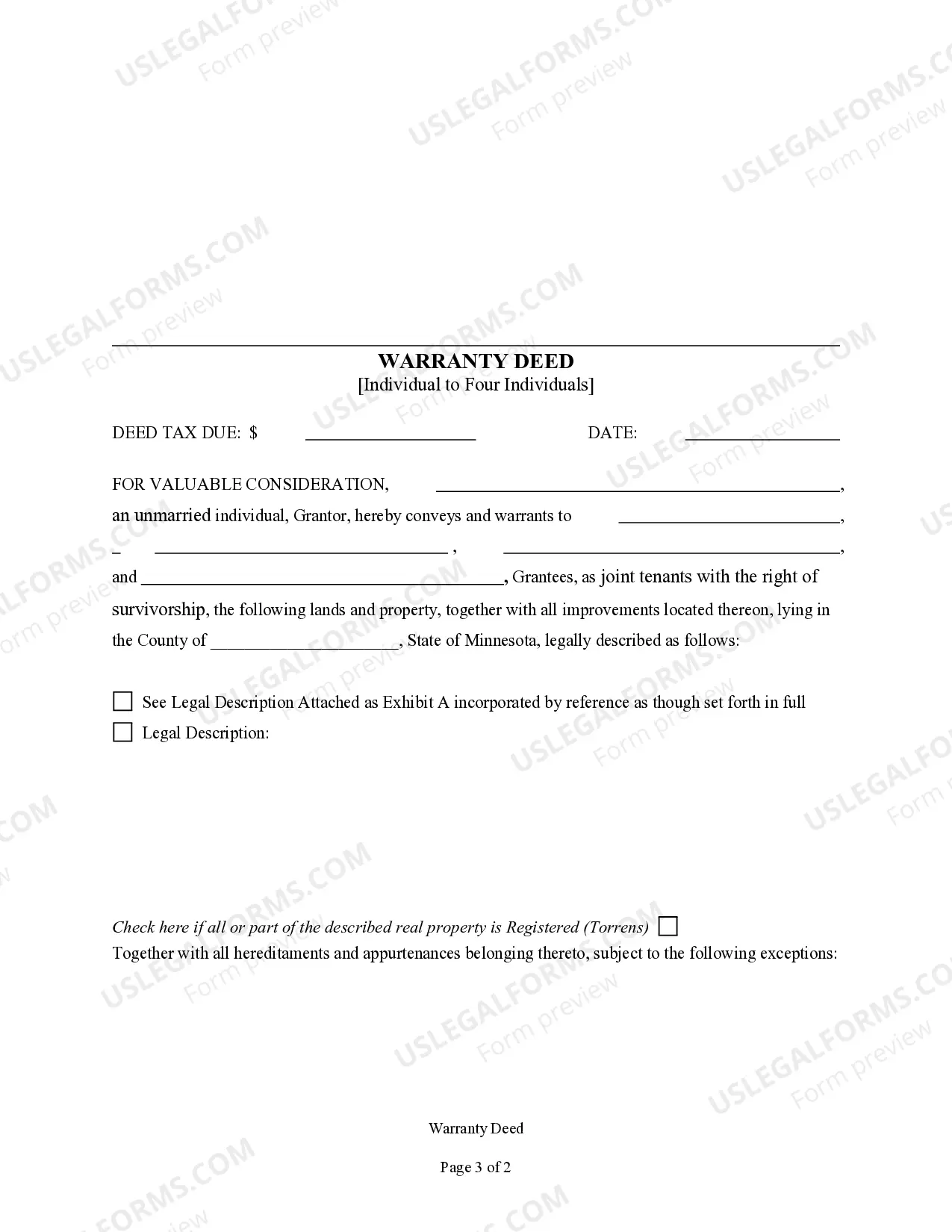
- Names and addresses of the Grantor and Grantees.
- Description of the property being conveyed.
- Statement of the type of ownership (tenancy in common or joint tenancy with rights of survivorship).
- Grantor's warranty of title.
- Signature of the Grantor.
- Date of execution.





When to use this document
This Warranty Deed should be used when an individual is transferring property ownership to four other individuals. It is particularly relevant in situations such as family property transfers, cooperative purchases, or joint investments in real estate, where multiple parties will share ownership of the property. It is important to have this form in place to ensure that all partiesâ rights and responsibilities are clearly defined and legally protected.
Who can use this document
This form is ideal for:
- Individuals looking to transfer real estate ownership to multiple parties.
- Families planning to share a property through joint ownership.
- Business partners investing in real estate together.
- Anyone needing a legally binding document that provides warranties regarding property title.
How to prepare this document
- Identify the Grantor and the four Grantees by entering their names and addresses.
- Clearly describe the property being transferred, including the legal description if available.
- Specify the kind of ownership structure (tenancy in common or joint tenancy with rights of survivorship).
- Have the Grantor sign the document in the designated area.
- Enter the date of signing to formalize the transaction.
Does this document require notarization?
This form must be notarized to be legally valid. US Legal Forms provides secure online notarization powered by Notarize, allowing you to complete the process through a verified video call.
Get your form ready online
Our built-in tools help you complete, sign, share, and store your documents in one place.
Make edits, fill in missing information, and update formatting in US Legal Forms—just like you would in MS Word.
Download a copy, print it, send it by email, or mail it via USPS—whatever works best for your next step.
Sign and collect signatures with our SignNow integration. Send to multiple recipients, set reminders, and more. Go Premium to unlock E-Sign.
If this form requires notarization, complete it online through a secure video call—no need to meet a notary in person or wait for an appointment.
We protect your documents and personal data by following strict security and privacy standards.
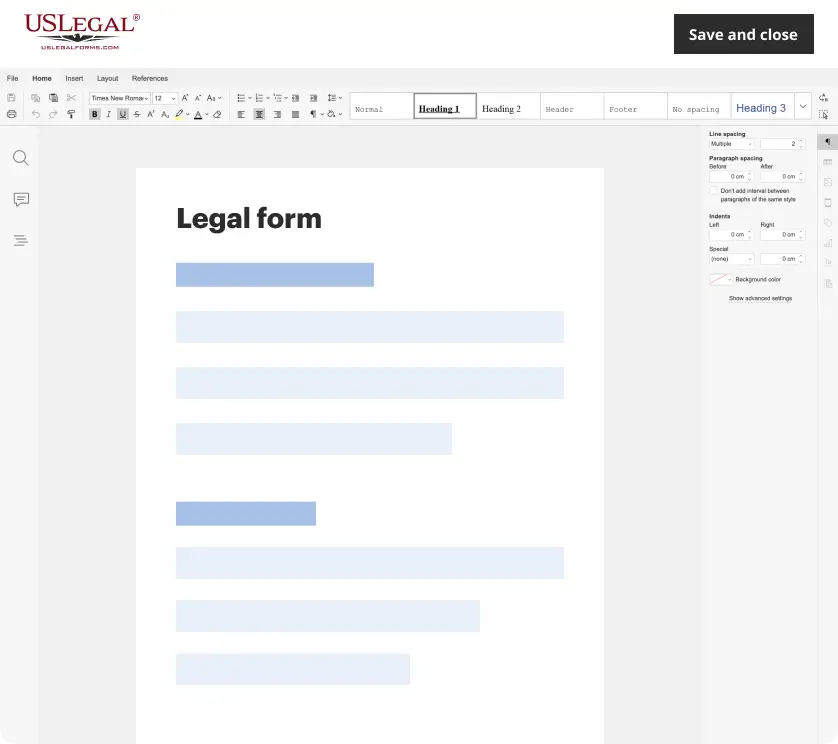
Make edits, fill in missing information, and update formatting in US Legal Forms—just like you would in MS Word.
Download a copy, print it, send it by email, or mail it via USPS—whatever works best for your next step.
Sign and collect signatures with our SignNow integration. Send to multiple recipients, set reminders, and more. Go Premium to unlock E-Sign.

If this form requires notarization, complete it online through a secure video call—no need to meet a notary in person or wait for an appointment.
We protect your documents and personal data by following strict security and privacy standards.
Common mistakes
- Failing to include a complete property description.
- Not specifying the correct ownership type that the Grantees will hold.
- Omitting required signatures or dates.
- Providing incorrect names or addresses for the parties involved.
Benefits of completing this form online
- Convenience: Download and fill out the form at your own pace from anywhere.
- Editability: Make corrections easily without starting from scratch.
- Reliability: Access to forms that are drafted by licensed attorneys to ensure compliance with legal standards.
Main things to remember
- The Warranty Deed - One Individual to Four Individuals is essential for transferring property to multiple owners.
- Accurate completion and notarization are crucial for the deed's legal validity.
- Understanding the ownership type impacts how the property is managed and inherited.
- Using this deed can simplify property transfers in family and business contexts.
Looking for another form?

Form popularity
FAQ
A special warranty deed can raise concerns for potential buyers, as it only guarantees that the grantor holds title during their ownership period. Unlike a full warranty deed, the Minnesota Warranty Deed - One Individual to Four Individuals offers broader protections against claims before the grantor's ownership. Buyers should be cautious and conduct thorough property research. Consulting with legal professionals can help clarify any risks associated with special warranty deeds.
Several factors can contribute to a deed's invalidity, including improper execution, lack of necessary signatures, or failure to adhere to state laws. If a deed does not accurately describe the property or if there are issues with the grantor's ownership rights, it may be challenged in court. For those dealing with potential deed issues, using resources like US Legal Forms can provide guidance on proper execution and compliance.
A warranty deed may be deemed invalid if it lacks essential elements, such as a signature from the grantor or proper notarization. Additionally, if the grantor did not have the legal capacity to transfer the property, the deed could be challenged. Errors in the property description or failure to meet state regulations can also render the Minnesota Warranty Deed - One Individual to Four Individuals invalid. It is crucial to ensure all requirements are met to avoid complications.
A Minnesota Warranty Deed - One Individual to Four Individuals is valid when it includes specific elements such as a clear description of the property, the grantor's signature, and proper notarization. The deed must also be delivered to the grantee to transfer ownership legally. Additionally, the grantor should have the legal capacity to convey the property. Ensuring that these components are in place can solidify the deed's legitimacy.
In Minnesota, a warranty deed must be signed by the grantor, who is transferring the property. However, it is not necessary for the grantee to sign the Minnesota Warranty Deed - One Individual to Four Individuals. This means that while the seller's signature is crucial for the deed's validity, the buyer's signature is not required. Still, having both parties sign can help prevent disputes and clarify intentions.
Yes, a Minnesota Warranty Deed - One Individual to Four Individuals can be challenged under certain circumstances. If a party believes that the deed was signed under duress, fraud, or misrepresentation, they may contest it in court. Additionally, disputes may arise regarding the property boundaries or ownership claims, which can lead to legal challenges. It is essential to understand your rights and seek legal advice if you believe a warranty deed has been improperly executed.
Adding someone to your deed can be straightforward if you follow the right steps. With the Minnesota Warranty Deed - One Individual to Four Individuals, you can easily outline the new ownership structure. While the process may involve some paperwork, using resources like US Legal Forms can make it easier by providing clear instructions and necessary forms. Overall, with the right guidance, you can successfully add a name to your deed without unnecessary complications.
To add a name to a property title, you will need to prepare a Minnesota Warranty Deed - One Individual to Four Individuals. This deed allows you to transfer ownership rights to another person effectively. You should ensure that you have the correct legal description of the property and the names of all individuals involved. Utilizing a platform like US Legal Forms can simplify this process, providing templates and guidance to help you complete the deed accurately.
Adding someone to your Minnesota Warranty Deed - One Individual to Four Individuals involves creating a new deed that includes both your name and the new co-owner's name. You will need to fill out a new warranty deed form, listing all parties involved, and include the property's legal description. After completing the form, sign it in front of a notary public, and then file the new deed with your local county recorder's office. Utilizing services like US Legal Forms can simplify this process and ensure you have the correct documentation.
Yes, you can complete a Minnesota Warranty Deed - One Individual to Four Individuals without an attorney, provided you understand the process. Many individuals find it straightforward by using templates or online services. However, while it is possible, consulting an attorney can help avoid potential mistakes and ensure compliance with local laws. If you choose to go without legal assistance, consider using platforms like US Legal Forms for guidance and accurate forms.