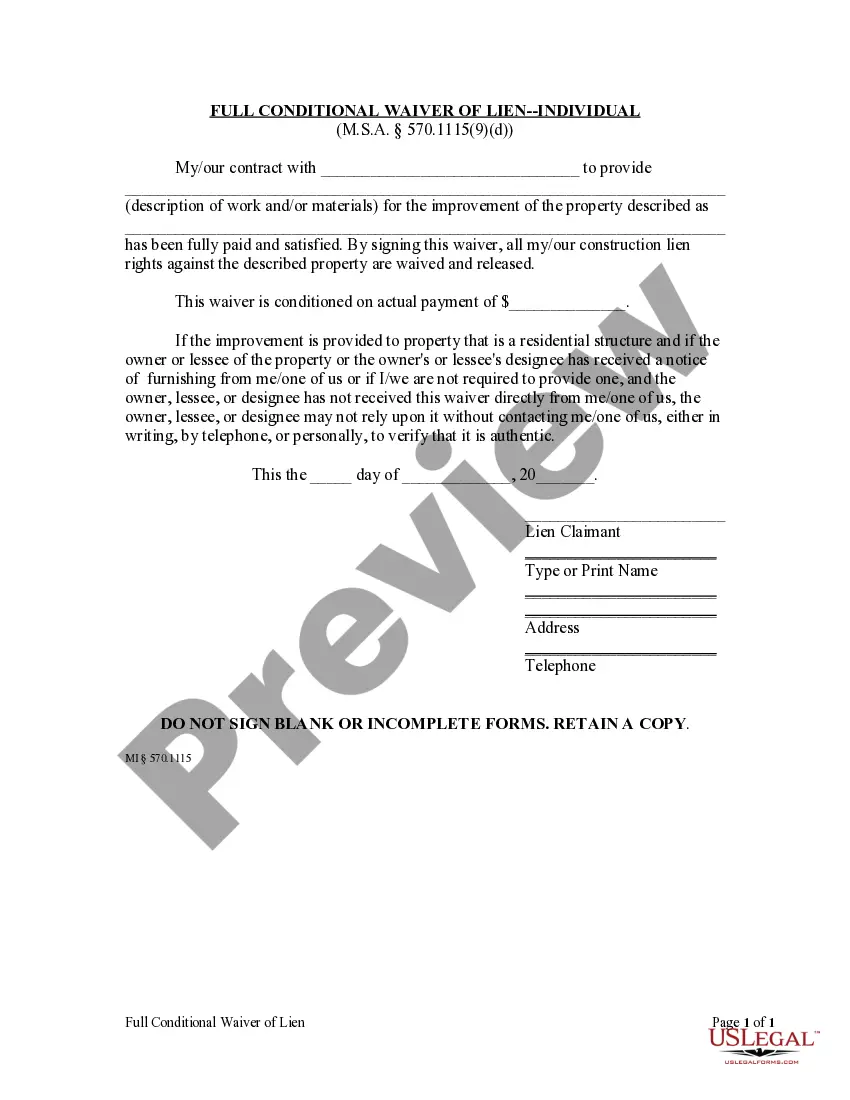
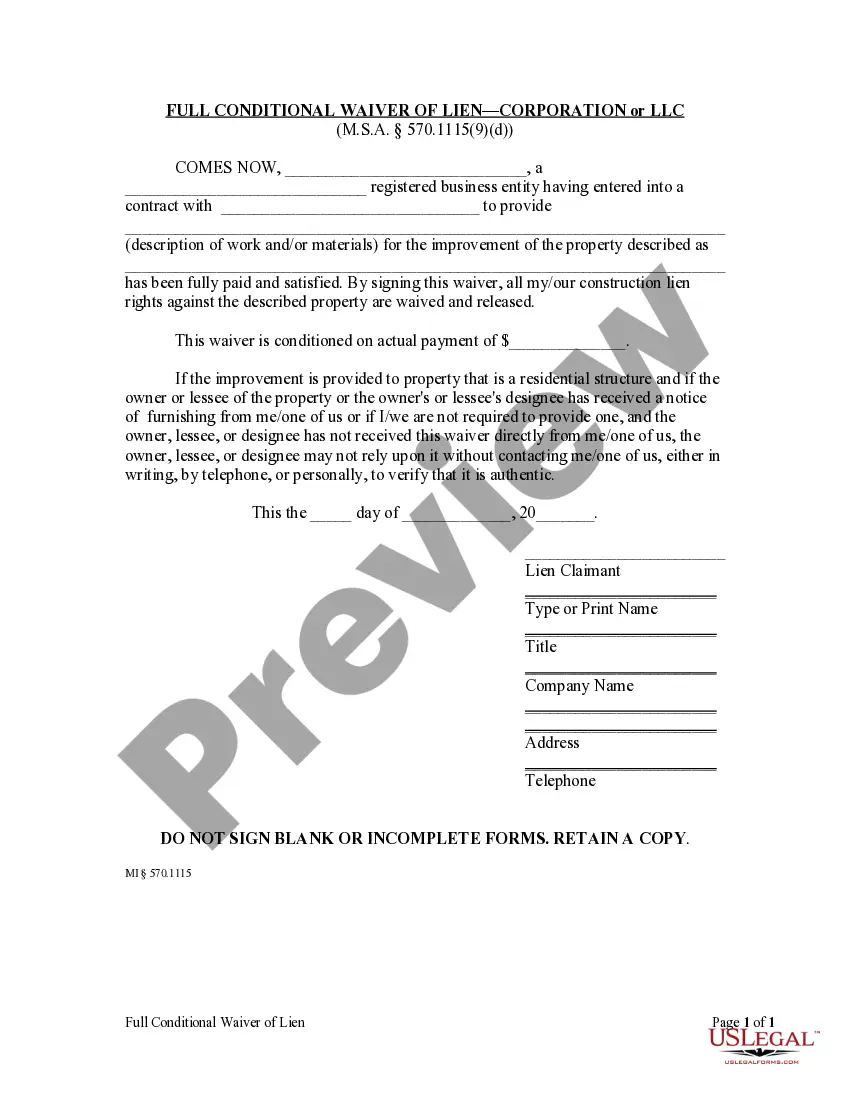
Michigan Full Conditional Waiver and Release of Lien by Contractor - Individual
What is this form?
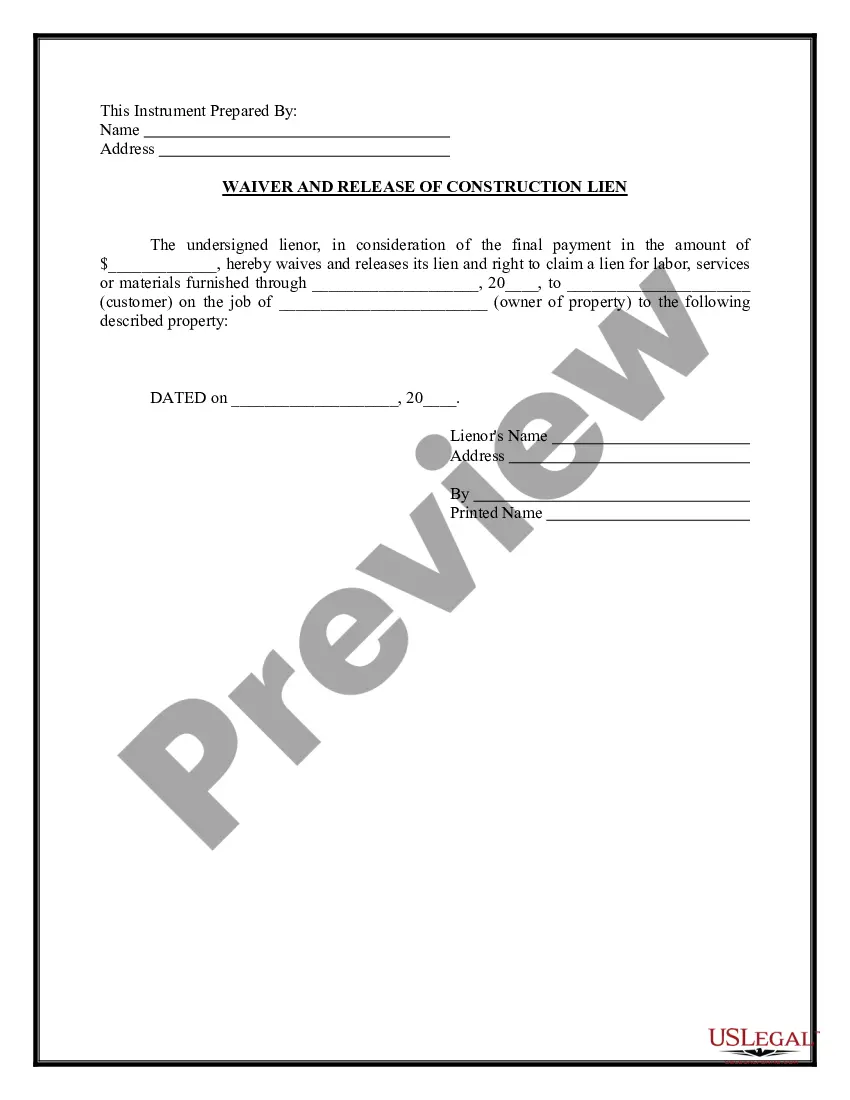
The Full Conditional Waiver and Release of Lien by Contractor - Individual is a legal document used by contractors, subcontractors, or suppliers when payment is made. Its primary purpose is to serve as both a receipt for payment and a notice to the property owner that construction lien rights are being waived. Unlike other forms of lien waivers, this full conditional waiver implies that the contractor is relinquishing their right to file a lien, contingent on the final payment being made.
Main sections of this form
- Contractorâs name and details of work or materials provided
- Description of the property where work was performed
- Conditional payment amount that triggers the waiver
- Signature and printed name of the lien claimant
- Date of signing the waiver

Common use cases
This form should be used in situations where a contractor, subcontractor, or supplier has completed work on a property and has received, or is about to receive, payment. It protects the contractor's interests while clearly communicating to the property owner that their right to file a lien will be waived upon the receipt of the agreed payment.
Who should use this form
- Contractors providing services or materials to a property
- Subcontractors working under main contractors
- Suppliers of construction materials
- Property owners receiving work that will trigger lien rights
Steps to complete this form
- Identify the parties involved, including the contractor and property owner.
- Clearly specify the work done or materials supplied.
- Describe the property accurately for legal clarity.
- Enter the exact payment amount that is conditional for the waiver.
- Sign and date the document, ensuring all fields are complete.
Does this document require notarization?
This form does not typically require notarization unless specified by local law. However, it is advised to check with legal counsel or local regulations to confirm if notarization is necessary for your specific situation.
Get your form ready online
Our built-in tools help you complete, sign, share, and store your documents in one place.
Make edits, fill in missing information, and update formatting in US Legal Forms—just like you would in MS Word.
Download a copy, print it, send it by email, or mail it via USPS—whatever works best for your next step.
Sign and collect signatures with our SignNow integration. Send to multiple recipients, set reminders, and more. Go Premium to unlock E-Sign.
If this form requires notarization, complete it online through a secure video call—no need to meet a notary in person or wait for an appointment.
We protect your documents and personal data by following strict security and privacy standards.

Make edits, fill in missing information, and update formatting in US Legal Forms—just like you would in MS Word.

Download a copy, print it, send it by email, or mail it via USPS—whatever works best for your next step.

Sign and collect signatures with our SignNow integration. Send to multiple recipients, set reminders, and more. Go Premium to unlock E-Sign.

If this form requires notarization, complete it online through a secure video call—no need to meet a notary in person or wait for an appointment.

We protect your documents and personal data by following strict security and privacy standards.
Typical mistakes to avoid
- Leaving fields blank, especially the payment amount and date.
- Failing to provide an accurate description of the property.
- Not obtaining proper signatures before submitting the form.
- Using this form when not all payment obligations have been met.
Benefits of using this form online
- Convenience of downloading and completing the form at your own pace.
- Editable format allows for easy adjustments and accurate information input.
- Access to templates drafted by licensed attorneys for legal reliability.
Looking for another form?

Form popularity
FAQ
Conditional lien waivers are conditioned upon something (typically the receipt of payment).The party receiving payment maintains its right to file a lien until the check is actually cashed; the party making payment will never face double payment (paying the party they hired and also being faced with a lien).
A "Conditional Waiver and Release Upon Progress Payment" discharges all claimant rights through a specific date, provided the payments have actually been received and processed. An "Unconditional Waiver and Release Upon Final Payment" extinguishes all claimant rights upon receipt of the payment.
Colorado does not require lien waivers to be notarized in order to be effective.
A lien waiver is signed before a lien is actually filed. The party submitting the lien waiver states that they waive the right to lien against the project. In some instances, the property owner or general contractor may request that you sign and deliver a lien waiver before payment is disbursed.
Conditional lien waivers are provided by contractors or suppliers before they've been paid.The form says they will waive their right to lien once they receive the payment, so they can't file a lien after payment has been received.
It basically states that you've paid the subcontractor what is owed, they accept the payment in full, and they waive the right to put a lien on your property. Simply present this form to the subcontractor with your payment and ask them to sign it. Make sure you get their signature!
LIen waivers are not required to be notarized. The primary times that a document needs to be notarized is if it is going to be filed with the county recorder or it is an affidavit. There are some other documents that often use notarization, but lien...
The main purpose of a lien waiver is to provide protection to the paying party. In exchange for such payment, the lien waiver waives the payee's right to file a lien for the exact value of the payment they have received.