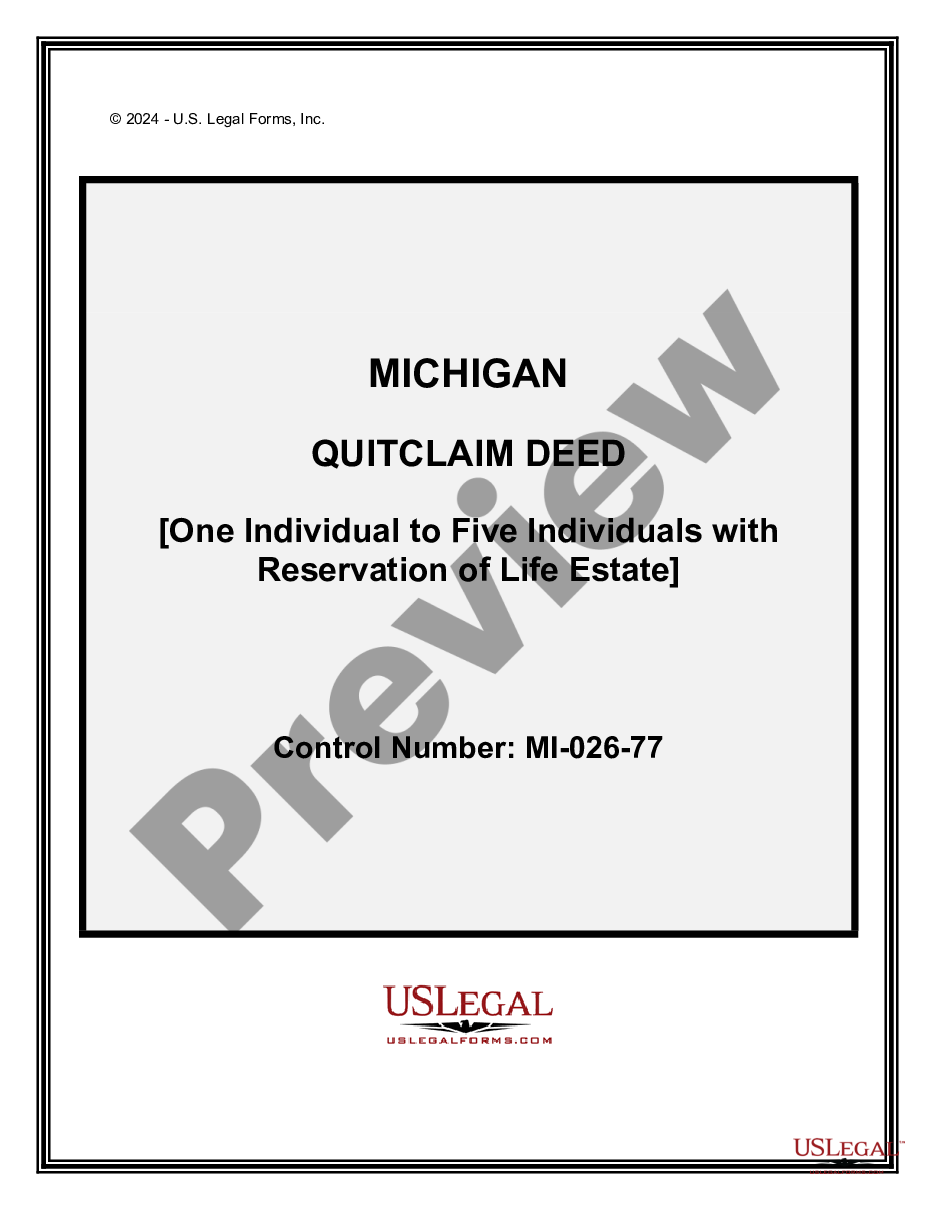
Michigan Quitclaim Deed - One Individual to Five Individuals Subject to Retained Life Estate
Understanding this form
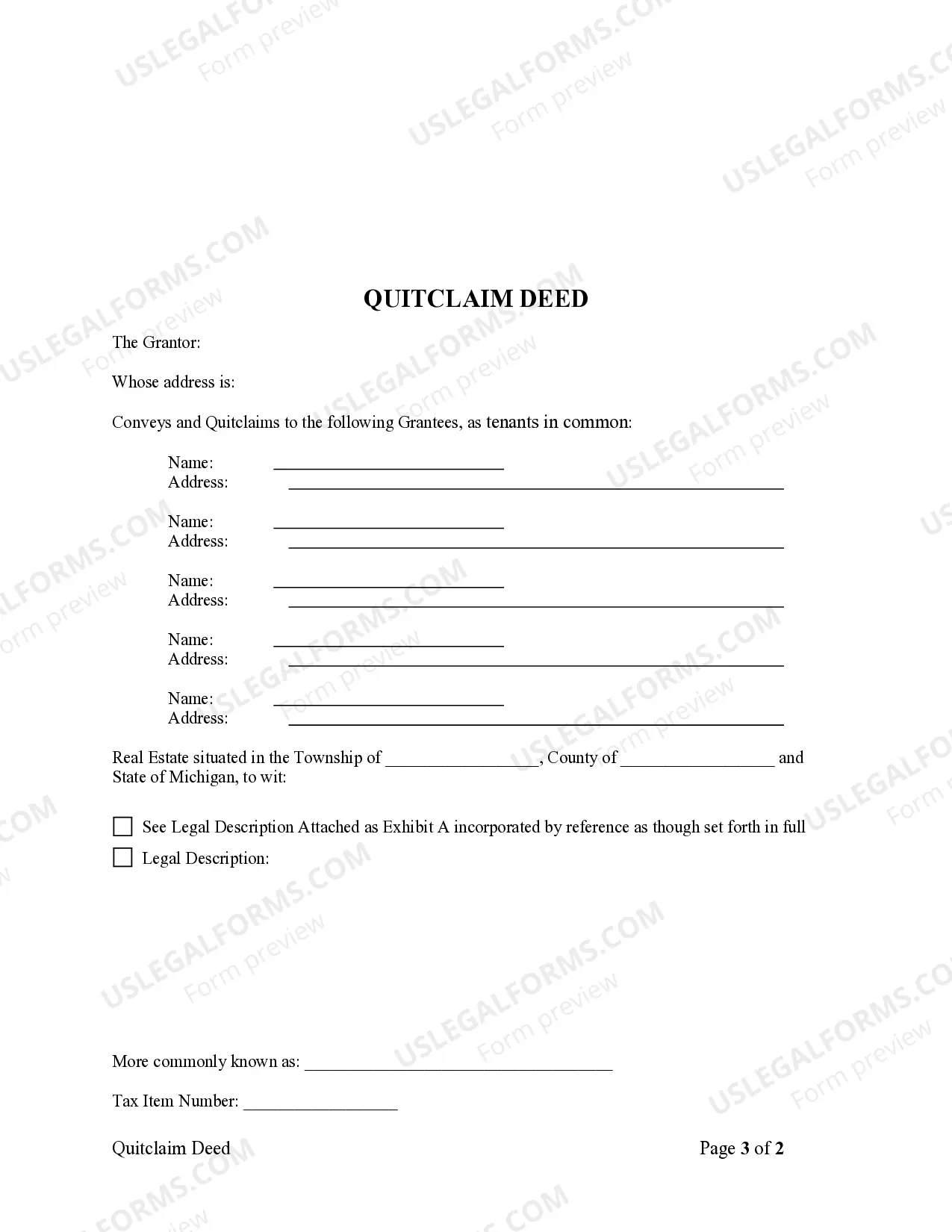
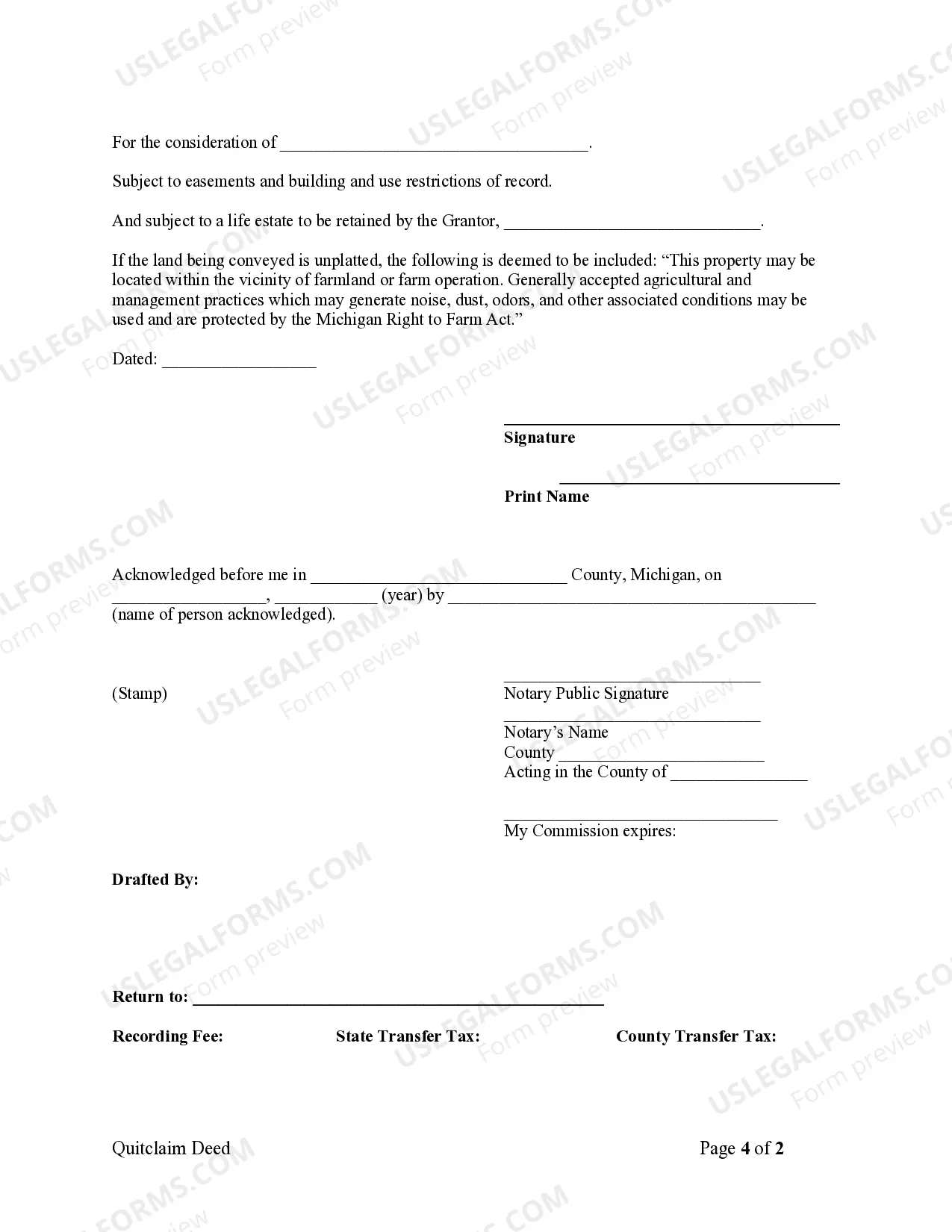
The Quitclaim Deed - One Individual to Five Individuals Subject to Retained Life Estate is a legal document used to transfer property ownership from one individual to five individuals. This form allows the grantor (the seller) to convey and quitclaim the described property to the grantees (the buyers) as either tenants in common or joint tenants with the right of survivorship, while retaining a life estate in the property. This form complies with all state statutory laws and differs from other deeds by emphasizing the grantor's rights during their lifetime.
What’s included in this form
- Identification of the grantor and grantees.
- Detailed description of the property being transferred.
- Specification of the ownership structure (tenants in common or joint tenants with right of survivorship).
- Retention of life estate by the grantor.
- Signatures of the parties involved, along with the date of execution.





When to use this form
This form is useful when an individual wishes to transfer property to multiple individuals while retaining a right to live in the property during their lifetime. Common scenarios include transferring family property to children or relatives where the grantor wants to maintain some control or residency in the property until their death.
Who should use this form
- Property owners looking to transfer property to multiple parties.
- Individuals who want to retain a life estate in the property being transferred.
- Heirs or beneficiaries managing property transitions after a family member's passing.
Steps to complete this form
- Identify the grantor and all grantees by providing their full legal names.
- Clearly describe the property being transferred, including its address and legal description.
- Indicate whether the ownership will be as tenants in common or joint tenants with the right of survivorship.
- Ensure the grantor's retained life estate is specified within the document.
- Sign and date the document in the presence of any necessary witnesses or notaries.
Notarization requirements for this form
This form does not typically require notarization unless specified by local law. However, signing in the presence of a notary can provide added legal protection and authenticity to the transfer.
Get your form ready online
Our built-in tools help you complete, sign, share, and store your documents in one place.
Make edits, fill in missing information, and update formatting in US Legal Forms—just like you would in MS Word.
Download a copy, print it, send it by email, or mail it via USPS—whatever works best for your next step.
Sign and collect signatures with our SignNow integration. Send to multiple recipients, set reminders, and more. Go Premium to unlock E-Sign.
If this form requires notarization, complete it online through a secure video call—no need to meet a notary in person or wait for an appointment.
We protect your documents and personal data by following strict security and privacy standards.

Make edits, fill in missing information, and update formatting in US Legal Forms—just like you would in MS Word.

Download a copy, print it, send it by email, or mail it via USPS—whatever works best for your next step.

Sign and collect signatures with our SignNow integration. Send to multiple recipients, set reminders, and more. Go Premium to unlock E-Sign.

If this form requires notarization, complete it online through a secure video call—no need to meet a notary in person or wait for an appointment.

We protect your documents and personal data by following strict security and privacy standards.
Mistakes to watch out for
- Failing to clearly identify the property description.
- Not specifying the correct form of ownership (tenants in common vs. joint tenants).
- Omitting signatures or dates, which can invalidate the deed.
Benefits of completing this form online
- Convenience of completing the form digitally, saving time and reducing errors.
- Editability allows users to make changes easily if details change.
- Reliability of using professionally drafted templates ensures compliance with legal standards.
Legal use & context
- The Quitclaim Deed effectively transfers ownership as intended.
- It is important for parties to understand the limitations regarding warranties.
- May not provide the same level of protection as other deed types, such as warranty deeds.
Looking for another form?
Form popularity
FAQ
Fill out the quit claim deed form, which can be obtained online, or write your own using the form as a guide. The person giving up the interest in the property is the grantor, and the person receiving the interest is the grantee.
Write the Deed Fill out the quit claim deed form, which can be obtained online, or write your own using the form as a guide. The person giving up the interest in the property is the grantor, and the person receiving the interest is the grantee.
Step 1: Download the MI quitclaim deed form. Step 2: Add the name and address of the preparer under Prepared By on the first line of the document. Step 3: Add the return address under After Recording Return To. This is typically the name and address of the grantee, but it could be a different party.
A Michigan lady bird deed form allows a person to retain control over Michigan real estate during his or her life and automatically transfer the real estate at his or her death. The property transfer occurs automatically at the prior owner's death, avoiding probate.
To use a Quitclaim Deed to add someone to a property deed or title, you would need to create a Quitclaim Deed and list all of the current owners in the grantor section. In the grantee section, you would list all of the current owners as well as the person you would like to add.
But you might be wondering if an owner can transfer a deed to another person without a real estate lawyer. The answer is yes. Parties to a transaction are always free to prepare their own deeds.A quitclaim deed, for example, is far simpler than a warranty deed.
It's usually a very straightforward transaction, but it's possible for a quitclaim deed to be challenged. If a quitclaim deed is challenged in court, the issue becomes whether the property was legally transferred and if the grantor had the legal right to transfer the property.
In Michigan, a quit claim deed must be signed by a witness, in addition to the notary, to make it legal.After all required signatures are collected and notarized, file the document with your local register of deeds to complete the transaction.
The Quit Claim Deed form uses the terms of Grantor (Seller or Owner of said property) and Grantee (Buyer of said property) for the two parties involved. First, the parties must fill in the date. Then, write in the name of the county and state in which the property is located.