Michigan Quitclaim Deed from Individual to Husband and Wife
About this form
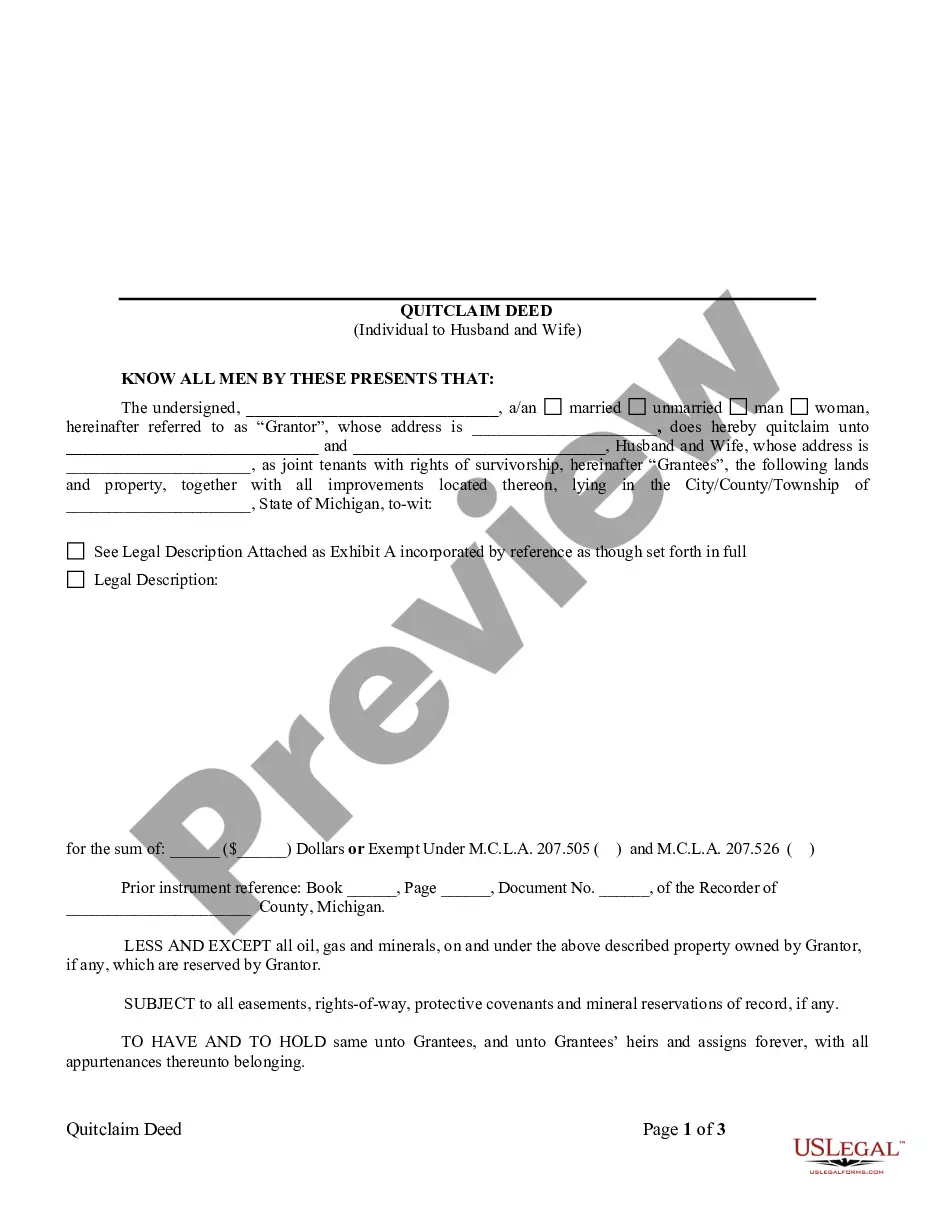
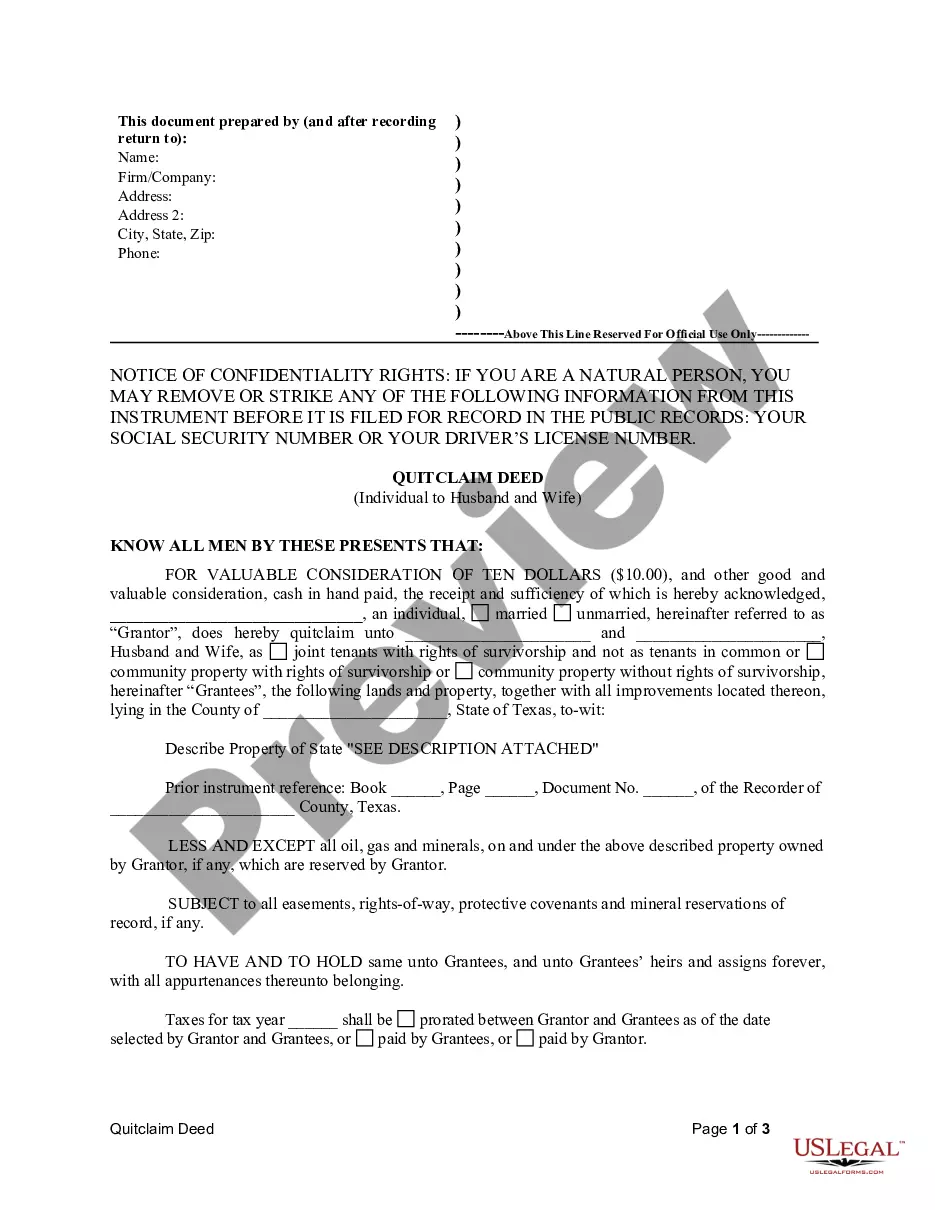
The Quitclaim Deed from Individual to Husband and Wife is a legal document that allows an individual (the Grantor) to transfer ownership of property to a married couple (the Grantees). This type of deed is commonly used to complete property transfers between family members or married couples. Unlike other deeds, a quitclaim deed does not assure the Grantees of clear title, making it a straightforward, often quicker option for transferring ownership without the complexities involved in a warranty deed.
Key components of this form
- Grantor's information: Name, marital status, and address of the individual transferring the property.
- Grantees' information: Names and addresses of the husband and wife receiving the property.
- Property description: A detailed legal description of the property being transferred.
- Reservation clause: Specifies any oil, gas, and mineral rights retained by the Grantor.
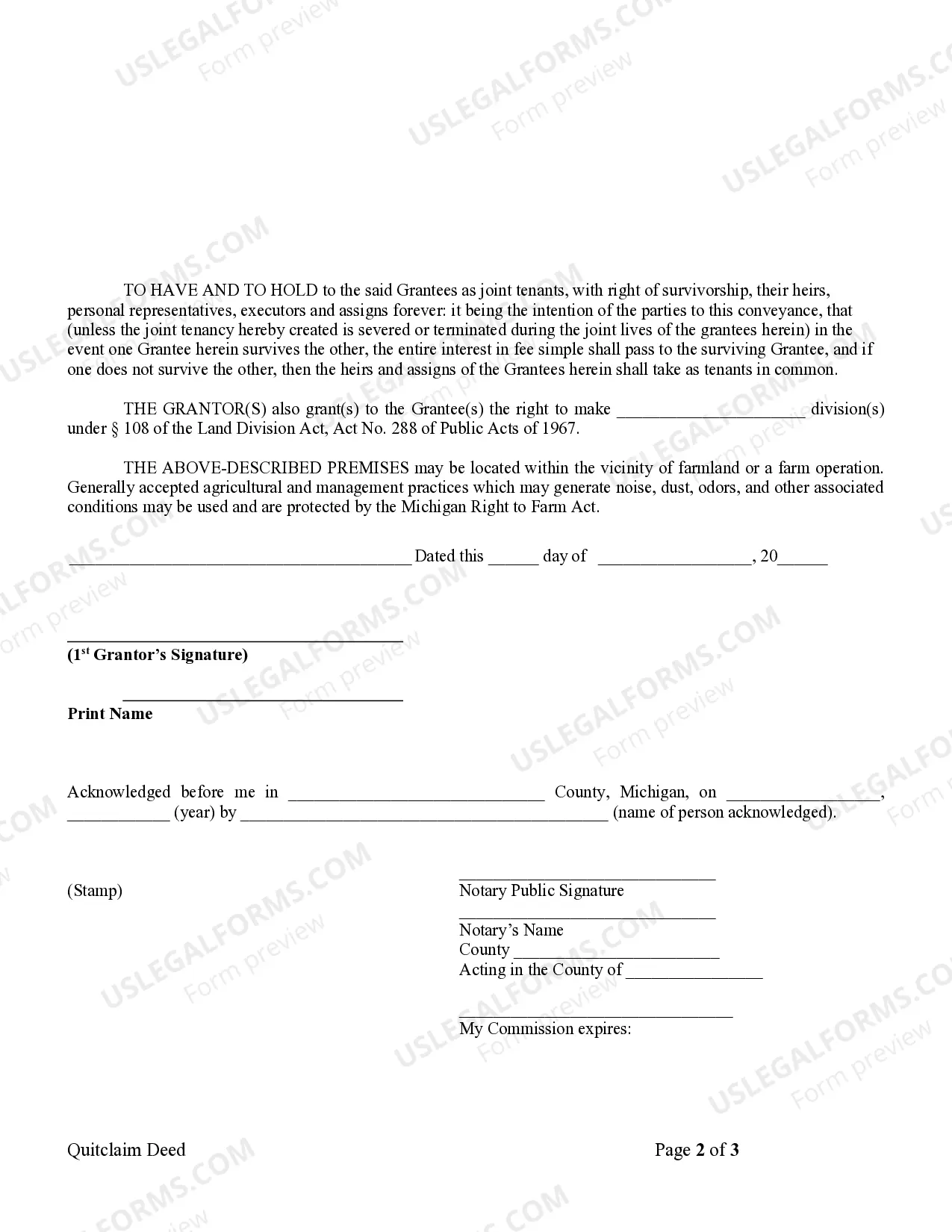
- Joint tenancy clause: Outlines the survivorship rights of the Grantees.
- Notary acknowledgment: Certification that the document was signed in front of a notary public.







When to use this document
This quitclaim deed is typically used when an individual wishes to transfer property ownership to their spouse or partner. Situations may include an individual wanting to formally add a spouse to the title of a property, transferring property as part of a divorce settlement, or managing estate planning within a family. It simplifies property ownership arrangements without the need for a sale or financial compensation.
Who needs this form
This form is intended for:
- Individuals who wish to transfer property to their spouse.
- Married couples who are consolidating their property ownership.
- Individuals involved in estate planning who want to ensure their spouse inherits property seamlessly.
- Property owners seeking to clarify joint ownership with rights of survivorship between spouses.
Steps to complete this form
- Identify the Grantor: Fill in the individualâs name, marital status, and address.
- Identify the Grantees: Enter the names and addresses of the husband and wife receiving the deed.
- Specify the property: Include a complete legal description of the property being transferred.
- Complete the reservation clause: Mark any retained rights, such as oil, gas, and minerals.
- Obtain notarization: Have the Grantor sign the document in front of a notary public to ensure its legality.
Does this document require notarization?
Yes, this form must be notarized to be legally valid. Notarization ensures that the document is recognized and enforceable in a court of law. US Legal Forms offers integrated online notarization services, allowing you to complete this process securely through video calls available 24/7 without the need for travel.
Get your form ready online
Our built-in tools help you complete, sign, share, and store your documents in one place.
Make edits, fill in missing information, and update formatting in US Legal Forms—just like you would in MS Word.
Download a copy, print it, send it by email, or mail it via USPS—whatever works best for your next step.
Sign and collect signatures with our SignNow integration. Send to multiple recipients, set reminders, and more. Go Premium to unlock E-Sign.
If this form requires notarization, complete it online through a secure video call—no need to meet a notary in person or wait for an appointment.
We protect your documents and personal data by following strict security and privacy standards.

Make edits, fill in missing information, and update formatting in US Legal Forms—just like you would in MS Word.

Download a copy, print it, send it by email, or mail it via USPS—whatever works best for your next step.

Sign and collect signatures with our SignNow integration. Send to multiple recipients, set reminders, and more. Go Premium to unlock E-Sign.

If this form requires notarization, complete it online through a secure video call—no need to meet a notary in person or wait for an appointment.

We protect your documents and personal data by following strict security and privacy standards.
Mistakes to watch out for
- Failing to provide a complete legal description of the property.
- Not obtaining a notary signature, which can invalidate the deed.
- Incorrectly filling out the names and details of the Grantor and Grantees.
- Omitting the reservation clause if applicable, leading to unintended loss of rights.
Why use this form online
- Convenience of completing the form from home without the need for physical paperwork.
- Editability allows for easy updates to be made as necessary before finalizing the document.
- Access to templates created by licensed attorneys, ensuring legal compliance.
What to keep in mind
- The Quitclaim Deed from Individual to Husband and Wife allows for the straightforward transfer of property ownership.
- It is essential to fill out the form correctly and have it notarized for it to be legally effective.
- This document does not guarantee clear title, making it a suitable choice for personal transactions.
- Understand state-specific requirements to ensure compliance with local laws.
Looking for another form?
Form popularity
FAQ
You can prepare your own Michigan Quitclaim Deed from Individual to Husband and Wife if you feel confident in your legal writing skills. However, using a service like US Legal Forms simplifies the process and provides you with properly formatted documents tailored to Michigan law. This option can save you time and reduce the risk of errors that could complicate your property transfer.
If you live in a common-law state, you can keep your spouse's name off the title the document that says who owns the property.You can put your spouse on the title without putting them on the mortgage; this would mean that they share ownership of the home but aren't legally responsible for making mortgage payments.
There will be a $30 recording fee. If you prepare a quitclaim deed using the Do-It-Yourself Quitclaim Deed (after Divorce) tool, detailed instructions on what to do next will print out along with the deed.
To add your spouse to your property deed: Have your lawyer do a Michigan Quit Claim Deed for you and then record it with your County's Register of Deeds. If you croak before you get it recorded, your property goes into probate, instead of to your spouse.
Signing: § 565.201 requires that the grantor sign the document in front of a notary public. Recording: All quitclaim deeds in Michigan must be filed with the Michigan Register of Deeds in the county where the property is located.
Yes you can. This is called a transfer of equity but you will need the permission of your lender. If you are not married or in a civil partnership you may wish to consider creating a deed of trust and a living together agreement which we can explain to you.
But you might be wondering if an owner can transfer a deed to another person without a real estate lawyer. The answer is yes. Parties to a transaction are always free to prepare their own deeds.A quitclaim deed, for example, is far simpler than a warranty deed.
A Michigan quitclaim deed form provides no warranty of title. That means that the new owner has no legal right to sue the prior owner if there is a problem with the title to the property. The new owner simply takes whatever title that the prior owner has.
When it comes to reasons why you shouldn't add your new spouse to the Deed, the answer is simple divorce and equitable distribution. If you choose not to put your spouse on the Deed and the two of you divorce, the entire value of the home is not subject to equitable distribution.
In Michigan, a quit claim deed must be signed by a witness, in addition to the notary, to make it legal.After all required signatures are collected and notarized, file the document with your local register of deeds to complete the transaction.