Maine Notice to Owner - Corporation or LLC
What is this form?
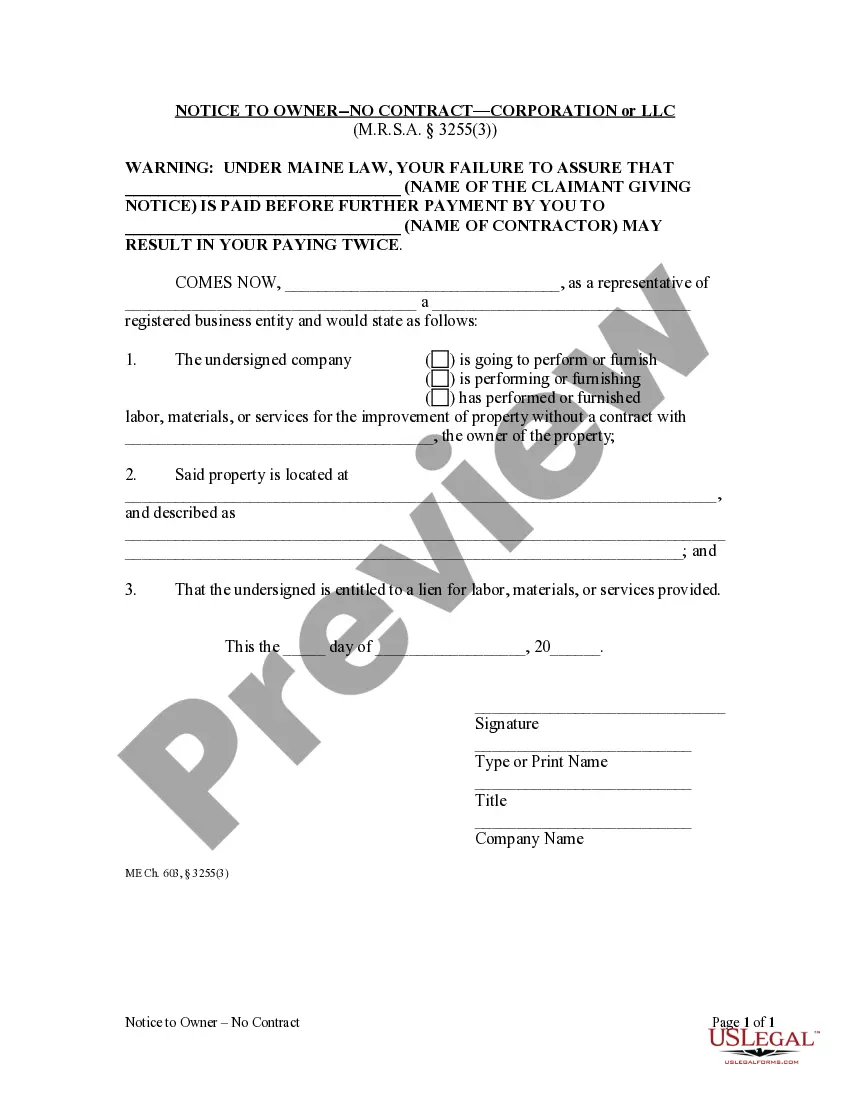
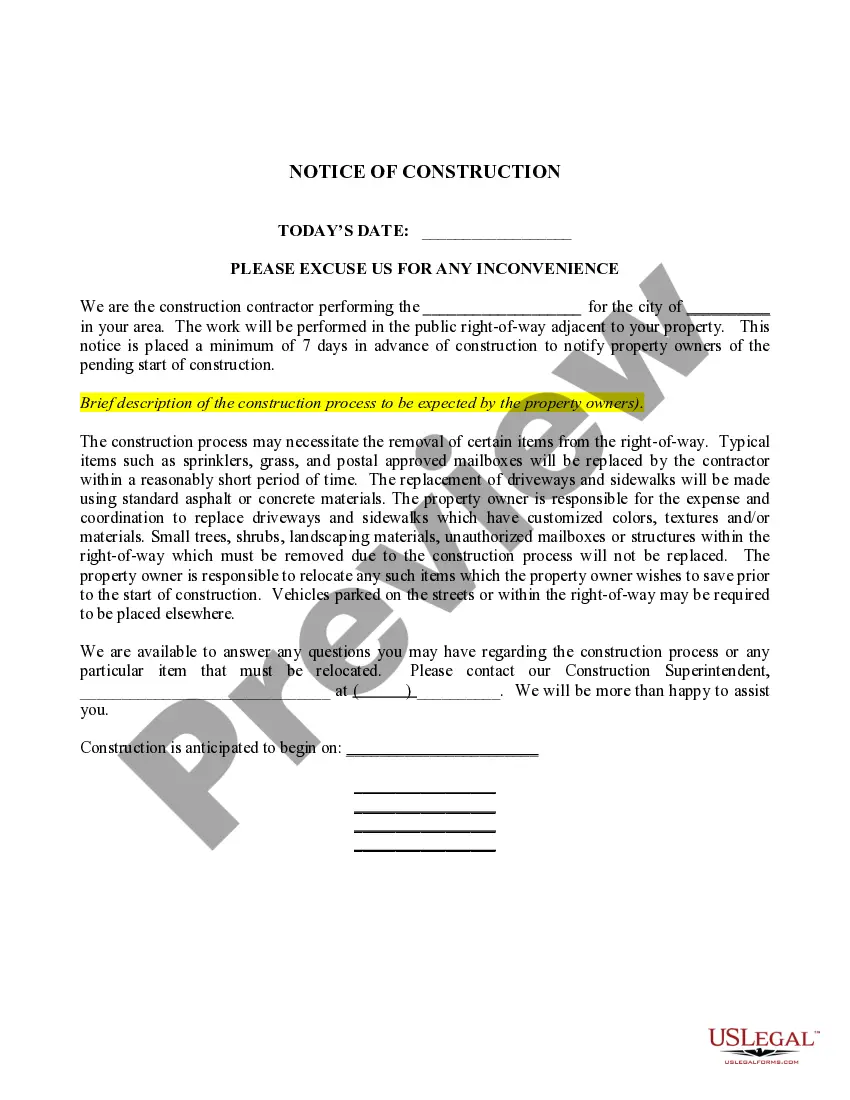
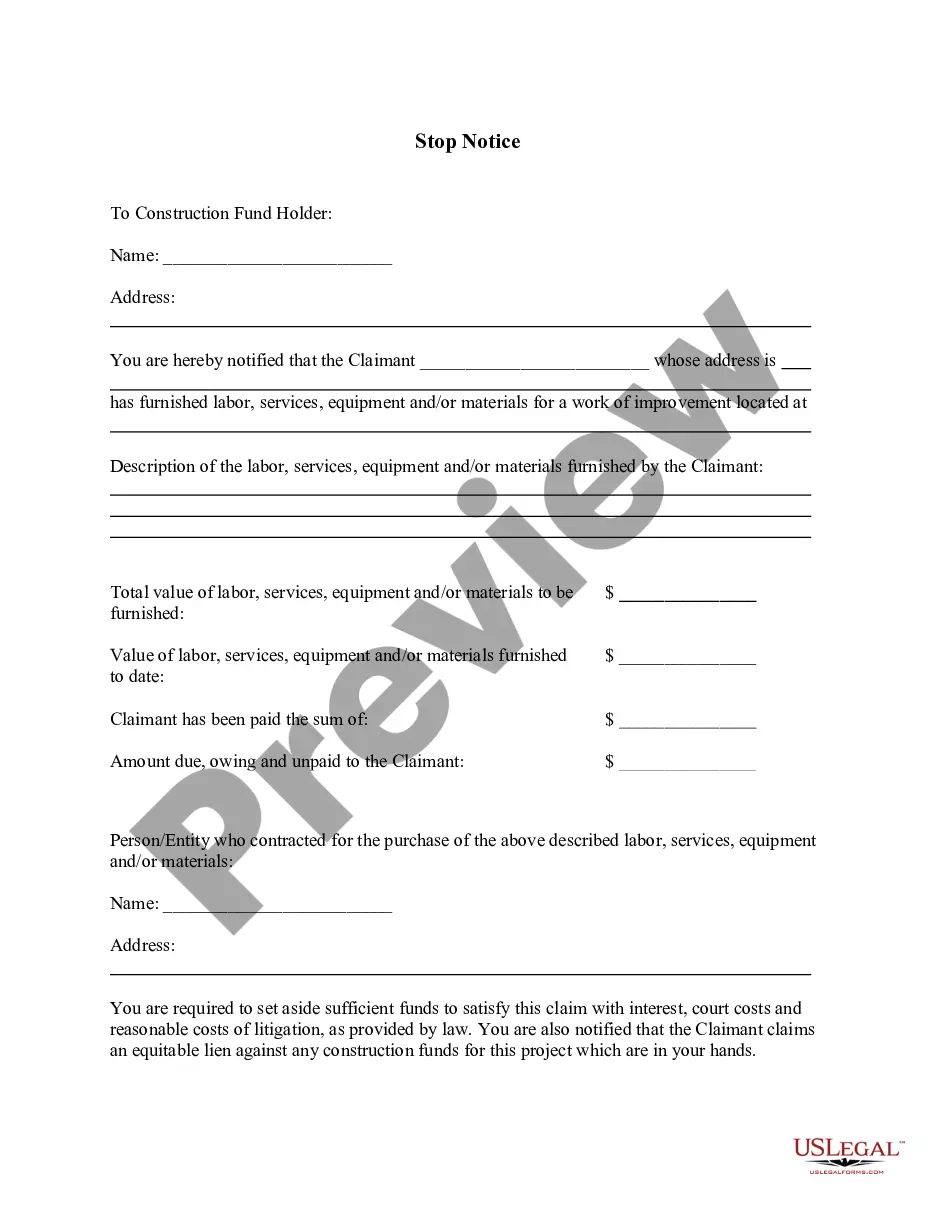
The Notice to Owner - Corporation or LLC is a legal document that alerts property owners of a subcontractor's rights when they provide labor, materials, or services without a direct contract with the owner. This form is crucial for ensuring that subcontractors can secure a lien on the property for unpaid work, protecting their financial interests. It differs from other legal notices as it specifically emphasizes the owner's responsibility to pay subcontractors to avoid double payment for the same services rendered.
Main sections of this form
- Warning notice about potential double payment obligations.
- Identification of the claimant subcontractor.
- Description of services, materials, or labor provided.
- Details of the property where the work was done.
- Signature and title of the authorized representative of the corporation.
Situations where this form applies
This form should be used any time a corporation or LLC provides labor, materials, or services to a property without a formal contract with the property owner. Utilizing this notice can safeguard the subcontractor's right to a lien against the property, especially when there is a concern that the owner may not be aware of their obligation to pay for the services rendered.
Who should use this form
- Subcontractors providing labor or services to a property.
- Corporations and LLCs that engage in contracting work without direct agreements with property owners.
- Property owners wishing to understand their responsibilities regarding subcontractors.
Completing this form step by step
- Identify and enter the name of the subcontractor giving notice.
- Specify the name of the contractor whom the owner has contracted.
- Describe the materials, services, or labor provided or to be provided.
- Provide details about the property, including its location and description.
- Have an authorized representative sign the document, including their title and corporation name.
Notarization requirements for this form
This form does not typically require notarization unless specified by local law. Users should check Maine law or consult with legal advisors for any specific notarization requirements.
Get your form ready online
Our built-in tools help you complete, sign, share, and store your documents in one place.
Make edits, fill in missing information, and update formatting in US Legal Forms—just like you would in MS Word.
Download a copy, print it, send it by email, or mail it via USPS—whatever works best for your next step.
Sign and collect signatures with our SignNow integration. Send to multiple recipients, set reminders, and more. Go Premium to unlock E-Sign.
If this form requires notarization, complete it online through a secure video call—no need to meet a notary in person or wait for an appointment.
We protect your documents and personal data by following strict security and privacy standards.

Make edits, fill in missing information, and update formatting in US Legal Forms—just like you would in MS Word.

Download a copy, print it, send it by email, or mail it via USPS—whatever works best for your next step.

Sign and collect signatures with our SignNow integration. Send to multiple recipients, set reminders, and more. Go Premium to unlock E-Sign.

If this form requires notarization, complete it online through a secure video call—no need to meet a notary in person or wait for an appointment.

We protect your documents and personal data by following strict security and privacy standards.
Common mistakes
- Not providing complete or accurate information about services provided.
- Failing to sign the form or provide the representative's title.
- Neglecting to deliver the notice to the property owner in a timely manner.
- Assuming that a verbal agreement is sufficient without written documentation.
Why complete this form online
- Convenient access to downloadable templates that can be tailored to specific needs.
- Easy edits allow for quick updates or modifications to specific details.
- Legal forms are drafted by licensed attorneys, ensuring compliance with state laws.
Looking for another form?
Form popularity
FAQ
Forming an LLC or a corporation will allow you to take advantage of limited personal liability for business obligations. LLCs are favored by small, owner-managed businesses that want flexibility without a lot of corporate formality. Corporations are a good choice for a business that plans to seek outside investment.
A limited liability company (LLC) is a type of business entity defined by state law. An individual may do business as an LLC in what is called a single-member LLC. A sole proprietorship, on the other hand, is a business owned and operated by one person, but it is neither an LLC nor a corporation.
A Limited Liability Company (LLC) is an entity created by state statute. Depending on elections made by the LLC and the number of members, the IRS will treat an LLC either as a corporation, partnership, or as part of the owner's tax return (a disregarded entity).
The main difference between an LLC and a corporation is that an llc is owned by one or more individuals, and a corporation is owned by its shareholders. No matter which entity you choose, both entities offer big benefits to your business. Incorporating a business allows you to establish credibility and professionalism.
How is a corporation formed? When individuals decide that they wish to form a corporation, they must file articles of incorporation with the Office of the Secretary of State. The articles of incorporation establish the individuals' intent to form the corporation and indicate who is forming the corporation.
In an LLC, individuals with an ownership share are called members. In a corporation, they are called shareholders. One of the advantages an LLC has over a corporation is that in many states, a creditor cannot collect a member's dividends, whereas in a corporation dividends can be collected from shareholders.
Can Two LLCs or Companies Have the Same Name? Yes, with some exceptions. When you're forming a corporation or an LLC in a state, the name must be unique to your business within that state. Others can form LLCs and businesses in other states that have the same name as yours.
All states recognize businesses formed as corporations, limited liability companies (LLCs) or partnerships, or variations of these forms. Forming an LLC. An LLC is formed by one or more business people, as owners. The owners, called "members," file Articles of Organization with a state.
An LLC can achieve pass-through taxation status without any of those restrictions. LLCs also offer more income tax choices in how you are taxed. By default, LLCs enjoy pass-through taxation under IRS rules. However, by making an IRS election, you could have your LLC taxed as a C corporation or an S Corporation.