Maine Renunciation and Disclaimer of Property from Will by Testate
What is this form?
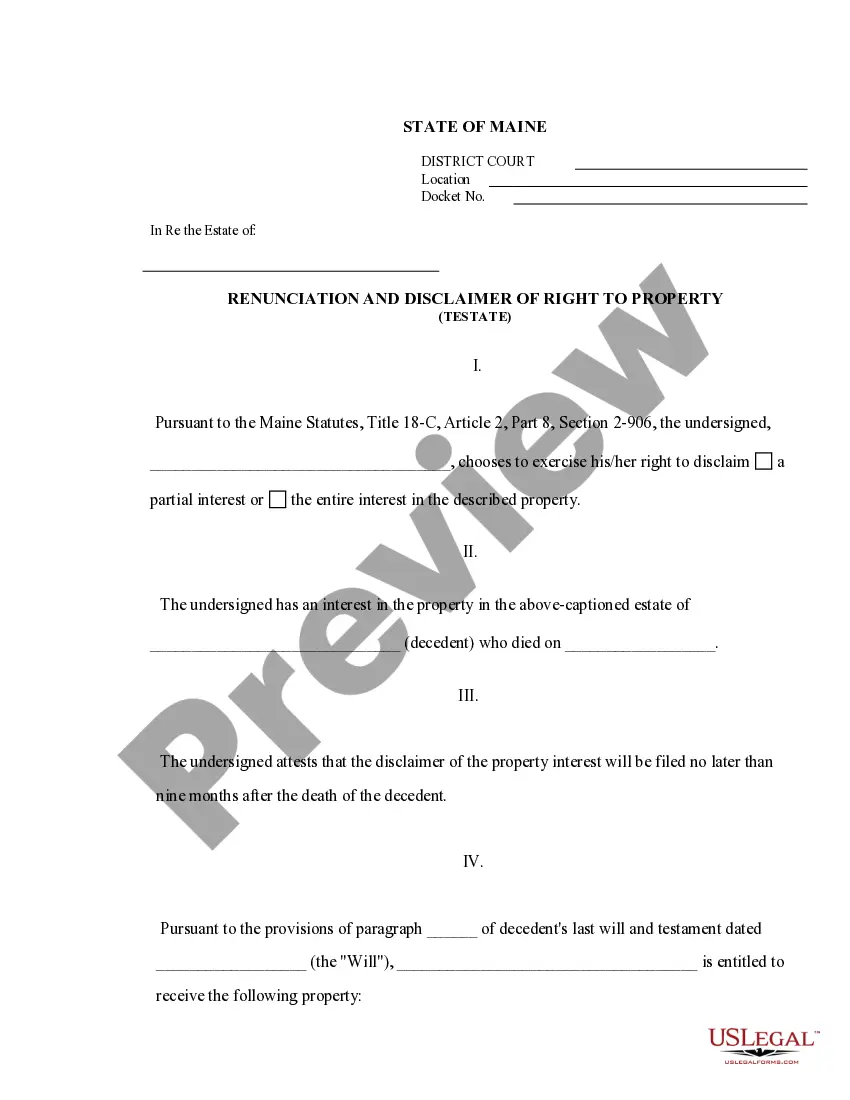
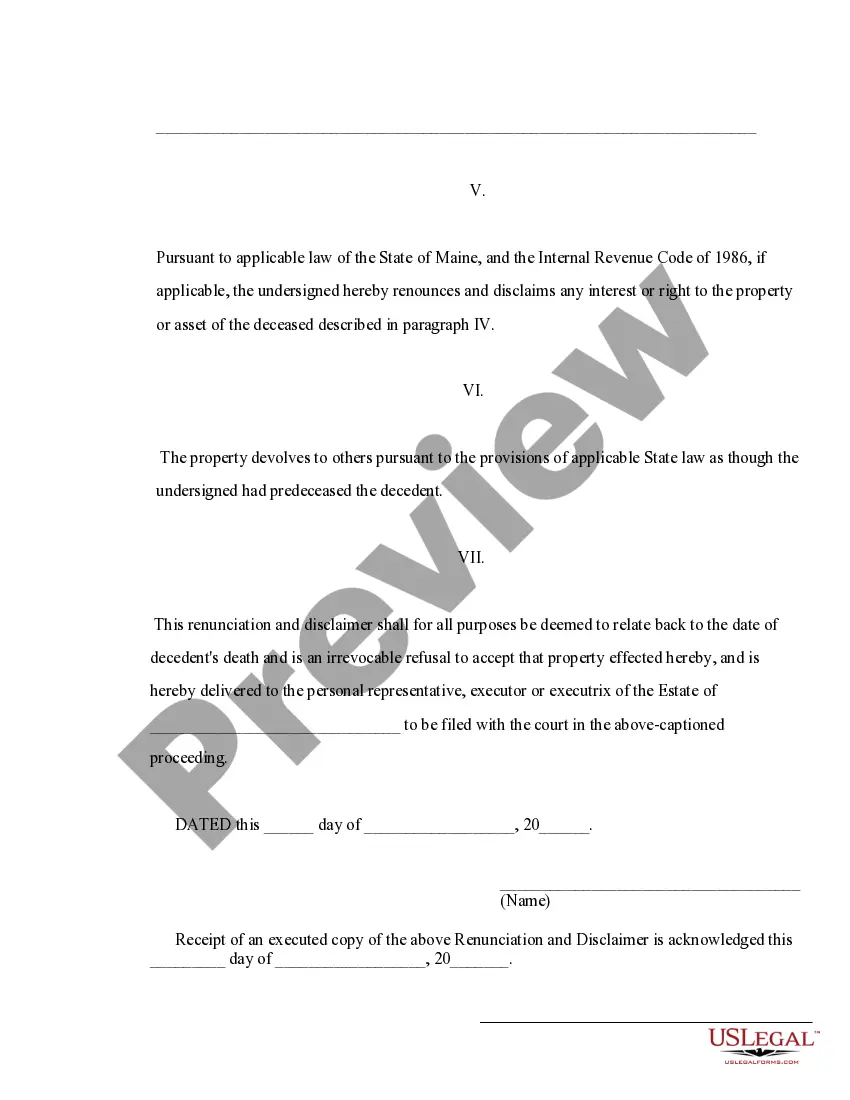
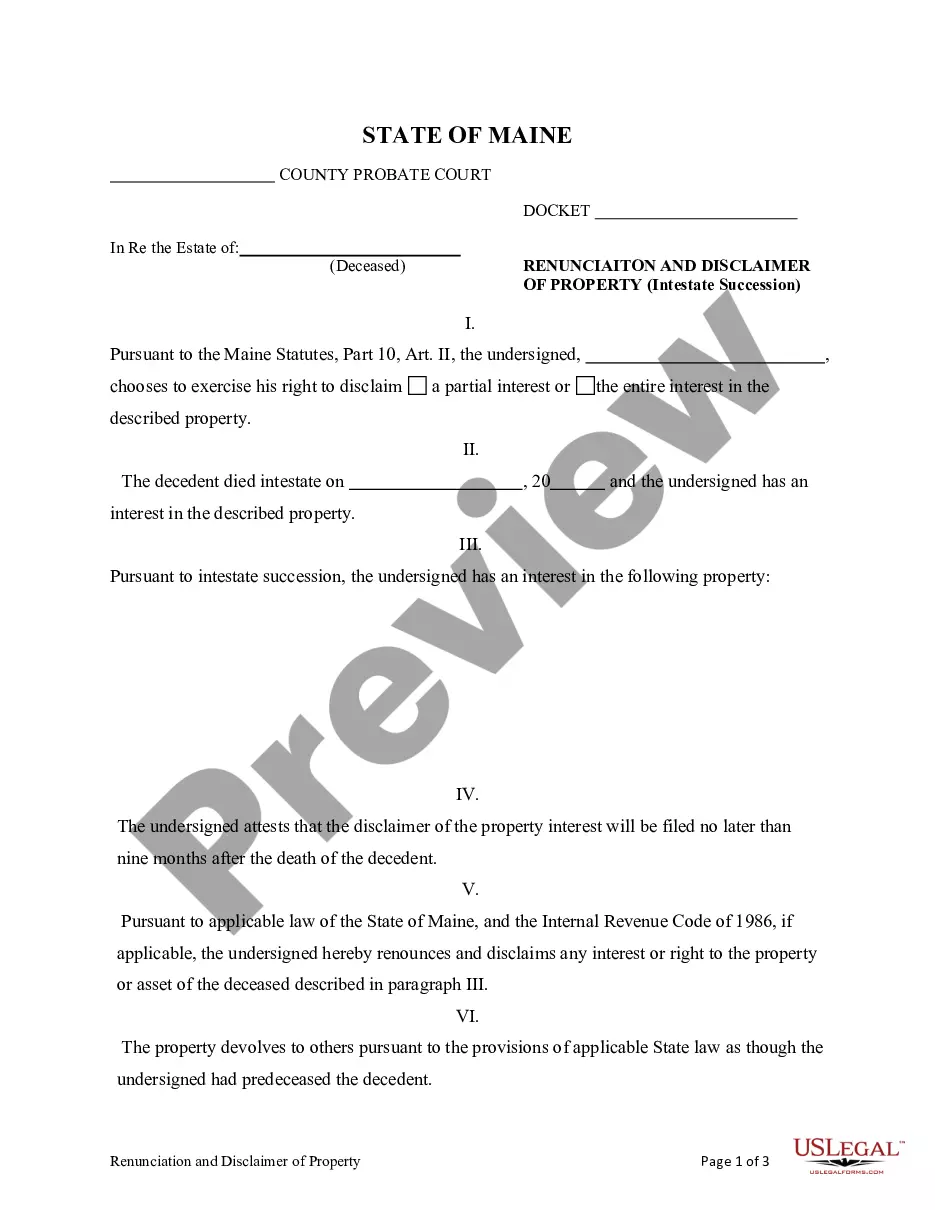
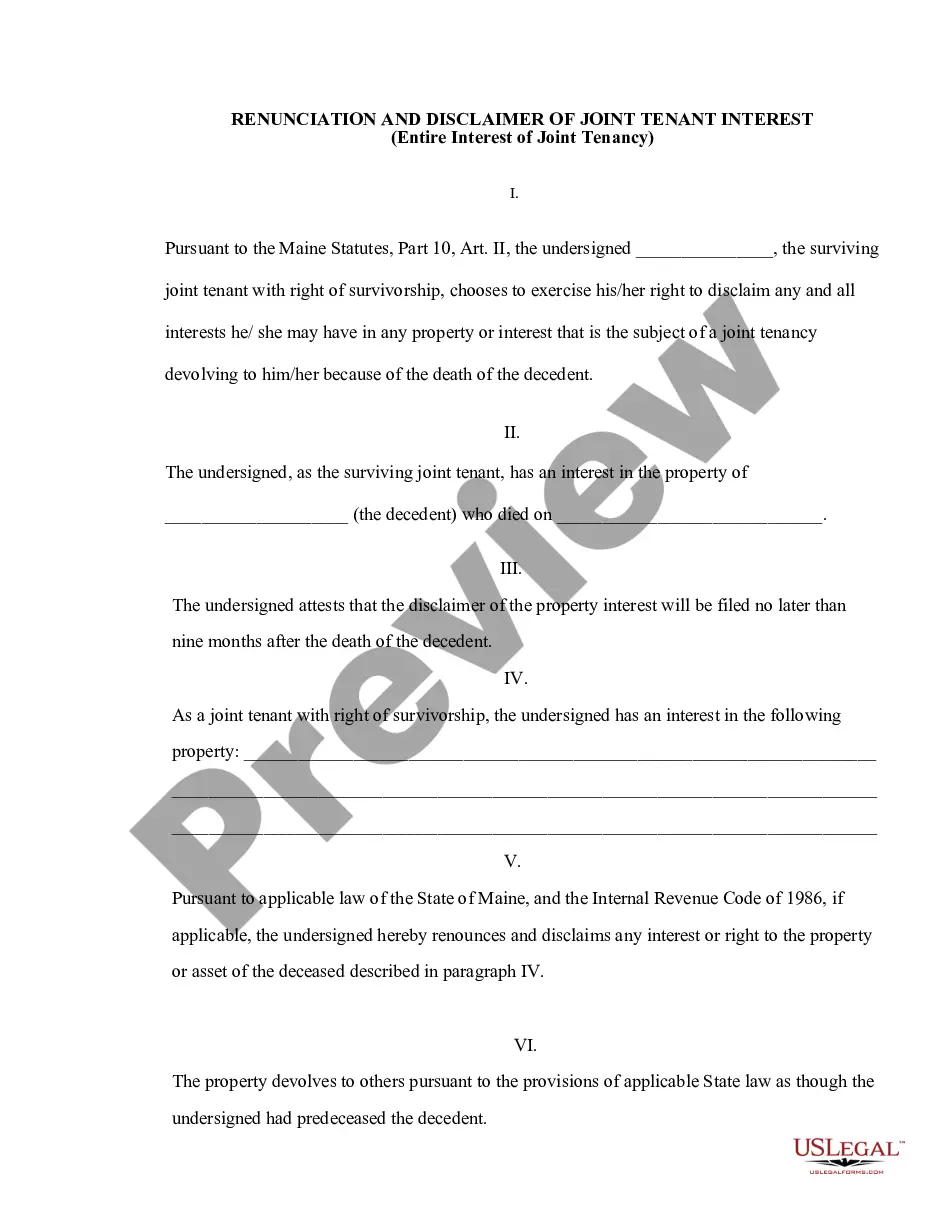
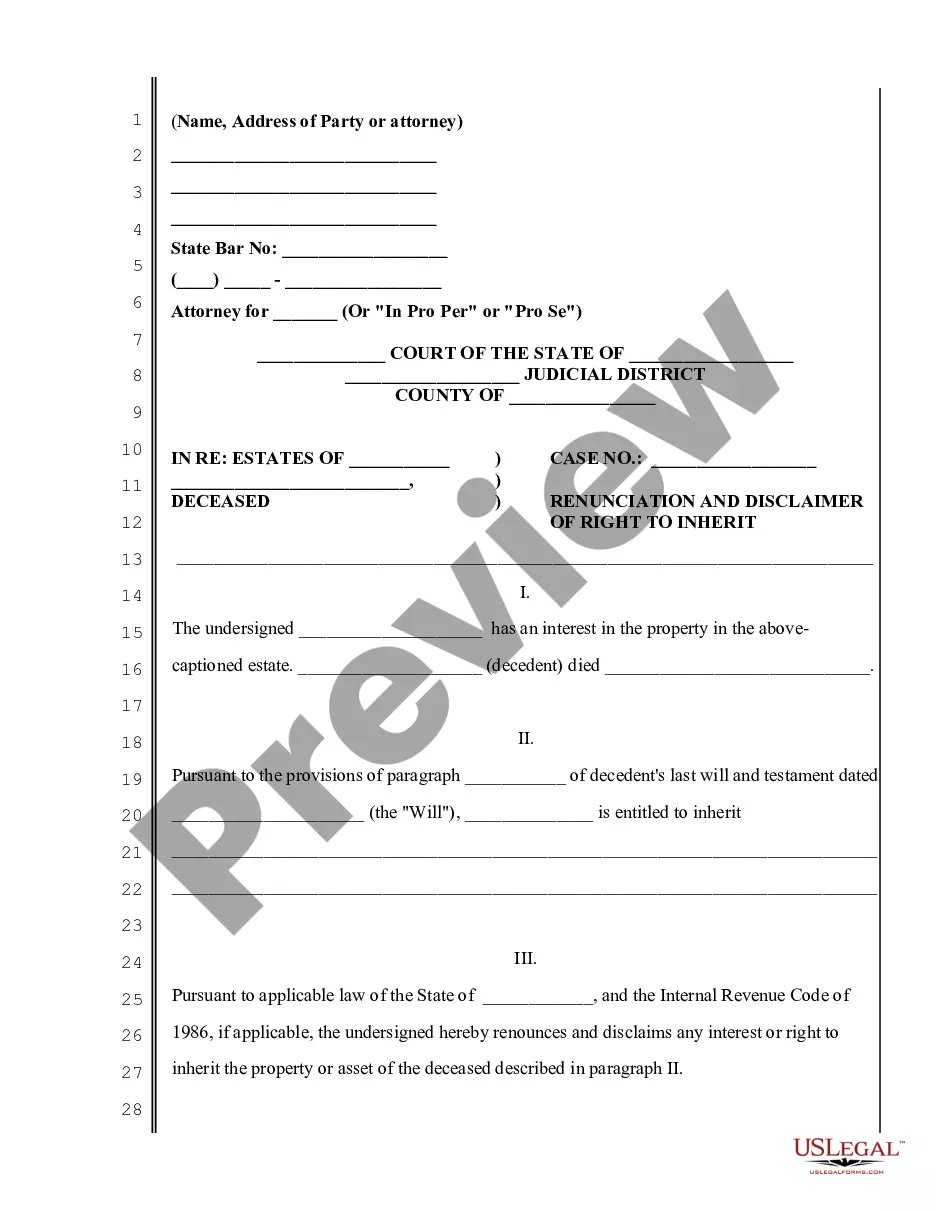
The Maine Renunciation and Disclaimer of Property from Will by Testate is a legal document that allows a beneficiary to formally refuse an interest in property received through a decedent's last will and testament. This form is crucial as it ensures that the property is redirected according to state laws, essentially as if the beneficiary had predeceased the decedent, allowing for seamless estate processing.
What’s included in this form
- Statement of the undersigned's choice to disclaim property.
- Identification of the decedent and the date of their passing.
- Specification of the property interest being disclaimed.
- Confirmation that the disclaimer will be filed within nine months of the decedent's death.
- Attestation that the renunciation relates back to the date of the decedent's death.

Common use cases
This form is necessary when a beneficiary decides they do not want to accept property or assets from a deceased individualâs estate, either due to personal, financial, or tax reasons. It may also be used to facilitate the distribution of the estate according to the beneficiary's wishes or the laws of Maine, ensuring that the property can pass to other heirs or beneficiaries.
Who needs this form
- Beneficiaries of a decedent's will who wish to disclaim their rights to inherited property.
- Individuals seeking to manage estate distribution without the burden of unsolicited inheritances.
- Those needing to comply with the laws of Maine regarding estate and property disclaimers.
How to prepare this document
- Begin by filling in your name as the disclaiming beneficiary.
- Enter the name of the decedent and their date of death.
- Specify whether you are disclaiming a partial or entire interest in the property.
- Indicate the property referred to in the relevant clause of the decedent's will.
- Sign and date the document to formalize your renunciation.
Is notarization required?
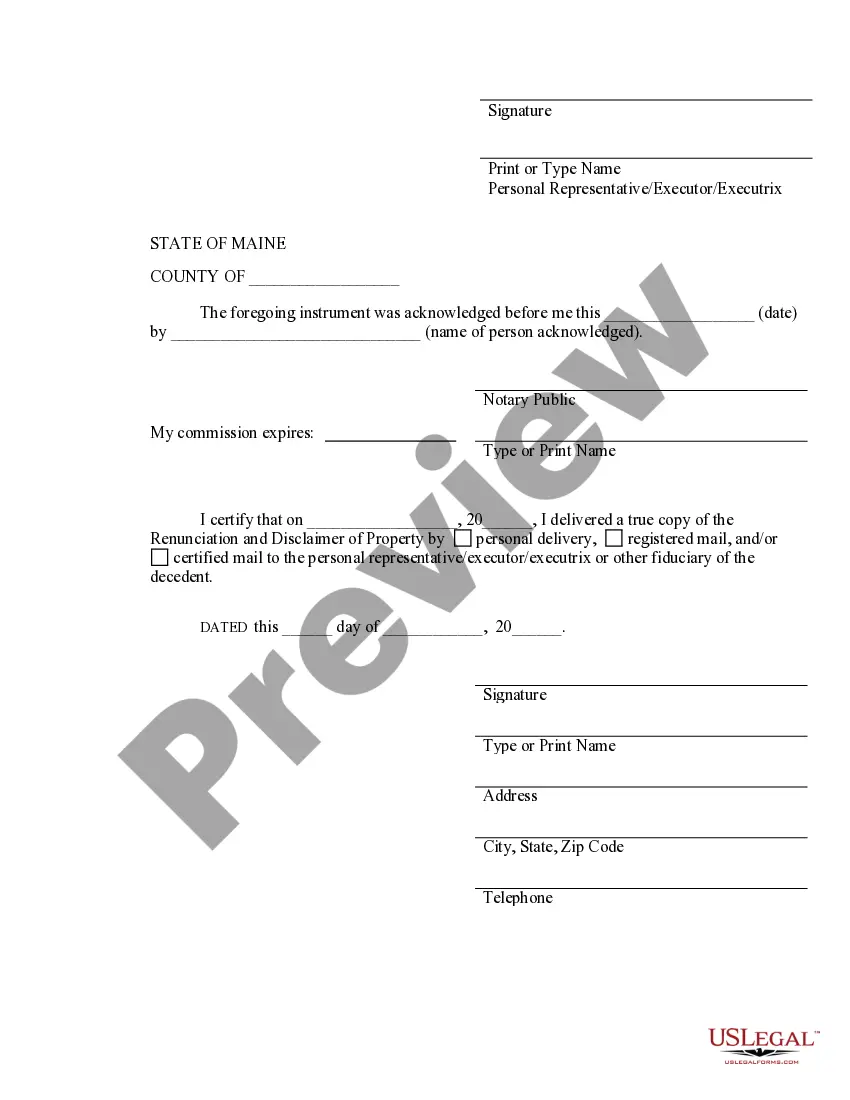
This form usually doesn’t need to be notarized. However, local laws or specific transactions may require it. Our online notarization service, powered by Notarize, lets you complete it remotely through a secure video session, available 24/7.
Get your form ready online
Our built-in tools help you complete, sign, share, and store your documents in one place.
Make edits, fill in missing information, and update formatting in US Legal Forms—just like you would in MS Word.
Download a copy, print it, send it by email, or mail it via USPS—whatever works best for your next step.
Sign and collect signatures with our SignNow integration. Send to multiple recipients, set reminders, and more. Go Premium to unlock E-Sign.
If this form requires notarization, complete it online through a secure video call—no need to meet a notary in person or wait for an appointment.
We protect your documents and personal data by following strict security and privacy standards.
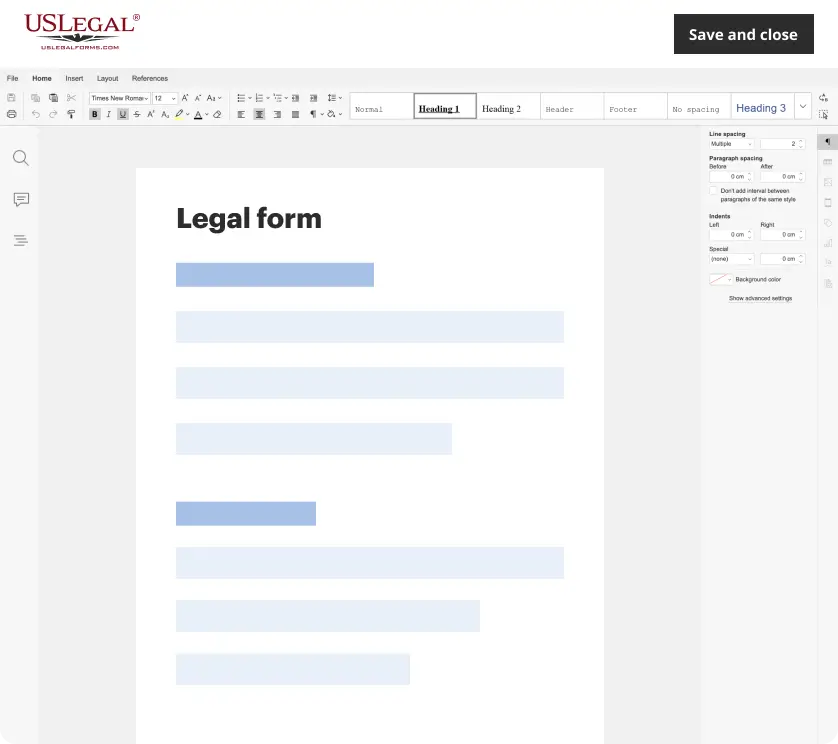
Make edits, fill in missing information, and update formatting in US Legal Forms—just like you would in MS Word.
Download a copy, print it, send it by email, or mail it via USPS—whatever works best for your next step.
Sign and collect signatures with our SignNow integration. Send to multiple recipients, set reminders, and more. Go Premium to unlock E-Sign.
If this form requires notarization, complete it online through a secure video call—no need to meet a notary in person or wait for an appointment.
We protect your documents and personal data by following strict security and privacy standards.
Common mistakes
- Failing to file the disclaimer within the specified nine-month time frame.
- Not clearly identifying the property being renounced.
- Incomplete or incorrect notarization, if required.
- Overlooking the need for signatures from all interested parties.
Why complete this form online
- Convenience of completing the form from home at any time.
- Editability to customize the document to fit specific needs.
- Access to reliable and accurate legal forms drafted by licensed attorneys.
- Reduction of time and effort compared to paper forms, with instant downloads available.
What to keep in mind
- The form allows beneficiaries to renounce property interests from a decedent's will.
- It ensures legal compliance with Maine's estate laws.
- Filing within nine months of the decedent's death is crucial for validity.
Looking for another form?
Form popularity
FAQ
Word forms: disclaimers A disclaimer is a statement in which a person says that they did not know about something or that they are not responsible for something. formal The company asserts in a disclaimer that it won't be held responsible for the accuracy of information.
A disclaimer warns readers that website content is for informational purposes only, and that users should not act on the information they read there or interpret it as actionable advice.Disclaimers are one of the defensive weapons in your digital arsenal that help protect you from lawsuits and liability.
Put your disclaimer where users can easily find it. You can put your disclaimer or disclaimers on a separate page, then link to that page in your website menu, website footer, or impressum page if you have one. You should also put your disclaimers on relevant content.
In your disclaimer, cover any and all liabilities for the product or service that you provide. You should warn consumers of any dangers or hazards posed by your product. You should list specific risks while at the same time acknowledging that the list is not exhaustive. For example, you could write, NOTICE OF RISK.
A disclaimer is generally any statement intended to specify or delimit the scope of rights and obligations that may be exercised and enforced by parties in a legally recognized relationship.
Get the free how to fill letter of disclaimer sbi form Balance Rs. Annexure A LETTER OF DISCLAIMER To be duly stamped as per the Stamp Act applicable to the State The Branch Manager / Chief Manager / Asstt. General Manager State Bank of India Dear Sir Account No in the name of Shri / Smt. / Kum Balance Rs.
In your disclaimer, cover any and all liabilities for the product or service that you provide. You should warn consumers of any dangers or hazards posed by your product. You should list specific risks while at the same time acknowledging that the list is not exhaustive. For example, you could write, NOTICE OF RISK.
While T&C's contain general liability waivers, Disclaimers address specific issues with your product or service. Disclaimers may cover medical or health risks, professional liability and earnings claims. If your website or app creates a risk of user error or misuse, a disclaimer will do more to help you than hurt you.
A beneficiary of an estate, whether by Will or the laws of intestacy is perfectly within their rights to reject their inheritance. Beneficiaries may wish to vary dispositions of property following death in order to redirect benefits to other family members who are more in need or less well provided for and to save tax.
Yes, a fiduciary can disclaim an interest in property if the will, trust or power of attorney gives the fiduciary that authority or if the appropriate probate court authorizes the disclaimer.The primary reason an executor or trustee might disclaim property passing to an estate or trust is to save death taxes.