Massachusetts Warranty Deed from Husband to Himself and Wife
About this form
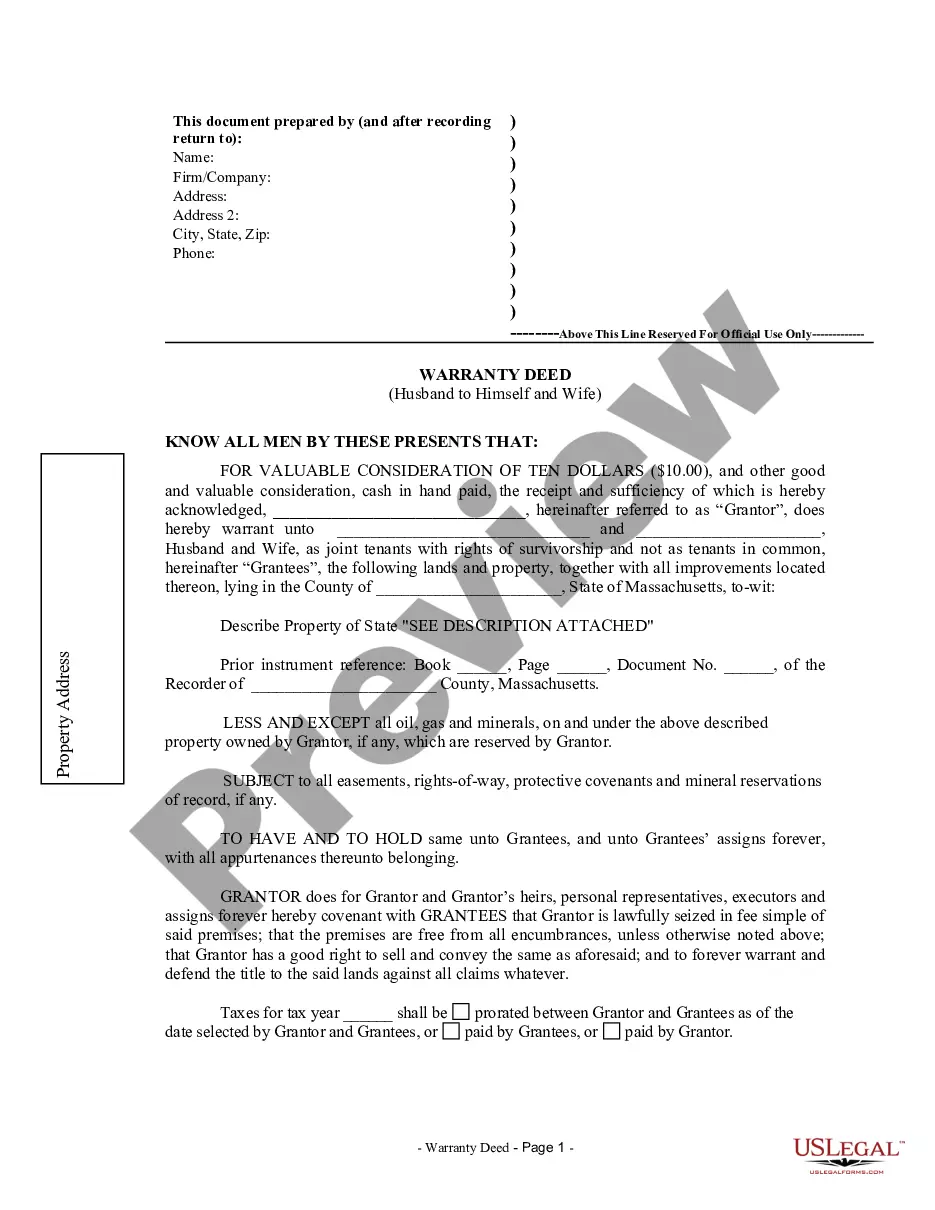
The Warranty Deed from Husband to Himself and Wife is a legal document that transfers ownership of property from a husband to himself and his wife. This form ensures that both spouses hold equal ownership as joint tenants with rights of survivorship. Unlike other types of deeds, this warranty deed provides a guarantee that the grantor has the authority to convey the property and that it is free from encumbrances, unless expressly noted. It is commonly used in estate planning to ensure smooth transfer of property rights between spouses while retaining survivorship benefits.
Form components explained
- Description of the property being conveyed.
- Identification of the grantor (husband) and grantees (husband and wife).
- Warranty of title, ensuring the property is free from encumbrances.
- Specification of rights of survivorship for joint ownership.
- Indication of any reserved rights to mineral, oil, or gas interests.
- Signatures and notarization section, confirming the validity of the document.




When this form is needed
This form is used when a husband wants to transfer property to himself and his wife, primarily for estate planning purposes. It may be relevant when there is a change in the title of the property or when creating a joint ownership arrangement, particularly to ensure that the property will automatically pass to the surviving spouse upon one spouse's death. It is also suitable for individuals wishing to clarify ownership in a marriage and avoid probate complications.
Who this form is for
- Married couples transferring property between themselves.
- Individuals looking to establish joint ownership with survivorship rights.
- Homeowners wanting to clarify property ownership in the context of estate planning.
- Those seeking to facilitate a smooth transition of property rights upon death.
How to complete this form
- Identify the parties involved: grantor (husband) and grantees (husband and wife).
- Provide a complete description of the property being transferred.
- Enter any details regarding prior property instruments, including book, page, and document numbers.
- Fill in the date of execution and gather necessary signatures.
- Ensure the document is notarized, confirming the identities of the signatories.
Does this document require notarization?
Yes, this form must be notarized to be legally valid. Notarization helps confirm the identities of the parties involved and ensures that the document is executed according to legal standards. US Legal Forms offers integrated online notarization through secure video calls, making it easy to complete the process without the need for in-person meetings.
Get your form ready online
Our built-in tools help you complete, sign, share, and store your documents in one place.
Make edits, fill in missing information, and update formatting in US Legal Forms—just like you would in MS Word.
Download a copy, print it, send it by email, or mail it via USPS—whatever works best for your next step.
Sign and collect signatures with our SignNow integration. Send to multiple recipients, set reminders, and more. Go Premium to unlock E-Sign.
If this form requires notarization, complete it online through a secure video call—no need to meet a notary in person or wait for an appointment.
We protect your documents and personal data by following strict security and privacy standards.

Make edits, fill in missing information, and update formatting in US Legal Forms—just like you would in MS Word.

Download a copy, print it, send it by email, or mail it via USPS—whatever works best for your next step.

Sign and collect signatures with our SignNow integration. Send to multiple recipients, set reminders, and more. Go Premium to unlock E-Sign.

If this form requires notarization, complete it online through a secure video call—no need to meet a notary in person or wait for an appointment.

We protect your documents and personal data by following strict security and privacy standards.
Mistakes to watch out for
- Failing to provide a complete and accurate property description.
- Not including necessary information about prior property instruments.
- Overlooking the need for notarization or signatures from both parties.
- Neglecting to specify any encumbrances or reserved rights on the property.
Why use this form online
- Convenient access to legal forms from any location.
- Editable templates allow for quick customization to fit specific needs.
- Reliable and accurate documents drafted by licensed attorneys.
- Secure storage and easy retrieval of completed forms.
What to keep in mind
- The Warranty Deed from Husband to Himself and Wife establishes joint property ownership.
- It is essential for estate planning and ensuring rights of survivorship.
- Accuracy in completing the form is crucial to avoid legal issues.
- Notarization is required to validate the deed.
Looking for another form?
Form popularity
FAQ
DEED: A written instrument by which one party, the Grantor, conveys the title of ownership in property to another party, the Grantee. A Warranty Deed contains promises, called covenants, that the Grantor makes to the Grantee.It is even possible that the Grantor does not have any title or ownership interest at all!
It's important to note that a warranty deed does not actually prove the grantor has ownership (a title search is the best way to prove that), but it is a promise by the grantor that they are transferring ownership and if it turns out they don't actually own the property, the grantor will be responsible for compensating
The two parties involved in a warranty deed are the seller or owner, also known as the grantor, and the buyer or the grantee. Either party can be an individual or a business, and are often strangers to each other.
A warranty deed guarantees that: The grantor is the rightful owner of the property and has the legal right to transfer the title.The title would withstand third-party claims to ownership of the property. The grantor will do anything to ensure the grantee's title to the property.