Louisiana Letter from Landlord to Tenant as Notice of Default on Commercial Lease
Overview of this form
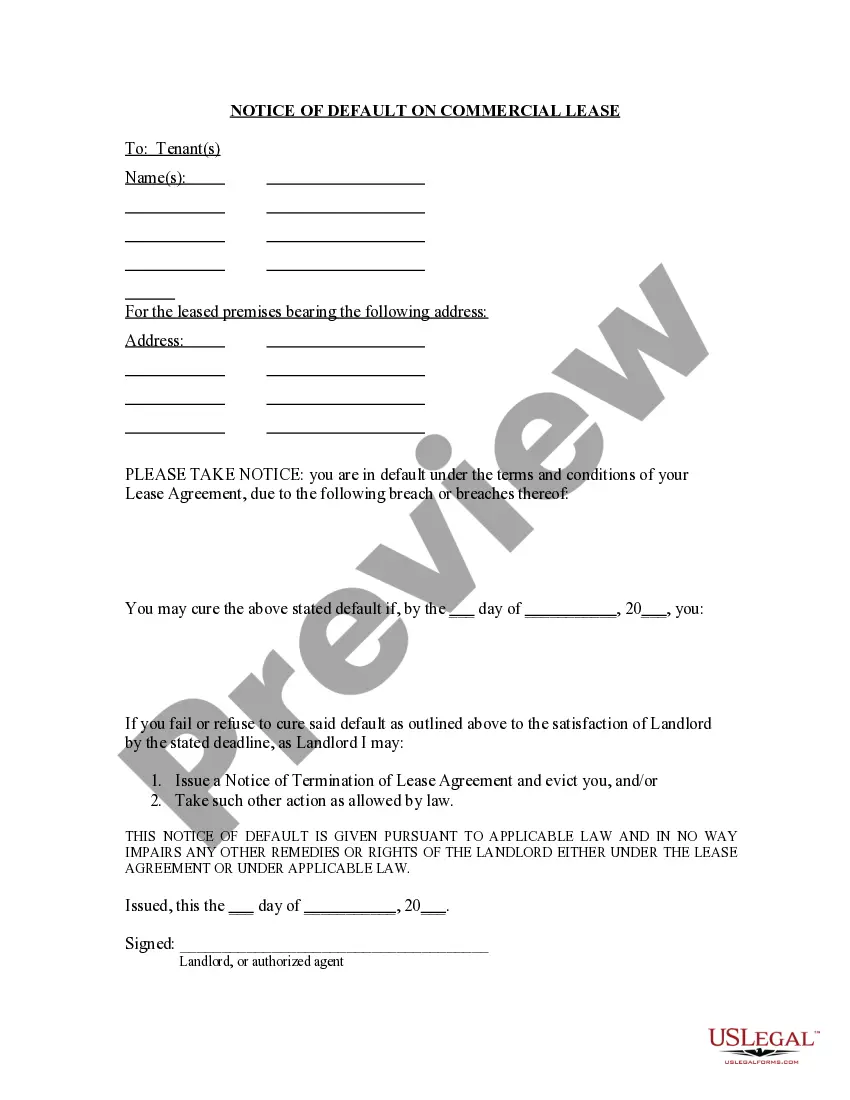
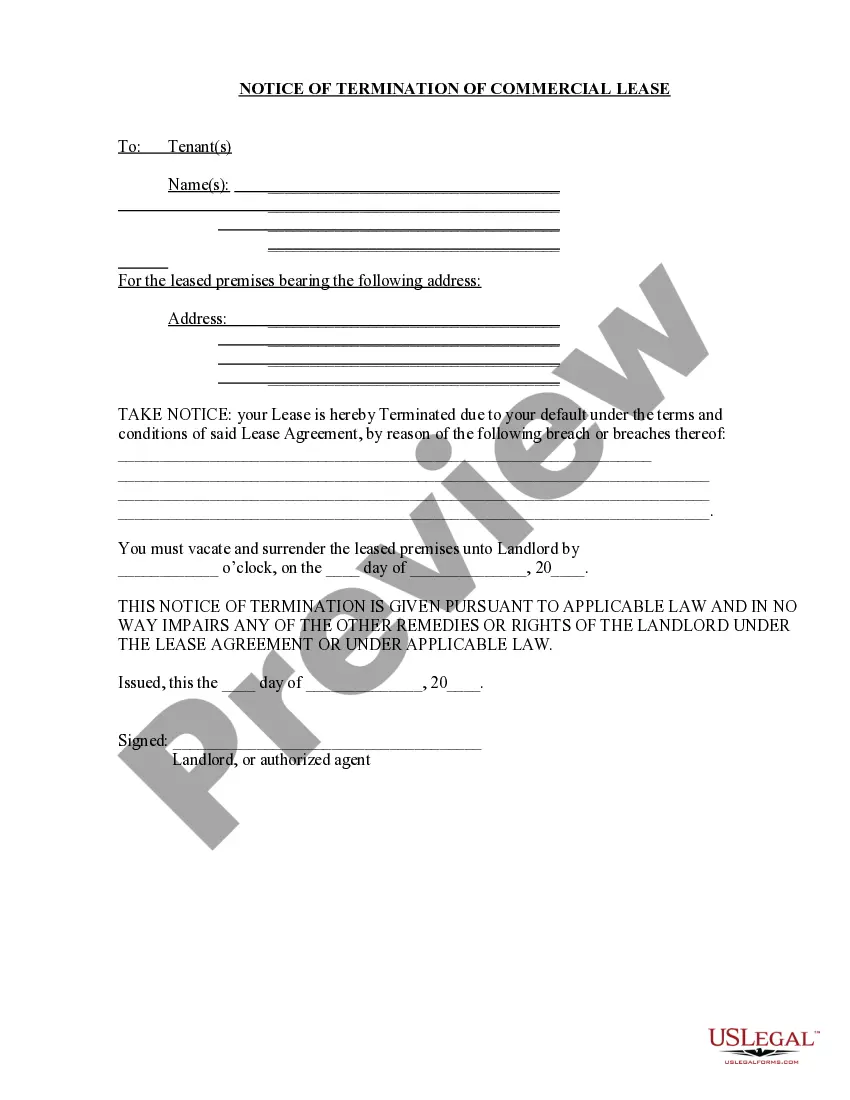
The Letter from Landlord to Tenant as Notice of Default on Commercial Lease is a legal document used by landlords to formally notify tenants of a default in their lease agreement. This form outlines specific breaches, such as failure to pay rent, and provides a deadline for the tenant to remedy those breaches. Unlike other lease termination notices, this letter emphasizes the tenant's obligations and the potential consequences of not addressing the default, including possible eviction. It is designed to be clear and concise, ensuring both parties understand their rights and responsibilities.
Key parts of this document
- Identification of the landlord and tenant involved in the lease agreement.
- Detailed description of the default, including specific breaches such as non-payment of rent.
- Deadline by which the tenant must cure the default to avoid further action.
- Statement of the landlord's rights under applicable law if the breach is not cured.
- Space for the landlordâs signature and date of issuance.


When to use this form
This form should be used when a tenant has failed to comply with the terms of their commercial lease, particularly regarding the payment of rent. Landlords typically send this notice before pursuing eviction proceedings or applying security deposit funds to cover unpaid rent. It is essential to use this form in situations where clear communication of the default is required, ensuring that the tenant has adequate notice and an opportunity to rectify the issue.
Who should use this form
- Commercial landlords seeking to formally notify tenants of lease defaults.
- Property managers responsible for managing commercial properties and tenant communications.
- Tenants who need to understand the implications of a default notice from their landlord.
Completing this form step by step
- Identify the parties by entering the names of the landlord and tenant at the top of the notice.
- Clearly describe the breach by specifying the default, such as unpaid rent or other violations.
- Set a specific deadline for the tenant to cure the default, ensuring it complies with local laws.
- Include any additional actions the landlord may take if the tenant fails to address the breach.
- Have the landlord or authorized agent sign and date the notice to finalize it.
Does this form need to be notarized?
This form does not typically require notarization unless specified by local law. It is advisable to confirm any local requirements to ensure enforceability.
Get your form ready online
Our built-in tools help you complete, sign, share, and store your documents in one place.
Make edits, fill in missing information, and update formatting in US Legal Forms—just like you would in MS Word.
Download a copy, print it, send it by email, or mail it via USPS—whatever works best for your next step.
Sign and collect signatures with our SignNow integration. Send to multiple recipients, set reminders, and more. Go Premium to unlock E-Sign.
If this form requires notarization, complete it online through a secure video call—no need to meet a notary in person or wait for an appointment.
We protect your documents and personal data by following strict security and privacy standards.

Make edits, fill in missing information, and update formatting in US Legal Forms—just like you would in MS Word.

Download a copy, print it, send it by email, or mail it via USPS—whatever works best for your next step.

Sign and collect signatures with our SignNow integration. Send to multiple recipients, set reminders, and more. Go Premium to unlock E-Sign.

If this form requires notarization, complete it online through a secure video call—no need to meet a notary in person or wait for an appointment.

We protect your documents and personal data by following strict security and privacy standards.
Typical mistakes to avoid
- Failing to provide sufficient details about the breach, which can lead to confusion.
- Not specifying a clear deadline for the tenant to cure the default.
- Neglecting to sign and date the notice, making it potentially invalid.
- Ignoring state-specific laws that govern landlord-tenant relationships and notice requirements.
Why complete this form online
- Quick and easy access to legally drafted templates saved on your device.
- Convenient editing options allow landlords to customize the form to their specific situation.
- Reliability and assurance that the document complies with current legal standards.
Legal use & context
- The notice of default serves as a formal communication under landlord-tenant law, outlining the tenant's obligations.
- Failure to provide this notice before eviction could limit the landlord's legal remedies.
- This form encourages resolution of disputes without resorting to legal action, fostering better landlord-tenant relations.
What to keep in mind
- The letter serves as an official notification of a default by the tenant in a commercial lease.
- It outlines specific terms and actions available to the landlord if the tenant does not cure the default.
- Using this form ensures proper legal procedures are followed, protecting both partiesâ rights.
Looking for another form?
Form popularity
FAQ
Step 1: Mention the Reason for Giving a Notice. Step 2: Use Formal Language. Step 3: Mention the Date for Vacating. Step 4: Address the Formalities to Be Taken Care Of. Step 5: Proofread the Letter.
Dear (Name of landlord or manager), This letter constitutes my written (number of days' notice that you need to give based on your lease agreement)-day notice that I will be moving out of my apartment on (date), the end of my current lease. I am leaving because (new job, rent increase, etc.)
Dear (Name of landlord or manager), This letter constitutes my written (number of days' notice that you need to give based on your lease agreement)-day notice that I will be moving out of my apartment on (date), the end of my current lease. I am leaving because (new job, rent increase, etc.)
The address of the property (The landlord may have many properties to manage. The specific date you plan to vacate. The date you plan to surrender the keys. The date you plan to have the utilities turned off. A request for property inspection. A forwarding address.
If you're an assured tenant or a protected tenant Your landlord will have to give you notice if they want you to leave. They have to give the reasons why they want to evict you - for example, if you have rent arrears or you've damaged the property. Your landlord will have to go to court and get a court order.
In most cases the landlord will ask that you remain secondarily responsible for paying the lease if the new tenant defaults. In both cases, there will likely be some charge by the landlord to cover their time and expense in reviewing and approving the arrangement.
Although my lease does not terminate until day, month, year, it is necessary that I move out earlier due to list specific reasons such as family crisis or leave of absence from the Institute. I intend to vacate the premises on day, month, year. I will call you on specific date to discuss the matter.
Write the title for your pay or quit notice across the top of the letter. If not included in the title, the number of days for the notice must be specified. Include the names of each of the tenants. Specify the address of the rental property.
Be in writing, Say the full name of the tenant or tenants, Have the address the notice is about, Say everything that the tenant did to break the lease or deserve a 3 day notice to leave, and include details and dates, Say clearly that the tenant has to move out as soon as the 3 days are up, and.