Louisiana Letter from Landlord to Tenant as Notice of Abandoned Personal Property
Understanding this form
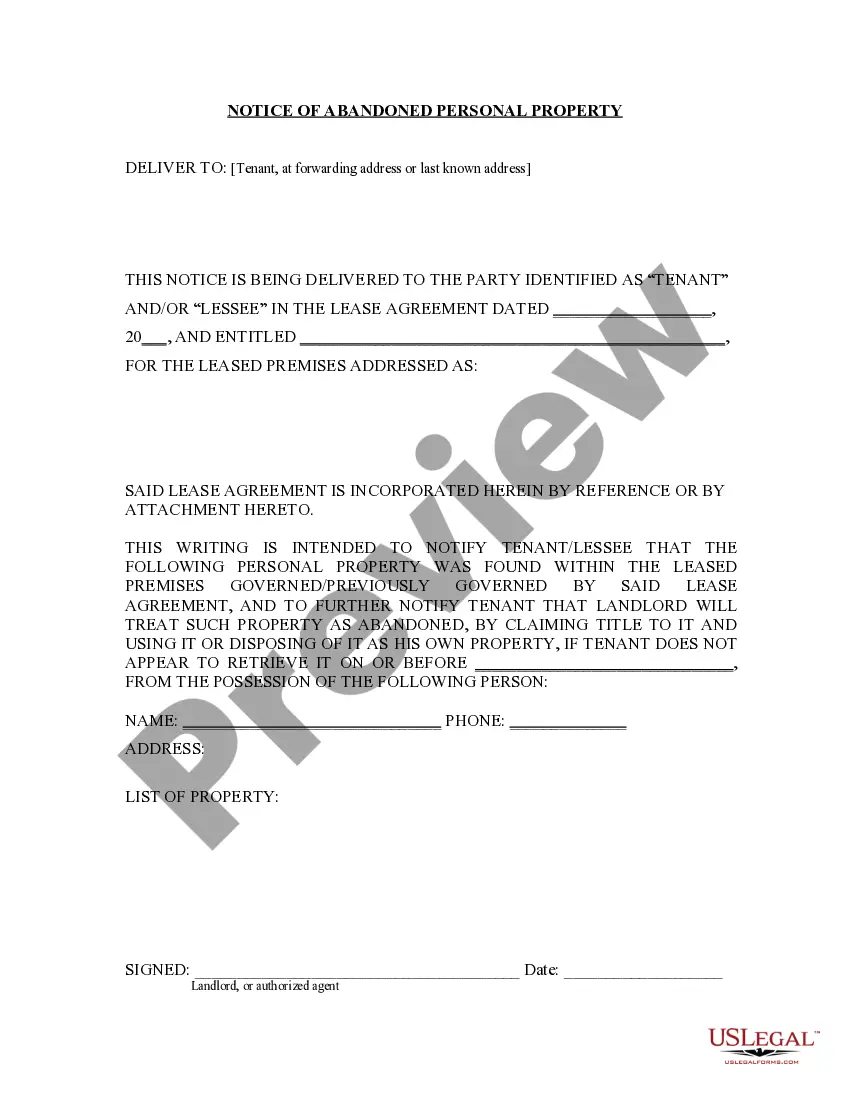
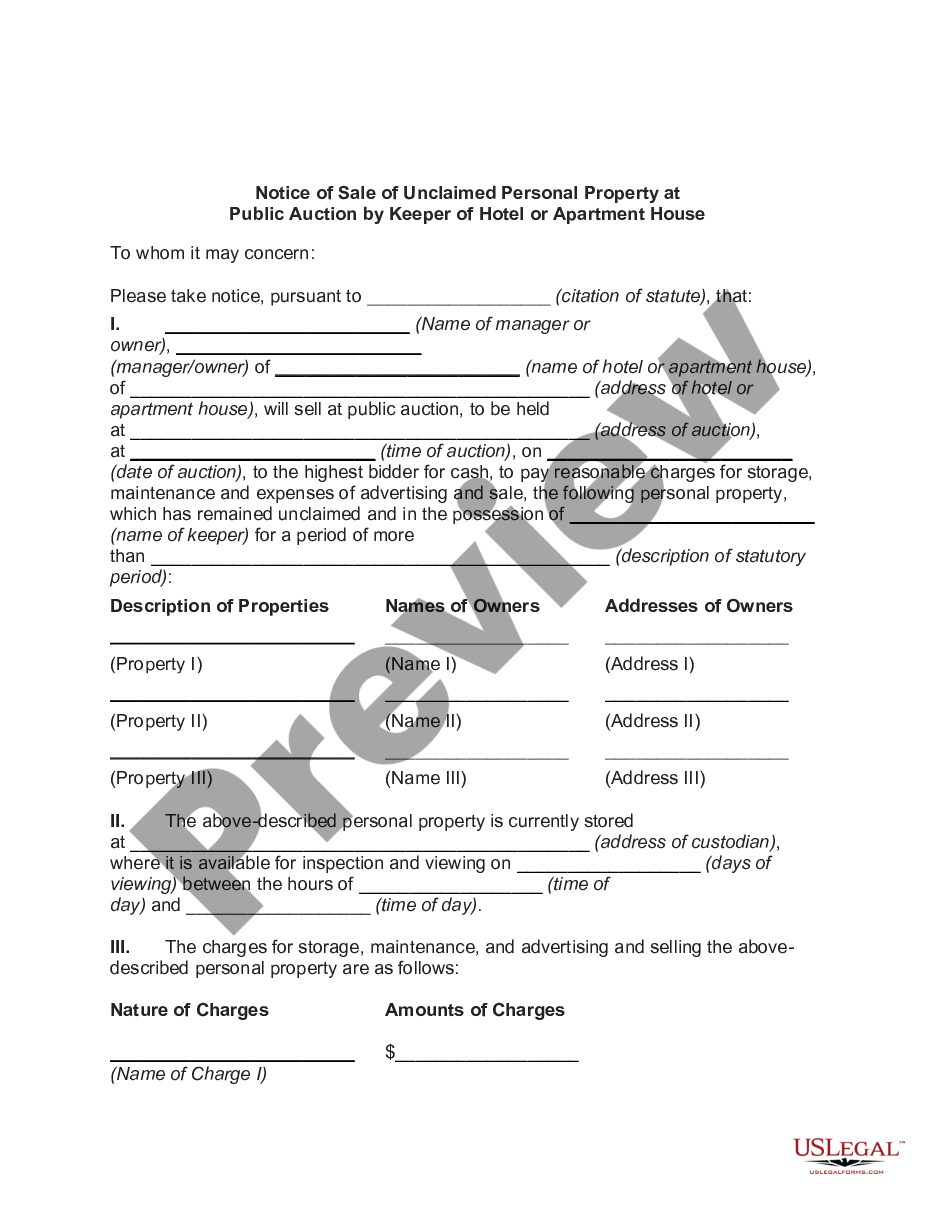
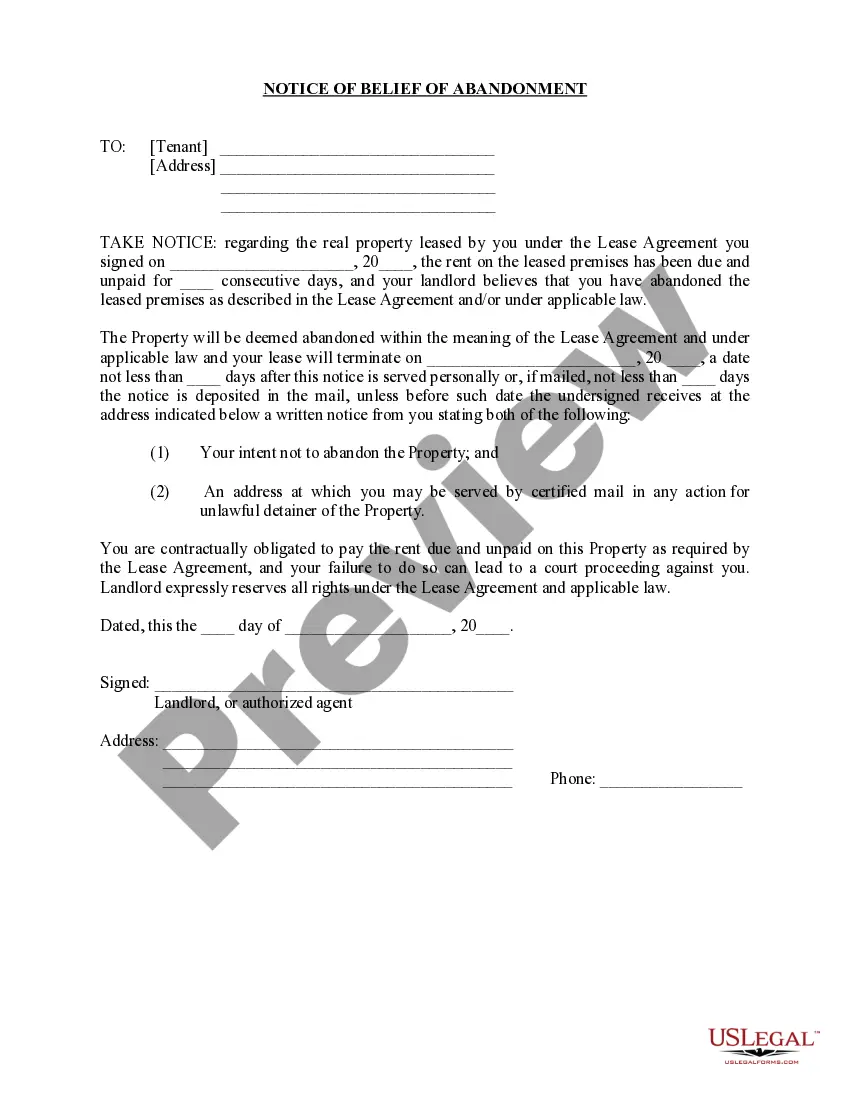
This Letter from Landlord to Tenant as Notice of Abandoned Personal Property serves as an official notification informing a tenant that certain personal belongings have been left behind in a rental property. The letter specifies the items, informs the tenant of the landlord's intentions regarding those items, and establishes a timeframe for retrieval. This document is essential for landlords to comply with state law when addressing abandoned property, distinguishing it from other eviction or termination notices.
What’s included in this form
- Identification of the tenant and the property address.
- Description of the personal property considered abandoned.
- Deadline for the tenant to retrieve their belongings.
- Statement of the landlordâs intention regarding the abandoned property.
- Signature of the landlord and date of notice issuance.

Common use cases
This form is used when a tenant has vacated a rental property but left behind personal belongings. It is critical for landlords to formally notify the tenant of these items and their plans to either return, dispose of, or claim ownership of them. Scenarios include after a tenant moves out and fails to collect their possessions or when items are left in common areas of an apartment complex.
Who needs this form
- Landlords managing rental properties.
- Property managers handling tenant relations.
- Real estate professionals involved in rental agreements.
Completing this form step by step
- Identify the parties: Clearly state the landlord's name and the tenant's name.
- Specify the property: Include the address of the rented premises.
- Describe the abandoned property: List the personal items left behind by the tenant.
- Set a retrieval deadline: Enter a date by which the tenant must claim their items.
- Sign and date the notice: Ensure the landlord provides a signature and date to validate the notice.
Does this document require notarization?
This form does not typically require notarization unless specified by local law. It is advisable to check state or local requirements to ensure compliance.
Get your form ready online
Our built-in tools help you complete, sign, share, and store your documents in one place.
Make edits, fill in missing information, and update formatting in US Legal Forms—just like you would in MS Word.
Download a copy, print it, send it by email, or mail it via USPS—whatever works best for your next step.
Sign and collect signatures with our SignNow integration. Send to multiple recipients, set reminders, and more. Go Premium to unlock E-Sign.
If this form requires notarization, complete it online through a secure video call—no need to meet a notary in person or wait for an appointment.
We protect your documents and personal data by following strict security and privacy standards.

Make edits, fill in missing information, and update formatting in US Legal Forms—just like you would in MS Word.

Download a copy, print it, send it by email, or mail it via USPS—whatever works best for your next step.

Sign and collect signatures with our SignNow integration. Send to multiple recipients, set reminders, and more. Go Premium to unlock E-Sign.

If this form requires notarization, complete it online through a secure video call—no need to meet a notary in person or wait for an appointment.

We protect your documents and personal data by following strict security and privacy standards.
Avoid these common issues
- Failing to clearly identify the abandoned property, leading to potential disputes.
- Not including a specific deadline for retrieval, which can create ambiguity.
- Neglecting to sign and date the letter, making it potentially unenforceable.
Benefits of completing this form online
- Convenient access to a legally compliant form from anywhere.
- Editable options allow landlords to customize the form easily.
- Reliable templates drafted by licensed attorneys ensure legal validity.
Legal use & context
- The form serves as a legal document to protect landlords from potential disputes regarding abandoned property.
- Proper usage ensures adherence to state statutes concerning property abandonment.
- This letter establishes a clear timeline for tenants, reducing ambiguity about their belongings.
Summary of main points
- The letter serves as an important legal notice regarding abandoned property.
- It outlines specific instructions for tenants to reclaim their belongings.
- The form must be completed accurately to avoid legal complications.
Looking for another form?
Form popularity
FAQ
Starting to Write State the most recent information you have on file and detail the attempts you have made to contact them. Warn that if there is no response within a specific time frame action will be taken. Post the letter to the last known address of the individual.
The landlord cannot rummage through your dresser drawers, or inspect the contents of boxes or the clothing in the closet. He can make you move items out of the closet or the under-sink cabinets to facilitate an inspection.
Job abandonment is when an employee fails to report to work for consecutive days without notice, and cannot be reached. Most company policies state that a job has been abandoned after 3 consecutive days, but it can vary. Job abandonment is a voluntary termination.
Starting to Write State the most recent information you have on file and detail the attempts you have made to contact them. Warn that if there is no response within a specific time frame action will be taken. Post the letter to the last known address of the individual.
Abandonment of a Property - when a Tenant leaves their Property without giving notice to Evolve Housing and the Property is found to be vacant.
Sue the landlord and whoever for up to $10,000 in small claims court for trespassing, breach of contract, invasion of privacy, and breach of quiet enjoyment; if you are two or more tenants, each can separately sue them for up to $10,000, and a joint action is not required.
A landlord cannot evict a tenant without an adequately obtained eviction notice and sufficient time. A landlord cannot retaliate against a tenant for a complaint. A landlord cannot forego completing necessary repairs or force a tenant to do their own repairs.A landlord cannot remove a tenant's personal belongings.
Abandonment can only be assumed from the tenant leaving the property, taking their possessions and handing in the keys. However as surrender of the property is implied from the same actions, an Abandonment Notice may be unnecessary.
While a landlord has a right of entry, this is balanced against your right to privacy as a tenant. Landlords are not entitled to go through your unit and belongings at will. They generally must have a valid reason to enter the unit and give you proper notice, unless you gave them permission in advance.