Louisiana Warranty Deed from Individual to a Trust
What this document covers
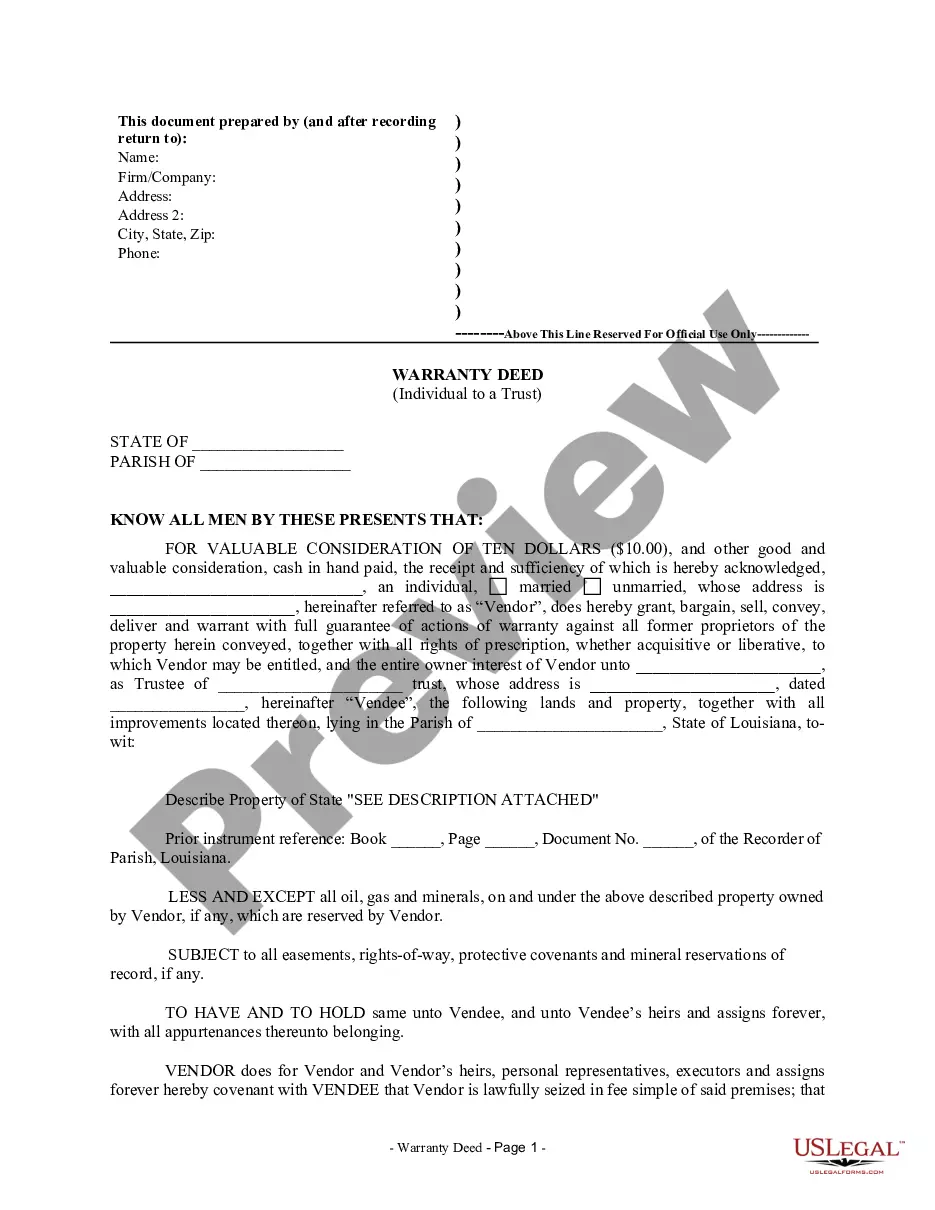
This Warranty Deed from Individual to a Trust is a legal document used to transfer property ownership from an individual (the grantor) to a trust (the grantee). This form ensures that the property is conveyed with a warranty of title, meaning the grantor guarantees their legal right to transfer the property and will defend that title against any claims. This deed specifically excludes any oil, gas, and mineral rights and complies with the statutory laws of the relevant state, distinguishing it from other types of deeds which may not provide such guarantees.
Form components explained
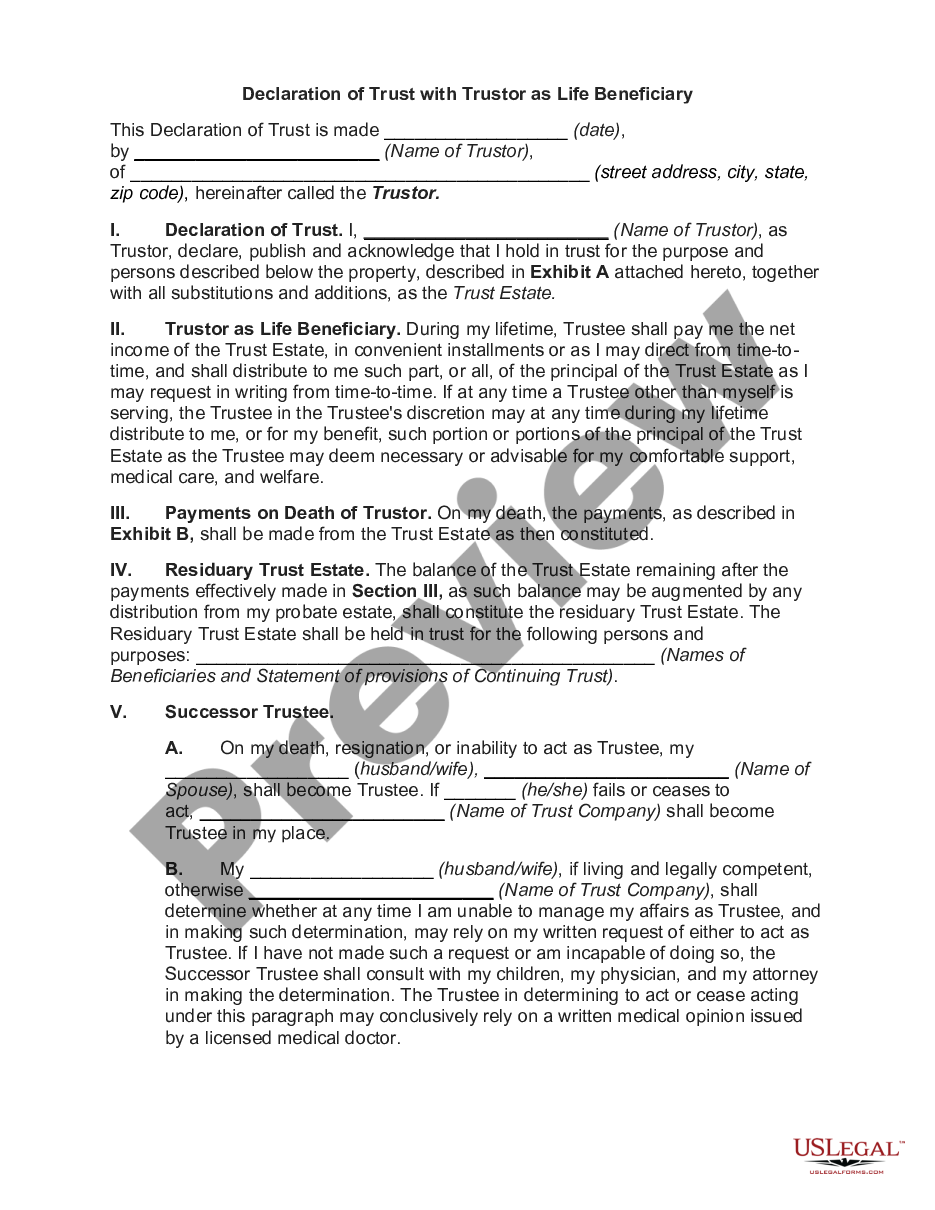
- Identification of the grantor (individual) and grantee (trust).
- Legal description of the property being transferred.
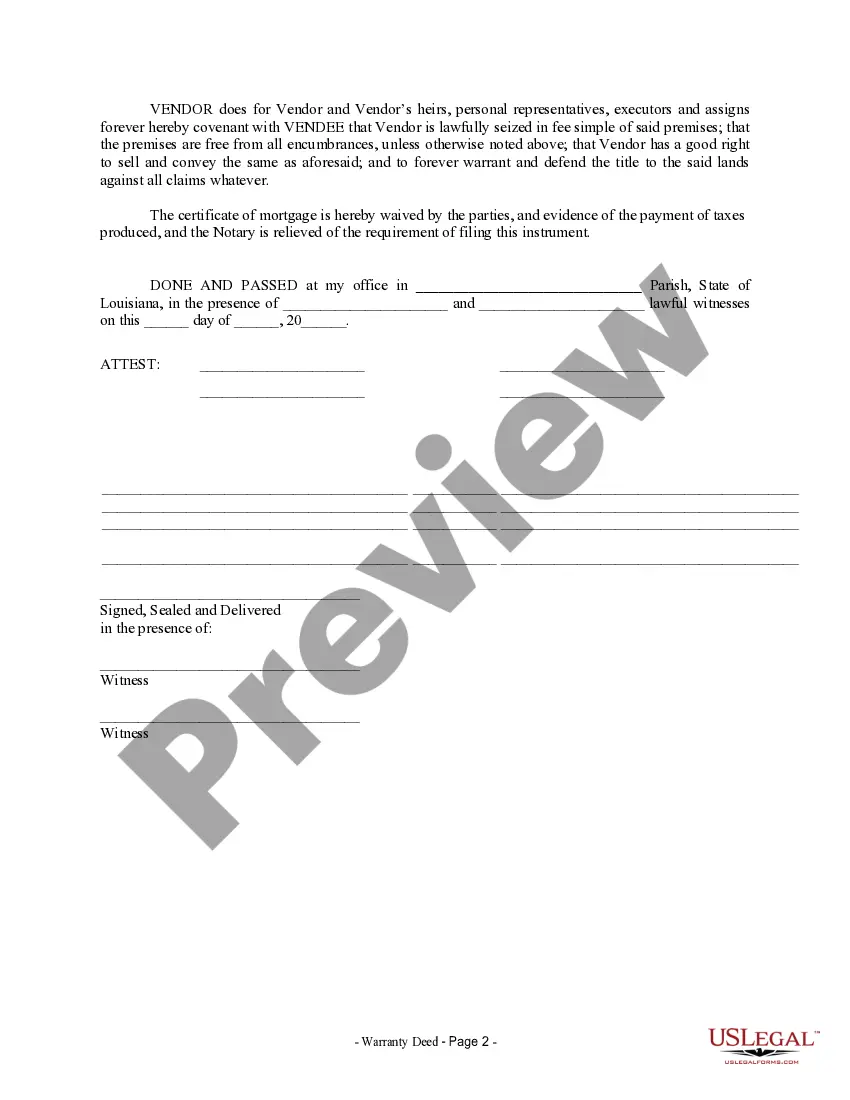
- Warranties of title provided by the grantor regarding ownership.
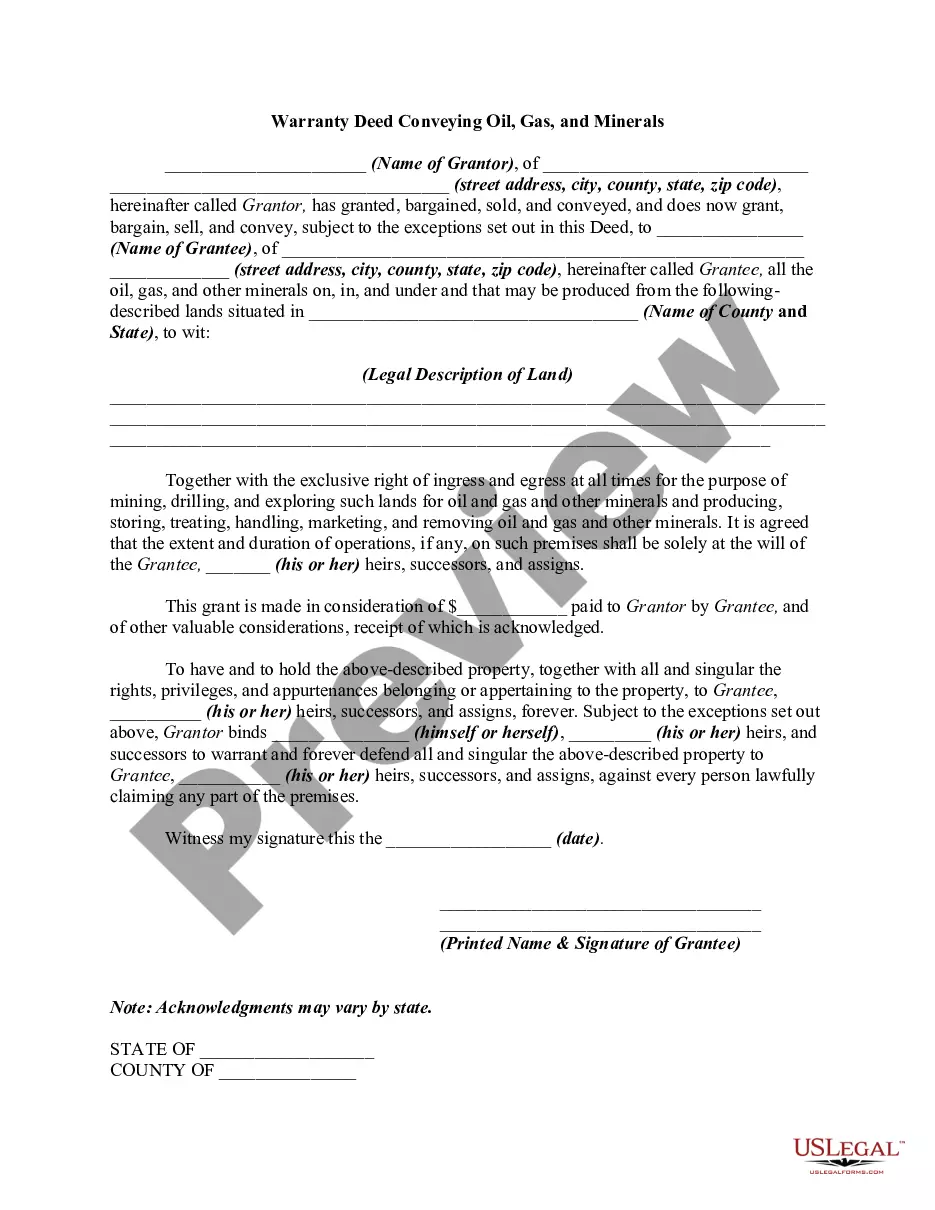
- Exclusion of oil, gas, and mineral rights from the transfer.
- Signatures of the parties involved and witnesses.
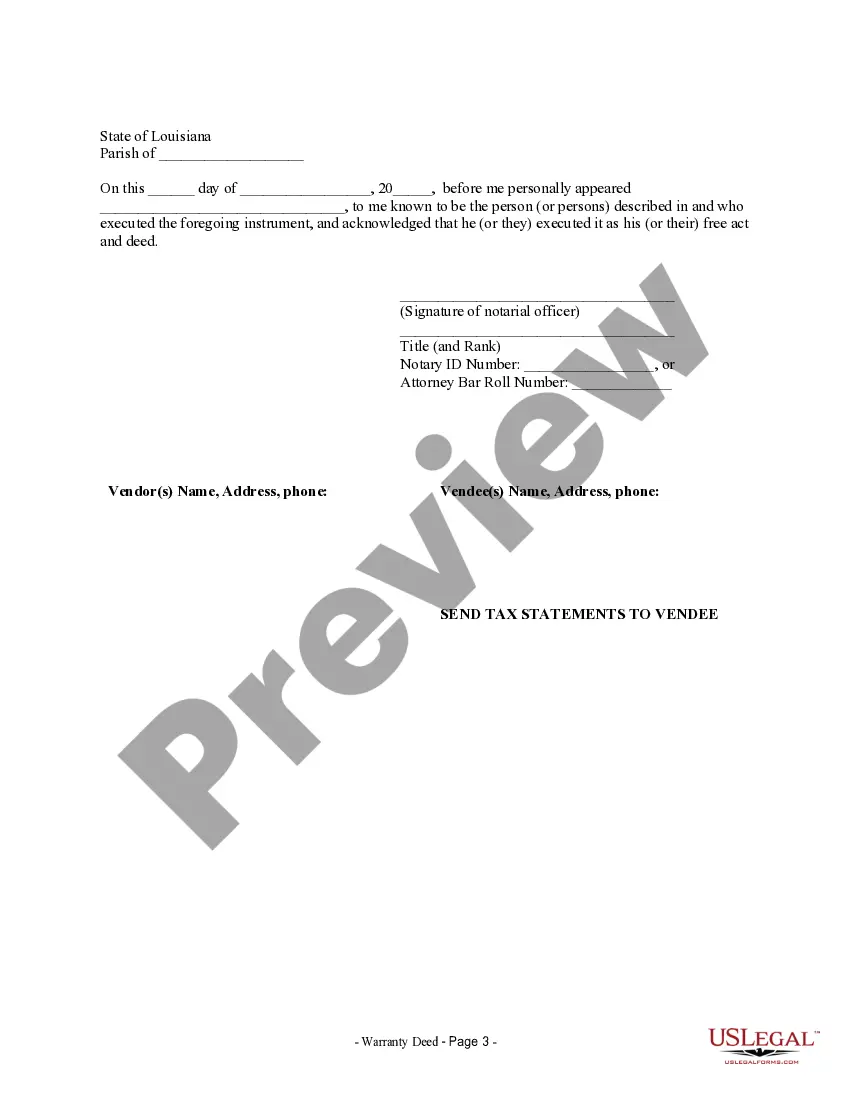
- Notary acknowledgment confirming the execution of the deed.


When to use this document
This form is typically used when an individual wants to transfer ownership of real property into a trust for estate planning or asset protection purposes. It is useful when the individual wishes to simplify asset management, ensure property is held according to the terms of the trust, or facilitate a smoother transfer to beneficiaries in the event of the individual's passing.
Who should use this form
- Individuals who are the lawful owners of real property.
- Trustees responsible for managing trust assets.
- Those seeking to protect assets through trust arrangements.
- Estate planners or attorneys assisting with property transfers to trusts.
Completing this form step by step
- Identify the grantor and provide their personal details, including marital status and address.
- Specify the trust name and trusteeâs information in the designated sections.
- Accurately describe the property being transferred, including its legal boundaries.
- Enter any conditions or exceptions, such as the reservation of mineral rights.
- Gather signatures from the grantor and witnesses, and ensure notarization is completed.
- File the completed deed with the appropriate recording office in the parish.
Does this document require notarization?
Yes, this form must be notarized to be legally valid. Notarization helps to confirm the identities of the parties involved and ensures that the deed was executed voluntarily. US Legal Forms provides integrated online notarization services that are available 24/7, making it easy to obtain notarization through a secure video call, ensuring legal compliance without the need to travel.
Get your form ready online
Our built-in tools help you complete, sign, share, and store your documents in one place.
Make edits, fill in missing information, and update formatting in US Legal Forms—just like you would in MS Word.
Download a copy, print it, send it by email, or mail it via USPS—whatever works best for your next step.
Sign and collect signatures with our SignNow integration. Send to multiple recipients, set reminders, and more. Go Premium to unlock E-Sign.
If this form requires notarization, complete it online through a secure video call—no need to meet a notary in person or wait for an appointment.
We protect your documents and personal data by following strict security and privacy standards.

Make edits, fill in missing information, and update formatting in US Legal Forms—just like you would in MS Word.

Download a copy, print it, send it by email, or mail it via USPS—whatever works best for your next step.

Sign and collect signatures with our SignNow integration. Send to multiple recipients, set reminders, and more. Go Premium to unlock E-Sign.

If this form requires notarization, complete it online through a secure video call—no need to meet a notary in person or wait for an appointment.

We protect your documents and personal data by following strict security and privacy standards.
Common mistakes to avoid
- Failing to accurately describe the property can lead to disputes.
- Not obtaining the proper signatures from witnesses.
- Overlooking the requirement for notarization, which can invalidate the deed.
- Leaving blank spaces or not providing essential information about the grantor or trust.
Advantages of online completion
- Convenience of completing the form from home without the need for paper copies.
- Editable templates that adapt to your specific needs.
- Access to reliable legal language crafted by licensed attorneys.
What to keep in mind
- The Warranty Deed from Individual to a Trust is essential for transferring property into a trust.
- Clear property descriptions and proper notarization are critical for legality.
- This form provides significant benefits in estate planning and property management.
Looking for another form?
Form popularity
FAQ
In Louisiana, giving away some of your surplus to a friend, relative or charitable organization is a simple matter of completing a form called an Act of Donation and having it notarized. The process is relatively quick and easy, but it does have potential tax implications.
A general warranty deed is used to transfer an interest in real estate in Louisiana in most real estate transactions. A Louisiana warranty deed conveys real property with warranty covenants to the buyer. It requires an acknowledgement of the grantor's signature.
The Louisiana quitclaim deed is used to transfer real estate in Louisiana from one person to another. A quitclaim has no guarantee or warranty attached to it.Signing A quitclaim deed must be authorized with the Grantor(s) (the Sellers) in front of two (2) witnesses and a notary public.
A warranty deed, also known as a general warranty deed, is a legal real estate document between the seller (grantor) and the buyer (grantee). The deed protects the buyer by pledging that the seller holds clear title to the property and there are no encumbrances, outstanding liens, or mortgages against it.
DEED: A written instrument by which one party, the Grantor, conveys the title of ownership in property to another party, the Grantee. A Warranty Deed contains promises, called covenants, that the Grantor makes to the Grantee.It is even possible that the Grantor does not have any title or ownership interest at all!
Property ownership in Louisiana is voluntarily transferred by a contract through the owner and the transferee. A transfer of real (immovable) property can be made by authentic act or by an act under private signature duly acknowledged (CC1839 Art. 1839).
Louisiana Property Search You can go to the clerk of the court's office to look at the chain of title. Some clerks of court have the records online, while others you will have to visit in person.
Retrieve your original deed. Get the appropriate deed form. Draft the deed. Sign the deed before a notary. Record the deed with the county recorder. Obtain the new original deed.
The legal document that transfers ownership of immovable property (i.e., a home, lot, building, immobilized mobile home) can be a cash sale or a quitclaim deed. A quitclaim deed is used when there is a transfer of property ownership without being sold.