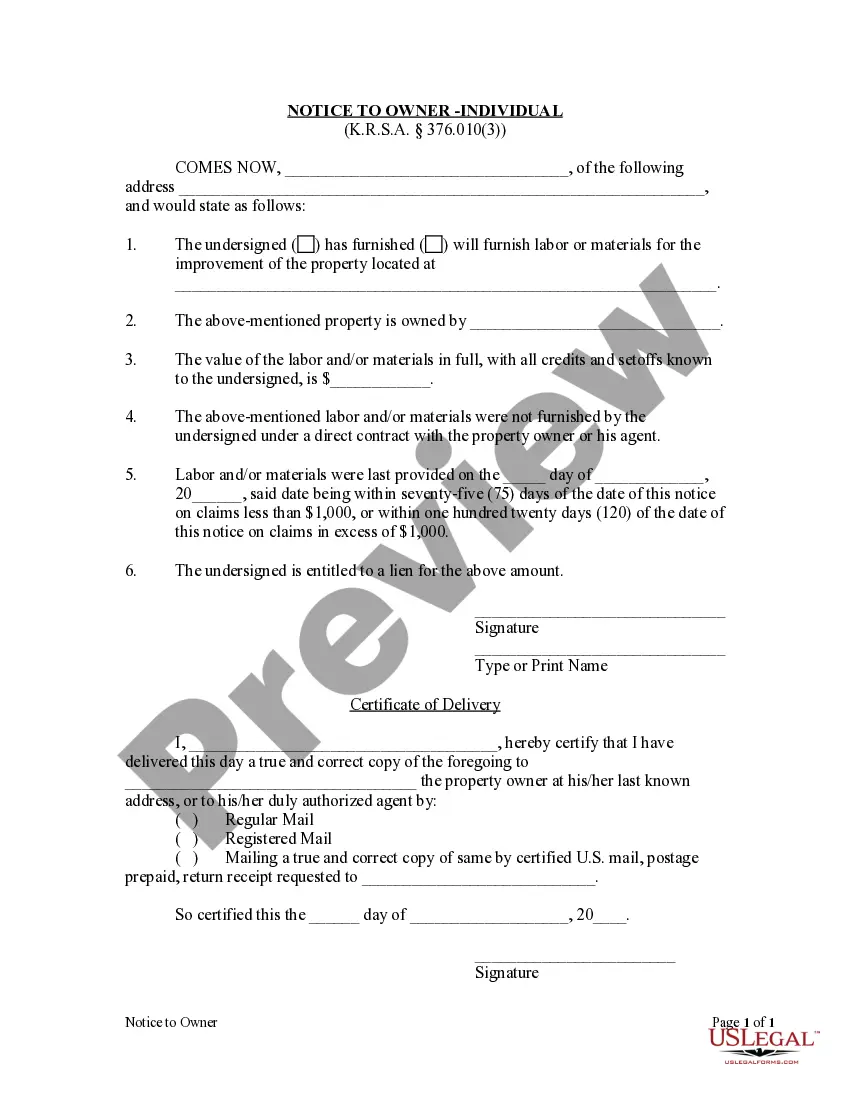
Kentucky Notice to Owner - Individual
What is this form?
The Notice to Owner - Individual is a legal document that informs a property owner about a lien claim made by an individual or entity that has not contracted directly with them. This form serves to protect the lien claimant's rights to establish a lien on the property, ensuring they comply with state laws by providing timely notice. Unlike similar forms, this notice specifically addresses situations where the claimant has not entered into a direct contract with the property owner, outlining the conditions under which a lien can be claimed.
Key parts of this document
- The name and address of the lien claimant.
- The property address requiring improvement.
- The owner's name associated with the property.
- The value of the labor and/or materials provided.
- The confirmation that no direct contract exists with the property owner.
- The date the last labor or materials were provided.
- The signature of the lien claimant and certificate of delivery details.
When this form is needed
This form should be used in situations where a contractor, supplier, or another service provider has supplied labor or materials to a property without having a direct contract with the property owner. It is essential to provide this notice to secure the right to claim a lien under state law, especially when the value of the claim is less than $1,000 or more than $1,000, as this affects the timing of the notice requirement.
Who should use this form
- Contractors or subcontractors who supplied services or materials but do not have a direct agreement with the property owner.
- Suppliers of materials looking to protect their rights to a lien on a property they have improved.
- Any individual or business entity that needs to inform the property owner of a lien claim based on work done.
Steps to complete this form
- Identify the lien claimant by filling in your name and address at the top of the form.
- Specify the property address where labor or materials were provided.
- Enter the owner's name as it appears on official property documents.
- Complete the total value of the labor and/or materials supplied.
- Indicate the last date that labor and/or materials were provided.
- Sign the form and certify delivery to the property owner or authorized agent.
Does this document require notarization?
This form usually doesn’t need to be notarized. However, local laws or specific transactions may require it. Our online notarization service, powered by Notarize, lets you complete it remotely through a secure video session, available 24/7.
Get your form ready online
Our built-in tools help you complete, sign, share, and store your documents in one place.
Make edits, fill in missing information, and update formatting in US Legal Forms—just like you would in MS Word.
Download a copy, print it, send it by email, or mail it via USPS—whatever works best for your next step.
Sign and collect signatures with our SignNow integration. Send to multiple recipients, set reminders, and more. Go Premium to unlock E-Sign.
If this form requires notarization, complete it online through a secure video call—no need to meet a notary in person or wait for an appointment.
We protect your documents and personal data by following strict security and privacy standards.

Make edits, fill in missing information, and update formatting in US Legal Forms—just like you would in MS Word.

Download a copy, print it, send it by email, or mail it via USPS—whatever works best for your next step.

Sign and collect signatures with our SignNow integration. Send to multiple recipients, set reminders, and more. Go Premium to unlock E-Sign.

If this form requires notarization, complete it online through a secure video call—no need to meet a notary in person or wait for an appointment.

We protect your documents and personal data by following strict security and privacy standards.
Typical mistakes to avoid
- Failing to send the notice within the required time frame based on the claim amount.
- Not including the correct property address or owner's name.
- Omitting the signature or certification of delivery.
- Assuming a lien can be claimed without providing this notice first.
Why complete this form online
- Quick and easy access to a legally vetted document.
- Ability to fill out the form at your convenience from any device.
- Editable format allows for accurate entry of details before downloading.
- Instant download to ensure timely submission to the property owner.
Looking for another form?

Form popularity
FAQ
Colorado does not require lien waivers to be notarized in order to be effective.
A lien waiver is signed before a lien is actually filed. The party submitting the lien waiver states that they waive the right to lien against the project. In some instances, the property owner or general contractor may request that you sign and deliver a lien waiver before payment is disbursed.
It basically states that you've paid the subcontractor what is owed, they accept the payment in full, and they waive the right to put a lien on your property. Simply present this form to the subcontractor with your payment and ask them to sign it. Make sure you get their signature!
A lien waiver is quite common in the construction business. Essentially, it is a document from a contractor, subcontractor, supplier, or another party who holds a mechanic's lien that states they have been paid in full and waive future lien rights to the disputed property.
How much does it cost to file a mechanics lien in Kentucky? As of January 1, 2020, the cost to file a mechanics lien with a county recorder in Kentucky is $46 for the first 5 pages, and $3 for each page thereafter.
The main purpose of a lien waiver is to provide protection to the paying party. In exchange for such payment, the lien waiver waives the payee's right to file a lien for the exact value of the payment they have received.
LIen waivers are not required to be notarized. The primary times that a document needs to be notarized is if it is going to be filed with the county recorder or it is an affidavit. There are some other documents that often use notarization, but lien waivers don't fall into any of those that "need to be notarized."