Kansas Revocation of Postnuptial Property Agreement
What this document covers
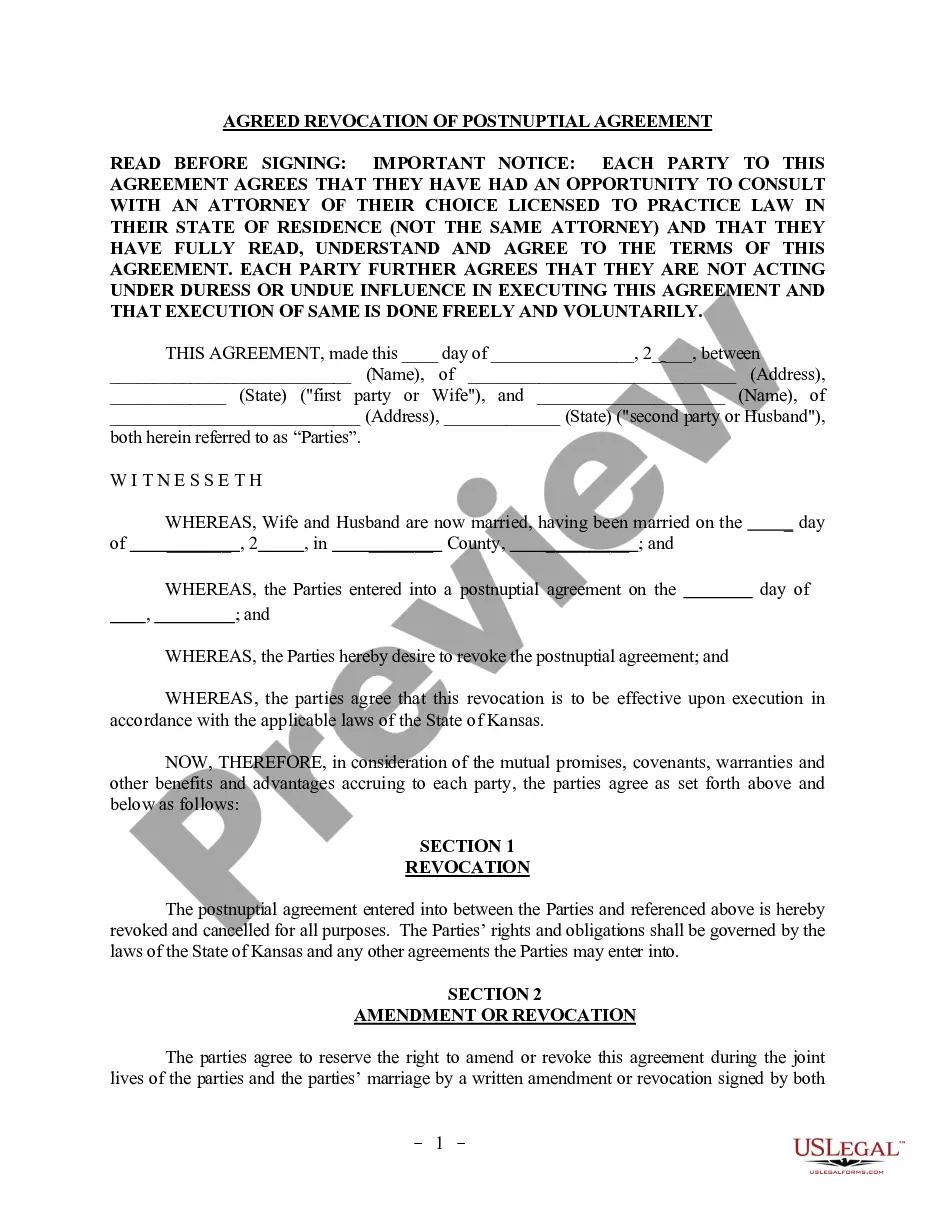
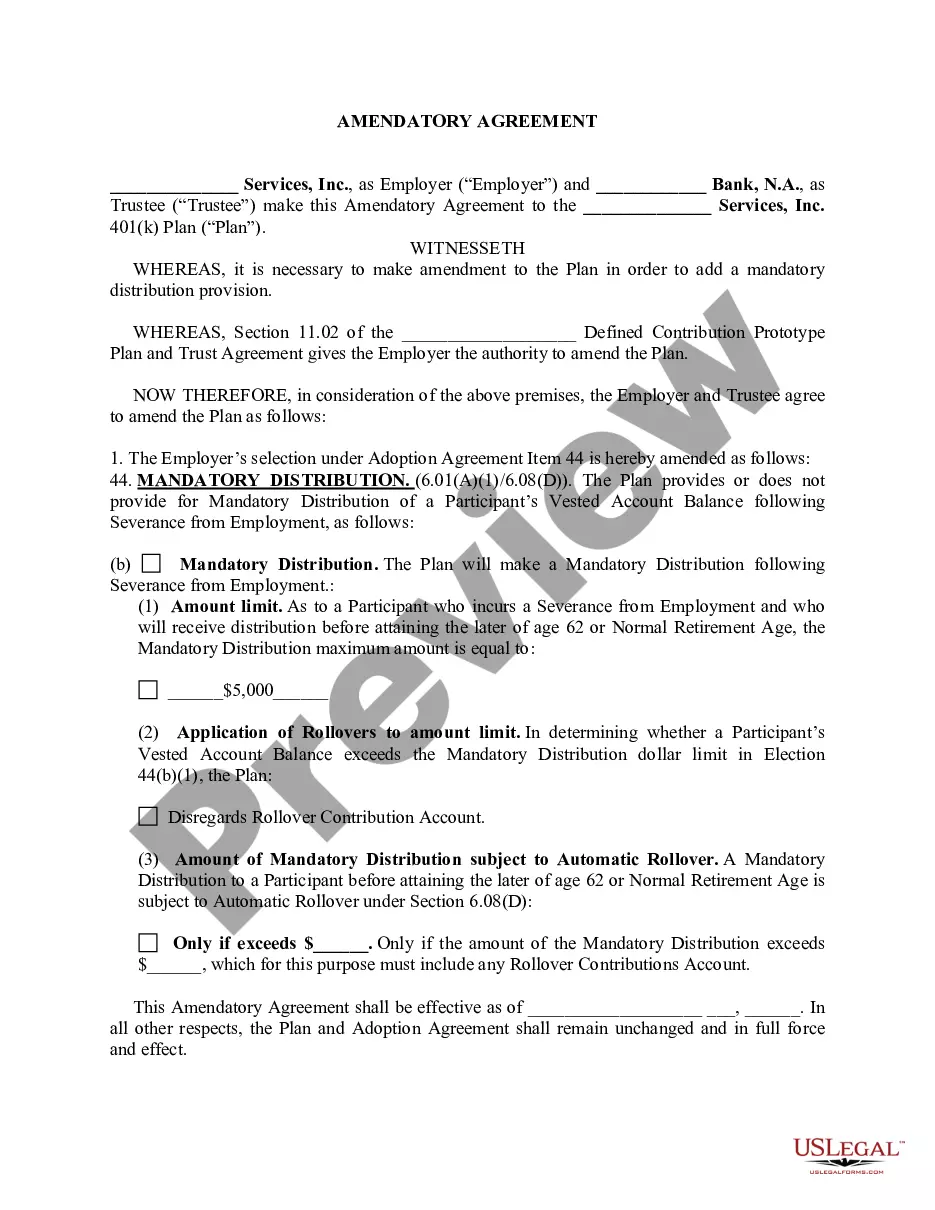
The Revocation of Postnuptial Property Agreement is a legal document used by spouses to formally revoke an existing postnuptial agreement. This form ensures that both parties acknowledge the revocation and outlines their rights and obligations moving forward. Unlike postnuptial agreements, which establish property rights during marriage, this revocation clarifies that the previous terms are no longer applicable.
Key parts of this document
- READ BEFORE SIGNING: A notice that both parties have had the opportunity to consult with separate attorneys.
- REVOCATION: A clause that formally cancels the prior postnuptial agreement.
- AMENDMENT OR REVOCATION: Provisions for future modifications to this revocation agreement.
- ABSENCE OF DURESS OR UNDUE INFLUENCE: Confirmation that both parties are acting voluntarily and without pressure.
- CONTROLLING LAW: Specifies that Kansas law governs the document.
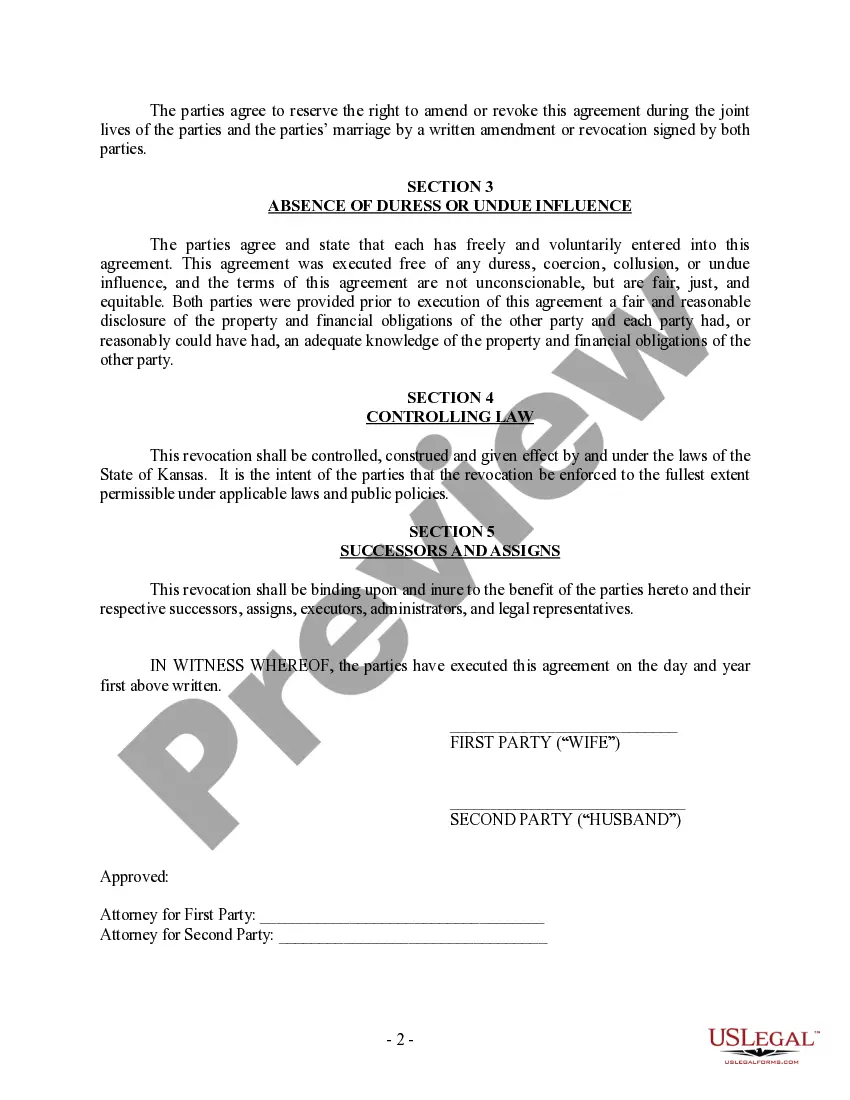
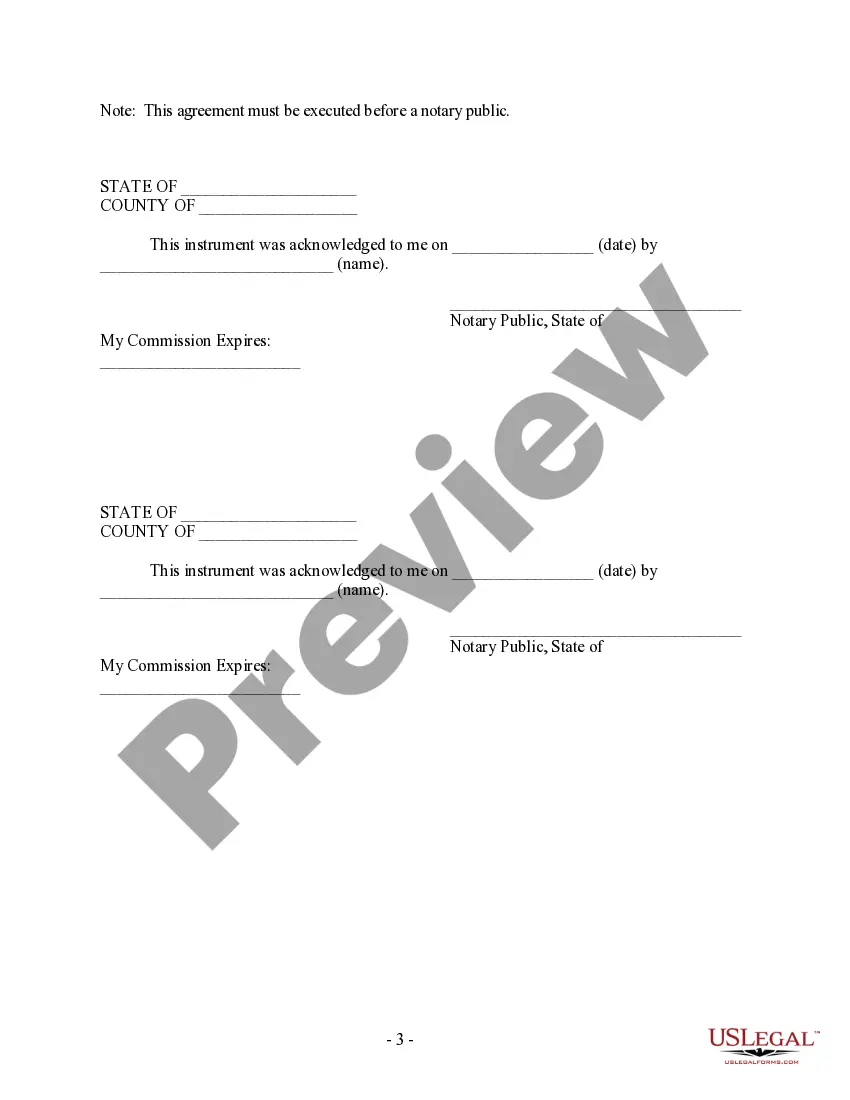
- SIGNATURES: Both parties must sign the document, which then requires notarization.
When this form is needed
This form should be used when both spouses agree to revoke a previously executed postnuptial agreement. Situations may include changes in financial circumstances, reconciliation after separation, or simply a mutual desire to move forward without the terms of the original agreement.
Who can use this document
- Married couples who wish to revoke an existing postnuptial property agreement.
- Parties who have mutually agreed that the original terms are no longer applicable.
- Individuals who want to ensure both parties acknowledge the change in their property rights.
Completing this form step by step
- Identify the parties involved, including their full names.
- Enter the date on which the agreement is being executed.
- Both parties should read each section carefully to understand their rights and responsibilities.
- Sign the document in front of a notary public to ensure legal validation.
- Ensure that the notary public signs and stamps the document after its execution.
Does this form need to be notarized?
This form must be notarized to be legally valid. US Legal Forms provides secure online notarization powered by Notarize, allowing you to complete the process through a verified video call.
Get your form ready online
Our built-in tools help you complete, sign, share, and store your documents in one place.
Make edits, fill in missing information, and update formatting in US Legal Forms—just like you would in MS Word.
Download a copy, print it, send it by email, or mail it via USPS—whatever works best for your next step.
Sign and collect signatures with our SignNow integration. Send to multiple recipients, set reminders, and more. Go Premium to unlock E-Sign.
If this form requires notarization, complete it online through a secure video call—no need to meet a notary in person or wait for an appointment.
We protect your documents and personal data by following strict security and privacy standards.
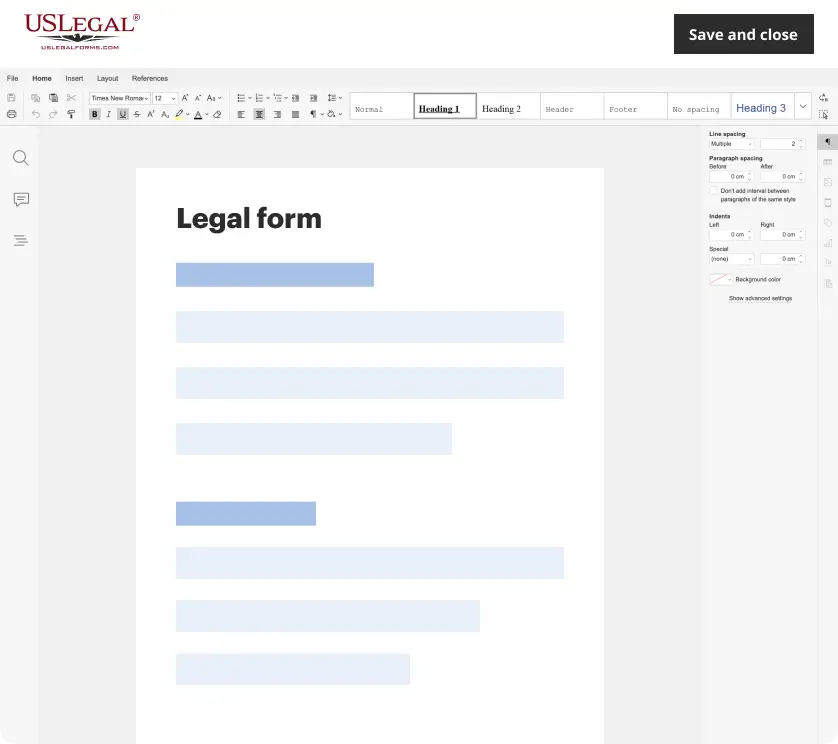
Make edits, fill in missing information, and update formatting in US Legal Forms—just like you would in MS Word.
Download a copy, print it, send it by email, or mail it via USPS—whatever works best for your next step.
Sign and collect signatures with our SignNow integration. Send to multiple recipients, set reminders, and more. Go Premium to unlock E-Sign.

If this form requires notarization, complete it online through a secure video call—no need to meet a notary in person or wait for an appointment.

We protect your documents and personal data by following strict security and privacy standards.
Avoid these common issues
- Failing to consult separate attorneys, which can lead to misunderstandings.
- Not notarizing the document, which may compromise its legal validity.
- Inadvertently leaving blank spaces that should be filled out before signing.
Why complete this form online
- Convenience of downloading the form at any time from your home.
- Editable fields make it easy to complete the form accurately.
- Access to reliable templates drafted by licensed attorneys ensures compliance with legal standards.
Looking for another form?
Form popularity
FAQ
An infidelity clause in a prenuptial agreement states that if one party is proved to have been involved in an extramarital affair, the aggrieved spouse will receive a financial award from the cheating spouse.The major pitfall of a infidelity clause is that it can raise doubt or mistrust where none is warranted.
As long as both parties are in agreement to the terms of the post nuptial contract, and have the ability to put those terms into a legal document, most states don't make it a legal requirement to have an attorney.
Per , since postnuptial agreements generally handle the same issues that prenuptial agreements address, the same circumstances that can cause a court to void part or all of a prenuptial agreement also apply to a postnuptial. Like a prenuptial, a postnuptial agreement should be in written form.
Are Post-Nuptial Agreements Legally Binding? Post-Nuptial Agreements are usually legally binding and the position has been strengthened since 2008 following a Privy Council judgement.
This is a contract that people sign during their engagement that outlines expectations for the marriage and also explains how the couple intends to split up their assets, debts and parenting time of shared children in the event of a divorce.
It needs to be in writing. An oral contract is often difficult to enforce legally in any case. It needs to be signed and notarized. It needs to be fair and reasonable. There must be full disclosure of assets by both spouses. Both parties agree to the terms of the postnuptial agreement.
Typically, a couple's prenuptial agreement will last for the lifetime of the marriage.For example, you can set the prenuptial agreement to last for 5 years before it automatically expires. If there is no sunset clause or specific stipulation regarding how long a prenup should last, its lifespan is indefinite.
In general, you should expect that a postnuptial agreement will receive scrutiny from the court before it decides to enforce the agreement. As your family law attorney would advise you, these agreements are not usually signed under the best of circumstances in the marriage.
A postnuptial agreement does the same thing as a prenuptial agreement in this way. However, the couple will sign a postnuptial agreement after marriage, not before. A postnuptial agreement can create rules for many different things should the couple divorce.