Illinois Subcontractor's 60 day Notice to Owner - Owner Occupied Residence - Mechanic Liens - Corporation or LLC
What this document covers
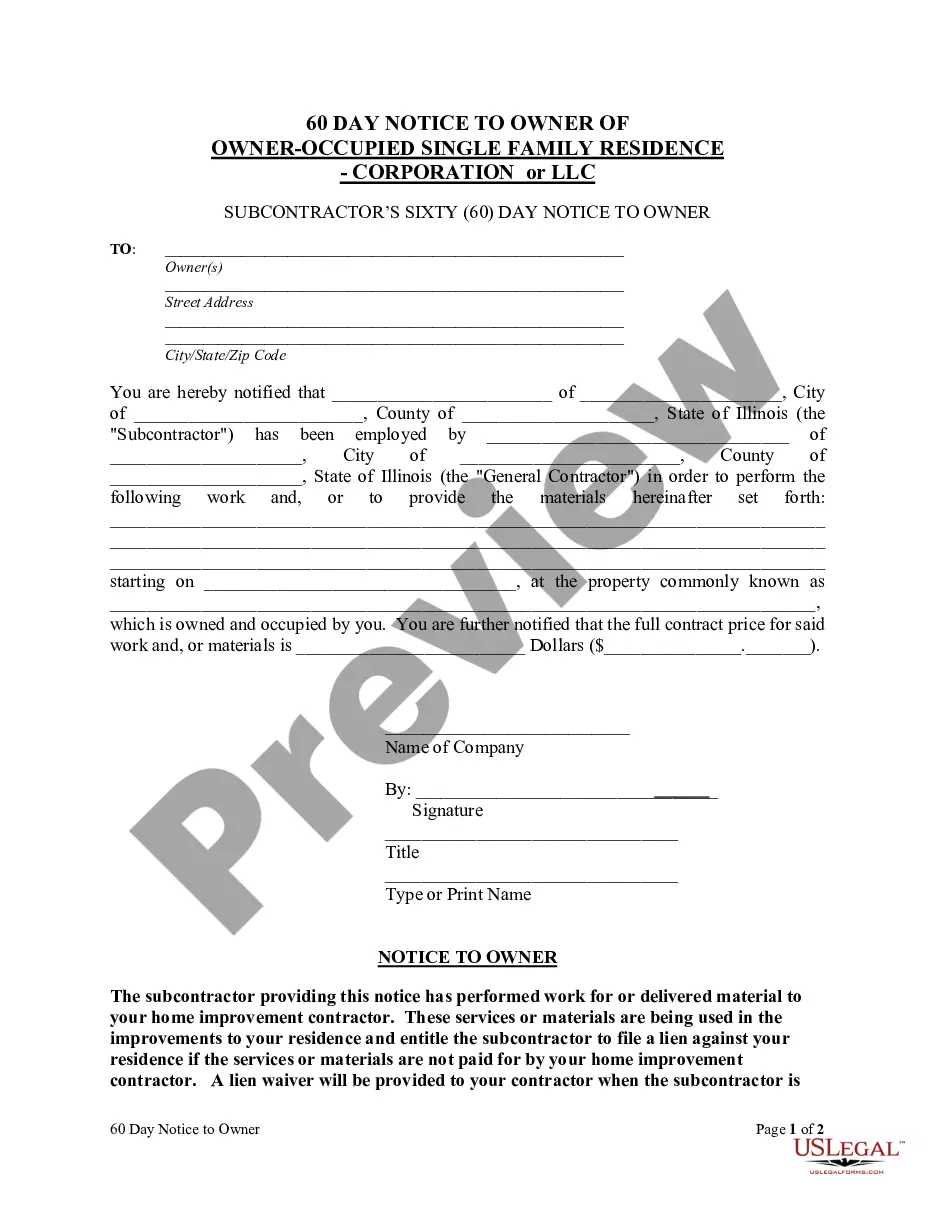
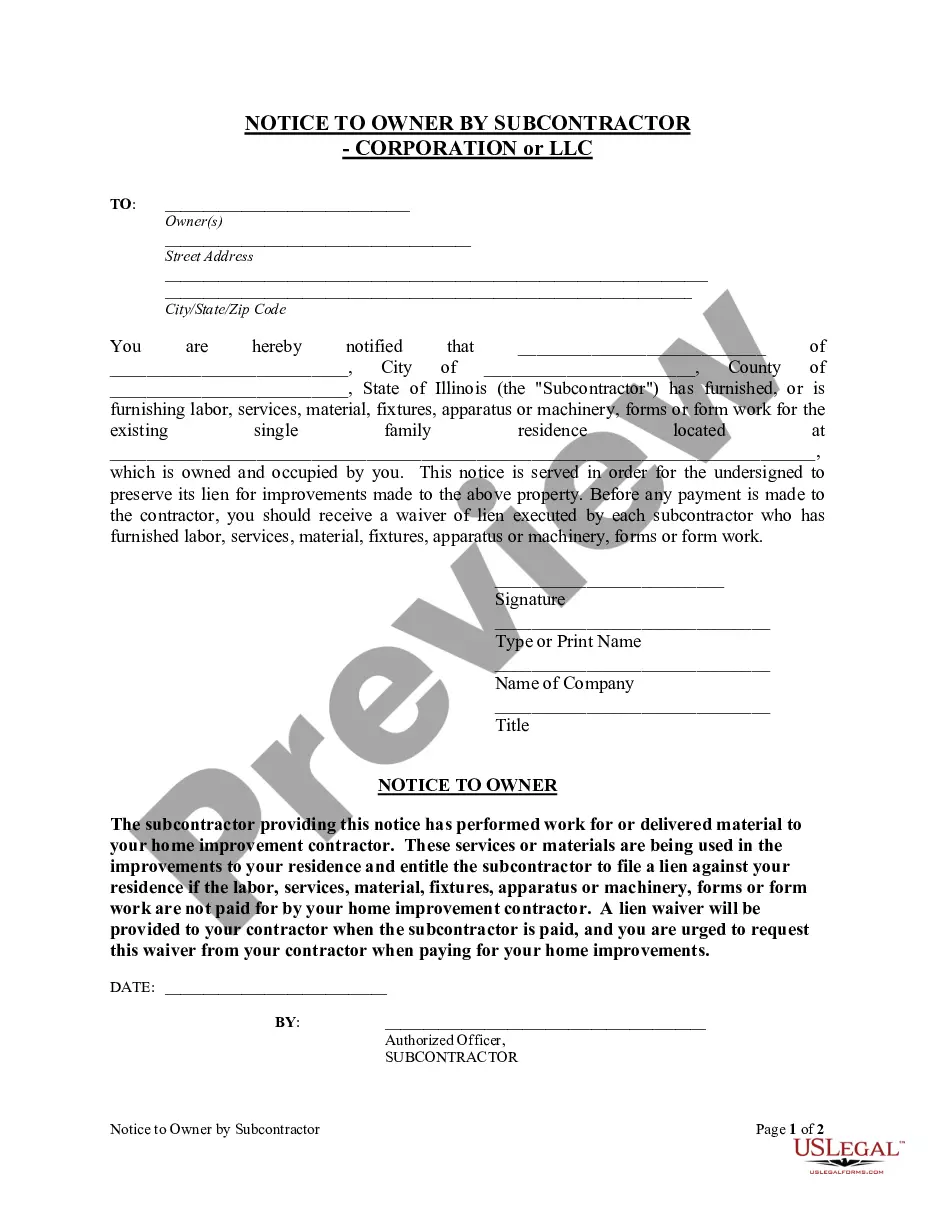
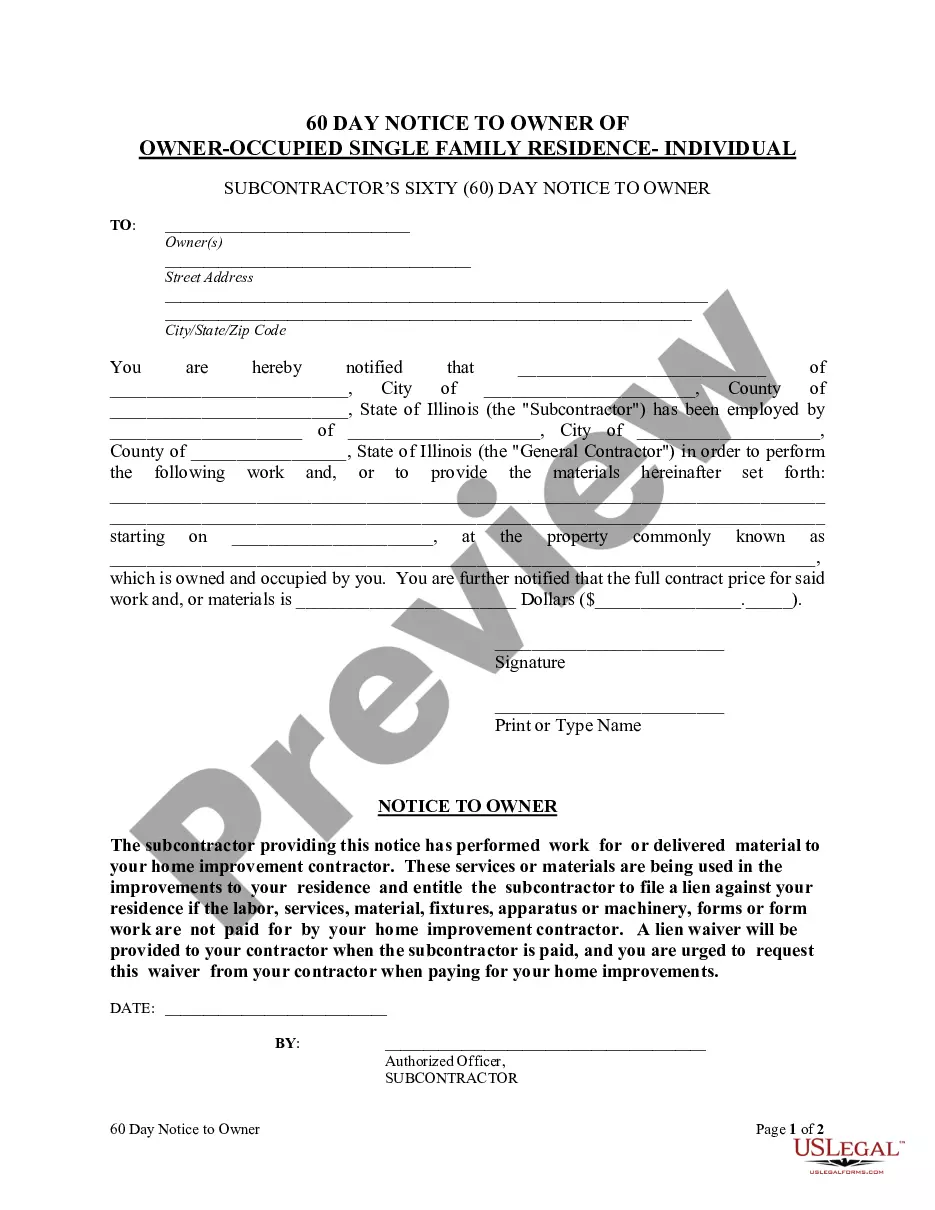
The Subcontractor's 60 Day Notice to Owner is a legal document required in Illinois for corporate or LLC subcontractors who have provided labor or materials on an owner-occupied residential property. This form serves the purpose of notifying the property owner that the subcontractor has rendered services or delivered materials as part of a construction project. It is essential for protecting the subcontractor's right to file a mechanic's lien if payment issues arise.
Key parts of this document
- Identification of the subcontractor and the general contractor involved in the project.
- Details of the specific work or materials provided, along with the contract price.
- Notification of the work commencement date.
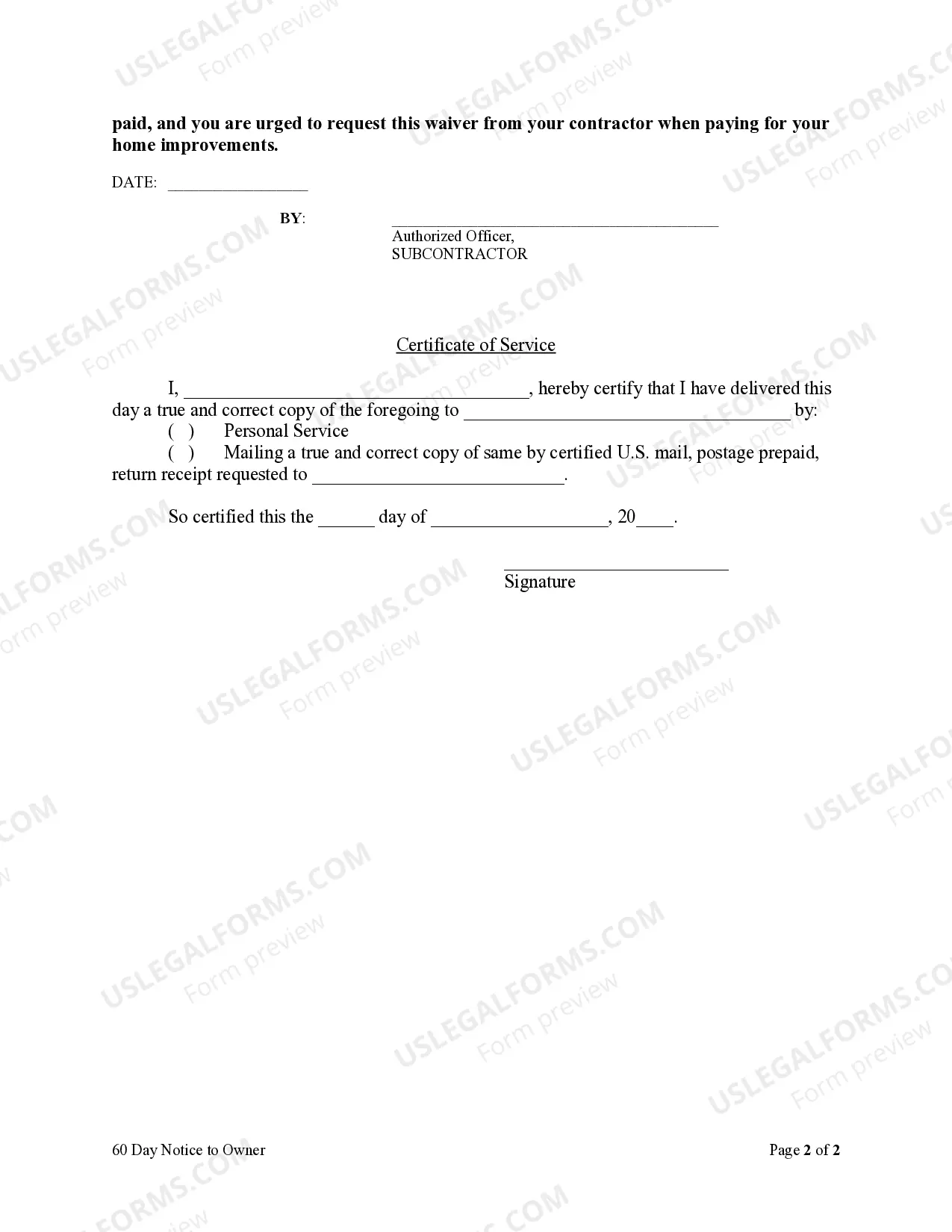
- Signature of an authorized officer from the subcontracting corporation.
- Certificate of service indicating how and when the notice was delivered to the owner.
Common use cases
This form should be used when a corporate or LLC subcontractor has provided labor or materials for home improvement work on an owner-occupied residential property in Illinois. It is particularly important to send this notice within sixty days from the last date of work or material delivery to protect the subcontractor's rights under state law.
Who can use this document
- Corporate or LLC subcontractors who have completed work on a residential property.
- General contractors who employ subcontractors for home improvement projects.
- Homeowners who need to understand lien rights related to contracted work on their residence.
How to complete this form
- Identify and enter the owner(s) and property address details in the appropriate fields.
- Provide the subcontractor's name, location, and details of the general contractor.
- Clearly describe the work performed or materials provided, along with the total contract price.
- Enter the commencement date of the work.
- Ensure an authorized officer from the subcontracting corporation signs the document.
- Complete the Certificate of Service detailing how the notice was delivered to the owner.
Does this form need to be notarized?
This form does not typically require notarization to be legally valid. However, some jurisdictions or document types may still require it. US Legal Forms provides secure online notarization powered by Notarize, available 24/7 for added convenience.
Get your form ready online
Our built-in tools help you complete, sign, share, and store your documents in one place.
Make edits, fill in missing information, and update formatting in US Legal Forms—just like you would in MS Word.
Download a copy, print it, send it by email, or mail it via USPS—whatever works best for your next step.
Sign and collect signatures with our SignNow integration. Send to multiple recipients, set reminders, and more. Go Premium to unlock E-Sign.
If this form requires notarization, complete it online through a secure video call—no need to meet a notary in person or wait for an appointment.
We protect your documents and personal data by following strict security and privacy standards.

Make edits, fill in missing information, and update formatting in US Legal Forms—just like you would in MS Word.

Download a copy, print it, send it by email, or mail it via USPS—whatever works best for your next step.

Sign and collect signatures with our SignNow integration. Send to multiple recipients, set reminders, and more. Go Premium to unlock E-Sign.

If this form requires notarization, complete it online through a secure video call—no need to meet a notary in person or wait for an appointment.

We protect your documents and personal data by following strict security and privacy standards.
Mistakes to watch out for
- Failing to send the notice within the sixty-day time frame after the last delivery of materials or labor.
- Not including all required information, such as the total contract price or work details.
- Omitting the signature of an authorized corporate officer.
Why use this form online
- Convenience of filling out and downloading the form at any time.
- Editability to customize details specific to your project before printing.
- Access to templates drafted by licensed attorneys to ensure legal compliance.
Looking for another form?


Form popularity
FAQ
Formalize a defense for disputing the amount of the lien. Gather supporting documentation for your rebuttal, depending on the type of lien. Contact the agent representing the creditor to dispute the amount of the claim. Negotiate a payment settlement with the creditor if you cannot pay the amount you owe in full.
The process of bonding off a mechanics lien starts after a claimant has filed a mechanics lien. After the claim is made, a general contractor or a property owner can contact a surety bond company to purchase a surety bond that replaces the value of the lien that was filed against the property.
How long does a judgment lien last in Illinois? A judgment lien in Illinois will remain attached to the debtor's property (even if the property changes hands) for seven years.
The deadline for contractors and subcontractors to file their statement of mechanic's lien is four months (not 120 days) from the last date of work (exclusive of warranty work or other work performed free of charge), or from the last date that materials were supplied to the project.
In order to enforce a lien, the contractor, subcontractor or supplier must file a lawsuit. The deadline to file a lawsuit is two years from the last date work was performed or materials were supplied. A recorded lien is valid for these two years, but a failure to sue within that time frame voids the lien.
Under Illinois law, any mechanics lien should be filed in the County Recorder of Deeds where the property being liened is located. This is crucial as the lien must be filed not only in the correct county but the correct office as well. The fees and specific document formatting vary depending on your county.
In order to enforce a lien, the contractor, subcontractor or supplier must file a lawsuit. The deadline to file a lawsuit is two years from the last date work was performed or materials were supplied. A recorded lien is valid for these two years, but a failure to sue within that time frame voids the lien.
Negotiate with the contractor who placed the lien (the "lienor" to remove it. Obtain a lien bond to discharge the lien, or. File a lawsuit to vacate the lien.