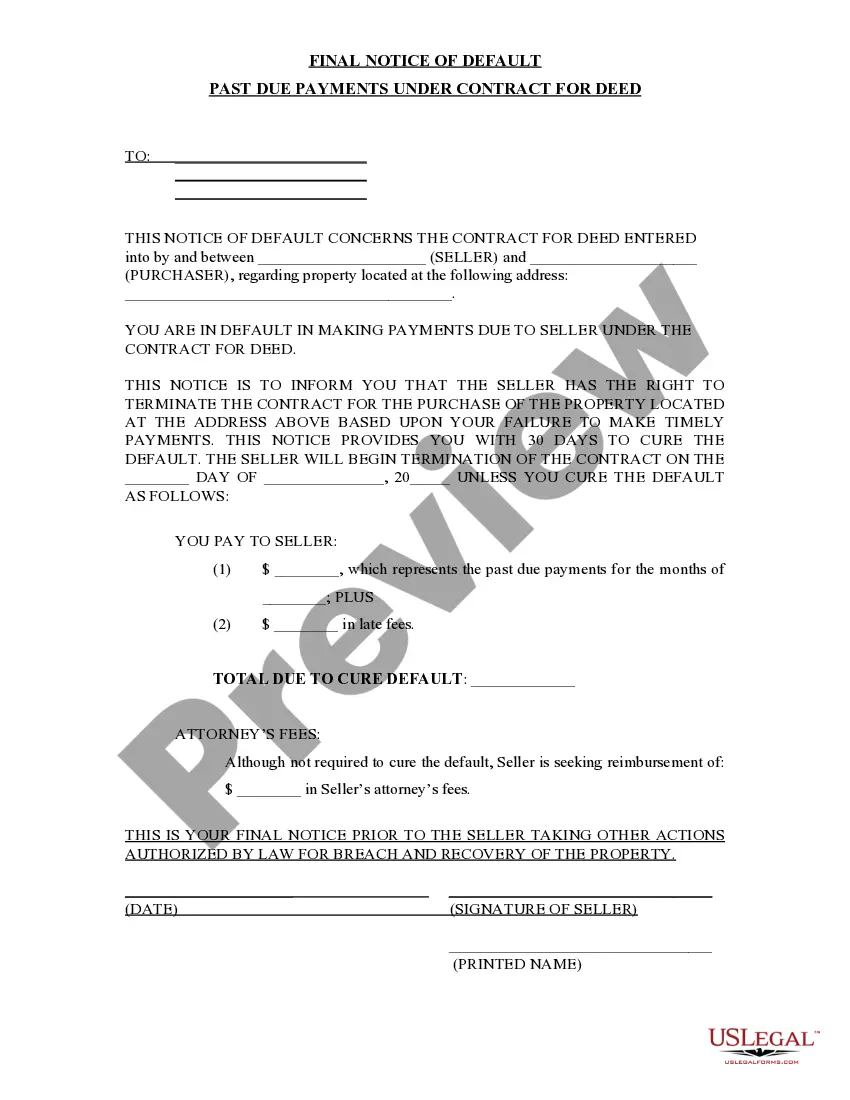
Iowa Final Notice of Default for Past Due Payments in connection with Contract for Deed
About this form
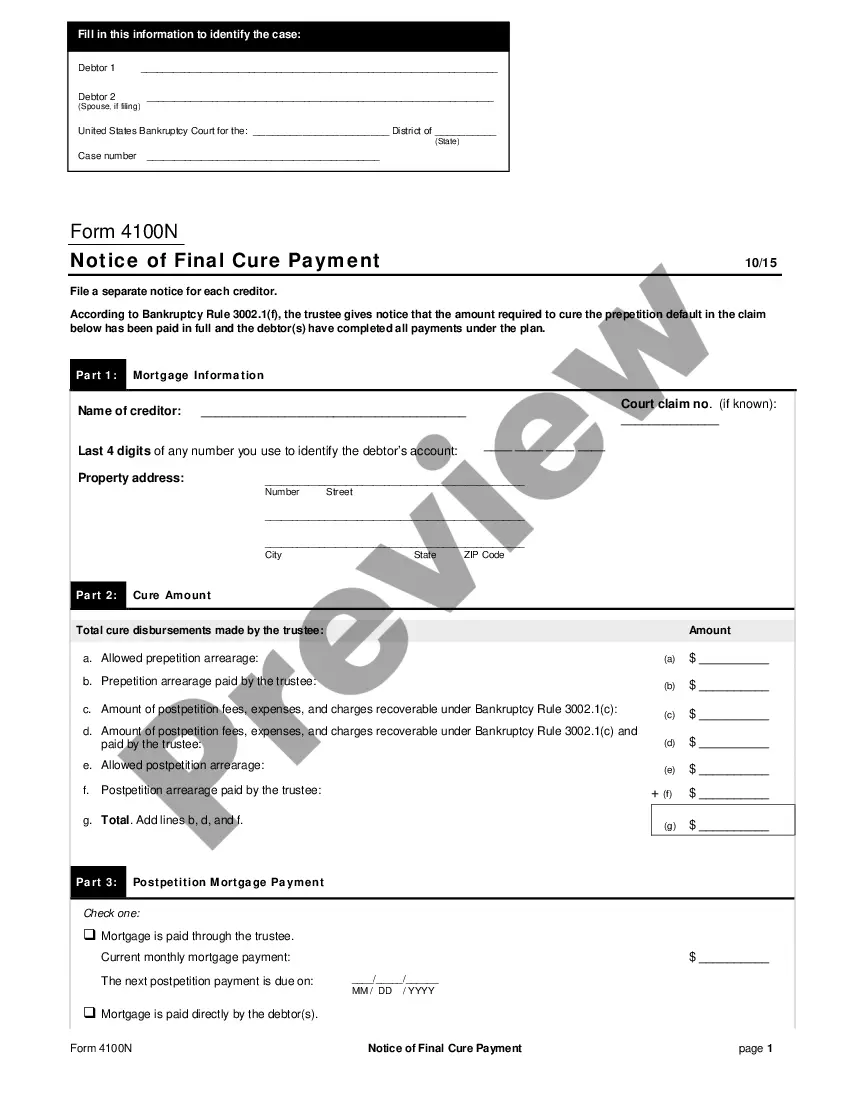
The Final Notice of Default for Past Due Payments in connection with Contract for Deed is a legal document sent by the seller to notify the purchaser of failure to make required payments on the property. This notice serves to establish that if the purchaser does not pay the specified amount by a certain deadline, they will be in default of the contract, and the seller may terminate the agreement, potentially leading to eviction and loss of payments made.
Main sections of this form
- Contact information of the seller and purchaser.
- Property address associated with the contract for deed.
- Details of the default, including amounts due and late fees.
- Deadline for payment to cure the default.
- Consequences of failing to make the payment, including potential eviction.
- Signature of the seller to validate the notice.

Common use cases
This form should be used when a purchaser has missed payments required under a Contract for Deed. It acts as the final warning before the seller takes legal action to terminate the contract and reclaim the property. Use this form if you wish to formally inform the purchaser of their current default status and the potential consequences of failing to remedy the situation.
Intended users of this form
- Sellers of property under a Contract for Deed who need to notify the purchaser of default.
- Purchasers who wish to understand the implications of their non-payment and the action their seller may take.
- Real estate professionals assisting clients in managing contracts for deed.
How to complete this form
- Identify the parties involved: seller and purchaser.
- Specify the property address linked to the contract.
- Detail the amount owed, including past due payments and any applicable late fees.
- Set a clear deadline for the purchaser to remedy the default.
- Correspondingly, complete the seller's signature and date to finalize the notice.
Does this document require notarization?
This form does not typically require notarization unless specified by local law.
Get your form ready online
Our built-in tools help you complete, sign, share, and store your documents in one place.
Make edits, fill in missing information, and update formatting in US Legal Forms—just like you would in MS Word.
Download a copy, print it, send it by email, or mail it via USPS—whatever works best for your next step.
Sign and collect signatures with our SignNow integration. Send to multiple recipients, set reminders, and more. Go Premium to unlock E-Sign.
If this form requires notarization, complete it online through a secure video call—no need to meet a notary in person or wait for an appointment.
We protect your documents and personal data by following strict security and privacy standards.

Make edits, fill in missing information, and update formatting in US Legal Forms—just like you would in MS Word.

Download a copy, print it, send it by email, or mail it via USPS—whatever works best for your next step.

Sign and collect signatures with our SignNow integration. Send to multiple recipients, set reminders, and more. Go Premium to unlock E-Sign.

If this form requires notarization, complete it online through a secure video call—no need to meet a notary in person or wait for an appointment.

We protect your documents and personal data by following strict security and privacy standards.
Common mistakes to avoid
- Failing to accurately state the amount due.
- Not providing a clear deadline for payment.
- Omitting signatures or dates, which can invalidate the notice.
- Not following local requirements regarding notice delivery.
Advantages of online completion
- Immediate access to the latest legal form templates.
- Convenient download options for ease of use.
- Editable forms that can be tailored to your specific situation.
- Reduced time spent on paperwork, allowing for efficient handling of legal matters.
Looking for another form?
Form popularity
FAQ
The primary risk for the buyer or borrower in a contract for deed involves potentially losing the property upon receiving an Iowa Final Notice of Default for Past Due Payments in connection with Contract for Deed. If the buyer fails to make timely payments, the seller may initiate foreclosure proceedings, which can lead to the loss of not only the property but also any equity built during the contract period. This situation highlights the importance of understanding the terms of the contract and maintaining consistent payment habits. Utilizing resources from uslegalforms can help clarify these terms and equip you with vital information to mitigate risks.
In Iowa, a borrower may typically face foreclosure after missing three consecutive payments. However, every lender may have different policies regarding this. The Iowa Final Notice of Default for Past Due Payments in connection with Contract for Deed signals that immediate action is essential to avoid foreclosure. Seeking guidance from resources like uslegalforms can provide critical insights and help you strategize your next steps.
A legal notice of default is a document that informs a borrower they have fallen behind on their payments. This notice serves as an alert of potential foreclosure proceedings if the situation is not resolved. When you encounter an Iowa Final Notice of Default for Past Due Payments in connection with Contract for Deed, it indicates urgency. Tools provided by uslegalforms can assist you in understanding your legal obligations and possible remedies.
In Iowa, the foreclosure process can last anywhere from six months to over a year. This time can be influenced by various elements such as legal proceedings and the nature of the mortgage. If you receive an Iowa Final Notice of Default for Past Due Payments in connection with Contract for Deed, it’s critical to take immediate action. Utilizing services like uslegalforms can guide you in understanding your position and potential next steps.
The time frame for a bank to foreclose on a house varies, often taking between three to twelve months. The timeline can fluctuate based on factors such as state laws and the borrower's situation. With the Iowa Final Notice of Default for Past Due Payments in connection with Contract for Deed, understanding these timelines can help you formulate an effective strategy. Consider using resources like uslegalforms to gain clarity on your rights and options.
The foreclosure process in Iowa typically takes anywhere from several months to over a year. This duration depends on various factors, including court schedules and the complexity of the case. When facing the Iowa Final Notice of Default for Past Due Payments in connection with Contract for Deed, it is essential to act promptly. Engaging with a legal professional can help you navigate this process efficiently.
When you receive a notice of default, it signals that you have fallen behind on your payments. This document, specifically the Iowa Final Notice of Default for Past Due Payments in connection with Contract for Deed, sets off a chain reaction that can lead to foreclosure if not addressed. Reviewing your financial situation and reaching out to your lender can help you formulate a plan to remedy the default.
A default notice is a serious warning regarding your financial obligations. It indicates that you are at risk of foreclosure if corrective action is not taken promptly. The Iowa Final Notice of Default for Past Due Payments in connection with Contract for Deed emphasizes the urgency of addressing your payments before you lose your property.
Once a house is in default, the lender typically initiates the foreclosure process. You may receive the Iowa Final Notice of Default for Past Due Payments in connection with Contract for Deed, which outlines your obligations and options moving forward. Engaging with your lender at this stage may offer ways to amend the situation before it escalates.
Yes, it is possible to halt a sheriff sale in Iowa, particularly if you take action quickly. You may need to negotiate with your lender or seek a court order to stop the sale. Addressing the Iowa Final Notice of Default for Past Due Payments in connection with Contract for Deed early on can provide you with options to avoid foreclosure.