Iowa Seller's Disclosure of Financing Terms for Residential Property in connection with Contract or Agreement for Deed a/k/a Land Contract
What this document covers
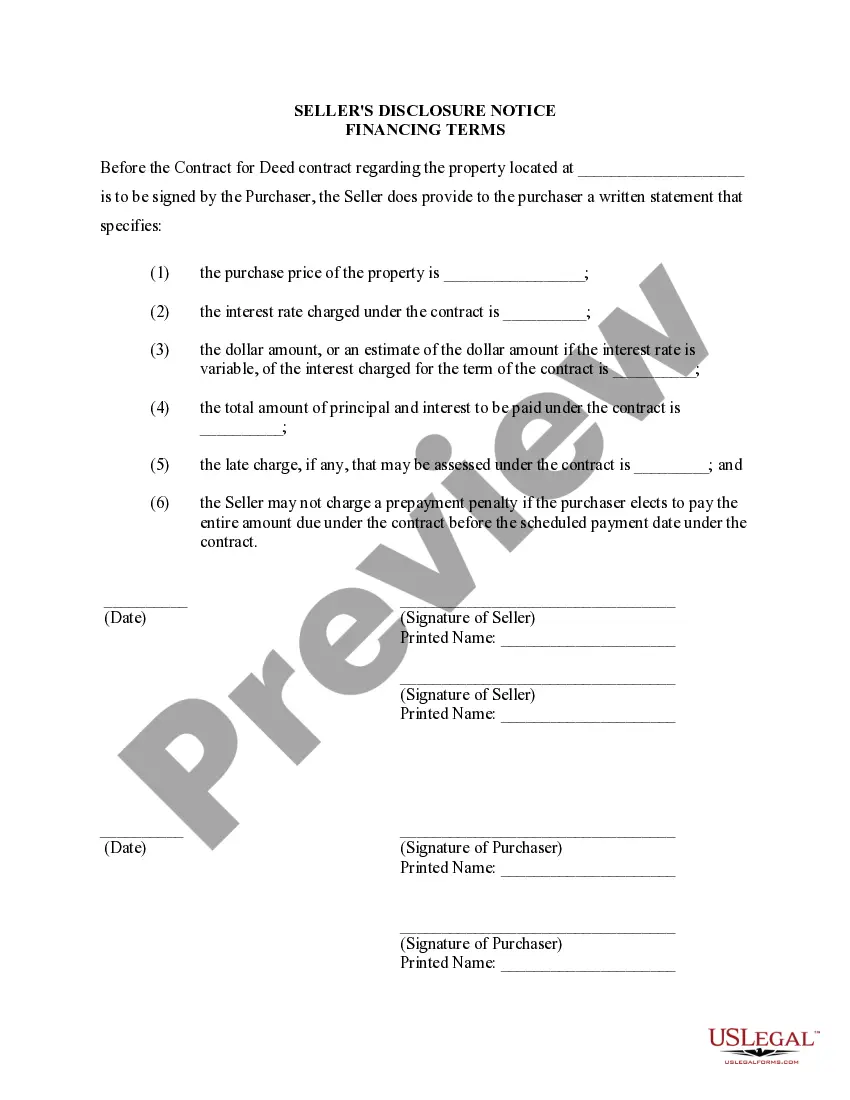
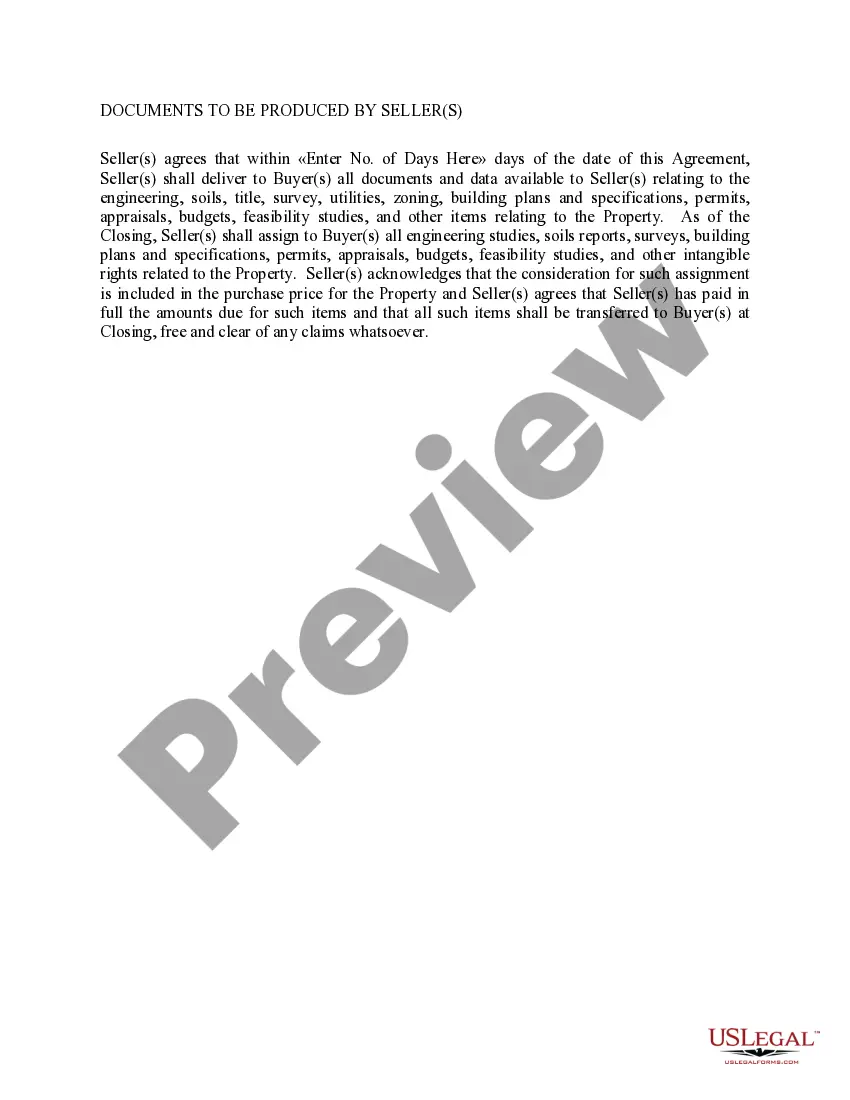
The Seller's Disclosure of Financing Terms for Residential Property, commonly known as the Seller's Disclosure Notice, is a legal document that outlines the financing terms of a property sale. This form informs the purchaser about the purchase price, payment structure, interest rates, and any applicable late charges. It is an essential tool for both parties, ensuring transparency and clarity before the execution of a contract for deed, also known as a land contract.
Main sections of this form
- Contact information for the seller and purchaser
- Details of the purchase price
- Payment terms, including frequency and amounts
- Calculation of interest rates
- Information on late charges and penalties
When this form is needed
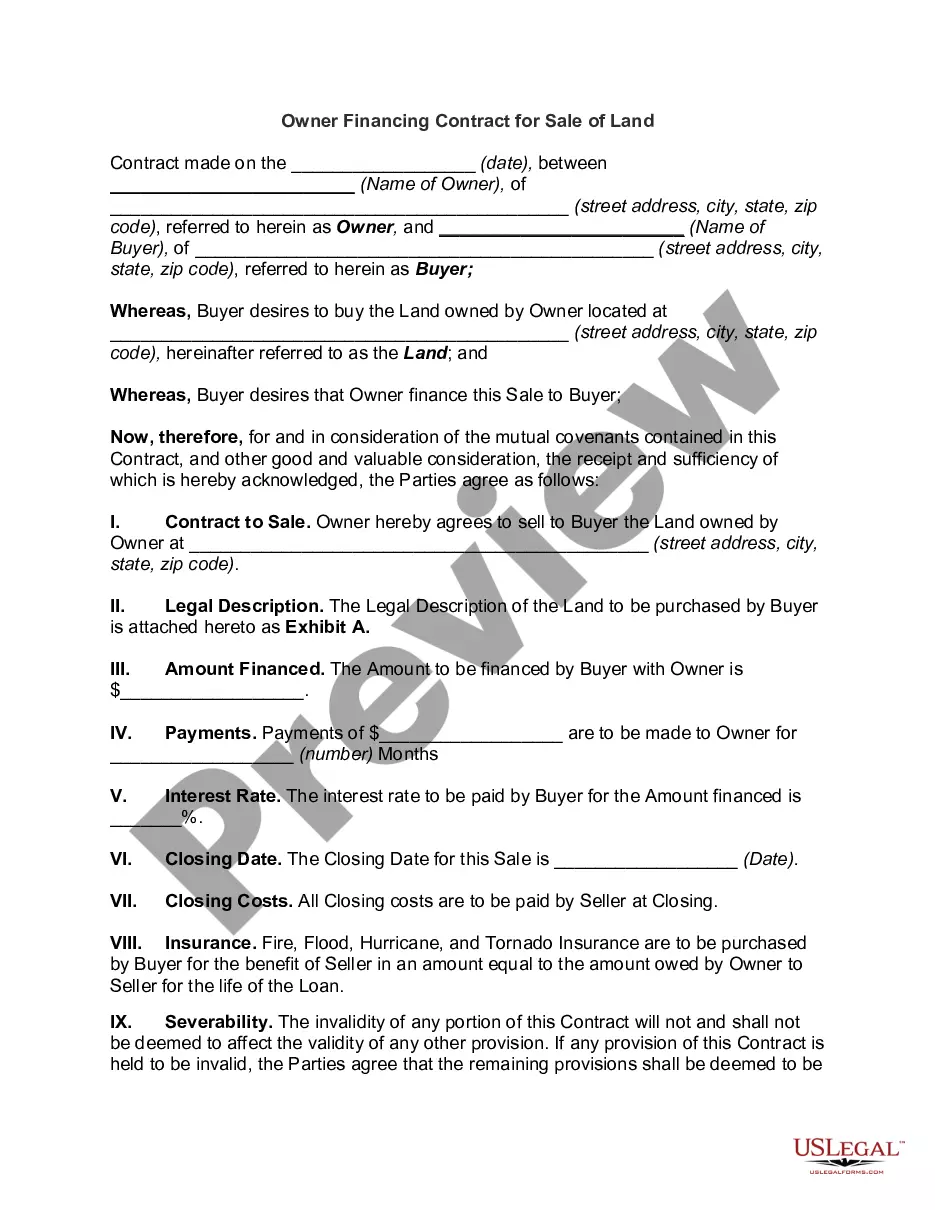
This form should be used when a seller and purchaser agree to a land contract for the sale of residential property. It is particularly important when the seller is providing financing for the buyer, as it clearly lays out essential financial terms and conditions. Use this form to ensure both parties are fully aware of their obligations and to avoid disputes regarding payment and financing down the line.
Intended users of this form
- Home sellers offering financing options to buyers
- Purchasers entering into a contract for deed
- Real estate agents facilitating such transactions
How to complete this form
- Identify and enter the names and contact information of both the seller and purchaser.
- Specify the total purchase price of the property.
- Outline the payment terms, including the amount and frequency of payments.
- Include details about the interest rate applicable to the financing.
- Document any late charges that may apply if payments are missed.
Is notarization required?
This form does not typically require notarization unless specified by local law. However, notarization can provide additional legal security and may be beneficial in certain transactions.
Get your form ready online
Our built-in tools help you complete, sign, share, and store your documents in one place.
Make edits, fill in missing information, and update formatting in US Legal Forms—just like you would in MS Word.
Download a copy, print it, send it by email, or mail it via USPS—whatever works best for your next step.
Sign and collect signatures with our SignNow integration. Send to multiple recipients, set reminders, and more. Go Premium to unlock E-Sign.
If this form requires notarization, complete it online through a secure video call—no need to meet a notary in person or wait for an appointment.
We protect your documents and personal data by following strict security and privacy standards.

Make edits, fill in missing information, and update formatting in US Legal Forms—just like you would in MS Word.

Download a copy, print it, send it by email, or mail it via USPS—whatever works best for your next step.

Sign and collect signatures with our SignNow integration. Send to multiple recipients, set reminders, and more. Go Premium to unlock E-Sign.

If this form requires notarization, complete it online through a secure video call—no need to meet a notary in person or wait for an appointment.

We protect your documents and personal data by following strict security and privacy standards.
Common mistakes
- Not fully completing the payment terms section.
- Failing to provide accurate contact information.
- Omitting late charges or penalties from the agreement.
- Not verifying the form's compliance with state-specific regulations.
Benefits of using this form online
- Convenient access to legally vetted form templates.
- Easy to fill out and customize for specific transaction needs.
- Secure download and storage options for future reference.
Summary of main points
- The Seller's Disclosure of Financing Terms is vital for transparency in land contracts.
- Completing the form accurately helps avoid future disputes between parties.
- This form is applicable in multiple states, but verify local regulations before use.
Looking for another form?
Form popularity
FAQ
What Are You Required to Disclose When You Sell Your Home? When you set out to sell a house, most states require you to make certain disclosures. Disclosures refer to any material defects in the home, and in many states you will be held liable if you don't tell the buyer about them upfront.
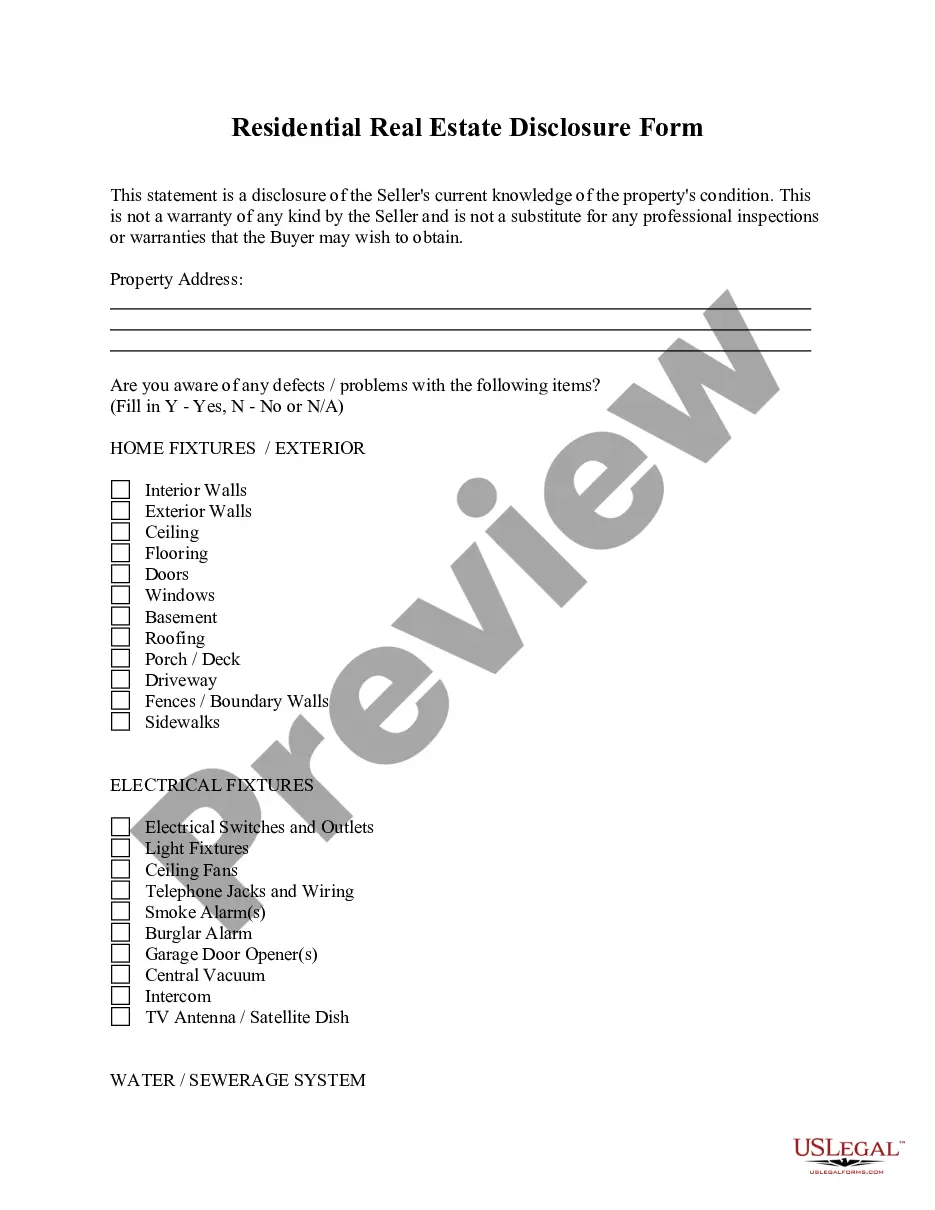
What does seller disclosure mean? In real estate, disclosures refer to the seller's legal obligation to reveal known defects about the home or property they're selling. A property disclosure statement is the actual documentation of a seller's disclosure.
The Seller's Disclosure Notice is a legal document in a real estate transaction that gives the buyer the details of the property.It is expected to be completed in full by the seller and is required to make notice of any malfunctions on the property concerning any of the appliances, features, equipment, and more.
Use common sense. Look to your state for guidance. Be ready to share your remodeling history. Expect a lot of yes/no checkboxes but elaborate when necessary. You can't disclose what you genuinely don't know.
As a broad rule, all sellers of residential real estate property containing one to four units in California must complete and provide written disclosures to the buyer. There are a few exceptions, such as for multi-unit buildings and properties that are transferred by court order or from one co-owner to another.
As a broad rule, all sellers of residential real estate property containing one to four units in California must complete and provide written disclosures to the buyer. There are a few exceptions, such as for multi-unit buildings and properties that are transferred by court order or from one co-owner to another.
When a seller fails to disclose a material, latent defect, that seller is liable for any costs the purchaser has to pay to remedy the situation. This liability extends to the listing agent.The owner and agent may remain liable even if the buyer's inspector does not discover the defect(s) during inspection.
Property disclosure statements essentially outline any flaws that the home sellers (and their real estate agents) are aware of that could negatively affect the home's value. These statements are required by law in most areas of the country so buyers can know a property's good and bad points before they close the deal.
Only one person is supposed to fill out the form. Well, technically. You can do it with another person, but make sure that only one person is physically checking off the boxes and typing in (or writing down) your answers.
Both the seller and the listing agent may be responsible for disclosing and required information to the home buyer prior to the sale. Disclosure forms vary by state and there are also some federal requirements surrounding lead paint in homes built before 1978.