Florida Uniform Donor Card for Anatomical Gift Act Donation
Overview of this form
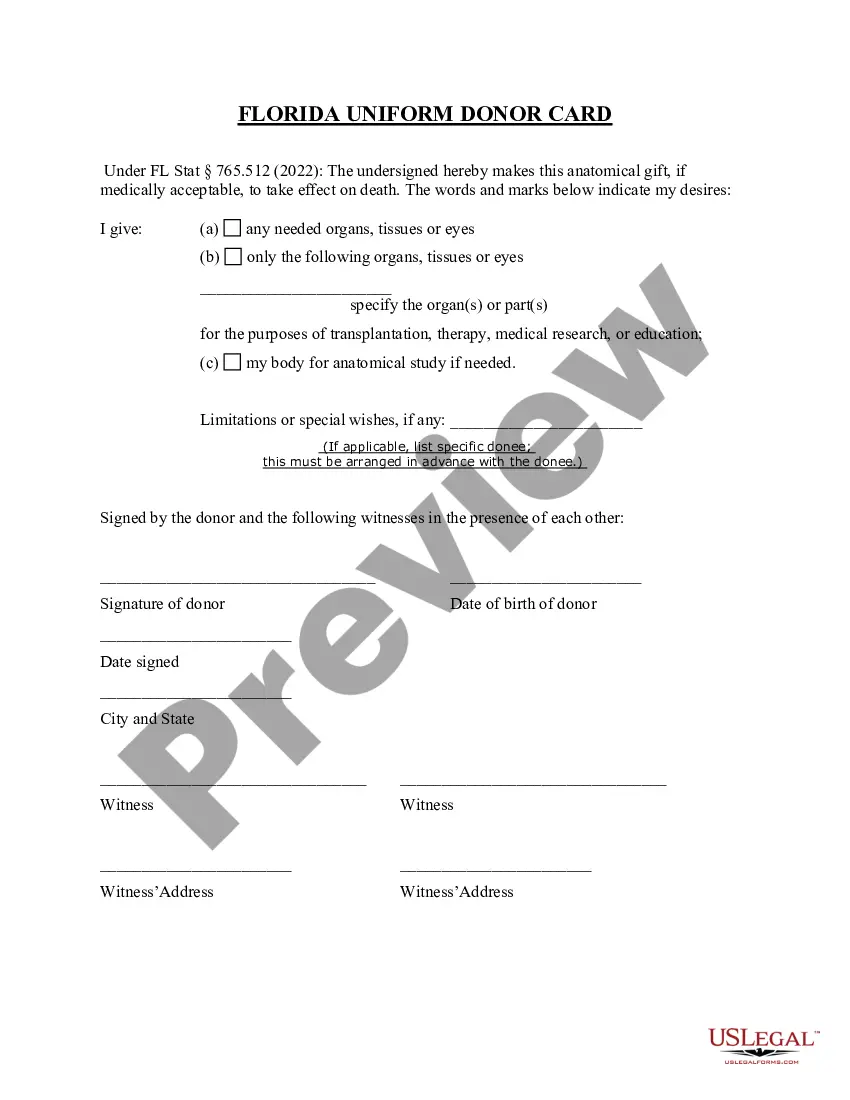
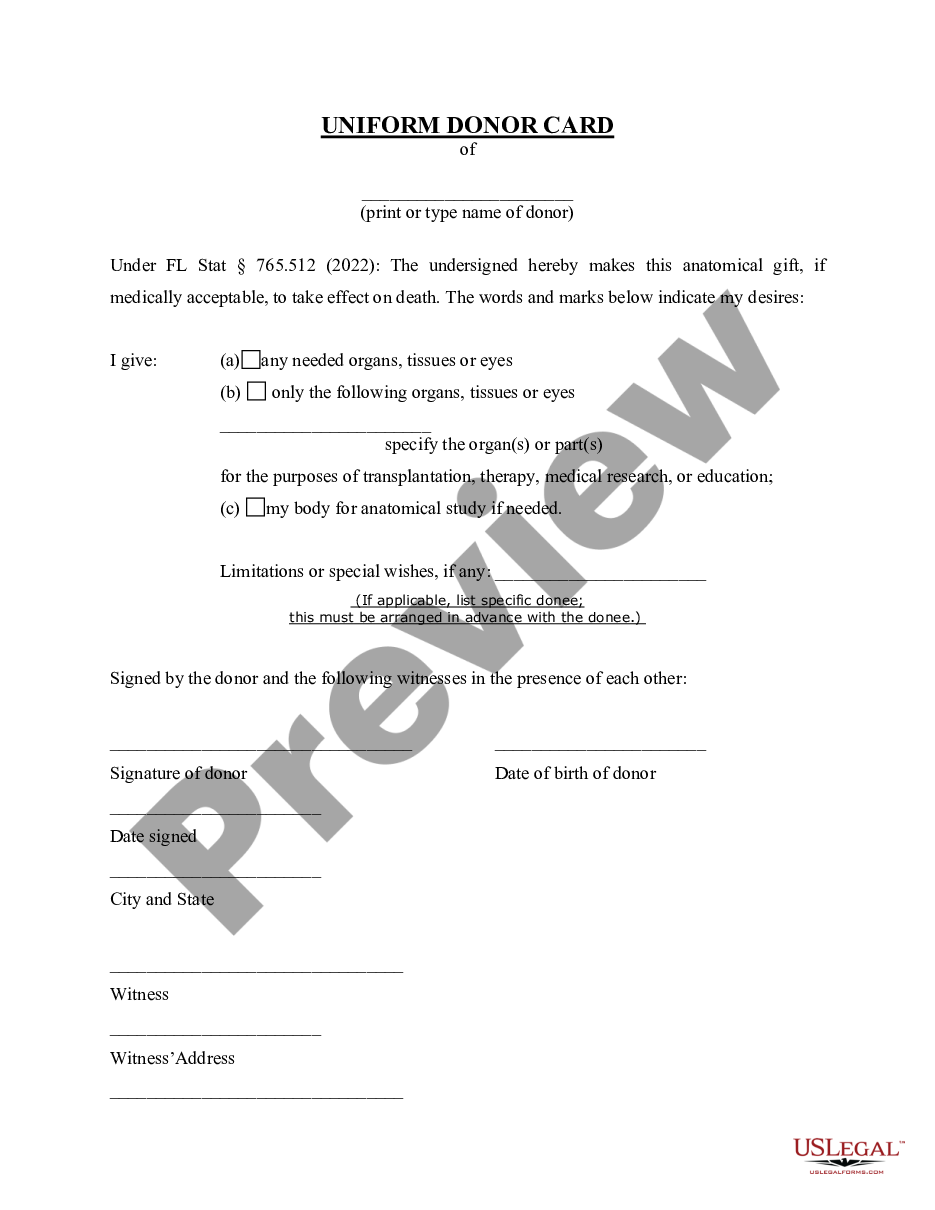
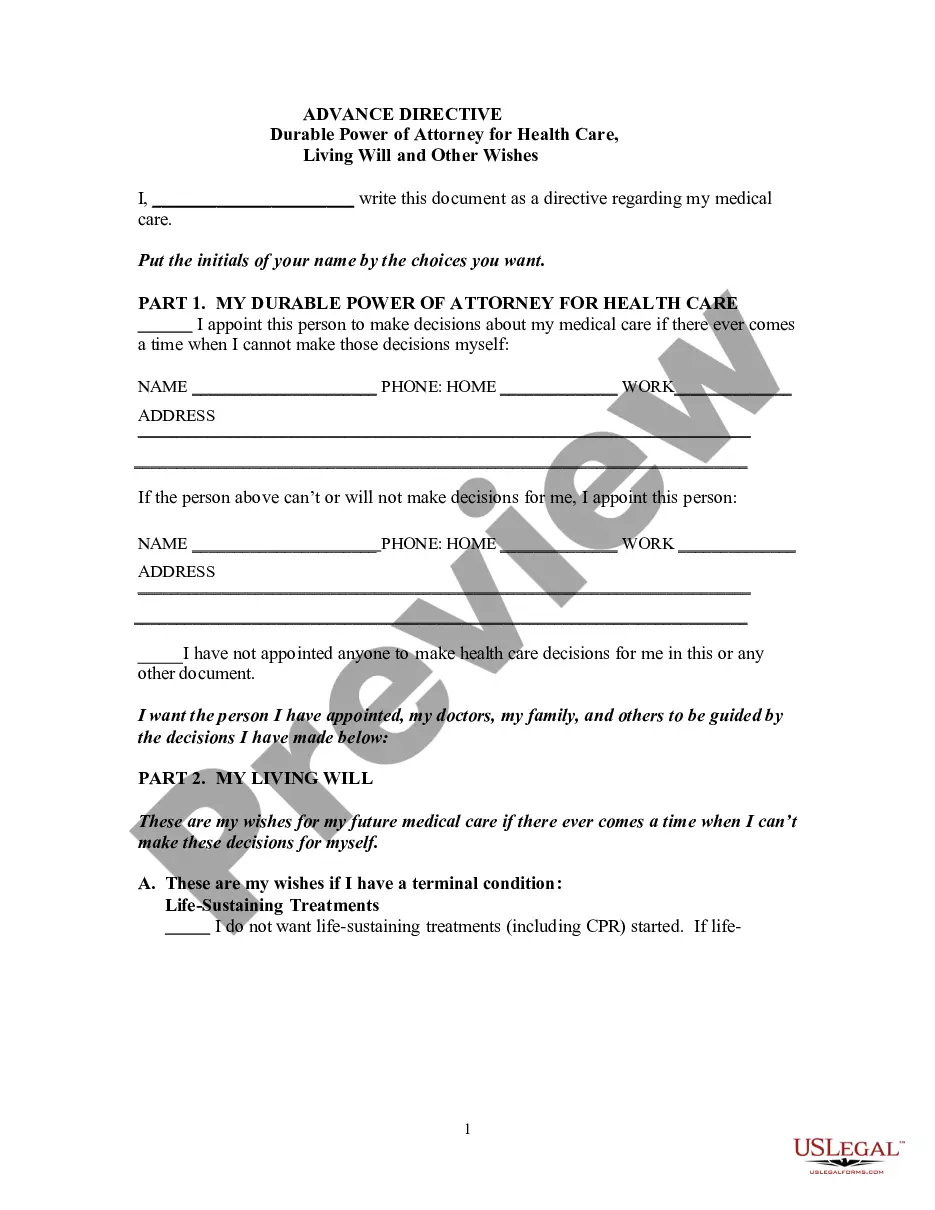
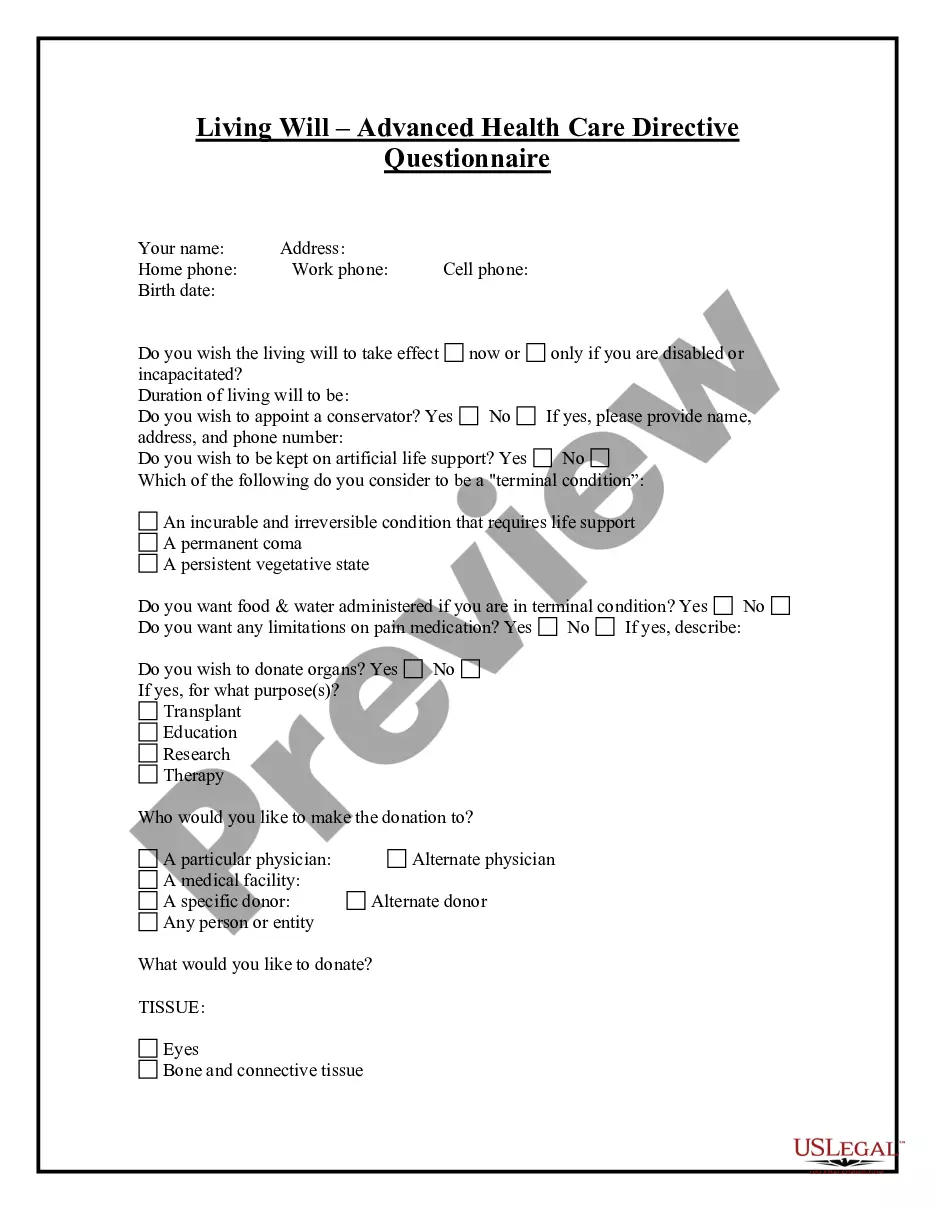
The Uniform Donor Card for Anatomical Gift Act Donation is a legal document that allows individuals to specify their wishes regarding organ and tissue donation upon death. This form differs from other donation forms by providing an explicit declaration of which body parts or organs the individual wishes to donate, alongside any limitations or special requests. It ensures that the individual's intentions are respected and legally acknowledged when the time comes.
Form components explained
- Identification of the donor's intentions regarding organ and tissue donation.
- Options to donate any needed organs, specific organs, or the entire body.
- Specifications for purposes of transplantation, therapy, medical research, or education.
- Space for donor's limitations or special wishes regarding the donation.
- Signature of the donor and two witnesses to validate the document.
- Notary acknowledgment to confirm the identities of the parties involved.
Common use cases
This form is useful when an individual wants to make a clear, formal declaration about their wishes to donate organs and tissues after death. It should be utilized in any situation where the donor wishes to ensure that their medical decisions regarding organ donation are legally binding and respected by family members and medical professionals. Examples include individuals organizing their end-of-life wishes or those with a family history of disease who want to facilitate organ donation for health purposes.
Who needs this form
This form is intended for:
- Individuals of legal age who want to donate their organs or tissues upon death.
- People who want to specify which body parts they wish to donate.
- Anyone seeking clarity for their loved ones and medical providers regarding their donation preferences.
Instructions for completing this form
- Identify your wishes regarding organ and tissue donation, clearly marking your preferences.
- Specify any limitations or special instructions related to your donation.
- Sign the document in the presence of two witnesses.
- Ensure each witness signs the form in your presence to validate it.
- If required by your state law, have the document notarized.
Notarization guidance
Notarization is not commonly needed for this form. However, certain documents or local rules may make it necessary. Our notarization service, powered by Notarize, allows you to finalize it securely online anytime, day or night.
Get your form ready online
Our built-in tools help you complete, sign, share, and store your documents in one place.
Make edits, fill in missing information, and update formatting in US Legal Forms—just like you would in MS Word.
Download a copy, print it, send it by email, or mail it via USPS—whatever works best for your next step.
Sign and collect signatures with our SignNow integration. Send to multiple recipients, set reminders, and more. Go Premium to unlock E-Sign.
If this form requires notarization, complete it online through a secure video call—no need to meet a notary in person or wait for an appointment.
We protect your documents and personal data by following strict security and privacy standards.

Make edits, fill in missing information, and update formatting in US Legal Forms—just like you would in MS Word.

Download a copy, print it, send it by email, or mail it via USPS—whatever works best for your next step.

Sign and collect signatures with our SignNow integration. Send to multiple recipients, set reminders, and more. Go Premium to unlock E-Sign.

If this form requires notarization, complete it online through a secure video call—no need to meet a notary in person or wait for an appointment.

We protect your documents and personal data by following strict security and privacy standards.
Mistakes to watch out for
- Failing to sign the form or missing witness signatures.
- Not specifying limitations or special wishes clearly.
- Overlooking notarization requirements where applicable.
- Using outdated forms that may not comply with current state laws.
Benefits of using this form online
- Convenient access to legal documents without the need for in-person visits.
- Editability allows users to tailor the form to their specific wishes easily.
- Reliability of forms drafted by licensed attorneys to ensure legal compliance.
Summary of main points
- The Uniform Donor Card allows individuals to document specific wishes regarding organ and tissue donation upon death.
- Clear specifications can avoid confusion and ensure that medical professionals respect the donor's intentions.
- Proper execution, including witness signatures and notarization, is essential for legality.
Looking for another form?

Form popularity
FAQ
Yes, you need to fill out paperwork to become an organ donor in Florida. Specifically, you'll complete the Florida Uniform Donor Card for Anatomical Gift Act Donation, which formalizes your intent to donate. This process can be done easily through online platforms like USLegalForms, which provide the necessary documents and guides. Properly filling out the paperwork ensures your gift is respected when the time arrives.
Completing organ donor registration in Florida is straightforward and can be done online or through physical forms. You will need to fill out the Florida Uniform Donor Card for Anatomical Gift Act Donation, where you will state your intent to donate. Upon completion, ensure your information is accurately entered in the state’s donor registry. Confirming your registration with your family is also important to avoid any confusion later.
The Uniform Anatomical Gift Act in Florida is a law that establishes guidelines for organ donation and anatomical gifts. It allows individuals to voluntarily donate their organs and tissues to save or enhance the lives of others. This act simplifies the process of organ donation and fosters a culture of generosity towards those in need. Understanding this act is vital for anyone considering the Florida Uniform Donor Card for Anatomical Gift Act Donation.
To register as an organ donor in Florida, you need to complete the Florida Uniform Donor Card for Anatomical Gift Act Donation. You can register online through the state’s official donor registry or visit designated agencies. A simple registration form will allow you to specify your wishes, and it’s crucial to inform your loved ones about your decision. This helps ensure that your donations are honored when the time comes.
Becoming an organ donor in Florida begins with understanding the importance of the Florida Uniform Donor Card for Anatomical Gift Act Donation. You express your wish to donate by signing a donor card and informing your family about your decision. It is essential to register your intent through official state registries, which ensures your wishes are honored. By taking these steps, you can contribute to saving lives and making a meaningful impact.
Anatomical body donation is the process of donating your entire body to medical research or education after death. This type of donation helps train future healthcare professionals and advance medical knowledge. It differs from organ donation, which focuses on specific organs for transplantation. To facilitate this process, utilizing the Florida Uniform Donor Card for Anatomical Gift Act Donation can ensure that your intent is communicated effectively.
Organ donation refers specifically to donating vital organs, such as the heart or kidneys, for transplantation. Body donation, on the other hand, involves donating the entire body for medical research or education. Each type of donation serves a unique purpose and can be crucial in advancing medical science. Using the Florida Uniform Donor Card for Anatomical Gift Act Donation allows you to specify your preferences clearly.
Making an anatomical gift involves voluntarily donating your organs or tissue after death for the purpose of transplantation or research. This gift can save lives and improve the quality of life for others. Completing the Florida Uniform Donor Card for Anatomical Gift Act Donation is a significant step in ensuring that your wishes are honored. By making this decision, you can leave a lasting impact on individuals in need.
DBD stands for donation after brain death, while DCD means donation after cardiac death. With DBD, the donor’s brain has irreversibly ceased functioning, allowing for organ donation to occur. In contrast, DCD involves donation occurring after the heart has stopped beating, but before brain death is declared. Understanding these differences can help you navigate the process of filling out the Florida Uniform Donor Card for Anatomical Gift Act Donation.
To check if you are an organ donor in Florida, you can look for a heart symbol on your driver’s license or ID card. This symbol indicates your registration under the Florida Uniform Donor Card for Anatomical Gift Act Donation. Additionally, you can visit the Florida Department of Highway Safety and Motor Vehicles website to verify your status. If you haven't registered yet, consider completing a donor card to make your wishes clear and simplify the process for your loved ones.