Florida Anatomical Gift Donor Card
Understanding this form
The Anatomical Gift Donor Card is a legal document that allows an individual to express their intention to donate their vital organs upon death. This form serves as a declaration of the donor's wishes and can include specific limitations on which organs may be donated. It is an important part of ensuring that one's wishes are known and respected after death and differs from general health care directives by focusing specifically on organ donation.
Form components explained
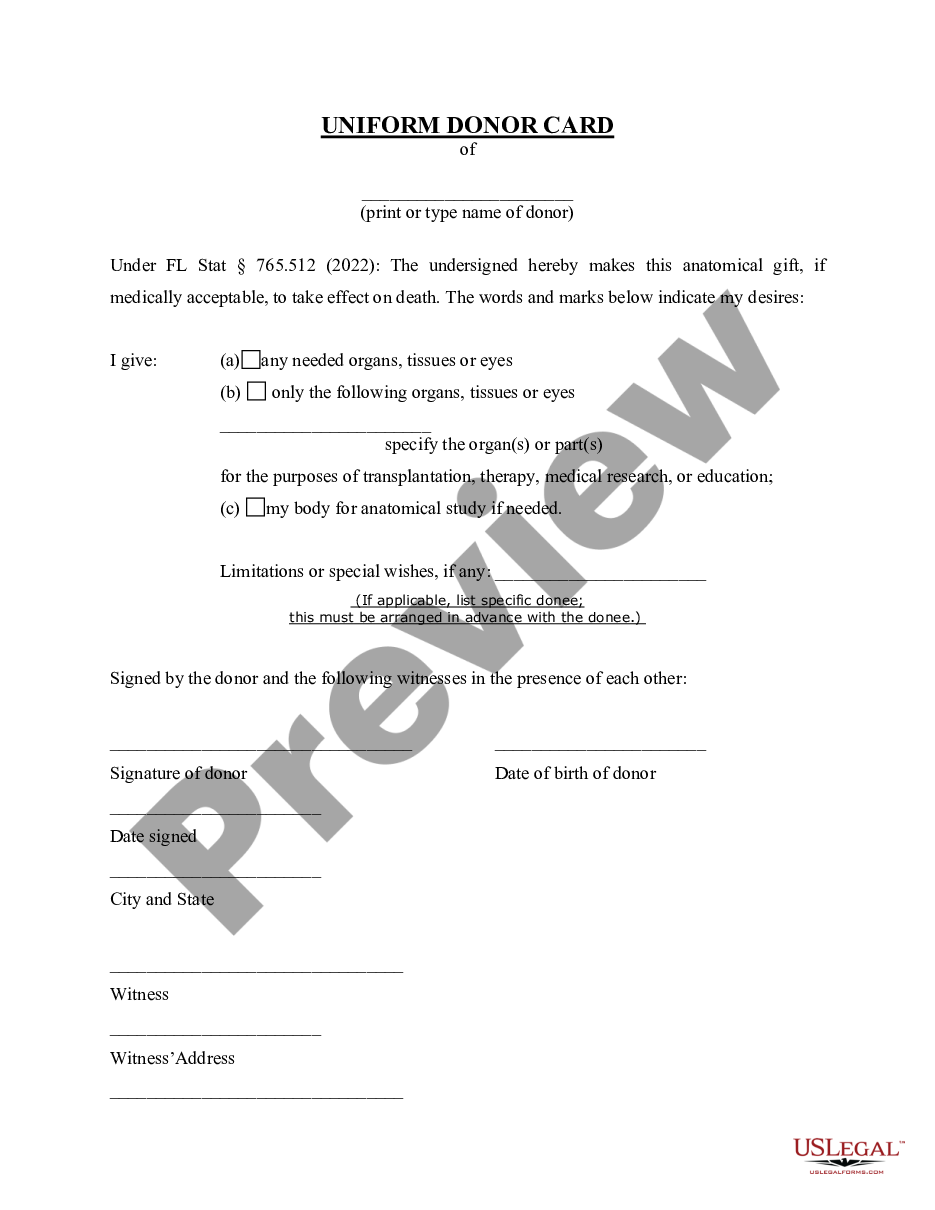
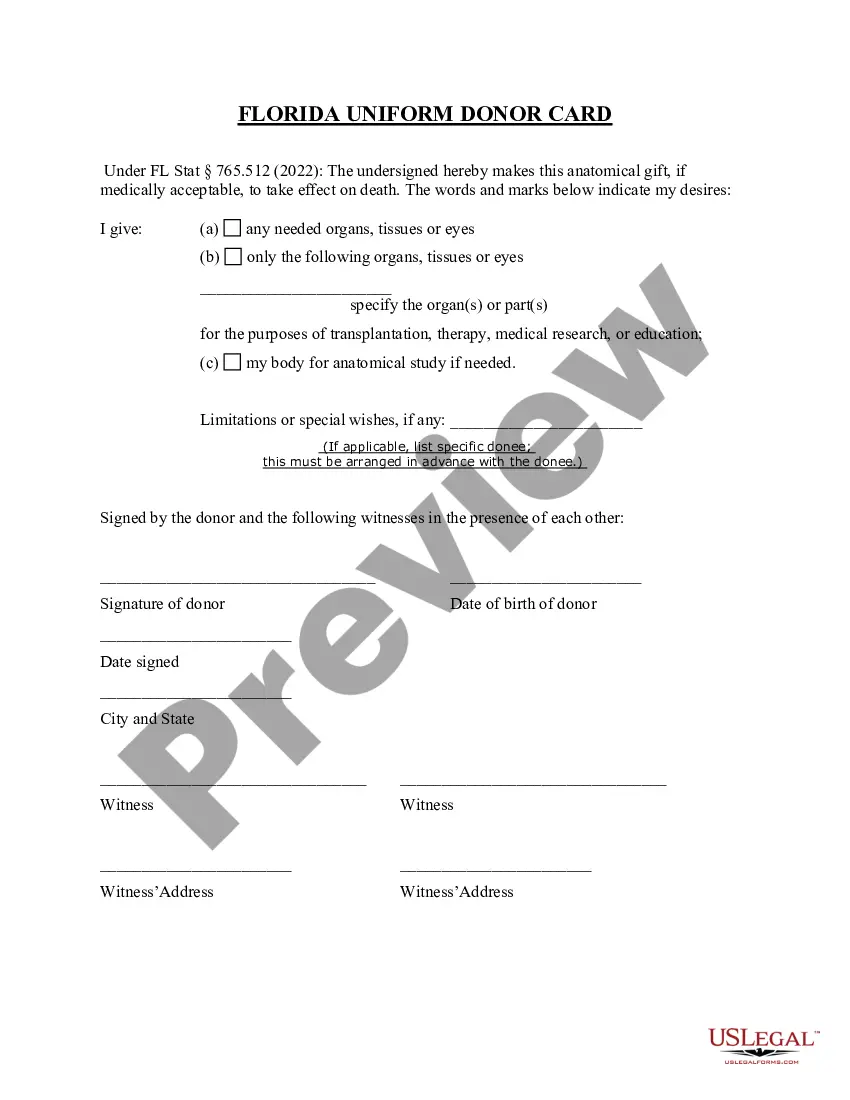
- Name of the donor: Print or type the full name of the individual making the anatomical gift.
- Donation options: Indicate if the donation includes any needed organs, only specific organs, or the entire body for anatomical study.
- Limitations or special wishes: Space to specify any conditions or preferences regarding the donation.
- Signatures: The donor must sign the card in the presence of witnesses, confirming their intent.
- Witness information: Names and addresses of the witnesses who observe the donor signing the card.

When this form is needed
This form is utilized when an individual wants to formally state their desire to donate organs after death. It is particularly important for those who wish to ensure their donation preferences are legally documented, allowing healthcare providers to honor these wishes. Common scenarios include discussions during estate planning, advanced health care planning, or when individuals wish to support organ donation initiatives.
Who this form is for
This form is suitable for:
- Individuals who wish to become organ donors.
- People involved in advanced healthcare planning.
- Anyone looking to communicate their organ donation wishes to their families and healthcare providers.
Completing this form step by step
- Print or type the donor's full name at the designated space.
- Select the preferred donation options by marking the appropriate checkboxes.
- If applicable, specify any limitations or special wishes regarding the donation.
- Sign the form in front of two witnesses, ensuring both witnesses sign the document.
- Fill in the dates and locations as required.
Does this document require notarization?
Notarization is not commonly needed for this form. However, certain documents or local rules may make it necessary. Our notarization service, powered by Notarize, allows you to finalize it securely online anytime, day or night.
Get your form ready online
Our built-in tools help you complete, sign, share, and store your documents in one place.
Make edits, fill in missing information, and update formatting in US Legal Forms—just like you would in MS Word.
Download a copy, print it, send it by email, or mail it via USPS—whatever works best for your next step.
Sign and collect signatures with our SignNow integration. Send to multiple recipients, set reminders, and more. Go Premium to unlock E-Sign.
If this form requires notarization, complete it online through a secure video call—no need to meet a notary in person or wait for an appointment.
We protect your documents and personal data by following strict security and privacy standards.

Make edits, fill in missing information, and update formatting in US Legal Forms—just like you would in MS Word.

Download a copy, print it, send it by email, or mail it via USPS—whatever works best for your next step.

Sign and collect signatures with our SignNow integration. Send to multiple recipients, set reminders, and more. Go Premium to unlock E-Sign.

If this form requires notarization, complete it online through a secure video call—no need to meet a notary in person or wait for an appointment.

We protect your documents and personal data by following strict security and privacy standards.
Mistakes to watch out for
- Not having the form signed in the presence of witnesses as required.
- Failing to specify limitations or preferences, leading to ambiguity.
- Using outdated versions of the form that may not comply with current state laws.
Benefits of completing this form online
- Immediate access to a legally vetted Anatomical Gift Donor Card template.
- Convenience of filling out the form at your own pace.
- Easy editing options to ensure your specific wishes are accurately reflected.
- Peace of mind knowing the document is prepared according to legal standards.
Legal use & context
- The form serves as a binding legal declaration of the donor's intentions.
- It may be used to ensure that medical personnel and family members are aware of the donor's wishes.
- Compliance with local laws increases the enforceability of the document.
Quick recap
- The Anatomical Gift Donor Card allows individuals to legally document their wishes regarding organ donation.
- Proper completion of the form requires the signature of the donor and witnessing by two individuals.
- The form should reflect any specific preferences or limitations regarding the donation.
Looking for another form?
Form popularity
FAQ
An anatomical gift in Florida statutes refers to the donation of a body part or organ for medical purposes, such as transplantation or research. This concept is crucial because it allows individuals to give the gift of life through actions documented in a Florida Anatomical Gift Donor Card. According to Florida law, individuals can make this decision voluntarily, and it plays an essential role in addressing the shortage of organs for those in need. Having clarity on this topic helps potential donors understand their impact on others.
The Florida Uniform Anatomical Gift Act is a law that regulates the donation of organs and tissues for transplantation and medical research. This law provides guidelines for individuals who wish to create a Florida Anatomical Gift Donor Card, ensuring their intent to donate is clearly expressed. It also outlines the rights and duties of various parties involved in the donation process. Understanding this act can help you make informed decisions about becoming an organ donor.
Making an anatomical gift means voluntarily donating part or all of your body for the purpose of medical education or research. You can communicate your wishes through a Florida Anatomical Gift Donor Card, which ensures that your intentions are clearly documented. This act of generosity can help save lives or improve medical training for future professionals.
Organ donation involves giving specific organs for the purpose of transplantation, whereas body donation means contributing your whole body for medical research and training. Both options carry their unique impacts, and choosing a Florida Anatomical Gift Donor Card allows individuals to make a significant contribution to science and healthcare education.
Organ donation typically refers to the donation of specific organs for transplantation, while anatomical gift encompasses a broader range, including the donation of the entire body. Both serve crucial purposes, but anatomical gifts, such as those made through a Florida Anatomical Gift Donor Card, focus on research and education rather than solely transplantation.
The official organ donor website in Florida is the Donate Life Florida website. This site provides essential information on how to register as an organ donor and outlines the steps for acquiring a Florida Anatomical Gift Donor Card. It serves as a valuable resource for anyone considering organ donation.
Anatomical body donation involves donating one's entire body for medical research and educational purposes. This process helps students and professionals in the healthcare field gain practical knowledge. By choosing to donate through a Florida Anatomical Gift Donor Card, individuals contribute to advancements in medicine and science.
DBD stands for Donation after Brain Death, while DCD means Donation after Cardiac Death. The primary difference lies in the circumstances of the donor's death. Understanding these definitions is important when discussing Florida Anatomical Gift Donor Card options, as both processes lead to valuable organ and tissue donations.
The Uniform Anatomical Gift Act in Florida provides guidelines on how individuals can donate their organs or bodies. This act outlines the process for making donations and ensures that donors' wishes are respected. It serves to protect both the donor and the recipient by clearly establishing legal protocols surrounding anatomical gifts.
The phrase 'I hereby make an anatomical gift' indicates your legal and binding decision to donate your organs or tissues after you pass away. By signing a Florida Anatomical Gift Donor Card, you are expressing your desire to help others in need, thus supporting vital medical procedures and education. This commitment reflects an invaluable contribution to society, potentially saving or enhancing many lives.