Florida Buyer's Request for Accounting from Seller under Contract for Deed
Overview of this form
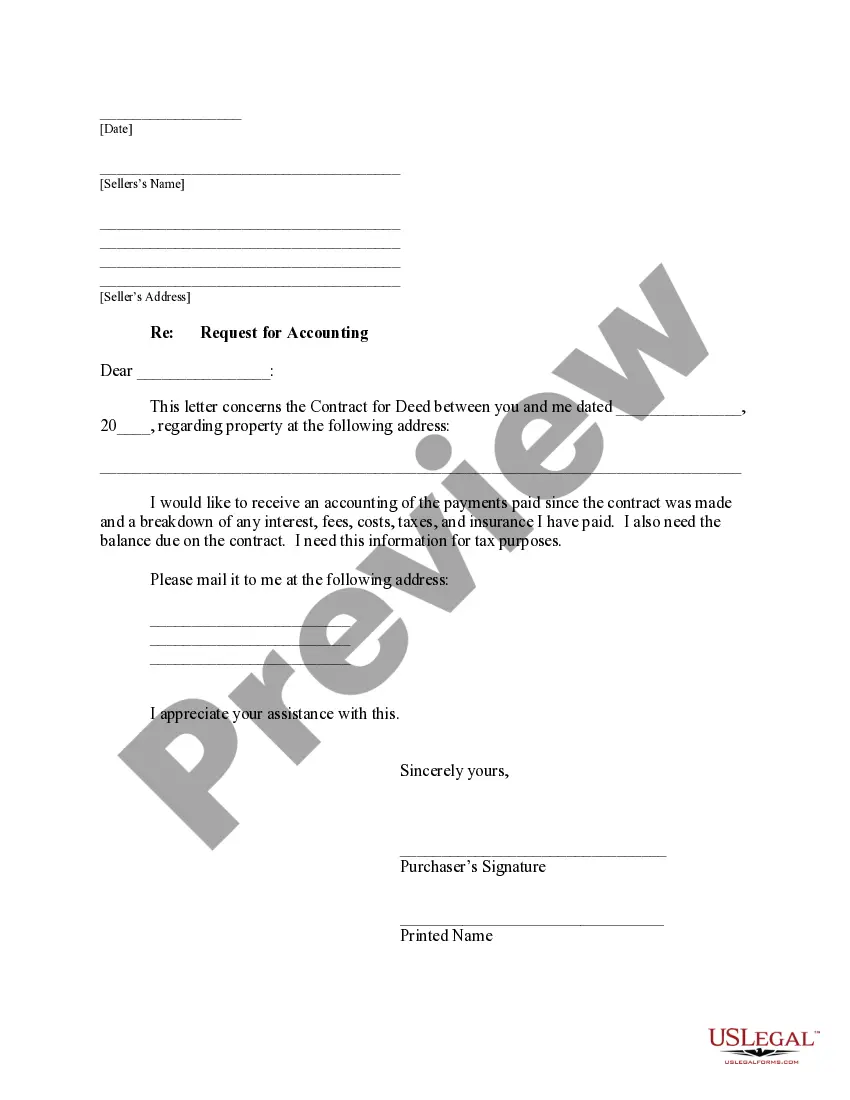
The Buyer's Request for Accounting from Seller under Contract for Deed is a formal written request from a purchaser to a seller. This document specifically seeks an accounting of payments made since the inception of the contract, detailing any associated interest, fees, costs, taxes, and insurance. It ultimately aims to clarify the balance owed on the contract, providing transparency and accountability between both parties.
What’s included in this form
- Request for accounting of payments made since the contract initiation.
- Detailed breakdown of interest, fees, costs, taxes, and insurance paid.
- Inquiry about the total balance due on the contract.
- Space for providing a mailing address for the seller's response.
- Signature and printed name of the purchaser for identification.
Situations where this form applies
This form is useful when a buyer under a contract for deed requires clarity on their financial status related to the contract. It is particularly important for tax purposes or when there is uncertainty about payment history and outstanding balances. Use this form if you need detailed accounting from the seller to ensure all payments and associated costs are properly documented.
Intended users of this form
This form is intended for:
- Purchasers under a contract for deed seeking an accounting of their payments.
- Individuals who want to ensure transparency in their financial dealings with a seller.
- Buyers needing records for tax reporting or financial planning.
How to complete this form
- Enter your name and contact information at the top of the form.
- Clearly request an accounting of all payments made since the contract was signed.
- Specify the breakdown of any other costs such as interest, fees, taxes, and insurance.
- Request the balance due on the contract to understand your current financial obligations.
- Sign and print your name at the bottom of the form before sending it to the seller.
Is notarization required?
Notarization is not commonly needed for this form. However, certain documents or local rules may make it necessary. Our notarization service, powered by Notarize, allows you to finalize it securely online anytime, day or night.
Get your form ready online
Our built-in tools help you complete, sign, share, and store your documents in one place.
Make edits, fill in missing information, and update formatting in US Legal Forms—just like you would in MS Word.
Download a copy, print it, send it by email, or mail it via USPS—whatever works best for your next step.
Sign and collect signatures with our SignNow integration. Send to multiple recipients, set reminders, and more. Go Premium to unlock E-Sign.
If this form requires notarization, complete it online through a secure video call—no need to meet a notary in person or wait for an appointment.
We protect your documents and personal data by following strict security and privacy standards.

Make edits, fill in missing information, and update formatting in US Legal Forms—just like you would in MS Word.

Download a copy, print it, send it by email, or mail it via USPS—whatever works best for your next step.

Sign and collect signatures with our SignNow integration. Send to multiple recipients, set reminders, and more. Go Premium to unlock E-Sign.

If this form requires notarization, complete it online through a secure video call—no need to meet a notary in person or wait for an appointment.

We protect your documents and personal data by following strict security and privacy standards.
Typical mistakes to avoid
- Failing to provide complete contact information, which can delay the response.
- Not clearly specifying the request for a detailed accounting breakdown.
- Forgetting to sign the document before submission.
- Neglecting to request the balance due, which is a crucial part of the inquiry.
Advantages of online completion
- Convenient access to the form anytime, allowing for easy completion at your own pace.
- Editability to adapt the content to your specific situation before printing.
- Reliability in ensuring you have a legally recognized document for your records.
Key takeaways
- The Buyer's Request for Accounting is essential for buyers under contract for deed seeking clarity on their payments.
- Accuracy in filling out the form can prevent misunderstandings with the seller.
- Utilizing this form can help in managing financial records for tax purposes.
Looking for another form?

Form popularity
FAQ
Purchase price. Down payment. Interest rate. Number of monthly installments. Responsibilities of the buyer and seller. Legal remedies for the seller if the buyer does not make payments.
In the first instance, if your deed is not recorded, there is nothing in the public record to stop the seller from conveying the property to another person.The second situation could happen if your seller fails to pay his or her debts and the seller's creditors file liens or judgments against your property.
But unlike buyers, sellers can't back out and forfeit their earnest deposit money (usually 1-3 percent of the offer price). If you decide to cancel a deal when the home is already under contract, you can be either legally forced to close anyway or sued for financial damages.
The buyer must record the contract for deed with the county recorder where the land is located within four months after the contract is signed. Contracts for deed must provide the legal name of the buyer and the buyer's address.
Since an agreement for deed is an agreement that the seller makes to the buyer to transfer the property once a specified amount of money has been received, it is considered a mortgage under Florida Law.The following phrases will often refer to as an agreement for deed: Contract for Deed.
Land contracts in Florida are a perfectly legal and binding alternative to traditional real estate financing methods. However, there are several very important considerations for both Buyers and Sellers to keep in mind before agreeing to enter into a land contract: 1.
A disadvantage to the seller is that a contract for deed is frequently characterized by a low down payment and the purchase price is paid in installments instead of one lump sum. If a seller needs funds from the sale to buy another property, this would not be a beneficial method of selling real estate.
Contact the other party and ask whether they are willing to negotiate the cancellation of the contract. Offer the other party an incentive to cancel the contract for deed.
Usually the contract requires the buyer to make payments over time with interest payable on the unpaid balance. Once a buyer pays all of the payments called for under the contract, the owner transfers to the buyer a deed to the property.