District of Columbia Letter from Landlord to Tenant as Notice of Default on Commercial Lease
About this form
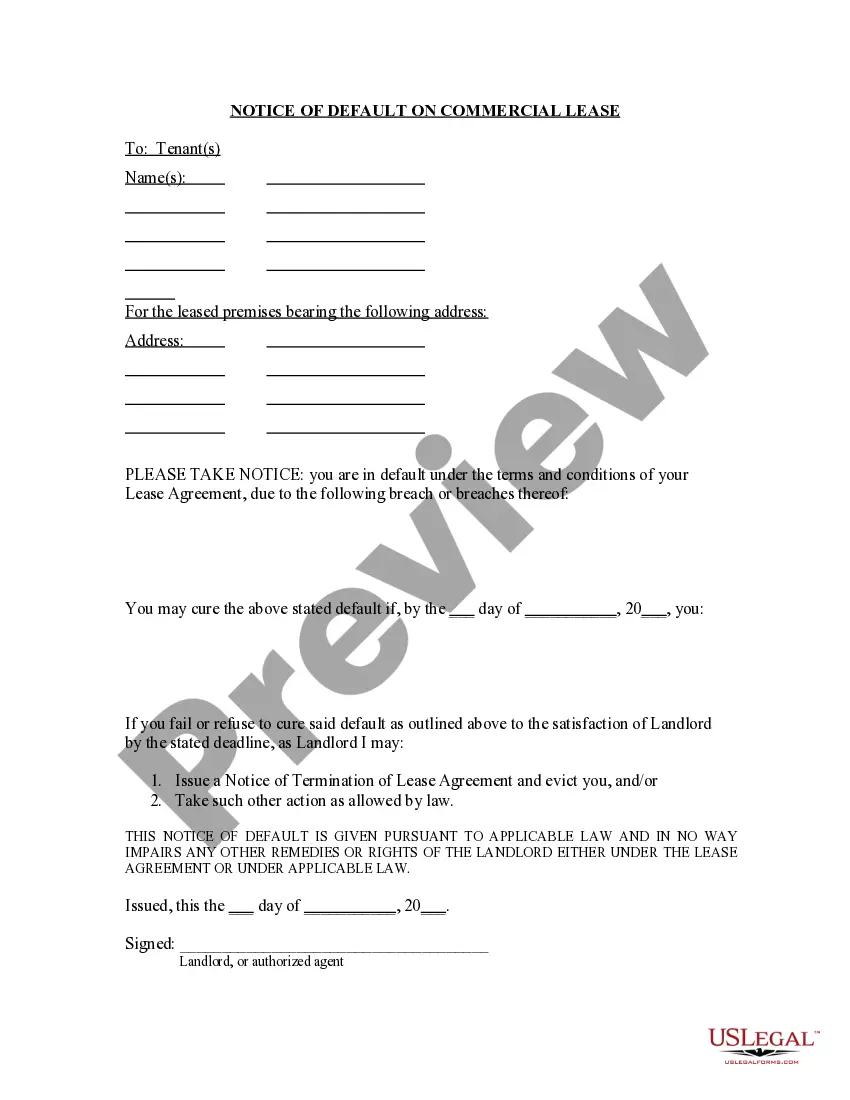
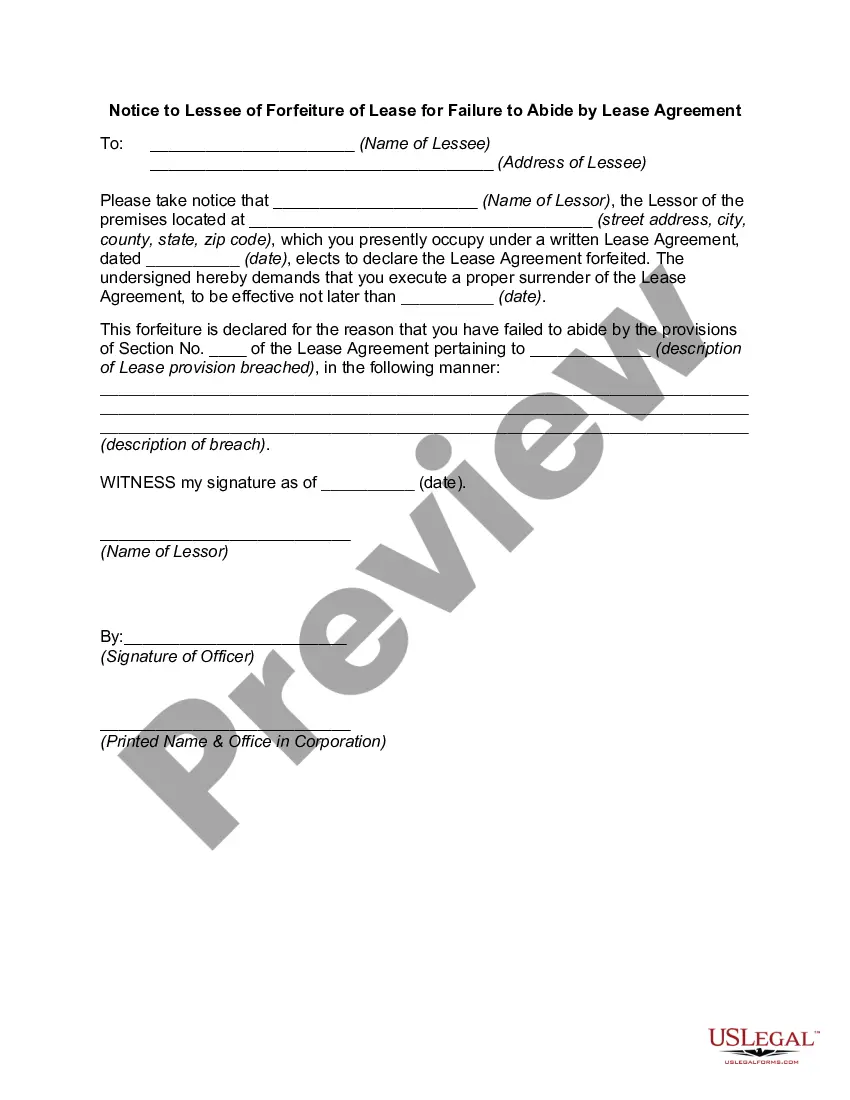
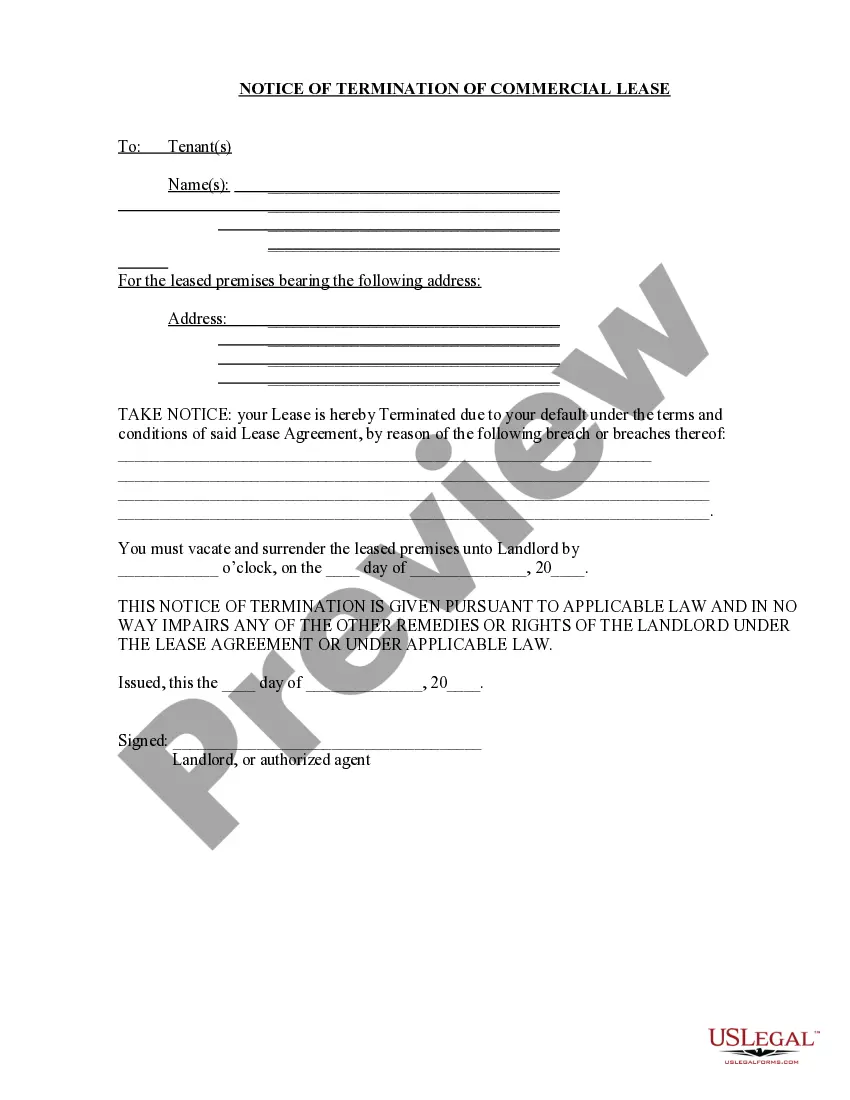
The Letter from Landlord to Tenant as Notice of Default on Commercial Lease is a formal notification issued by a landlord to inform a tenant of specific breaches of their lease agreement. This form serves to initiate rectification of the issues by defining the breaches and setting a deadline for their resolution. If the tenant fails to cure these breaches, the landlord can take further actions, including eviction, as permitted by law. Unlike general communication, this notice clearly outlines the legal implications of the tenant's default, ensuring that all parties are aware of their rights and obligations.
Main sections of this form
- Identification of the landlord and tenant
- Details of the default, including specific breaches of the lease agreement
- Deadline provided for the tenant to cure the breaches
- Statement of further actions the landlord may take if the issue is not resolved
- Signature line for the landlord or authorized agent

Common use cases
This notice should be used when a tenant has failed to meet their obligations under a commercial lease, such as not paying rent on time or violating other lease terms. It is an important first step in the eviction process, as it formally informs the tenant of their default status and provides them with an opportunity to remedy the issue, thus protecting the landlord's legal rights.
Intended users of this form
This form is intended for:
- Landlords of commercial properties
- Property managers acting on behalf of landlords
- Legal representatives of landlords
Completing this form step by step
- Identify the landlord and tenant by filling in their names and addresses.
- Clearly state the breaches of the lease that have occurred.
- Set a specific deadline by which the tenant must rectify the breaches.
- Outline the potential actions the landlord may take if the tenant does not comply.
- Sign the form and date it appropriately.
Notarization guidance
This form does not typically require notarization unless specified by local law.
Get your form ready online
Our built-in tools help you complete, sign, share, and store your documents in one place.
Make edits, fill in missing information, and update formatting in US Legal Forms—just like you would in MS Word.
Download a copy, print it, send it by email, or mail it via USPS—whatever works best for your next step.
Sign and collect signatures with our SignNow integration. Send to multiple recipients, set reminders, and more. Go Premium to unlock E-Sign.
If this form requires notarization, complete it online through a secure video call—no need to meet a notary in person or wait for an appointment.
We protect your documents and personal data by following strict security and privacy standards.

Make edits, fill in missing information, and update formatting in US Legal Forms—just like you would in MS Word.

Download a copy, print it, send it by email, or mail it via USPS—whatever works best for your next step.

Sign and collect signatures with our SignNow integration. Send to multiple recipients, set reminders, and more. Go Premium to unlock E-Sign.

If this form requires notarization, complete it online through a secure video call—no need to meet a notary in person or wait for an appointment.

We protect your documents and personal data by following strict security and privacy standards.
Mistakes to watch out for
- Failing to specify the exact breaches of the lease.
- Not providing a clear deadline for the tenant to respond.
- Omitting the signature of the landlord or authorized agent.
- Not checking for compliance with local laws regarding notice provisions.
Why complete this form online
- Conveniently download the form and fill it out at your own pace.
- Edit and customize the text to meet specific situations or regional requirements.
- Reliable templates drafted by licensed attorneys to ensure legal accuracy.
- Easy access to legal forms 24/7 from the comfort of your own home or office.
- This notice serves as a legal requirement in most jurisdictions before initiating eviction proceedings.
- Failure to provide proper notice may void any potential legal action for eviction.
Main things to remember
- The form serves as an official notice of default for tenants in commercial leases.
- It allows landlords to inform tenants of breaches and outlines next steps.
- Properly completing and sending this notice is crucial for protecting landlord rights.
- Always consult local regulations to ensure compliance with state-specific requirements.
Looking for another form?
Form popularity
FAQ
When you default on a commercial lease, the landlord may initiate proceedings to regain possession of the property. The landlord may also seek damages for unpaid rent or seek to recover costs associated with the default. Receiving a District of Columbia Letter from Landlord to Tenant as Notice of Default on Commercial Lease usually signals the start of the formal process and outlines what steps you must take to address the situation.
Defaulting on a commercial lease means failing to comply with the terms agreed upon in the lease contract. This could involve not paying rent on time or not following other crucial lease provisions. Often, such a default can trigger actions like a District of Columbia Letter from Landlord to Tenant as Notice of Default on Commercial Lease, which formally notifies the tenant of the issues needing resolution.
One effective excuse to break a commercial lease could be the failure of the property to meet local health or safety codes. You may also find that unforeseen circumstances, such as natural disasters, can provide reasonable grounds. However, it's essential to consult a legal professional about the specific laws in your area, especially if you receive a District of Columbia Letter from Landlord to Tenant as Notice of Default on Commercial Lease.
When writing a letter to terminate a commercial lease, it is important to be clear and concise. Begin by stating your intention to vacate and reference the specific terms of the lease. Including a District of Columbia Letter from Landlord to Tenant as Notice of Default on Commercial Lease can be beneficial if you are addressing previous lease violations. Make sure to provide your contact information and a request for acknowledgment to ensure that all parties are aware of the termination.
To evict a commercial tenant effectively, you should start by providing proper written notice. A District of Columbia Letter from Landlord to Tenant as Notice of Default on Commercial Lease serves this purpose well, informing the tenant of their lease violations. If the tenant fails to resolve the issue, you may need to file an eviction lawsuit in court. It is essential to follow all legal procedures to avoid complications and ensure a smooth process.
A default notice letter is a formal document issued by the landlord to notify the tenant of their default on the lease terms. It specifies the nature of the default and the time frame within which the tenant must address the issues to avoid further consequences. This letter is important for legal compliance and protects both parties' rights under the lease agreement. A useful approach is to refer to the District of Columbia Letter from Landlord to Tenant as Notice of Default on Commercial Lease for guidance in drafting this letter.
A letter of intent for a commercial lease outlines your proposal to lease a specific property. Start with the basic details of the lease terms, including the rental rate, duration, and any contingencies. Ensure you express your intent clearly and positively to foster goodwill between you and the potential landlord. Utilizing resources like the District of Columbia Letter from Landlord to Tenant as Notice of Default on Commercial Lease can provide a structure to your communication.
The purpose of a notice of default is to formally inform the tenant that they have not complied with the lease terms. This notice acts as a warning, providing the tenant with an opportunity to rectify the issues before further action is taken. It is a crucial step in the legal process, aiming to resolve conflicts without escalating to eviction. A District of Columbia Letter from Landlord to Tenant as Notice of Default on Commercial Lease serves to document these concerns clearly.
Writing a commercial lease termination letter requires clarity and specificity. Begin by stating your intention to terminate the lease, referencing the lease agreement and any relevant clauses. It is best to include the final date of occupancy and other pertinent details. Using a District of Columbia Letter from Landlord to Tenant as Notice of Default on Commercial Lease template can streamlining this process, ensuring you meet all legal requirements.
When a tenant defaults, it means they have not adhered to the conditions set forth in their commercial lease agreement. This could involve not paying rent, failing to maintain the property, or breaching any other critical lease terms. Defaulting can lead to legal consequences, including eviction, making it crucial for tenants to understand and comply with their lease obligations. In such cases, a District of Columbia Letter from Landlord to Tenant as Notice of Default on Commercial Lease outlines the specific issues and next steps.