Colorado Letter from Tenant to Landlord about Fair Housing Reduction or Denial of services to Family with Children
What this document covers
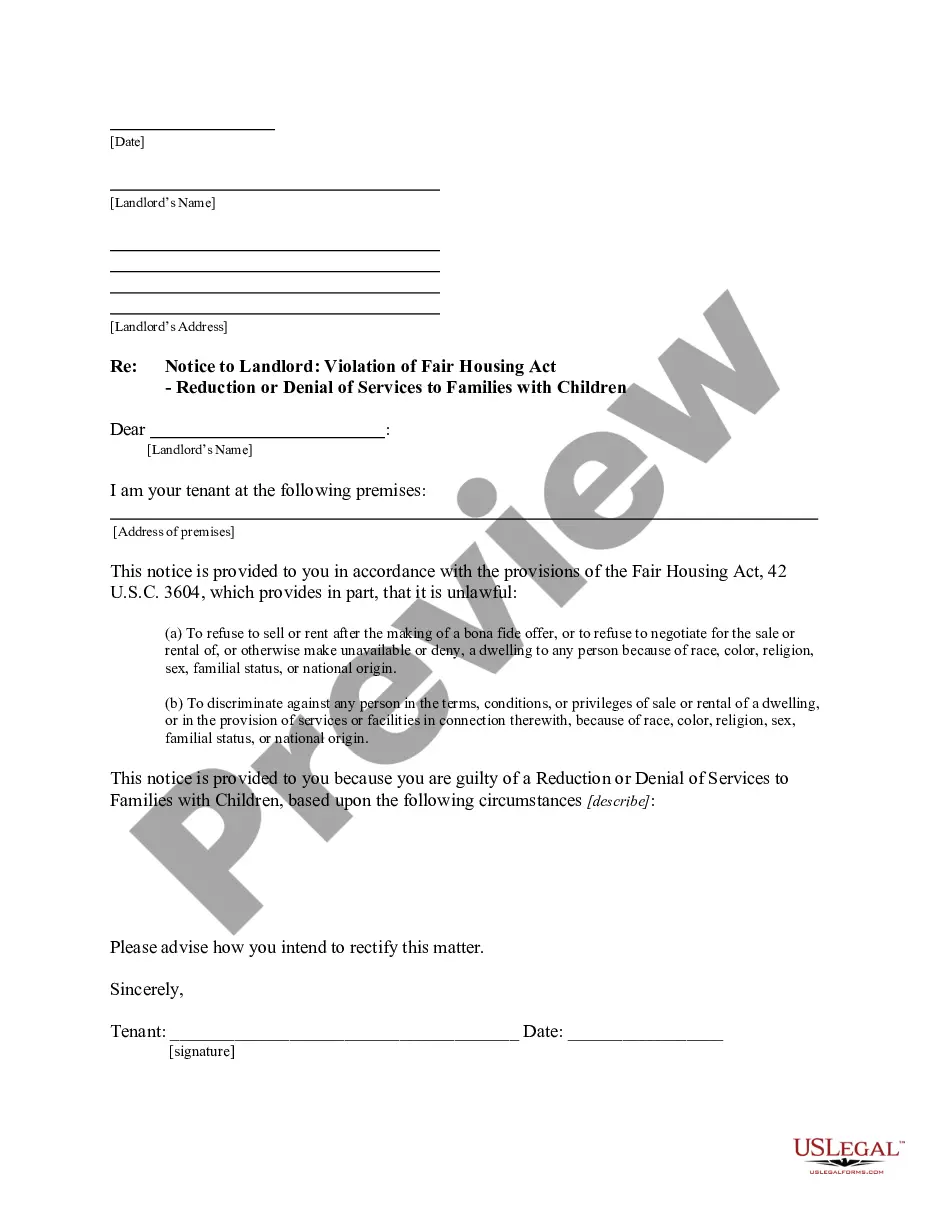
This form is a Letter from Tenant to Landlord regarding Fair Housing practices. It serves to notify the landlord that their actions may violate the Fair Housing Act by reducing or denying services to families with children. It is important because it outlines the tenant's rights and the landlord's obligations under the law, ensuring that housing discrimination does not occur based on familial status, among other factors.
What’s included in this form
- Tenant's contact information: Name and address of the tenant sending the letter.
- Landlord's details: Name and address of the landlord receiving the notice.
- Statement of violation: Clear statement indicating the landlord's reduction or denial of services to families with children.
- Description of circumstances: A detailed account of the events leading to the tenant's assertion of violation.
- Request for action: A call for the landlord to rectify the situation to comply with Fair Housing laws.

When to use this document
This form should be used when a tenant believes that their landlord is in violation of fair housing laws, specifically regarding the denial of services or discrimination against families with children. Scenarios might include instances where a landlord refuses access to amenities or services that are available to other tenants without children, or when the landlord communicates negatively about tenants with children.
Intended users of this form
- Tenants who are part of a family with children and feel they are being discriminated against by their landlord.
- Individuals who have experienced reductions in services or communication from a landlord that suggest discrimination based on familial status.
- Anyone looking to formally notify a landlord of potential violations of the Fair Housing Act.
How to prepare this document
- Begin by entering your personal information at the top of the letter.
- Clearly state the landlord's name and address to ensure proper delivery.
- Describe the specific actions or policies that have led to your belief of unfair treatment.
- Include a detailed account of the circumstances surrounding the reduction or denial of services.
- Sign and date the letter before sending it to your landlord.
Does this document require notarization?
This form usually doesn’t need to be notarized. However, local laws or specific transactions may require it. Our online notarization service, powered by Notarize, lets you complete it remotely through a secure video session, available 24/7.
Get your form ready online
Our built-in tools help you complete, sign, share, and store your documents in one place.
Make edits, fill in missing information, and update formatting in US Legal Forms—just like you would in MS Word.
Download a copy, print it, send it by email, or mail it via USPS—whatever works best for your next step.
Sign and collect signatures with our SignNow integration. Send to multiple recipients, set reminders, and more. Go Premium to unlock E-Sign.
If this form requires notarization, complete it online through a secure video call—no need to meet a notary in person or wait for an appointment.
We protect your documents and personal data by following strict security and privacy standards.

Make edits, fill in missing information, and update formatting in US Legal Forms—just like you would in MS Word.

Download a copy, print it, send it by email, or mail it via USPS—whatever works best for your next step.

Sign and collect signatures with our SignNow integration. Send to multiple recipients, set reminders, and more. Go Premium to unlock E-Sign.

If this form requires notarization, complete it online through a secure video call—no need to meet a notary in person or wait for an appointment.

We protect your documents and personal data by following strict security and privacy standards.
Avoid these common issues
- Failing to include all necessary contact information for both parties.
- Not specifying the exact services that were reduced or denied.
- Using vague language rather than providing clear facts and circumstances.
- Neglecting to keep a copy of the letter for personal records.
Why complete this form online
- Easy access to a professionally drafted template tailored to your needs.
- Convenience of filling out the form at your own pace from home.
- Ability to customize the letter to accurately reflect your situation.
- Print and download options for your records.
Looking for another form?
Form popularity
FAQ
The most common form of fair housing discrimination involves familial status, where individuals or families with children face unfair barriers in housing. This discrimination can manifest as refusal to rent, additional fees, or unfavorable lease terms. If you believe you are a victim of such discrimination, consider drafting a Colorado Letter from Tenant to Landlord about Fair Housing Reduction or Denial of services to Family with Children to clearly express your concerns and seek resolution.
It is illegal under the Fair Housing Act to refuse to rent or sell housing to someone based on protected characteristics. Additionally, imposing different rental terms or conditions based on these characteristics also constitutes illegal behavior. If you encounter discrimination, a carefully written Colorado Letter from Tenant to Landlord about Fair Housing Reduction or Denial of services to Family with Children can address your situation effectively.
Familial status is a key prohibited basis under the Fair Housing Act, which protects families with children. This means landlords cannot discriminate against households with children or impose additional conditions on tenancy based on family size. If you believe you have experienced such discrimination, writing a Colorado Letter from Tenant to Landlord about Fair Housing Reduction or Denial of services to Family with Children can help advocate for your rights.
The Fair Housing Act restricts the use of certain words that could indicate discrimination. Terms that suggest a preference, limitation, or discrimination against a specific group, such as 'no families with children,' violate these protections. It is essential to avoid language that could create barriers based on protected characteristics. Writing a Colorado Letter from Tenant to Landlord about Fair Housing Reduction or Denial of services to Family with Children can clarify such issues.
The burden of proof for discrimination lies with the complainant, typically the tenant. This means that you must present sufficient evidence showcasing discriminatory practices. Accessing resources through the uslegalforms platform can simplify generating proof documents and correspondence.
Establishing discrimination can be a complex process. It often necessitates factual evidence showing that a landlord acted unfairly based on a protected characteristic. Utilizing a Colorado Letter from Tenant to Landlord about Fair Housing Reduction or Denial of services to Family with Children can help clarify your situation.
Proving housing discrimination can be challenging, as it often requires evidence of intent and impact. Tenants must gather documentation and witness statements to support their claims. Resources like the uslegalforms platform can help you draft essential documents for a compelling case.
In Colorado, the Division of Civil Rights investigates fair housing complaints. Tenants can file their grievances regarding discrimination directly through this office. If you are facing denial of services, consider issuing a Colorado Letter from Tenant to Landlord about Fair Housing Reduction or Denial of services to Family with Children.
Source of income is a protected class under the Colorado Fair Housing Act but is not included in the Federal Fair Housing Act. This means landlords cannot discriminate against tenants based on their income source, enhancing protections for those receiving assistance. It is vital to be aware of these differences when navigating housing issues.
The Colorado Fair Housing Act prohibits housing discrimination based on various factors, including familial status. This means landlords cannot deny services to families with children. It is crucial to understand these laws to protect your rights and address any unfair treatment effectively.