Arkansas Last Will and Testament with All Property to Trust called a Pour Over Will
What is this form?
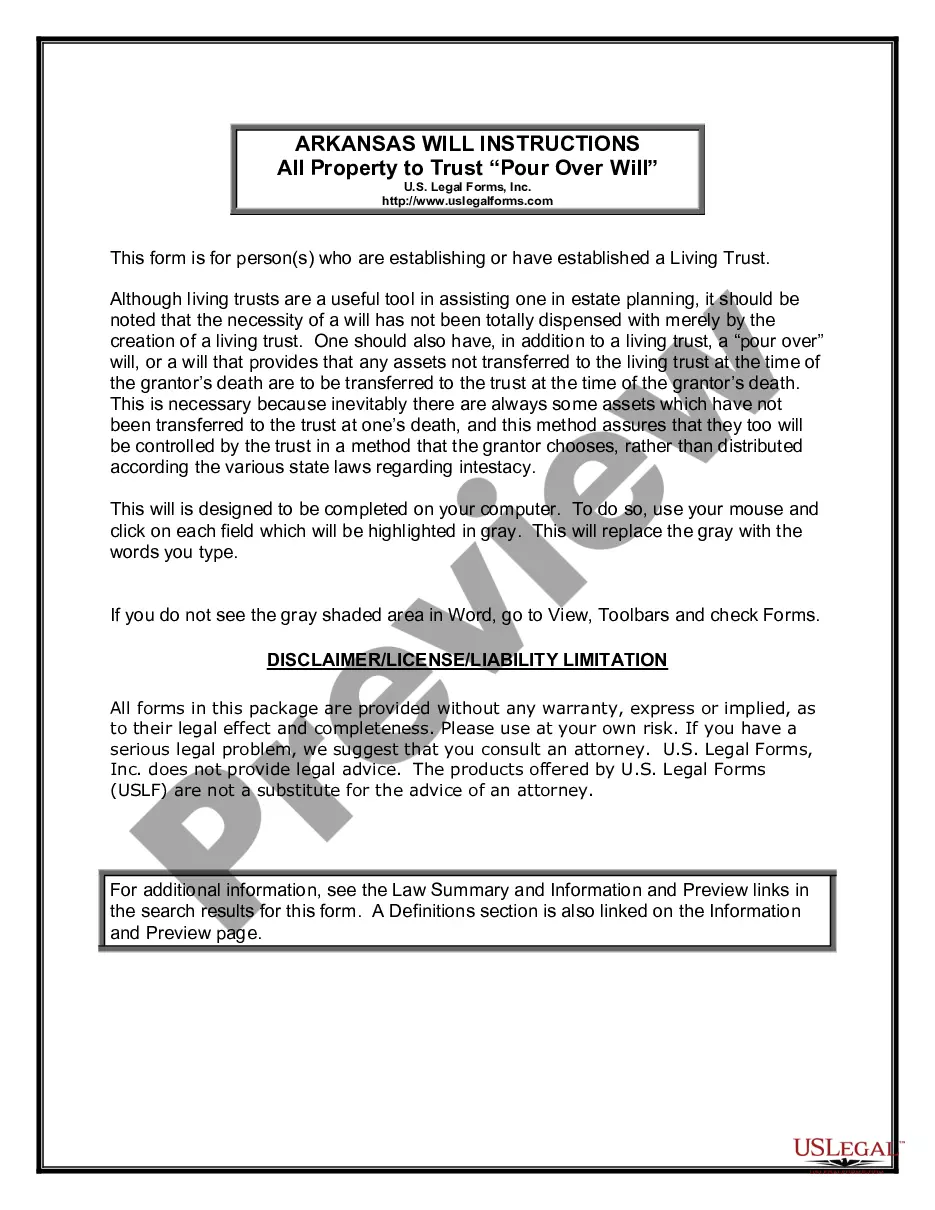
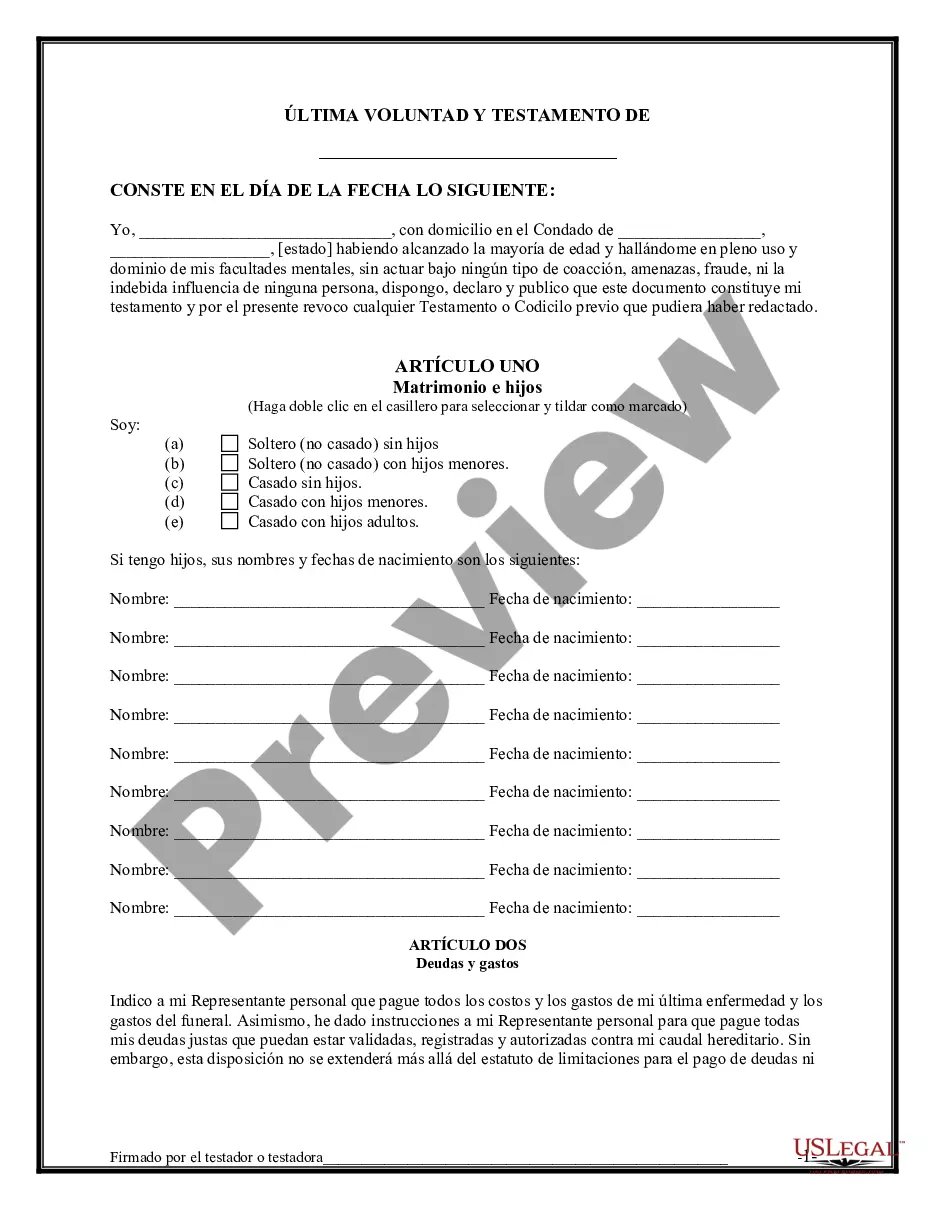
The Last Will and Testament with All Property to Trust, commonly known as a Pour Over Will, is a legal document that allows individuals to ensure that any property not previously transferred to a living trust is allocated to that trust upon their passing. This form is essential for those who have created or intend to create a living trust, as it helps streamline estate planning and provides clarity on asset distribution after death.
What’s included in this form
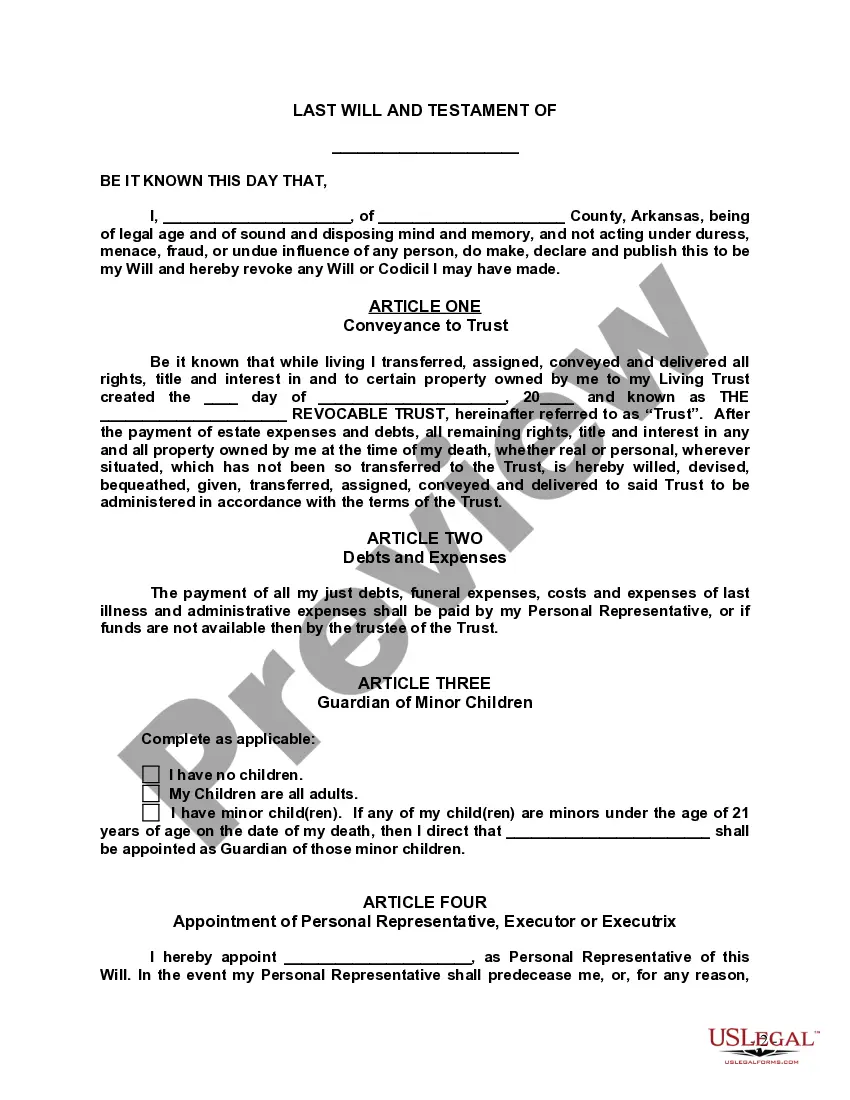
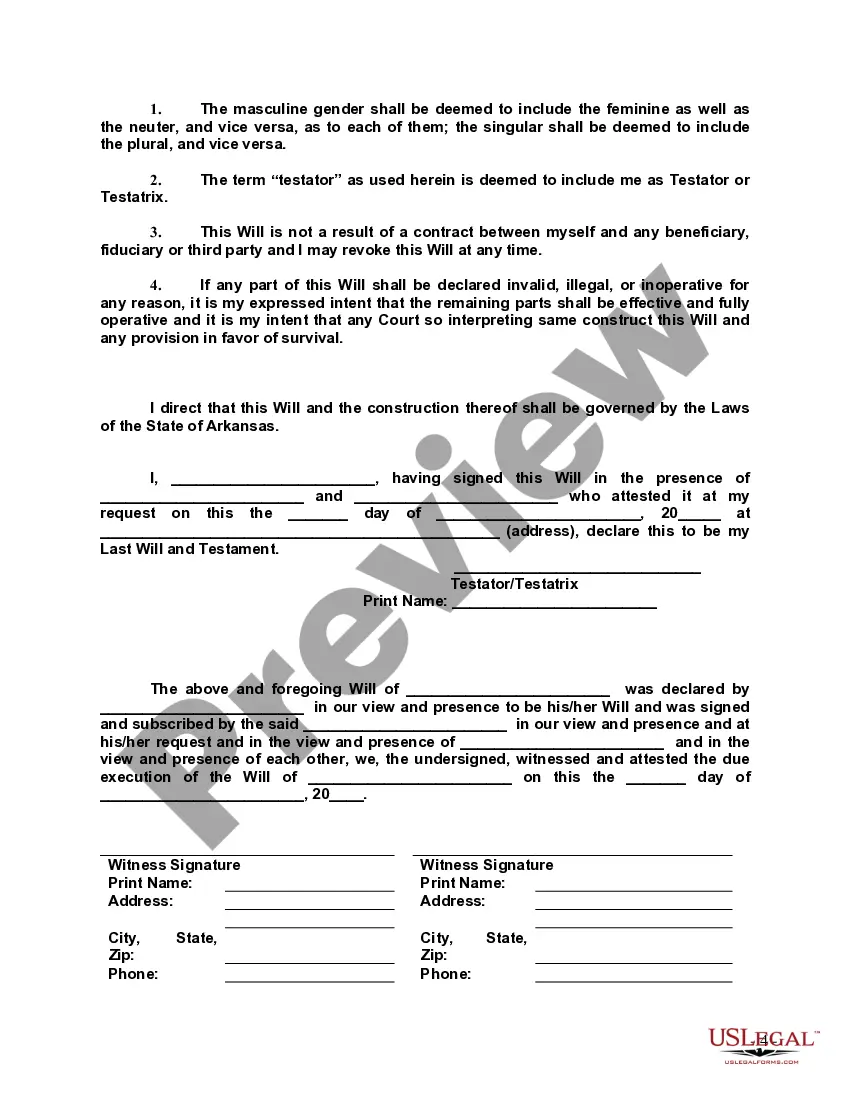
- Conveyance of all property to the trust after debts and taxes are settled.
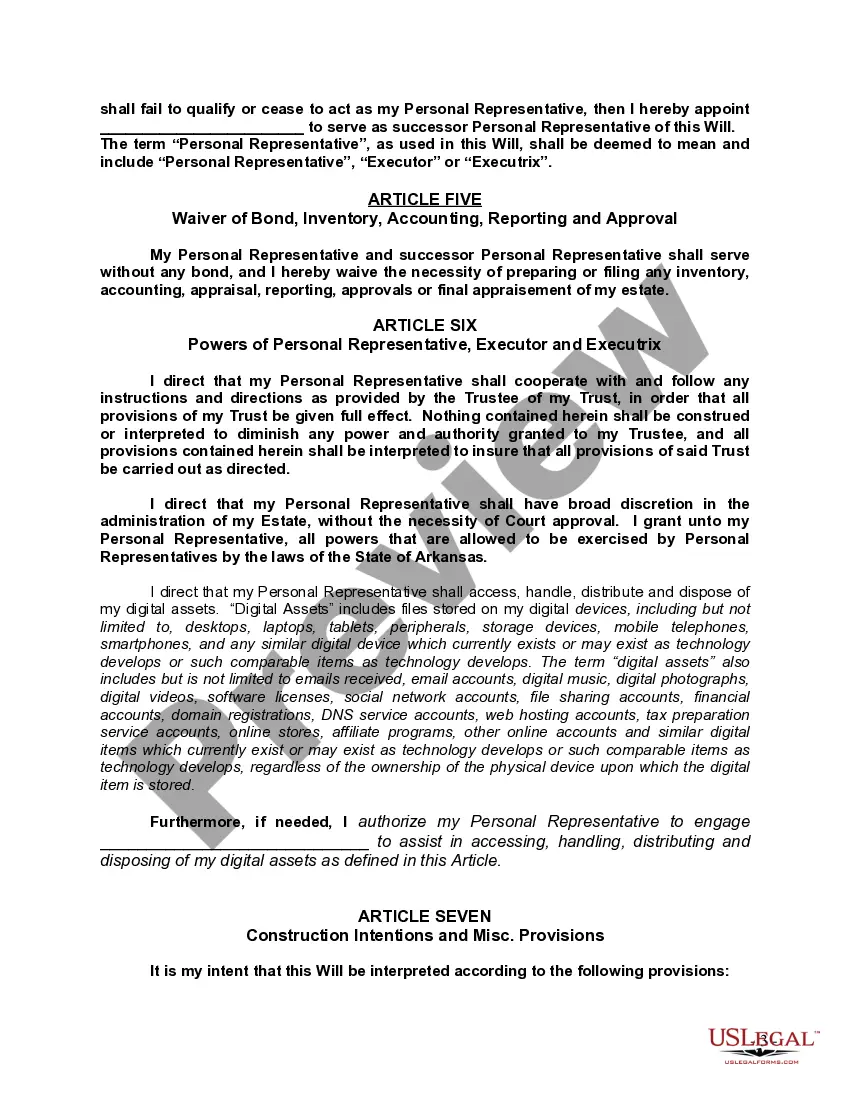
- Appointment of a personal representative to manage the estate.
- Provisions for the guardianship of minor children, if applicable.
- Waiver of bond and requirement for inventory or accounting by the personal representative.
- Instructions for the distribution of assets according to trust provisions.




Common use cases
This form is typically used when an individual has established a living trust but has assets that have not been transferred into that trust. It is appropriate in scenarios such as planning an estate, managing assets, or ensuring specific wishes are followed in distributing one's property after death. This will ensures that any remaining assets will be handled according to the terms of the existing trust.
Who should use this form
- Individuals establishing or who have already established a living trust.
- Anyone who wants to simplify the management of their estate upon death.
- People with minor children who need to designate guardianship in their will.
- Those who wish to ensure that all their assets are controlled by their trust.
Instructions for completing this form
- Identify and enter your name and county in the appropriate fields.
- Clearly specify the details of your living trust by including its name and the date it was created.
- List any minor children and appoint a guardian if applicable.
- Choose your personal representative and provide alternative names if necessary.
- Review the document for completeness and accuracy, ensuring all sections are filled out correctly.
- Sign the will in the presence of witnesses as required by state laws.
Notarization guidance
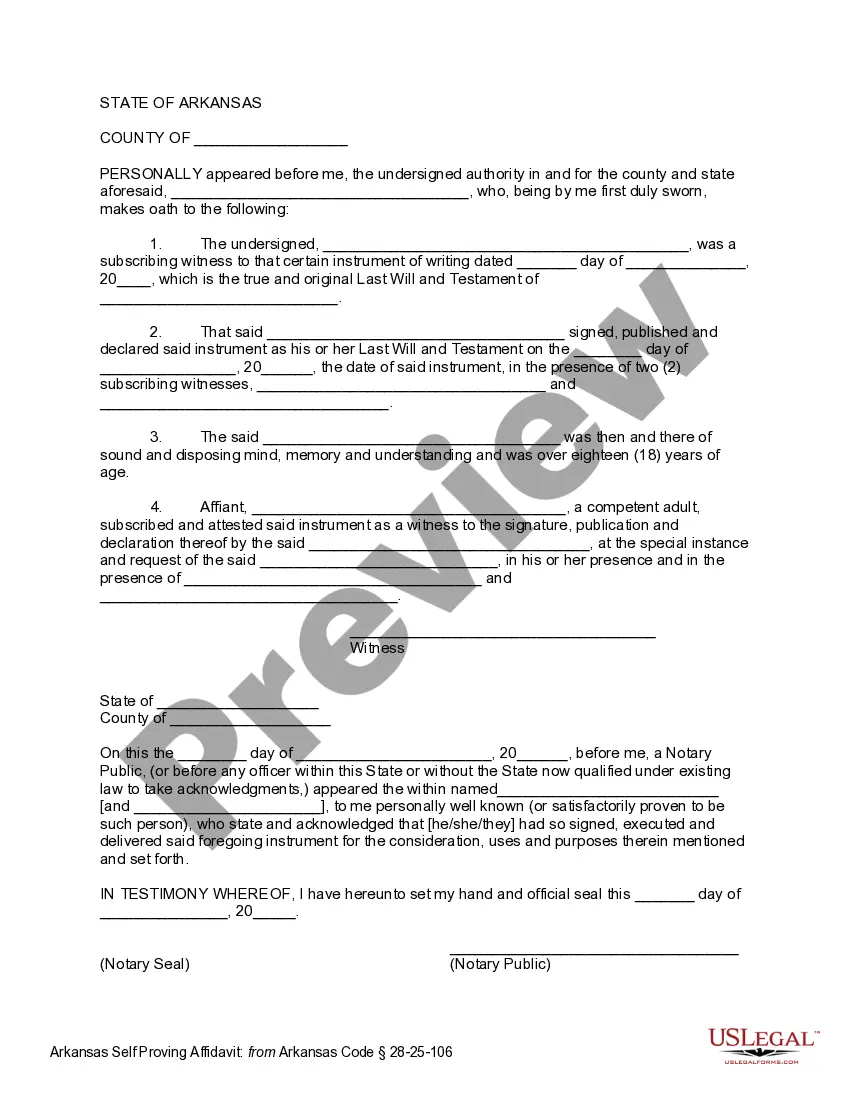
This form must be notarized to be legally valid. US Legal Forms provides secure online notarization powered by Notarize, allowing you to complete the process through a verified video call.
Get your form ready online
Our built-in tools help you complete, sign, share, and store your documents in one place.
Make edits, fill in missing information, and update formatting in US Legal Forms—just like you would in MS Word.
Download a copy, print it, send it by email, or mail it via USPS—whatever works best for your next step.
Sign and collect signatures with our SignNow integration. Send to multiple recipients, set reminders, and more. Go Premium to unlock E-Sign.
If this form requires notarization, complete it online through a secure video call—no need to meet a notary in person or wait for an appointment.
We protect your documents and personal data by following strict security and privacy standards.

Make edits, fill in missing information, and update formatting in US Legal Forms—just like you would in MS Word.

Download a copy, print it, send it by email, or mail it via USPS—whatever works best for your next step.

Sign and collect signatures with our SignNow integration. Send to multiple recipients, set reminders, and more. Go Premium to unlock E-Sign.

If this form requires notarization, complete it online through a secure video call—no need to meet a notary in person or wait for an appointment.

We protect your documents and personal data by following strict security and privacy standards.
Typical mistakes to avoid
- Failure to transfer all assets into the trust before death.
- Not properly signing or witnessing the will, which may invalidate the document.
- Neglecting to appoint a guardian for minor children.
- Overlooking updates to the will after major life changes (e.g., marriage, divorce).
Why complete this form online
- Convenience of completing the form from home at your own pace.
- Editability allows for easy updates and modifications as needed.
- Access to professional templates created by licensed attorneys, ensuring legal validity.
- Quick download options provide immediate access to the completed form.
Looking for another form?
Form popularity
FAQ
Yes, you can write your own will in Arkansas, but there are specific legal requirements it must meet to be valid. It’s important to ensure your Arkansas Last Will and Testament with All Property to Trust called a Pour Over Will adheres to these standards, which include being signed by you and witnessed properly. To get it right, consider using resources like uslegalforms, which provide guidance in this process.
A Pour Over Will in Arkansas effectively transfers any remaining assets into your trust upon your passing. This ensures that all your property is managed according to your trust’s terms. When considering your estate plan, it is advisable to establish this type of will to catch any overlooked assets, streamlining the process for your loved ones.
Certain types of assets typically cannot be placed in a trust, such as retirement accounts like IRAs or 401(k)s, which have their own beneficiary designations. Additionally, personal property that is not titled cannot be transferred directly into a trust. It's important to consult with an expert to handle your Arkansas Last Will and Testament with All Property to Trust called a Pour Over Will properly for the best results.
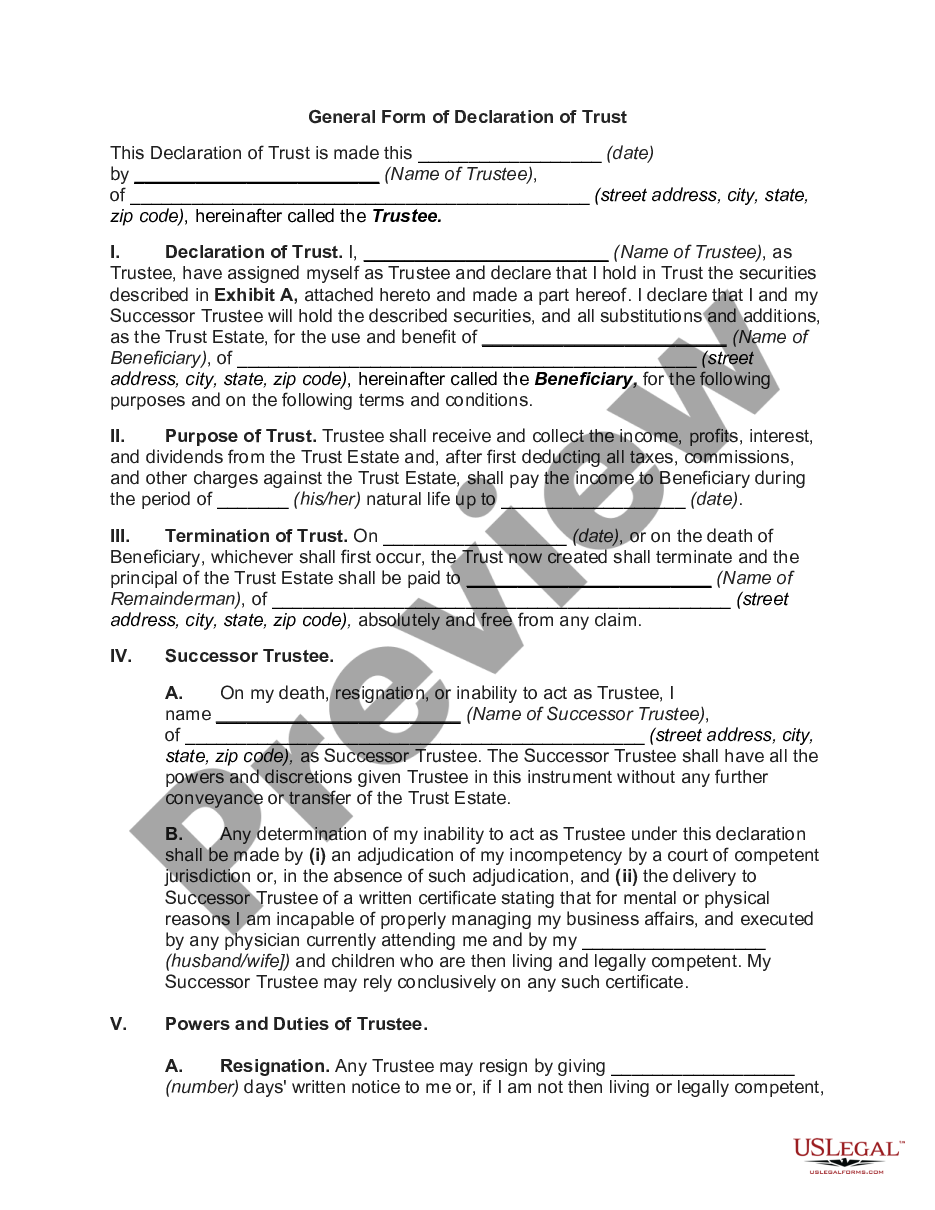
In Arkansas, a trust works by designating a trustee to manage your assets for the benefit of your beneficiaries. When you create an Arkansas Last Will and Testament with All Property to Trust called a Pour Over Will, any assets passed through this will go directly into the trust upon your passing, ensuring a smooth transition. Understanding the roles and responsibilities involved in setting up this arrangement can help you create a more effective estate plan.
Whether a trust is better than a will in Arkansas often depends on your individual circumstances. A trust, particularly an Arkansas Last Will and Testament with All Property to Trust called a Pour Over Will, can help you avoid probate and manage taxes more efficiently. However, crafting the right document for your needs might require professional assistance, so consider working with uslegalforms for clarity.
While trusts offer many benefits, they do have some disadvantages. Setting up a trust can involve higher upfront costs, and maintaining it requires ongoing management. Additionally, a Pour Over Will, which complements your trust, may lead to probate for any assets not transferred, so understanding the intricacies is essential.
In Arkansas, a Last Will and Testament does not have to be notarized to be valid. However, having your will notarized can enhance its credibility, especially when it involves a Pour Over Will, which transfers your assets to a trust. It's a good practice to discuss your options with an attorney to ensure your estate plans are effective.
Generally, a last will and testament will not override a deed if the property is placed in joint tenancy or is a transfer-on-death deed. For an Arkansas Last Will and Testament with All Property to Trust called a Pour Over Will, properties transferred through a deed typically bypass the will entirely. Consequently, understanding how each document interacts is essential to ensuring that your estate plan works harmoniously.
A last will and testament does not override a trust; rather, it complements it. When individuals draft an Arkansas Last Will and Testament with All Property to Trust called a Pour Over Will, they create a system where the will directs any leftover assets into the trust. Consequently, the trust provisions govern how those assets should be managed and distributed, allowing for a smooth transition of wealth.
Typically, legal documents such as a living trust or a prenuptial agreement can take precedence over a will. Assets placed in a trust, such as an Arkansas Last Will and Testament with All Property to Trust called a Pour Over Will, are managed according to the terms of the trust, not the will. It's crucial to ensure all estate planning documents are aligned to avoid conflicts in asset distribution.