Alaska Partial Release of Property From Deed of Trust for Individual
Understanding this form
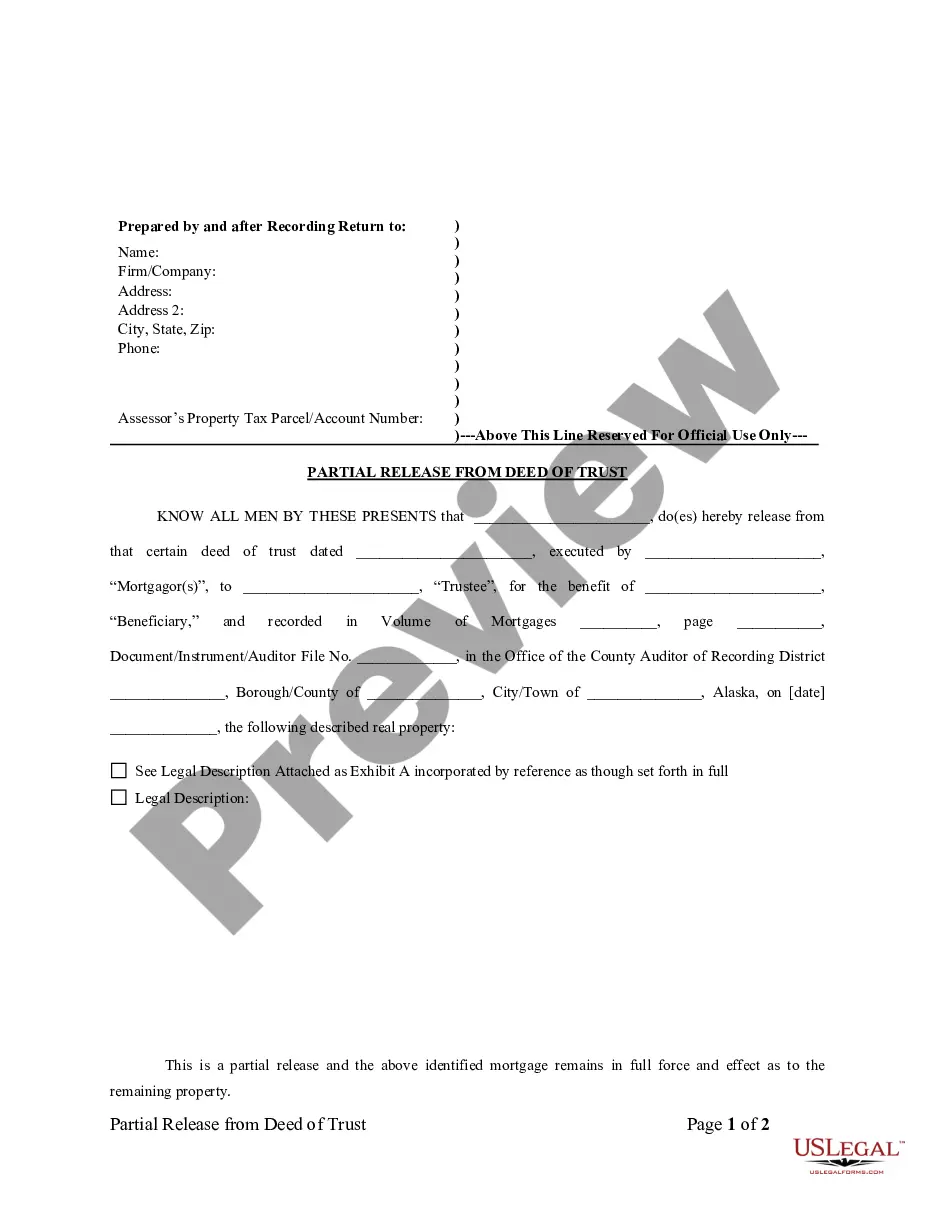
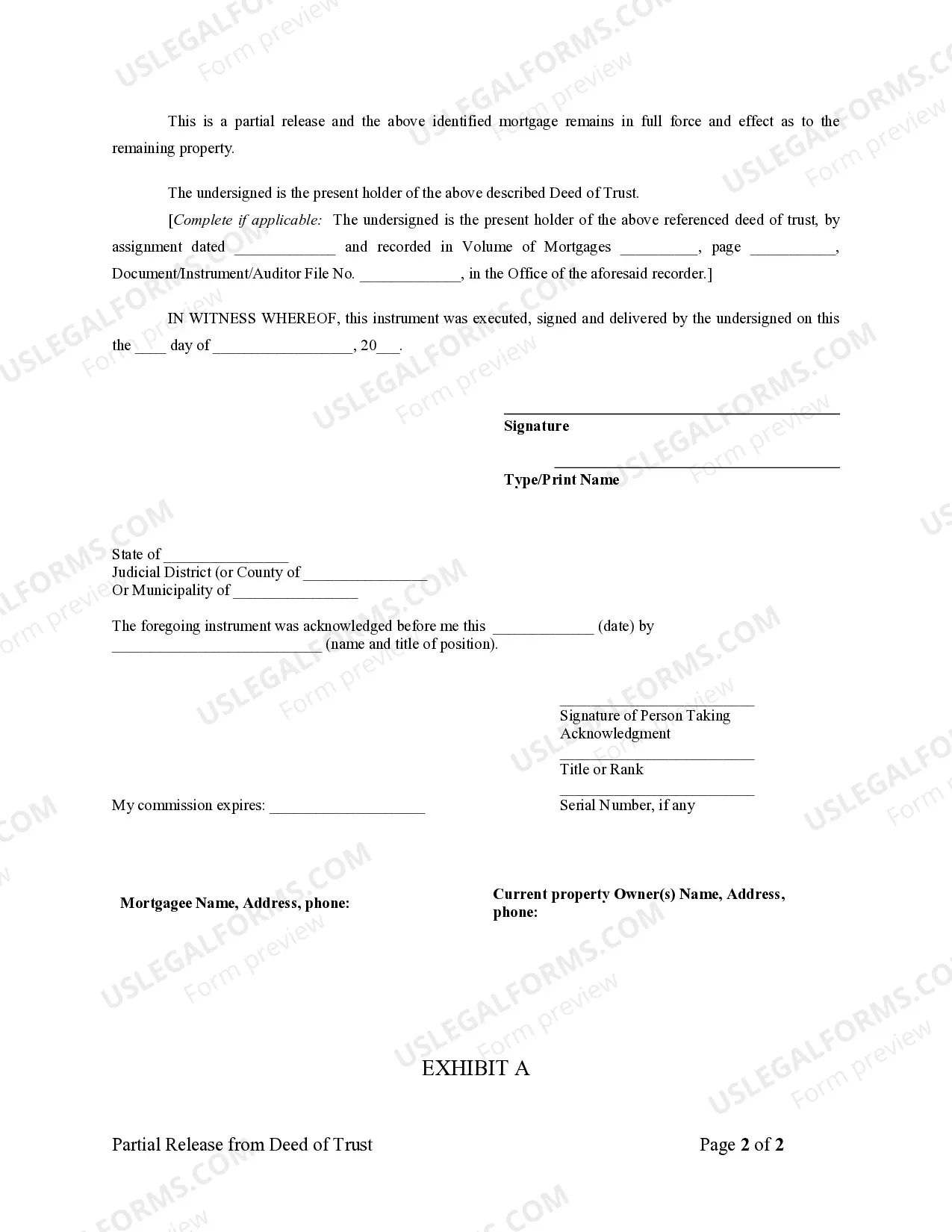
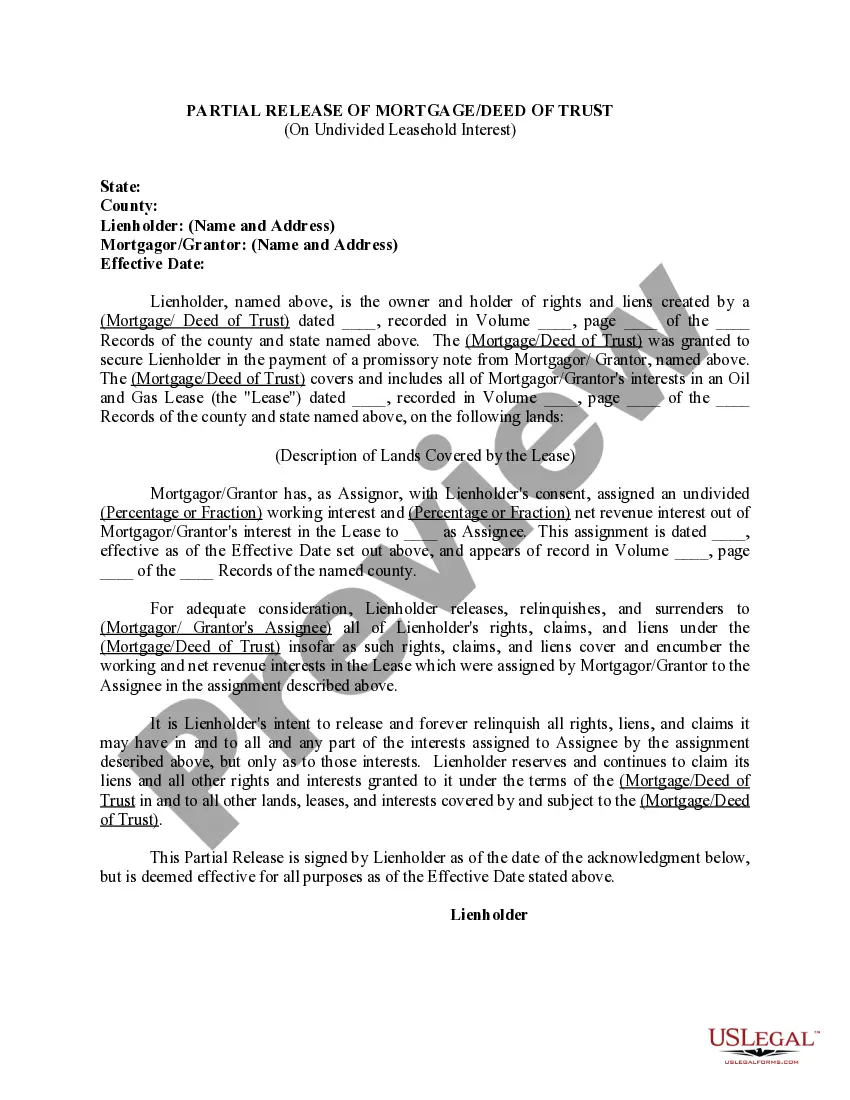
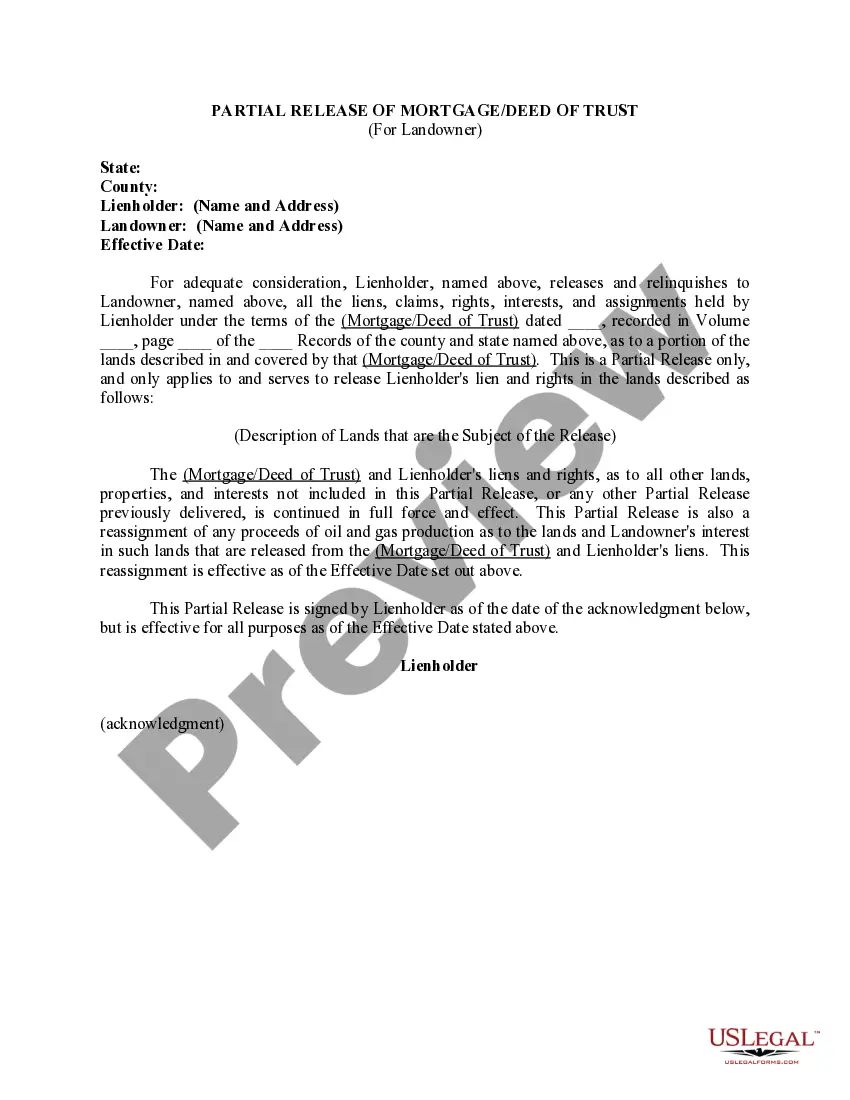
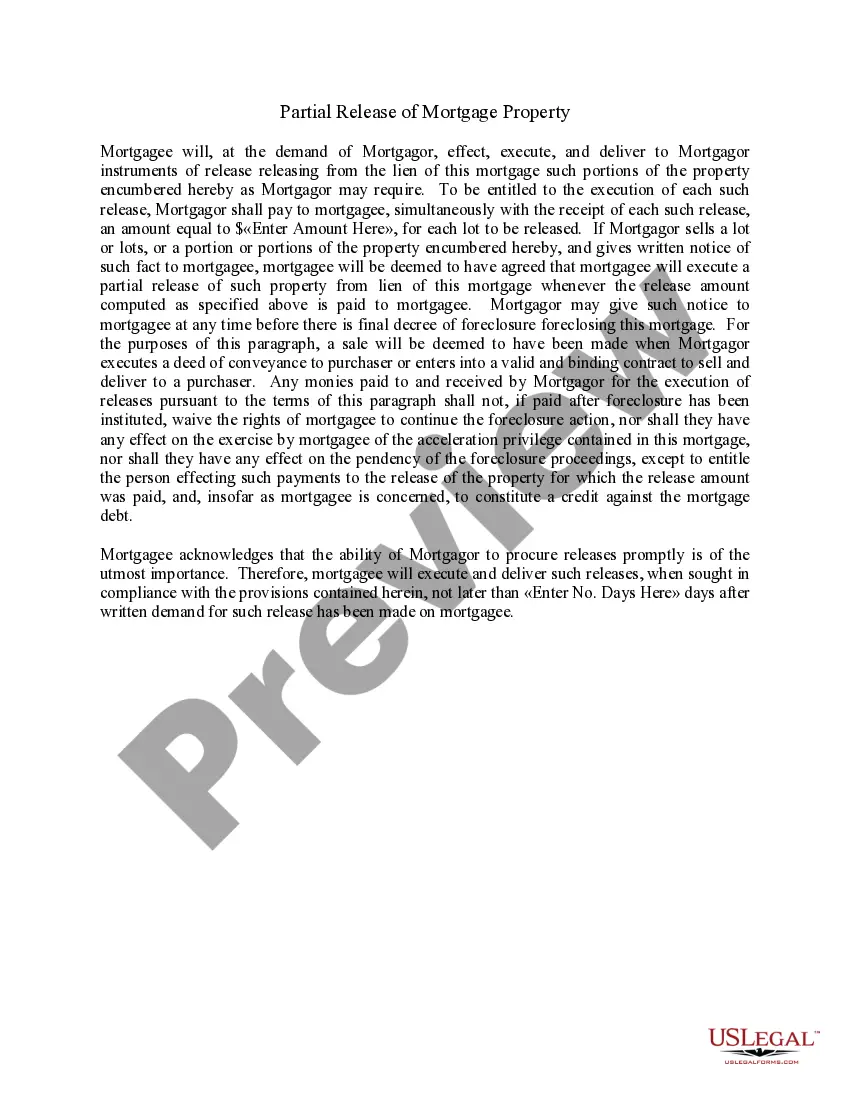
The Partial Release of Property From Deed of Trust form is a legal document used by a holder of a deed of trust or mortgage to release a portion of the real property that is secured by the deed. This form acknowledges that the deed of trust or mortgage remains enforceable for the remaining property, distinguishing it from other property release documents by its specific focus on partial releases.
Key components of this form
- Legal description of the property to be released, attached as Exhibit A
- Execution date for the document
- Signature of the parties involved
- Notary public's acknowledgment including their name, serial number, and commission expiration date
- Contact information for the mortgagee, including name, address, and phone number



When to use this form
This form is typically used when a borrower has paid off a part of their mortgage or needs to release a specific portion of the property from the deed of trust. It can be necessary during property sales, refinancing, or when adjusting ownership responsibilities among co-owners.
Who needs this form
- Homeowners seeking to release part of their property from a deed of trust
- Mortgage holders or lenders involved in partial releases
- Attorneys handling real estate transactions requiring property releases
- Individuals seeking to clarify mortgage obligations with their lender
How to complete this form
- Identify the parties involved, including the lender and borrower.
- Clearly specify the portion of the property to be released, referring to the legal description in Exhibit A.
- Enter the date on which the form is executed.
- Sign the document in the presence of a notary public.
- Ensure the notary's information is filled in correctly, including their commission details.
Notarization guidance
Yes, this form must be notarized to be legally valid. US Legal Forms offers integrated online notarization services, available 24/7 via secure video calls, ensuring compliance with legal standards without the need for in-person visits.
Get your form ready online
Our built-in tools help you complete, sign, share, and store your documents in one place.
Make edits, fill in missing information, and update formatting in US Legal Forms—just like you would in MS Word.
Download a copy, print it, send it by email, or mail it via USPS—whatever works best for your next step.
Sign and collect signatures with our SignNow integration. Send to multiple recipients, set reminders, and more. Go Premium to unlock E-Sign.
If this form requires notarization, complete it online through a secure video call—no need to meet a notary in person or wait for an appointment.
We protect your documents and personal data by following strict security and privacy standards.

Make edits, fill in missing information, and update formatting in US Legal Forms—just like you would in MS Word.

Download a copy, print it, send it by email, or mail it via USPS—whatever works best for your next step.

Sign and collect signatures with our SignNow integration. Send to multiple recipients, set reminders, and more. Go Premium to unlock E-Sign.

If this form requires notarization, complete it online through a secure video call—no need to meet a notary in person or wait for an appointment.

We protect your documents and personal data by following strict security and privacy standards.
Mistakes to watch out for
- Failing to attach Exhibit A with the legal description of the property.
- Not obtaining the necessary notarization, which can invalidate the form.
- Incorrectly identifying the parties or property details, leading to legal complications.
- Not specifying the correct execution date, which may affect the validity of the form.
Advantages of online completion
- Convenience of immediate access and downloading from anywhere.
- Editability allows customization to fit specific needs and circumstances.
- Reliability of professionally drafted documents, minimizing legal errors.
Quick recap
- The Partial Release of Property From Deed of Trust form allows for the release of specific property portions while maintaining the security of the remaining property.
- It is essential for homeowners and lenders involved in particular real estate transactions.
- Notarization is required for this form to ensure its legality.
Looking for another form?
Form popularity
FAQ
Whether you have a deed of trust or a mortgage, they both serve to assure that a loan is repaid, either to a lender or an individual person. A mortgage only involves two parties the borrower and the lender. A deed of trust adds an additional party, a trustee, who holds the home's title until the loan is repaid.
They serve different purposes and are signed by different parties. The warranty deed transfers the property's ownership from the current owner to the new buyer, while the deed of trust ensures the lender has interest in the property in the event a buyer defaults on the loan.
In financed real estate transactions, trust deeds transfer the legal title of a property to a third partysuch as a bank, escrow company, or title companyto hold until the borrower repays their debt to the lender. Trust deeds are used in place of mortgages in several states.
Whether you have a deed of trust or a mortgage, they both serve to assure that a loan is repaid, either to a lender or an individual person. A mortgage only involves two parties the borrower and the lender. A deed of trust adds an additional party, a trustee, who holds the home's title until the loan is repaid.
A Deed of Trust is a type of secured real-estate transaction that some states use instead of mortgages.A deed of trust involves three parties: a lender, a borrower, and a trustee. The lender gives the borrower money. In exchange, the borrower gives the lender one or more promissory notes.
A deed of trust acts as an agreement between youthe homebuyerand your lender. It states not just that you'll repay the loan, but that a third party called the trustee will hold legal title to the property until you do. A deed of trust is the security for your loan, and it's recorded in the public records.
A Deed of Trust is a type of secured real-estate transaction that some states use instead of mortgages.A deed of trust involves three parties: a lender, a borrower, and a trustee. The lender gives the borrower money. In exchange, the borrower gives the lender one or more promissory notes.
A deed conveys ownership; a deed of trust secures a loan.
If there's a deed of trust on a property, the lender can sell the property and pay off the loan. Whether your loan falls under the mortgage or deed of trust definition, you'll need to get approval from the lender before you sell your home for less than you owe.