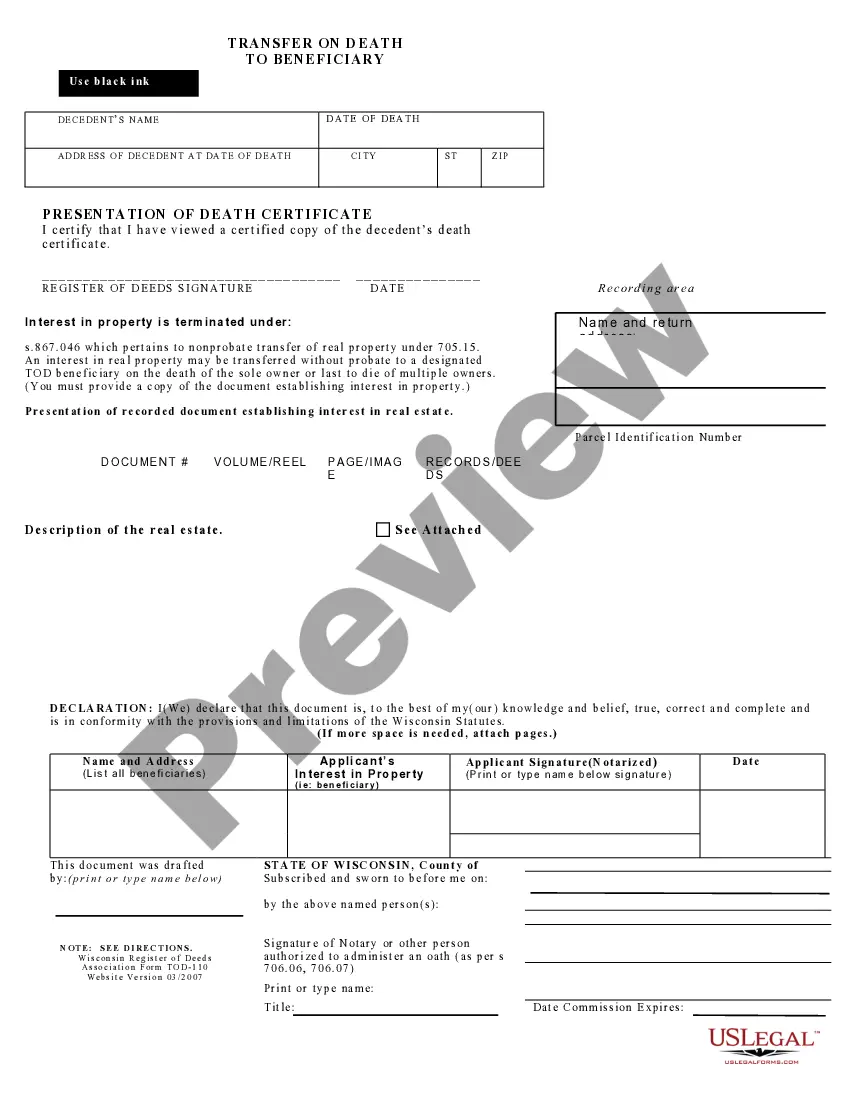
Wisconsin Tod Form For Car
Description

Get your form ready online
Our built-in tools help you complete, sign, share, and store your documents in one place.
Make edits, fill in missing information, and update formatting in US Legal Forms—just like you would in MS Word.
Download a copy, print it, send it by email, or mail it via USPS—whatever works best for your next step.
Sign and collect signatures with our SignNow integration. Send to multiple recipients, set reminders, and more. Go Premium to unlock E-Sign.
If this form requires notarization, complete it online through a secure video call—no need to meet a notary in person or wait for an appointment.
We protect your documents and personal data by following strict security and privacy standards.

Make edits, fill in missing information, and update formatting in US Legal Forms—just like you would in MS Word.

Download a copy, print it, send it by email, or mail it via USPS—whatever works best for your next step.

Sign and collect signatures with our SignNow integration. Send to multiple recipients, set reminders, and more. Go Premium to unlock E-Sign.

If this form requires notarization, complete it online through a secure video call—no need to meet a notary in person or wait for an appointment.

We protect your documents and personal data by following strict security and privacy standards.
Looking for another form?




How to fill out Wisconsin Transfer On Death Or TOD To Beneficiary - Official Form Used To Record Beneficiary's Interest Following Death Of Grantor?
Locating a reliable source to obtain the most up-to-date and suitable legal templates is a significant part of dealing with bureaucracy. Identifying the appropriate legal documents requires accuracy and meticulousness, which is why it is crucial to source Wisconsin Tod Form For Car exclusively from trustworthy providers, such as US Legal Forms. An incorrect template can squander your time and delay your situation. With US Legal Forms, you can rest easy. You can access and review all pertinent information regarding the document’s applicability and significance for your situation and in your jurisdiction.
Consider the following steps to finalize your Wisconsin Tod Form For Car.
Once the form is saved on your device, you can modify it using the editor or print it out and complete it by hand. Eliminate the complications associated with your legal documentation. Explore the extensive US Legal Forms catalog to discover legal templates, assess their relevance to your situation, and download them instantly.
- Utilize the catalog navigation or search bar to locate your template.
- Examine the form’s details to verify it aligns with the regulations of your state and area.
- Preview the form, if an option, to confirm it is the correct document you need.
- Return to the search and locate the appropriate document if the Wisconsin Tod Form For Car does not meet your requirements.
- Once you are confident about the form’s applicability, download it.
- If you are a registered user, click Log in to verify your identity and gain access to your selected forms in My documents.
- If you do not yet have an account, click Buy now to obtain the template.
- Choose the pricing option that best fits your needs.
- Proceed with the registration to finalize your transaction.
- Complete your purchase by selecting a payment method (credit card or PayPal).
- Select the document format for downloading Wisconsin Tod Form For Car.
Form popularity
FAQ
How do you transfer a vehicle to an heir in Wisconsin? If the decedent's solely-owned property is less than $50,000, probate is not required. An heir or heirs may transfer ownership of a vehicle when a decedent leaves solely-owned property not exceeding $50,000 in value.
An heir may title the vehicle in their name as owner or may sign as heir to sell the vehicle. In both cases, Statement of Transfer of Vehicles to a Surviving Spouse, Domestic Partner or Heir form MV2300? is required as a supporting document.
A Transfer on Death (TOD) beneficiary is a simple way to transfer ownership of a vehicle after the titled owner has died. By naming a TOD beneficiary on your title application, you can avoid the need for the vehicle to go through probate upon your death.
The Transfer of Ownership Document (TOD) provides a reasonable assurance that the seller is the rightful owner of the vehicle. The TOD assists consumers in several ways. The TOD shows: Any vehicle status under the Stolen & Wrecked Vehicle Monitoring Program.
Also exempt from probate is property titled in joint ownership, which automatically passes to the surviving owner. In addition, life insurance payments and funds in an IRA, pension, 401(k), or other retirement plan bypass probate ? if the decedent has named beneficiaries other than the estate.