Written Property Landlord For Vacate
Description

Get your form ready online
Our built-in tools help you complete, sign, share, and store your documents in one place.
Make edits, fill in missing information, and update formatting in US Legal Forms—just like you would in MS Word.
Download a copy, print it, send it by email, or mail it via USPS—whatever works best for your next step.
Sign and collect signatures with our SignNow integration. Send to multiple recipients, set reminders, and more. Go Premium to unlock E-Sign.
If this form requires notarization, complete it online through a secure video call—no need to meet a notary in person or wait for an appointment.
We protect your documents and personal data by following strict security and privacy standards.

Make edits, fill in missing information, and update formatting in US Legal Forms—just like you would in MS Word.

Download a copy, print it, send it by email, or mail it via USPS—whatever works best for your next step.

Sign and collect signatures with our SignNow integration. Send to multiple recipients, set reminders, and more. Go Premium to unlock E-Sign.

If this form requires notarization, complete it online through a secure video call—no need to meet a notary in person or wait for an appointment.

We protect your documents and personal data by following strict security and privacy standards.
Looking for another form?






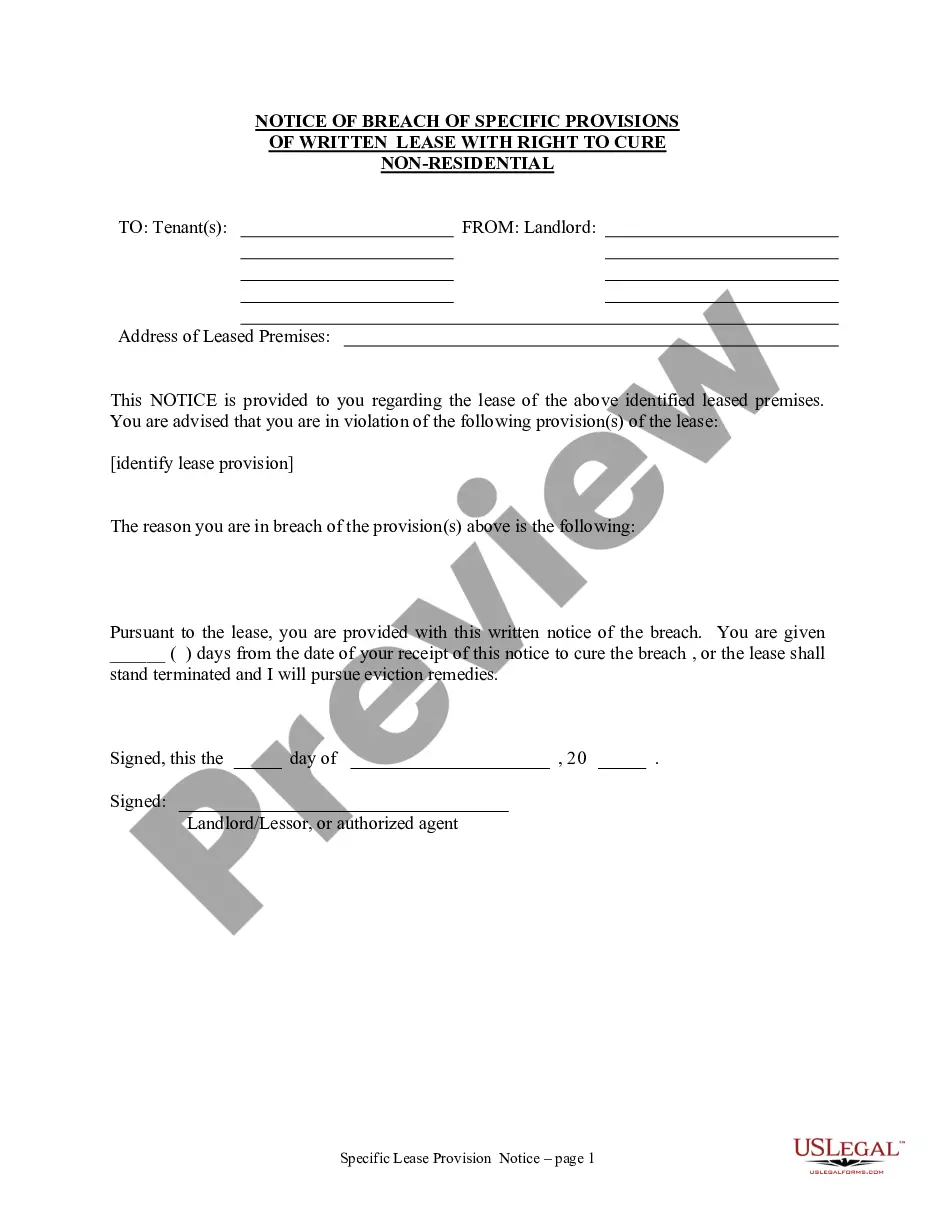
How to fill out Washington Notice Of Breach Of Written Lease For Violating Specific Provisions Of Lease With Right To Cure For Nonresidential Property From Landlord To Tenant?
- If you have previously used US Legal Forms, log in to your account and locate the required form template. Click the Download button to save it to your device, ensuring your subscription is active. If necessary, renew your plan.
- For first-time users, begin by browsing the form descriptions and preview to determine if the selected document aligns with your requirements and local legalities.
- If you need to search for another template, utilize the Search tab to find the most accurate option. Once located, proceed to the next step.
- Purchase the document by clicking the Buy Now button and selecting your preferred subscription plan. You'll need to create an account to access the full library of resources.
- Complete your purchase by entering your payment details, either via credit card or PayPal.
- After the purchase, download your form and save it for easy access. You can also find it anytime in the My Forms section of your profile.
By following these straightforward steps, you can effectively secure the necessary legal documentation with ease and confidence.
Take advantage of US Legal Forms’ extensive resources today and simplify your documentation process!
Form popularity
FAQ
In New York, landlords cannot legally evict tenants without following due process, which usually involves going to court for an eviction proceeding. Landlords must provide proper notice before initiating an eviction process. If you receive an eviction notice, it is vital to understand your options and rights. Resources like US Legal Forms can help you navigate these situations by providing the necessary documents and guidance for written property landlord for vacate.
In New York, landlords must adhere to specific timelines for eviction notices based on the lease's terms. For month-to-month agreements, a landlord must provide at least 30 days' notice to vacate. If the lease spans more than one year, the notice extends to 60 days. To ensure you follow legal requirements, consider using resources from US Legal Forms for written property landlord for vacate.
In New York, the notice period for a landlord to inform tenants to move out usually depends on the lease duration. For month-to-month leases, landlords typically give 30 days' notice. For tenants with a lease longer than one year, a 60-day notification is required. Familiarizing yourself with these regulations is essential, and utilizing US Legal Forms can assist in creating the necessary documents.
The notice period for a tenant to move out varies by state and the lease agreement's terms. Generally, landlords must provide at least 30 days' notice for most situations. However, specific conditions may warrant longer notice periods. Understanding these rules is crucial, and US Legal Forms provides resources for written property landlord for vacate to ensure compliance.
To write a letter to vacate a rental property, start by clearly stating your intent to leave the property. Include the date you plan to vacate, as well as any forwarding address for future correspondence. It's advisable to reference your lease agreement and maintain a formal tone. Using a template from US Legal Forms can simplify this process and ensure you communicate effectively.
A notice to vacate may be deemed invalid if it fails to adhere to the notice period specified in your lease or if it lacks essential details, such as your intended move-out date. Additionally, if it does not follow the communication methods outlined in your agreement, it may not be legally enforceable. Utilizing resources like the US Legal Forms platform can assist you in crafting a valid written property landlord for vacate.
Absolutely, a notice to vacate can be an email, given that it adheres to your lease's requirements. Ensure it is properly formatted and contains all necessary information. Compliance with the written property landlord for vacate guidelines will help avoid any potential disputes.
A written notice can indeed be an email, as long as it meets the criteria for formal communication outlined in your lease. Make sure the email clearly states your intention to vacate and includes relevant details. This approach provides a quick and efficient method of confirming your written property landlord for vacate.
Yes, an email can count as written notice to vacate, provided it complies with your lease agreement's terms. It is crucial to double-check your lease for any specific requirements regarding notification methods. Using a clear subject line and maintaining a professional tone can enhance the validity of your written property landlord for vacate.
To write a letter to your landlord for moving out, start with a clear statement of your intent to vacate. Include your address, the date you plan to move, and any necessary details like your forwarding address. This written property landlord for vacate not only serves as official notice but also helps ensure a smooth transition.