Foreclosure Landlord Tenant Washington
Description


Get your form ready online
Our built-in tools help you complete, sign, share, and store your documents in one place.
Make edits, fill in missing information, and update formatting in US Legal Forms—just like you would in MS Word.
Download a copy, print it, send it by email, or mail it via USPS—whatever works best for your next step.
Sign and collect signatures with our SignNow integration. Send to multiple recipients, set reminders, and more. Go Premium to unlock E-Sign.
If this form requires notarization, complete it online through a secure video call—no need to meet a notary in person or wait for an appointment.
We protect your documents and personal data by following strict security and privacy standards.

Make edits, fill in missing information, and update formatting in US Legal Forms—just like you would in MS Word.

Download a copy, print it, send it by email, or mail it via USPS—whatever works best for your next step.

Sign and collect signatures with our SignNow integration. Send to multiple recipients, set reminders, and more. Go Premium to unlock E-Sign.

If this form requires notarization, complete it online through a secure video call—no need to meet a notary in person or wait for an appointment.

We protect your documents and personal data by following strict security and privacy standards.
Looking for another form?








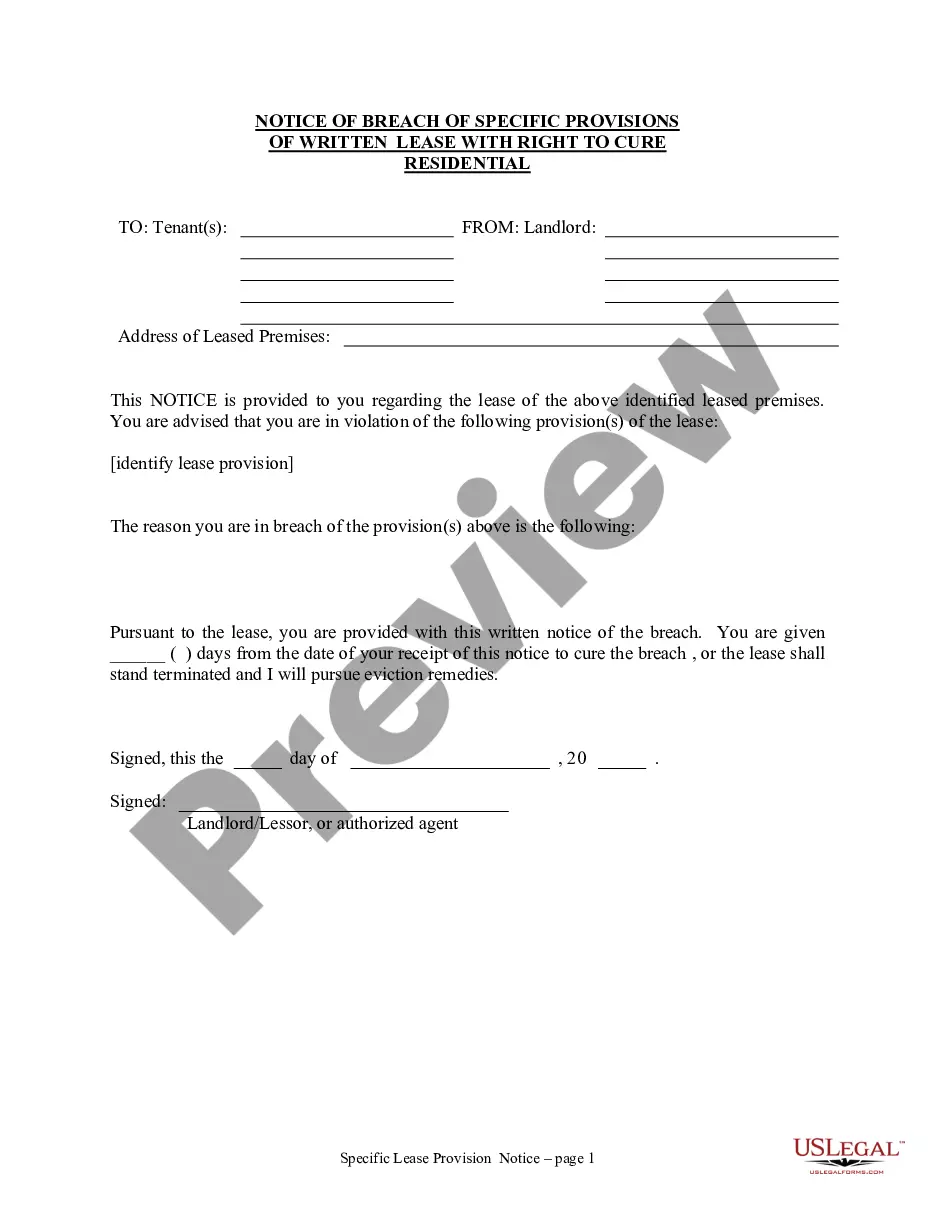
How to fill out Washington Notice Of Breach Of Written Lease For Violating Specific Provisions Of Lease With Right To Cure For Residential Property From Landlord To Tenant?
Managing legal documents can be exasperating, even for the most adept experts.
When searching for a Foreclosure Landlord Tenant Washington and not having the opportunity to dedicate time to find the correct and updated version, the procedures may be challenging.
US Legal Forms meets any needs you might have, ranging from personal to business forms, all in one location.
Utilize innovative tools to complete and manage your Foreclosure Landlord Tenant Washington.
Here are the actions to follow after locating the form you need: Verify that this is the correct form by previewing and checking its details. Ensure the sample is recognized in your state or county. Click Buy Now when you are ready. Select a subscription plan. Obtain the format you need, and Download, complete, sign, print, and send your documents. Take advantage of the US Legal Forms online library, backed by 25 years of expertise and dependability. Transform your document management process into a seamless and user-friendly experience today.
- Access a repository of articles, guides, handbooks, and materials pertinent to your circumstances and requirements.
- Save time and effort searching for the documents you require, and use US Legal Forms’ advanced search and Review feature to find Foreclosure Landlord Tenant Washington.
- If you have a subscription, Log In to your US Legal Forms account, search for the form, and retrieve it.
- Check the My documents tab to see the documents you have previously saved and to manage your folders as desired.
- If this is your first experience with US Legal Forms, create a complimentary account and enjoy unlimited access to all the library benefits.
- A comprehensive online form library can be transformative for anyone seeking to address these issues efficiently.
- US Legal Forms stands as a frontrunner in online legal forms, with more than 85,000 state-specific legal forms available to you at any time.
- You can access state- or county-specific legal and business documents.
Form popularity
FAQ
If a landlord in Washington does not return the security deposit within 21 days after the tenant moves out, they may lose the right to retain any portion of the deposit. Tenants can seek legal recourse to recover their funds. Understanding this law is crucial for landlords and tenants navigating foreclosure landlord tenant Washington issues.
New laws affecting renters in Washington State in 2023 Within 30 days after a tenant moves out, the landlord must either return the full security deposit or give the tenant a written statement documenting why they kept some or all of it.
The Washington Nonjudicial Foreclosure Process. A third party, called a "trustee," handles the nonjudicial foreclosure process in Washington. At least 30 days before recording or serving a notice of sale, the trustee mails a notice of default to you and posts it on the property (or personally serves it to you).
Anti-hazing bill: 'Sam's Law' A new law that increases the legal penalty for hazing will take effect this month. Sam Martinez was set to graduate this May along with the rest of the Washington State University class of 2023.
Landlords are generally prohibited from locking a tenant out of the premises, from taking a tenant's property for nonpayment of rent (except for abandoned property under certain conditions), or from intentionally terminating a tenant's utility service. Various penalties exist for violating these protections.
If the borrower does not pay the outstanding amounts (i.e. cure the default) within 30 days of the issuance of the notice of default the lender may authorize the trustee to issue a notice of sale. The sale may not take place less than 120 days from the issuance of the notice of default.