Living Trust Taxes
Description

Get your form ready online
Our built-in tools help you complete, sign, share, and store your documents in one place.
Make edits, fill in missing information, and update formatting in US Legal Forms—just like you would in MS Word.
Download a copy, print it, send it by email, or mail it via USPS—whatever works best for your next step.
Sign and collect signatures with our SignNow integration. Send to multiple recipients, set reminders, and more. Go Premium to unlock E-Sign.
If this form requires notarization, complete it online through a secure video call—no need to meet a notary in person or wait for an appointment.
We protect your documents and personal data by following strict security and privacy standards.

Make edits, fill in missing information, and update formatting in US Legal Forms—just like you would in MS Word.

Download a copy, print it, send it by email, or mail it via USPS—whatever works best for your next step.

Sign and collect signatures with our SignNow integration. Send to multiple recipients, set reminders, and more. Go Premium to unlock E-Sign.

If this form requires notarization, complete it online through a secure video call—no need to meet a notary in person or wait for an appointment.

We protect your documents and personal data by following strict security and privacy standards.
Looking for another form?









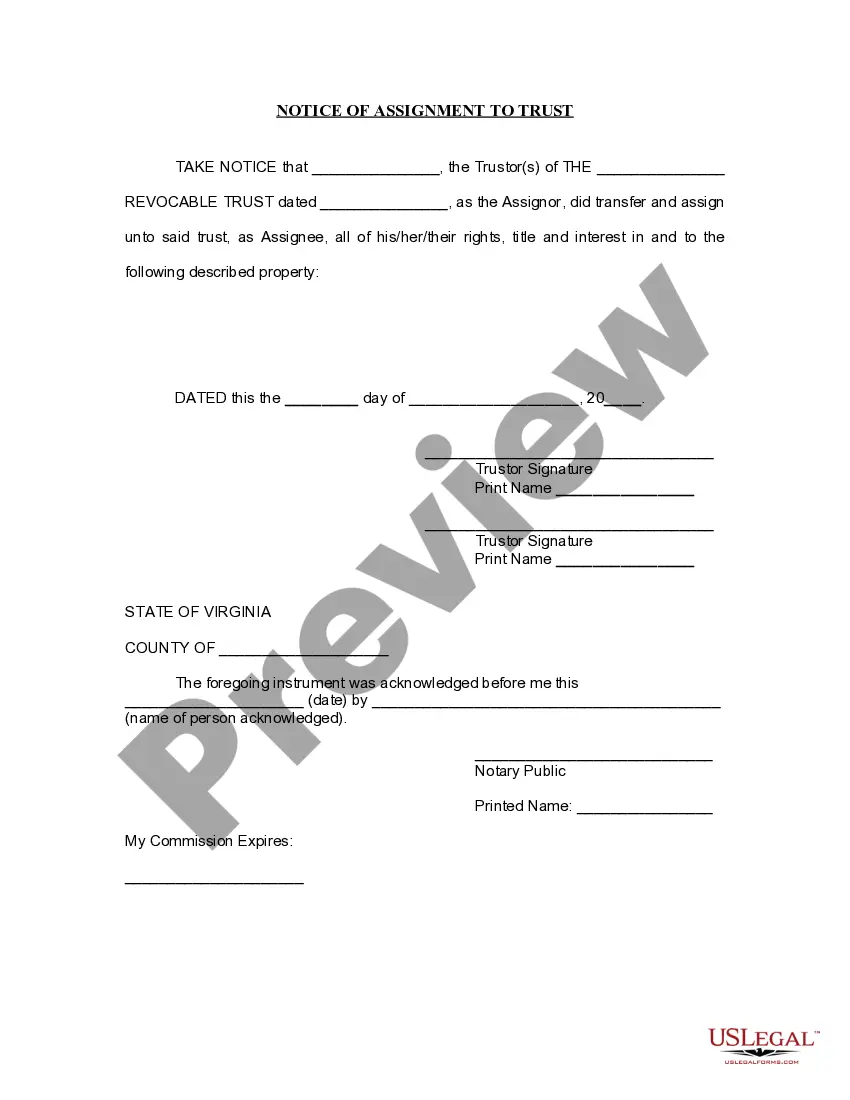
How to fill out Virginia Notice Of Assignment To Living Trust?
- If you’re a returning user, log in to your account to download your desired form template by clicking the Download button. Ensure that your subscription is active; if not, renew it as per your plan.
- For first-time users, start by checking the Preview mode to review form descriptions. Confirm that the selected form fits your requirements and complies with local jurisdiction.
- If necessary, use the Search bar to locate alternative templates. Once you find a suitable form, proceed to the next step.
- Purchase your selected document by clicking the Buy Now button. Choose a subscription plan that best fits your needs and create an account to access the full library.
- Complete the payment using your credit card or PayPal. Ensure that your transaction is processed successfully.
- Finally, download your form to your device. Access it anytime via the My Forms section of your profile.
In conclusion, US Legal Forms simplifies the process of acquiring legal documents, empowering you to manage living trust taxes with ease. With a robust collection and expert assistance available, you can ensure your forms are both accurate and compliant.
Start streamlining your tax paperwork today with US Legal Forms.
Form popularity
FAQ
The IRS has recently clarified regulations regarding living trust taxes, emphasizing the need for accurate reporting of trust income. Trusts must now comply with specific filing requirements to avoid penalties. This change encourages transparency and accountability among trustees. Staying updated on these new rules is essential, and platforms like USLegalForms can assist you in adhering to the latest regulations.
The primary responsibility for filing a trust tax return falls on the trustee, especially if the trust is irrevocable. The trustee must ensure that all income and distributions are reported accurately. If the trust is revocable, the grantor usually handles the tax matters personally. Understanding your role in managing living trust taxes is crucial for compliance.
Generally, a living trust does not file a separate tax return while it is revocable. The income earned by the trust is reported on the grantor's personal tax return because the grantor retains control over the assets. However, once a living trust becomes irrevocable, it may need to file its own tax return. To navigate these requirements efficiently, utilizing platforms like USLegalForms can simplify the documentation process.
Living trust taxes are often not filed separately from the individual grantor’s taxes. The income generated by a revocable living trust typically passes through to the grantor, which means it is reported on the grantor's personal tax return. However, if the trust becomes irrevocable, it may require its own tax identification number and a separate tax return. It's important to understand these distinctions to ensure compliance with tax regulations.
Yes, trusts generally must file tax returns annually, specifically if they generate income or exceed certain thresholds. This requirement applies to living trust taxes, as the trust needs to report its income and distributions. Filing accurately ensures compliance and helps avoid penalties that can arise from neglect. Utilizing platforms like US Legal Forms can simplify this process for trust administrators.
A living trust itself does not count as income; however, any income generated by the trust's assets is taxable. For example, rental income, dividends, or interest earned by trust assets will be considered living trust taxes. Beneficiaries may have tax obligations based on the distributions they receive from the trust. Understanding this distinction is key to proper tax planning.
A living trust can receive a 1099 if it generates income in a taxable year. The trust must report this income on its tax return, meaning it is subject to living trust taxes. Depending on its structure, the trust may need to issue 1099 forms to the beneficiaries who receive distributions. Being organized helps manage these obligations effectively.
Yes, the IRS can pursue a trust for unpaid taxes. Trusts are separate legal entities, and they are responsible for their tax obligations, including living trust taxes. If a trust fails to fulfill its tax duties, the IRS can take action, which may include levying assets or seeking payment from the trust's beneficiaries. Staying informed and compliant is essential.
If you skip filing a trust tax return, the IRS may initiate penalties and interest on unpaid taxes. This action can also affect the trust’s beneficiaries, as they may face unexpected tax liabilities. Ignoring living trust taxes can lead to legal issues that complicate the trust's administration. Therefore, it’s vital to remain vigilant and meet filing requirements.
Not filing a trust tax return can lead to significant penalties. The IRS imposes fines that can accumulate over time, depending on how long the return is overdue. Additionally, failing to report living trust taxes may result in audits or additional scrutiny from tax authorities. It is crucial to stay compliant to avoid these complications.