Waive Or Waiver
Description

Get your form ready online
Our built-in tools help you complete, sign, share, and store your documents in one place.
Make edits, fill in missing information, and update formatting in US Legal Forms—just like you would in MS Word.
Download a copy, print it, send it by email, or mail it via USPS—whatever works best for your next step.
Sign and collect signatures with our SignNow integration. Send to multiple recipients, set reminders, and more. Go Premium to unlock E-Sign.
If this form requires notarization, complete it online through a secure video call—no need to meet a notary in person or wait for an appointment.
We protect your documents and personal data by following strict security and privacy standards.

Make edits, fill in missing information, and update formatting in US Legal Forms—just like you would in MS Word.

Download a copy, print it, send it by email, or mail it via USPS—whatever works best for your next step.

Sign and collect signatures with our SignNow integration. Send to multiple recipients, set reminders, and more. Go Premium to unlock E-Sign.

If this form requires notarization, complete it online through a secure video call—no need to meet a notary in person or wait for an appointment.

We protect your documents and personal data by following strict security and privacy standards.
Looking for another form?










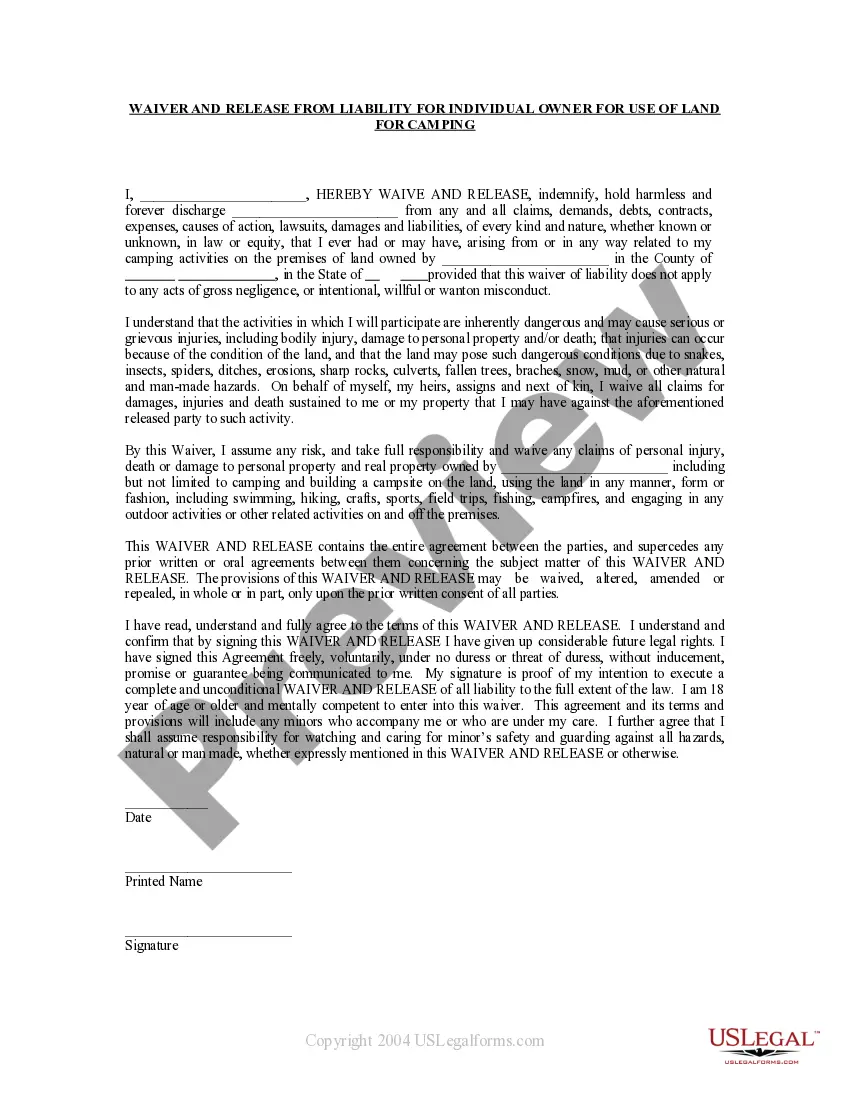
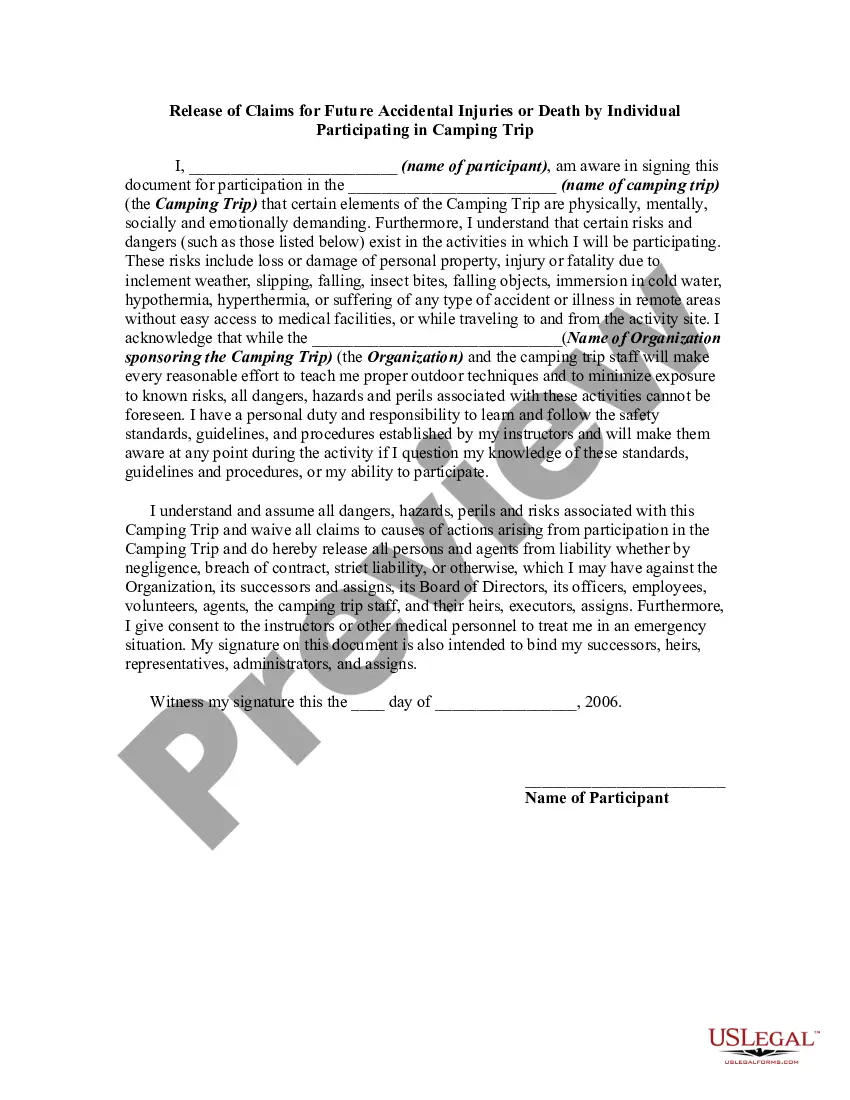
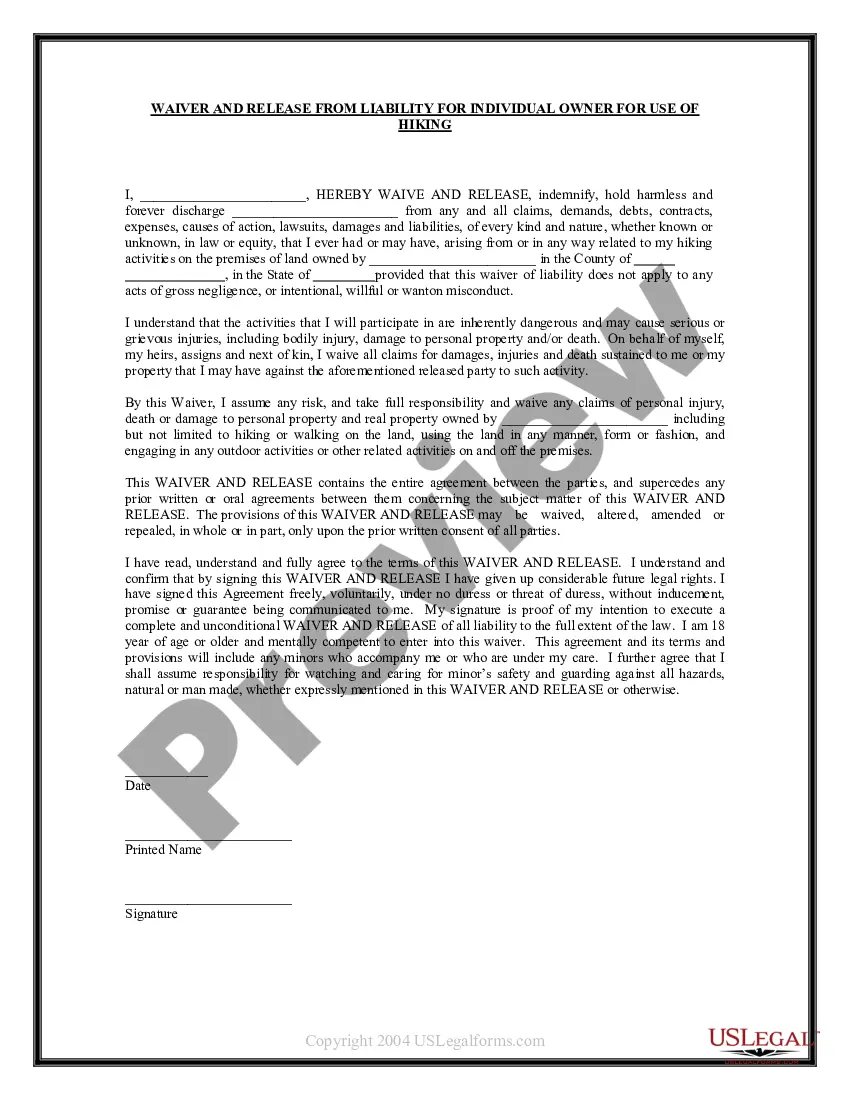
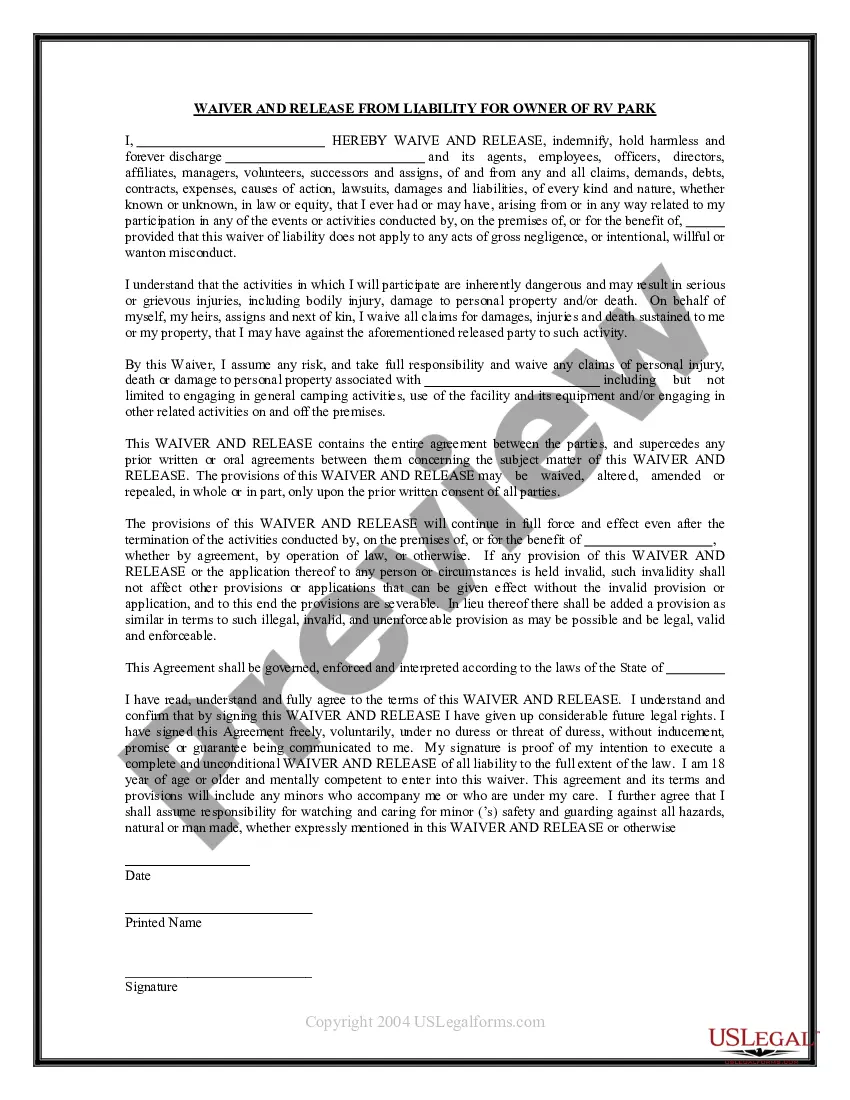
How to fill out Waiver And Release From Liability For Adult For Land For Individual Camping?
It’s clear that you cannot transform into a legal expert instantly, nor can you acquire the skills needed to swiftly create Waive Or Waiver without having a specialized education.
Drafting legal documents is a lengthy process that necessitates specific training and expertise. So why not entrust the creation of the Waive Or Waiver to the specialists.
With US Legal Forms, which has one of the broadest libraries of legal templates, you can gain access to anything from court papers to in-office communication templates. We understand the significance of compliance and observance of federal and state regulations.
Hit Buy now. Once the purchase is complete, you can acquire the Waive Or Waiver, fill it out, print it, and send it or dispatch it by mail to the required individuals or organizations.
You can retrieve your documents from the My documents tab at any time. If you’re a current client, you can easily Log In and locate and download the template from the same section. Regardless of your paperwork needs—whether they are financial, legal, or personal—our website has everything covered. Give US Legal Forms a try today!
- Start by visiting our website and obtaining the form you need in just minutes.
- Find the document you require using the search bar at the top of the page.
- Preview it (if this option is available) and review the accompanying description to see if Waive Or Waiver is what you seek.
- Begin your search again if you need a different document.
- Register for a free account and select a subscription plan to purchase the template.
Form popularity
FAQ
In legal discussions, 'waive' is the action of giving up a right, while 'waiver' is the result of that action. Both terms are frequently used together, but they should not be confused. By understanding the difference, you can communicate more effectively in legal matters. US Legal Forms offers guidance on both terms to help you draft precise agreements.
The correct term is 'waive' when referring to the act of giving up a right or claim. 'Waive off' is less commonly used and can create confusion in legal contexts. To maintain clarity in your legal documents, it's best to use 'waive' as it directly conveys the intended meaning. With US Legal Forms, you can find templates that clarify these terms effectively.
The term 'waiver' refers to the formal act of relinquishing a right, while 'waive' is the verb that describes the action itself. Both terms are essential in legal contexts, but they serve different grammatical purposes. When drafting legal documents, clarity is crucial, and US Legal Forms can assist you in ensuring you use these terms correctly.
To waive means to voluntarily give up a right or claim. This action often occurs in legal agreements, where one party may choose to relinquish a specific entitlement. Understanding how to waive a right can be essential in various legal situations, and our platform, US Legal Forms, provides resources to help you navigate these scenarios effectively.
Engaging a lawyer when drafting waivers can be advantageous, especially for significant legal matters. Lawyers bring expertise that can safeguard your interests and clarify any legal jargon present in the waiver. However, for simpler waivers, you might find that using platforms like US Legal Forms allows you to create effective waivers without needing extensive legal assistance.
While you can write a waiver on your own, consulting a lawyer can be beneficial, particularly for complex situations. A lawyer can help you navigate legal requirements and tailor the waiver to meet your specific needs. If you prefer a DIY approach, US Legal Forms offers user-friendly templates that guide you through the writing process, ensuring your waiver is effective and compliant.
To apply for a waiver, you typically need to provide specific information about the context and reason for the waiver. This may include personal details, supporting documentation, and a clear explanation of why you seek to waive certain rights or responsibilities. Ensure you follow the necessary steps outlined by the relevant authority, and consider using US Legal Forms to access resources that simplify the application process.
You do not necessarily need a lawyer to draft a waiver, especially if the waiver is straightforward. However, legal nuances may arise, and a lawyer can ensure that the waiver protects your interests effectively. Using a platform like US Legal Forms can provide you with templates and guidance to create a suitable waiver without needing to hire a lawyer.
Filling out a waiver involves a few straightforward steps. Begin by entering the date and location where the waiver is being executed. Then, list the individuals or organizations that are waiving their rights, along with a detailed description of what rights are being waived. You can find user-friendly templates on US Legal Forms that guide you through each section with ease.
To fill out a waiver, start by clearly stating the purpose of the waiver at the top of the document. Next, include the names of all parties involved, ensuring you provide enough space for signatures at the bottom. It's essential to outline any specific terms or conditions that apply, as this will help clarify the agreement. If you need assistance, consider using the US Legal Forms platform to access templates that simplify the process.