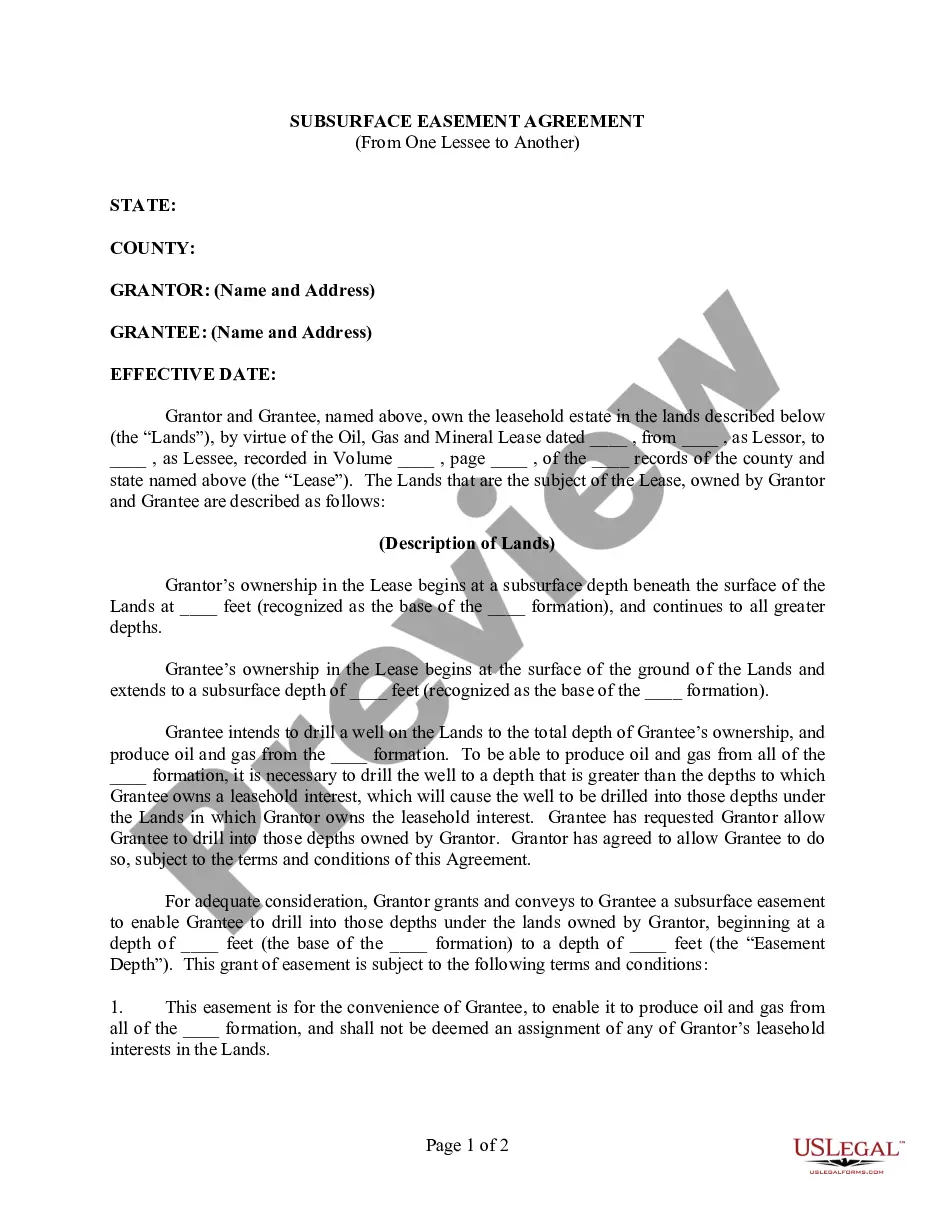
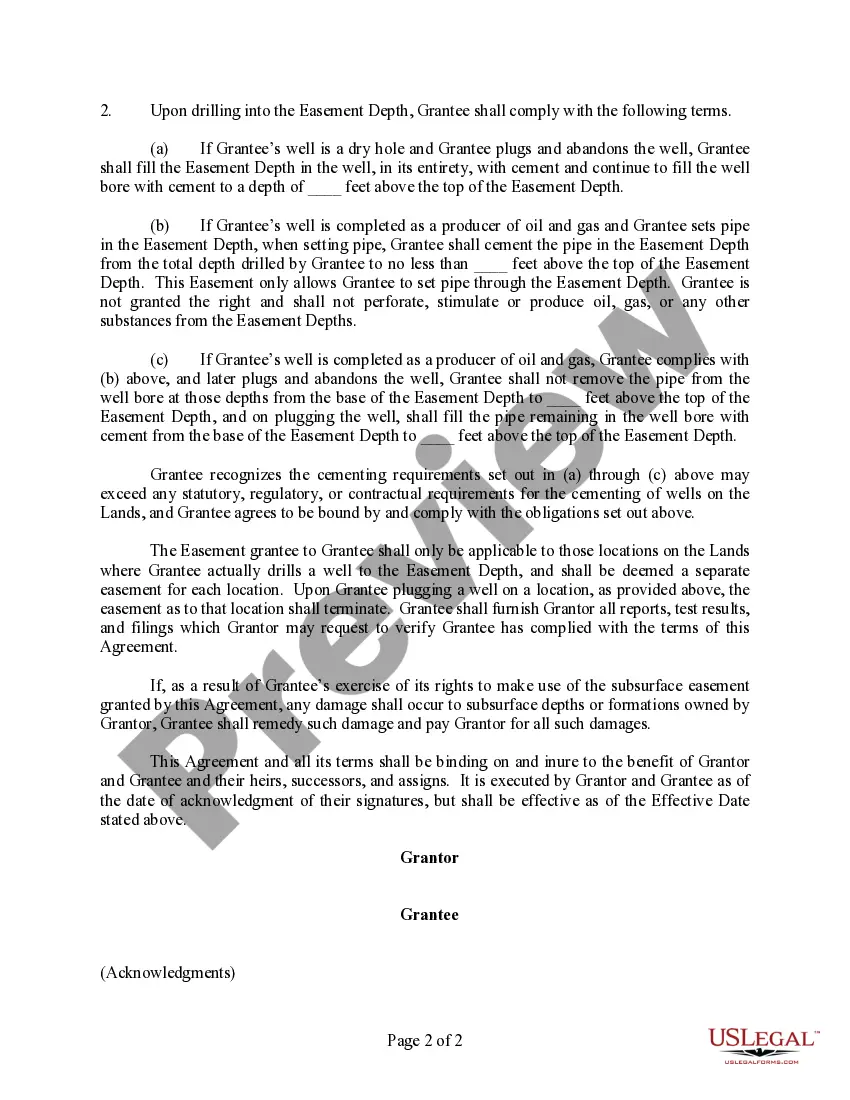
Subsurface Easement Agreement For Horizontal Drilling
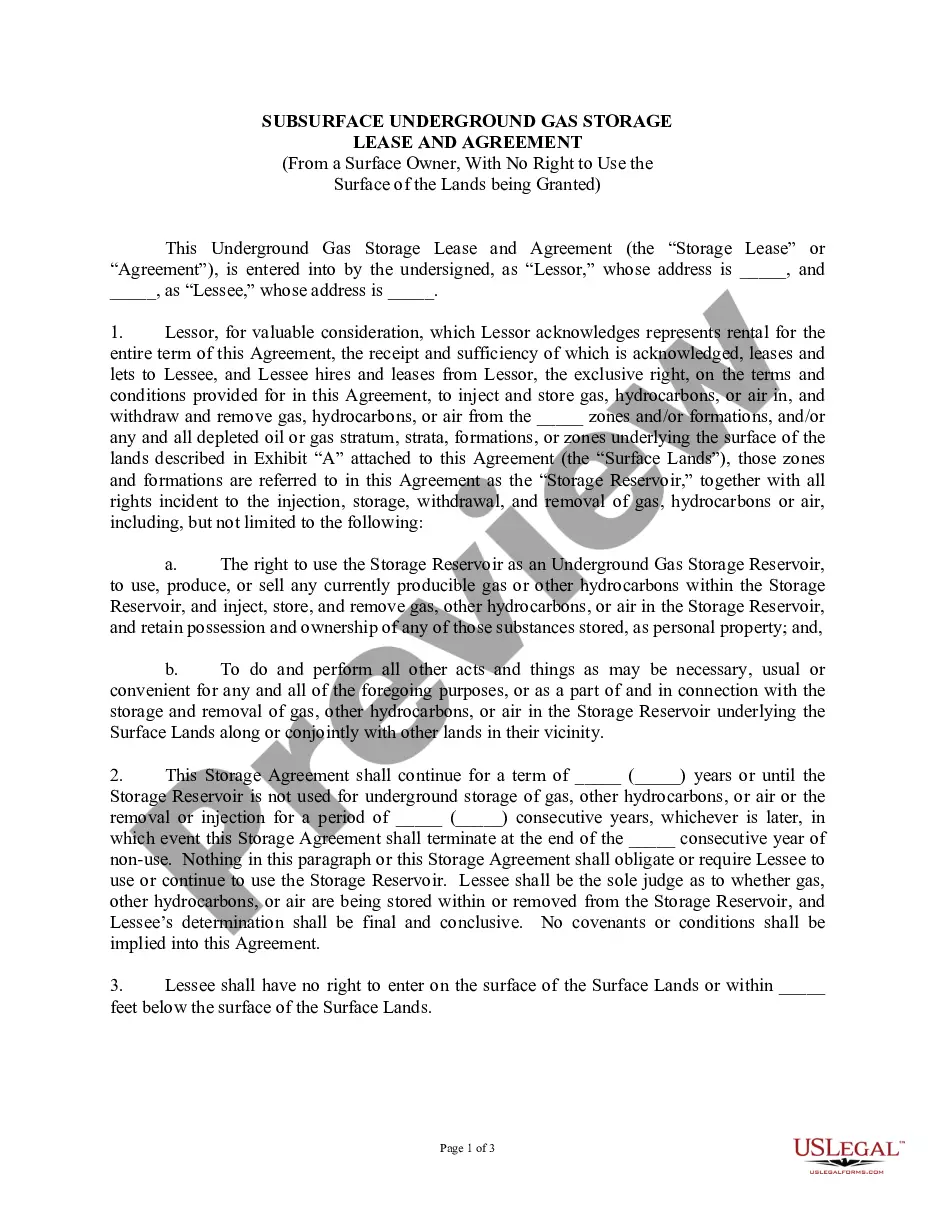
Description
Get your form ready online
Our built-in tools help you complete, sign, share, and store your documents in one place.
Make edits, fill in missing information, and update formatting in US Legal Forms—just like you would in MS Word.
Download a copy, print it, send it by email, or mail it via USPS—whatever works best for your next step.
Sign and collect signatures with our SignNow integration. Send to multiple recipients, set reminders, and more. Go Premium to unlock E-Sign.
If this form requires notarization, complete it online through a secure video call—no need to meet a notary in person or wait for an appointment.
We protect your documents and personal data by following strict security and privacy standards.

Make edits, fill in missing information, and update formatting in US Legal Forms—just like you would in MS Word.

Download a copy, print it, send it by email, or mail it via USPS—whatever works best for your next step.

Sign and collect signatures with our SignNow integration. Send to multiple recipients, set reminders, and more. Go Premium to unlock E-Sign.

If this form requires notarization, complete it online through a secure video call—no need to meet a notary in person or wait for an appointment.

We protect your documents and personal data by following strict security and privacy standards.
Looking for another form?
How to fill out Subsurface Easement Agreement From One Lessee To Another?
Legal documentation administration can be overwhelming, even for the most adept experts.
When you seek a Subsurface Easement Agreement for Horizontal Drilling and don't have the opportunity to invest time in finding the appropriate and current version, the tasks may be challenging.
Access a valuable resource library of articles, tutorials, and guides related to your situation and needs.
Conserve time and energy in hunting for the forms you need, utilizing US Legal Forms’ sophisticated search and Preview feature to locate the Subsurface Easement Agreement for Horizontal Drilling and secure it.
Make use of the US Legal Forms online library, supported by 25 years of expertise and reliability. Revolutionize your everyday document management into a straightforward and user-friendly process today.
- If you possess a subscription, Log In to your US Legal Forms account, search for the form, and retrieve it.
- Consult the My documents section to review the documents you previously saved and manage your folders as suited.
- If it’s your first experience with US Legal Forms, create an account and obtain unlimited access to all features of the library.
- After locating the required form, verify it is the correct document by previewing it and reviewing its description.
- Confirm that the template is recognized in your state or county.
- Click Buy Now when you are prepared.
- Select a monthly subscription package.
- Choose the file format you require, and Download, fill out, eSign, print, and send your document.
- Access state- or county-specific legal and business documentation.
- US Legal Forms meets any requirements you might have, from personal to corporate paperwork, all in one location.
- Employ cutting-edge tools to complete and manage your Subsurface Easement Agreement for Horizontal Drilling.
Form popularity
FAQ
She says the issue has raised concerns about the environmental risks and legality of drilling in the Great Lakes. But Tom Wellman, a geologist with the Michigan Department of Environmental Quality, says slant drilling is legal, and it won't hurt the environment.
This is commonly referred to as the "rule of capture?. In the event that you have the mineral rights to penetrate a well on your property, you reserve a privilege to all the oil you catch, regardless of whether the oil is drawn or pooled from the bordering properties of your neighbors.
The rule of capture is the governing principle of Texas groundwater law. The rule of capture essentially provides that because a landowner owns the water beneath his property, the landowner has the right to pump as much water as he wishes even at the expense of his neighbor.
Louisiana law, however, recognizes what is known as the "rule of capture," which means that once groundwater is pumped to the surface, or "captured" in legal terms, it belongs to the individual landowner and can be used for whatever purposes that may be needed: home or commercial use, agricultural irrigation, or ...
Stated simply, the rule of capture provides that a person owns all of the oil and gas produced from a well bottomed on his own land, regardless of the substances' original location ? regardless, indeed, of the fact that the well may have been deliberately located at a spot that would cause the maximum drainage of ...